
Why does my packaging look cheap?
When packaging lacks texture and presence, the core issue is usually a poor match between paper stock and finishing. At this point, using the "MINDS (MS, mid-to-high-end fully custom commercial printing) three-check print workflow" (set the structure, choose the paper, lock in the details) lets you raise the premium feel precisely with foil stamping or embossing
Finishing refers to surface treatments or physical shaping done to paper after printing, such as foil stamping, embossing, and coating
It gives flat packaging a tactile, dimensional feel and a metallic sheen, making it a key step for adding visual depth and anti-counterfeiting effects
When clients receive a proof, they often look at ordinary four-color printing and feel something is missing
In reality, take a common 300g coated duplex board, add a matte film, then apply matte gold foil to the Logo, and the whole piece instantly feels twice as valuable
This is what I often tell clients: spend a little more of the budget on finishing, and the visual difference will be huge

How should foil-stamping black artwork be prepared so it does not get rejected?
Foil stamping, also called Hot Stamping, uses heat and pressure to transfer metallic foil onto paper
Many designers know they want foil stamping, but get stuck when preparing files for the print shop
Here are the black-artwork traps most likely to cause trouble
・Separate layer: the foil-stamping area must be pulled out onto its own layer and clearly labeled "foil-stamping black artwork"
・Single-color black setting: the black artwork must be pure black (K100). Never mix in CMY to make four-color black
・Closed vector shapes: foil-stamping graphics must be closed vector paths. Do not use raster images or effects with transparent gradients
・Physical limits: this is the most common rejection reason I see at MINDS. The thinnest foil-stamping line must not be smaller than 0.2mm (about 0.57pt)
・Clear space: text should preferably be larger than 6pt, and the spacing between lines should be greater than 0.3mm. Otherwise, once the metallic foil expands with heat, it will absolutely blur into a mess
Can embossing and foil stamping be done together? How should I choose the material?
Embossing uses male and female dies to press from both sides, raising the design and creating a clear three-dimensional touch
Foil stamping plus embossing, often called foil embossing in the industry, creates a highly premium effect, but registration accuracy becomes a serious test
For a clean result, the choice of paper often decides whether the job succeeds or fails
・Control paper thickness: embossing requires paper with enough toughness. A thickness between 250g and 350g is ideal
・Avoid extreme materials: paper that is too thin will break under pressure, while cardboard that is too thick, such as greyboard, will not rise properly
・Watch the surface texture: thick card with deep grain can emboss beautifully, but if foil stamping is added on top, the deep texture can keep the gold foil from adhering evenly
・Professional evaluation: if you are not sure whether the chosen paper can survive combined finishing, it is best to ask the consulting team at Mai Strategy Knowledge Academy to evaluate it for you, so you do not discover halfway through the job that it cannot be printed
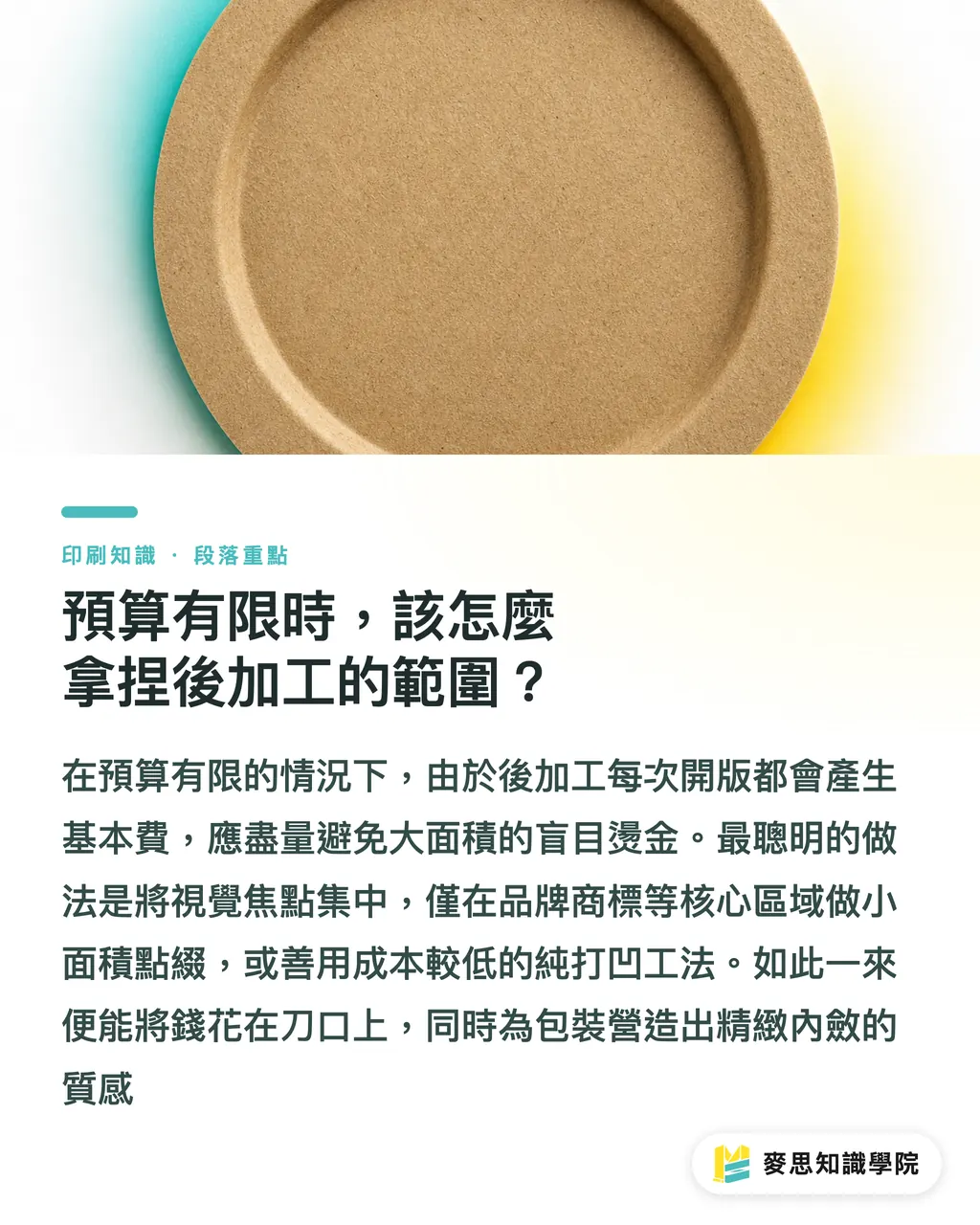
When the budget is limited, how should you decide the finishing area?
Every finishing process requires an extra plate or die, such as a foil-stamping plate or embossing die, which means the base cost cannot be avoided
If the budget is tight, do not scatter foil stamping across the whole surface
・Focus the visual attention: apply foil only to the brand Logo or core emblem. A small, refined area can actually feel more premium
・Make good use of debossing: debossing does not add metallic foil. It relies purely on pressure to press the graphic inward, and usually costs less than foil stamping
・Create a restrained feel: simple debossing on thick board can create a quiet, crafted quality. This works especially well for cultural and creative packaging
・Consider sharing dies: for packaging in the same series, you can consider using the same foil-stamping plate and only replacing the underlying printed artwork. On the production line, this is an extremely practical cost-saving shortcut
Key Takeaways
There is one hard rule for black artwork setup: K100 single-color black, pure vector paths, and a fully separate layer
Remember the physical limits: foil-stamping lines should be above 0.2mm, and embossing paper thickness is safest between 250g and 350g
Spend the budget where it matters: instead of foiling everywhere, concentrate the effect on the Logo. The more white space you leave around finishing, the more premium it looks
Further Thoughts
For both design and manufacturing teams, finishing has never been something you can solve by clicking a few effects in design software. It is a hard fight between physical materials and machine pressure
In the future, if SaaS tools can automatically detect black-artwork line thickness and registration risks during the design stage, they will greatly reduce communication costs and file rejection rates between print shops and designers
FAQ
- Why did the print shop reject my foil-stamping black artwork for having a gradient?
- Foil stamping is a physical transfer of metallic foil. There are only two states: stamped or not stamped. The black artwork must be solid K100 only, with no transparency, gradients, feathering, or shadows
- Can the embossed area on a packaging box land right on a fold line?
- Absolutely not. Embossing damages the paper's original structural toughness. If it lands on a crease line, the box will 100% crack when it is folded into shape. It must stay at least 3mm away from the die-cut lines
- Can foil stamping only be done in gold or silver?
- There are actually many foil colors, including rose gold, matte black, platinum, and even holographic anti-counterfeit foil or transparent pearl foil. Choose the right foil film, and you can create all kinds of texture variations
Related articles





The Print × AI weekly
The print and AI know-how designers, brands and enterprises can use before they commit — one email, every week
MINDS Free Tools
Spine width and imposition calculators — skip the manual math, free in your browser.
MINDS Group
Need actual printing or gifting services?
From premium printing to online ordering and festive gifts — the MINDS Group sister brands take it from here.