

How does changing paper stock affect printing costs?
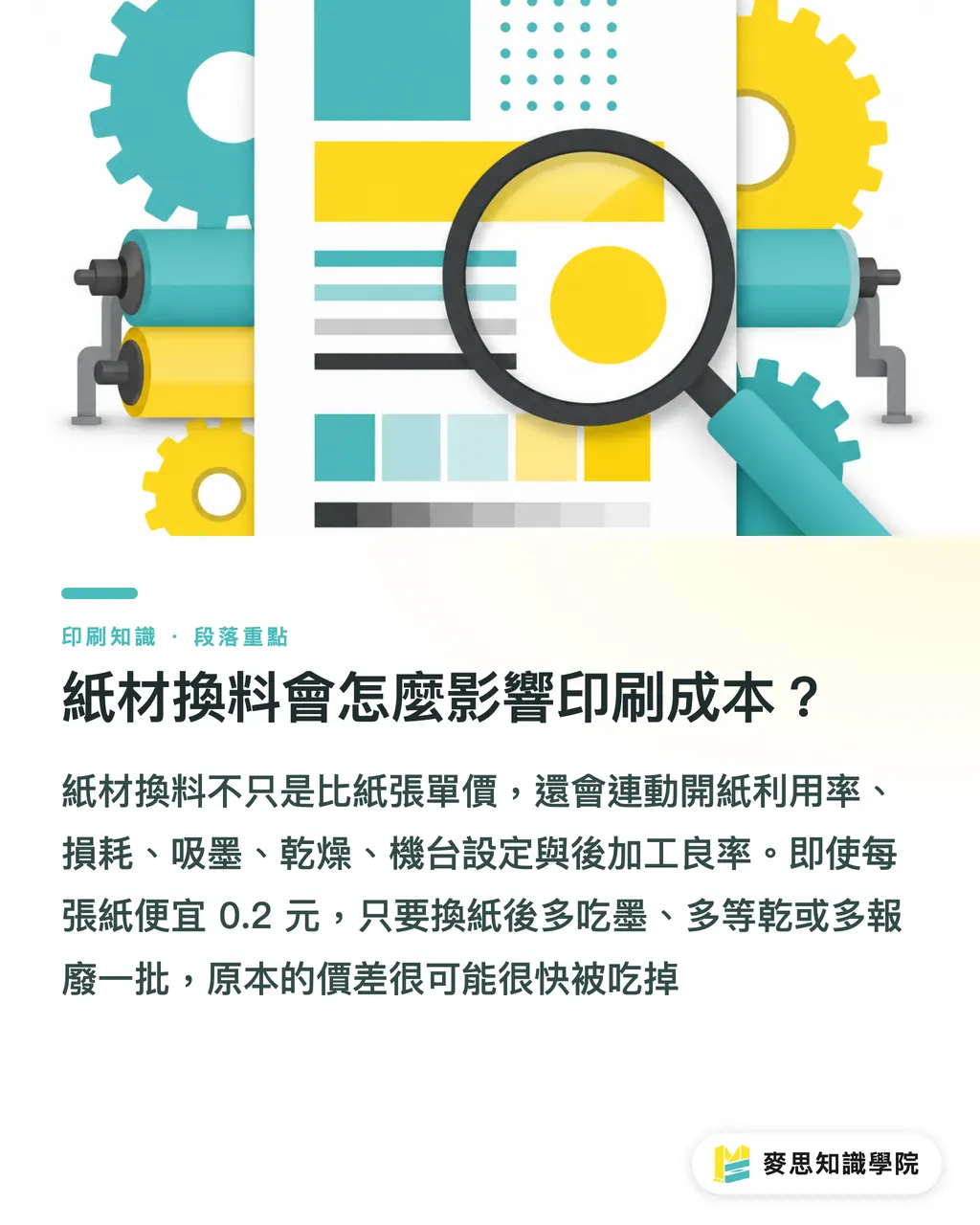
Changing paper stock affects the unit price of the paper, sheet yield, waste rate, ink absorption, drying time, press setup, and post-press yield. When MINDS (MS) reviews a quote for a paper change, it usually starts with a "seven-point paper change check" to separate these 7 factors instead of only asking how much cheaper one kilogram or one sheet is
A paper change means using a different paper type, weight, mill batch, or supplier source for the same printed product while the size, print quantity, and number of colors remain roughly the same. Examples include switching from coated paper to woodfree paper, from 250gsm to 300gsm, or from one batch to another within the same paper type. This kind of change affects printing, drying, cutting, folding, die-cutting, lamination, and binding. Every step can shift the cost
I have seen many procurement comparisons get stuck in the same blind spot: Paper A is 0.2 dollars cheaper per sheet, so 10,000 sheets should directly save 2,000 dollars. That is not how production calculates it. If the new paper uses more ink, takes longer to dry, needs more press testing, or causes one extra rejected batch, that small paper-price gap disappears fast
The seven-point paper change check can be read like this:
・Paper unit price: only meaningful when paper type, weight, size, and supply terms are the same
・Sheet yield: how much leftover material remains when parent sheets are cut down to the finished size directly affects actual paper consumption per piece
・Waste rate: test printing, color registration, cutting, and post-press work all consume a certain quantity
・Ink absorption: the more ink the paper absorbs, the more ink volume, color stability, and drying time change
・Drying time: slow drying affects delivery time and raises the risk of setoff and smearing
・Press setup: changing paper often means readjusting pressure, feeding, ink volume, and speed
・Post-press yield: cracked folds, lamination bubbles, and rough die-cut edges can all make cheap paper expensive
Why can the quote differ so much when the size is the same?
For the same 210 × 297mm A4 finished product, switching to a different parent sheet size or a different mill supply specification can completely change the cutting layout. Once sheet yield changes, the real issue is not the number of finished pieces, but how efficiently that batch of parent sheets is used before it goes on press
When a print shop estimates paper, it usually does not only look at how many finished pieces are needed. It looks at how the parent sheet is imposed, how it is cut, and how much waste allowance must be added. Suppose a catalog cover needs 3,000 copies. The finished size stays the same, but the mill supplies a different sheet size. A parent sheet that used to fit 8 units may only fit 6 after the paper change. Even if the unit price per sheet is lower, total paper consumption may rise
Paper weight also affects pricing. Switching from 250gsm to 300gsm makes the paper thicker, and shipping, stacking, folding, and binding pressure all change with it. Thicker paper is not necessarily bad. Packaging, covers, and hang tags need stiffness. But procurement should not only ask, "How much more for thicker paper?" The better question is whether post-press methods need to change after the stock gets thicker
Some papers look identical on the spec sheet, but feel different from batch to batch. This is more common with specialty papers, recycled papers, textured papers, and imported papers. If procurement keeps only the PDF and not a physical sample, reprints can easily run into the problem of "same name, but it does not feel like the same paper"
Can changing paper weight really save money?
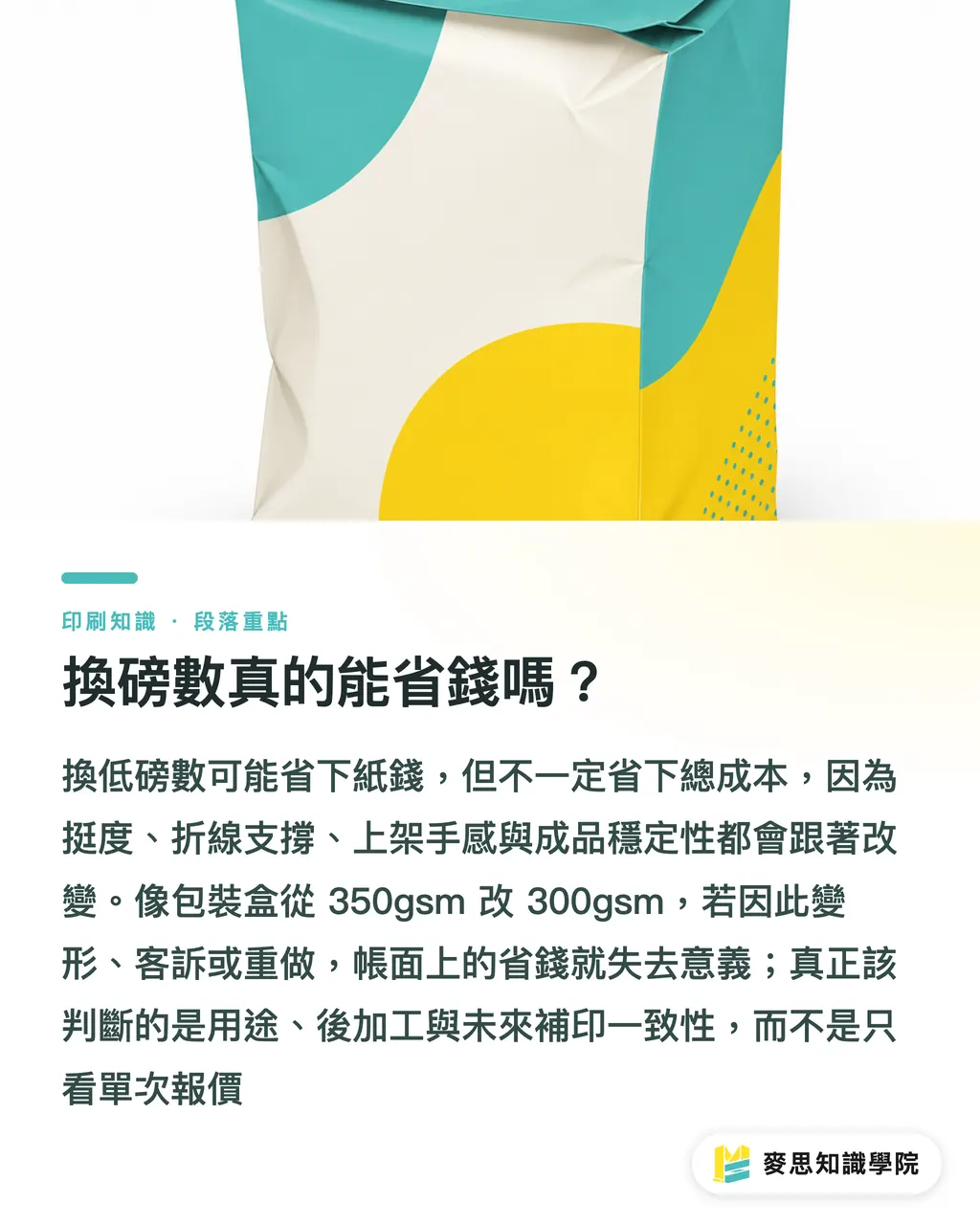
Switching to a lower weight may save on paper, but it does not guarantee a lower total cost. If a packaging box changes from 350gsm to 300gsm, the paper cost may drop, but box stiffness, crease support, and shelf feel will all change. If the finished product deforms, leads to complaints, or has to be remade, the money saved on the procurement sheet is not really saved
Switching to a higher weight is not always just an added cost either. Some covers changed from 220gsm to 250gsm may feel more stable and reduce later warping or hand-feel inconsistency. The point is that the decision cannot rest on a vague feeling that it is "more premium." It has to go back to use: catalog cover, outer box, hang tag, DM, or inner page
I would judge paper weight with 3 questions:
・Load and use: is this paper meant to be looked at, wrapped around something, hung up, or used to protect a product
・Post-press limits: does this paper need folding, die-cutting, lamination, foil stamping, embossing, debossing, or saddle stitching
・Reprint consistency: after this batch is printed, will the same item be reprinted 3 or 6 months later
For a one-off event DM, lowering the paper weight may make sense. For core brand packaging, regular product boxes, or catalogs that will be reprinted over the long term, I usually do not recommend changing stock just to make a single quote look better. Paper is part of a brand's tactile feel. If it feels a little off, customers notice quickly
How should procurement compare quotes using one spec sheet?
The biggest problem in procurement comparisons is asking three print shops and having all three quote based on their own interpretation. For the same design, without a fixed spec sheet, vendors may quote different paper types, different waste assumptions, and different post-press conditions. In the end, you are comparing 3 different products
A usable paper change spec sheet should include at least 10 fields:
・Finished size: for example A 4, A 5, unfolded size, or box die-line size
・Print quantity: for example 500, 1 000, 3,000, or 10,000 copies
・Paper type: for example coated paper, woodfree paper, cardstock, specialty paper
・Paper weight or basis weight: for example 120gsm, 250gsm, 300gsm
・Number of print colors: for example single color, four-color, spot color
・Surface treatment: for example matte lamination, gloss lamination, spot UV, foil stamping
・Post-press work: for example folding, die-cutting, box gluing, saddle stitching
・Delivery time: rush jobs and standard jobs have different costs
・Whether it will be reprinted: reprints depend on color difference and paper-batch consistency
・Physical sample benchmark: keep 1 approved sample and 1 finished sample
When MINDS handles mid- to high-end fully custom commercial printing, it looks at paper, color, post-press work, and physical samples together. Mai Printing is better suited to common items with clear specs, price sensitivity, and online ordering. Neither route is inherently better. The difference is whether you need custom stability or standardized efficiency
My own habit is to ask the client to confirm two versions side by side before changing paper: the "original spec quote" and the "alternative paper quote." Procurement needs to see not just the total price, but how the paper, processing, waste, delivery time, and notes each change. If the quote leaves only one total number, it is very hard to trace the issue later when something goes wrong
Why keep physical samples instead of only files?
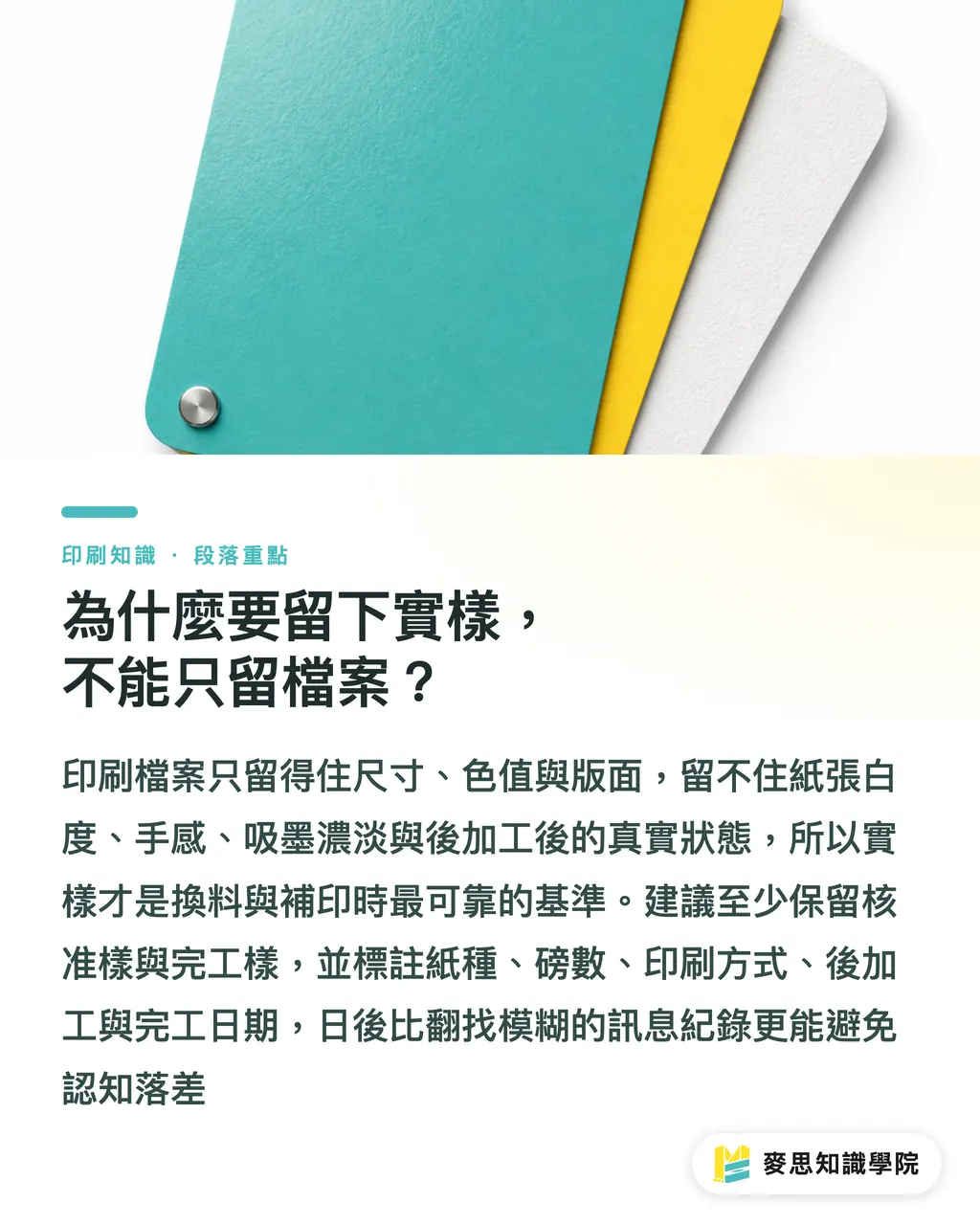
Print files can record size, color values, and layout, but they cannot fully record paper feel, whiteness, density after ink absorption, feel after lamination, or the condition of fold lines. The places where paper changes most easily go wrong are exactly the places a PDF cannot show
I recommend keeping at least 2 types of physical samples:
・Approved sample: the paper and print effect confirmed before the stock change or during proofing
・Finished sample: the actual mass-produced delivered piece, used as the benchmark for the next reprint
You can place a small label on the sample with 6 details: paper type, weight, supply batch or mill name, printing method, post-press process, and completion date. This label is a very low-tech move, but it works. Six months later, when you need a reprint, it is much more reliable than a vague LINE conversation
For designers, physical samples are also strong communication tools. Off-white on screen, off-white on paper, and off-white after lamination are 3 different things. If the design side can include paper stock in the proposal, the client is less likely to say on delivery day, "Why is this different from what I imagined?"
Key Takeaways
・Whether a paper change saves money depends on calculating 7 things together: paper price, sheet yield, waste, ink absorption, drying, press setup, and post-press work
・Comparing quotes with the same spec sheet is the only way to know whether the price gap comes from paper, process, delivery time, or different vendor interpretations
・Lowering paper weight may save on paper, but it may also sacrifice stiffness, feel, and post-press yield
・Physical samples are the procurement benchmark for the next reprint. A PDF cannot remember the feel of paper for you
・Before changing paper, compare the original spec and the alternative spec side by side. Only then is the total price worth discussing
Further Thinking
Paper changes are a print workflow problem that suits digital management very well. On the manufacturing side, print teams can turn paper specs, waste, press settings, and post-press results into an internal knowledge base. On the design side, teams can deliver paper samples, use cases, and brand feel together. Procurement can use a fixed spec sheet for inquiries. If a SaaS team wants to enter the printing industry, solving "spec version management for the same printed item" will be closer to real production than only building online quoting. A tool that can actually land in the field needs sales, procurement, design, and production teams to understand the same spec sheet, instead of making everyone translate it once on their own
FAQ
- Will changing paper stock always lower printing costs?
- Not always. Even if the unit price of the paper drops, total cost may rise because sheet yield gets worse, waste increases, drying slows down, or post-press yield falls
- How detailed should paper specs be when procurement compares quotes?
- At minimum, include finished size, print quantity, paper type, paper weight, number of print colors, surface treatment, post-press work, delivery time, and whether there will be reprints. For paper change projects, it is best to add a physical sample benchmark as well
- Will switching to a lower paper weight affect the finished feel?
- Yes. A lower weight may make the paper softer, increase show-through, or weaken box support. Whether that is acceptable depends on the item's use. DM pieces, covers, hang tags, and packaging boxes all have different standards
- Why can different batches of the same paper type still vary?
- Paper batches can have subtle differences in whiteness, hand feel, ink absorption, or surface condition. For brand materials that need long-term reprints, keep both an approved sample and a finished sample so the next run is not matched by name alone
- When is MINDS a better fit, and when is Mai Printing a better fit?
- For paper recommendations, specialty processing, brand packaging, or mid- to high-end custom products, MINDS is a better fit. For clear specs, price-sensitive jobs, and common items ordered online, Mai Printing will be more efficient
Related articles





The Print × AI weekly
The print and AI know-how designers, brands and enterprises can use before they commit — one email, every week
MINDS Free Tools
Spine width and imposition calculators — skip the manual math, free in your browser.
MINDS Group
Need actual printing or gifting services?
From premium printing to online ordering and festive gifts — the MINDS Group sister brands take it from here.