

Why is there such a huge gap in quotes for the same file?
You have probably faced this situation: you send the same file to three different printers, and the price difference can be as much as two or three times higher
The gap is usually not because the vendor is being dishonest, but because you did not understand the differences in production processes behind the quotes
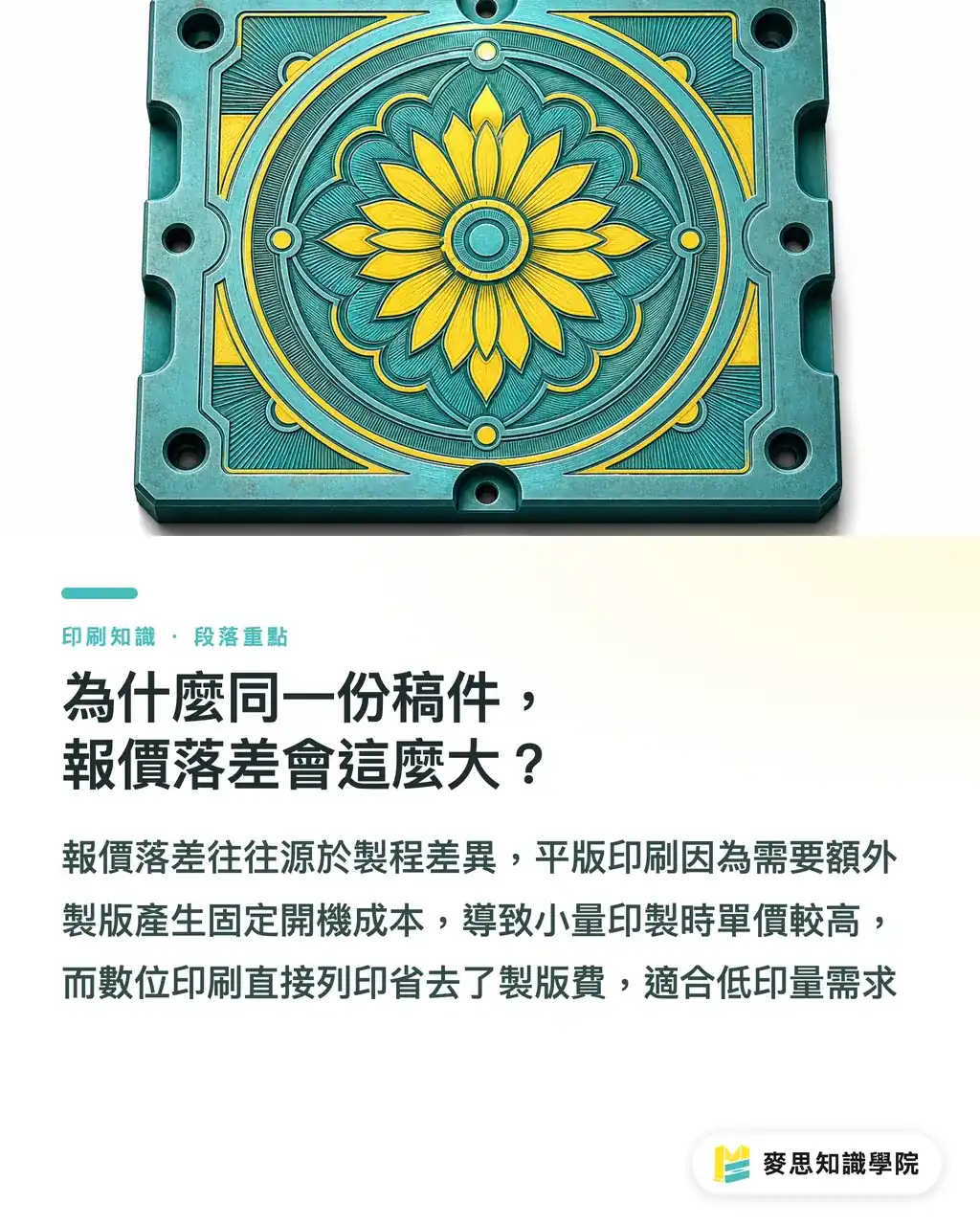
The core of Offset printing lies in "plate making." Before the job hits the machine, four-color (CMYK) aluminum plates must be produced, which incurs a fixed startup cost of several thousand dollars
Digital printing is like a large industrial printer; files are transmitted and printed directly, completely eliminating the preliminary plate-making fees
This means that when print volumes are very small, the unit price for Offset is inflated significantly by the plate-making fee, while digital remains relatively accessible
Is 500 copies really the golden crossover point between digital and offset?
Here is the bottom line: when your print volume is under 500 copies, digital printing is definitely more cost-effective
This is recognized as the cost watershed for most production lines, but this line can be completely rewritten by "variable data."
If you need to print 500 business cards, but these 500 are for 5 different employees, Offset would require 5 sets of plates, causing costs to spiral instantly
Digital printing has no physical plates, so every single impression can be different (e.g., serial numbers, unique custom names)
For projects involving variable content or multiple small-batch items, even if the total volume exceeds 1,000, digital remains the superior business choice
Where are the limits of color stability and paper selection?
Returning to the quality aspect, the operating mechanisms of both determine the limits of the finished product's texture
Digital printing relies primarily on toner or inkjet. High-end machines offer excellent color rendering, but toner sometimes floats on the surface of the paper
This means that if you are using thick paper that requires creasing or folding, the toner at the edges is prone to cracking, leaving white gaps
Offset printing is based on the chemical balance of ink and water; the ink naturally penetrates the paper fibers, making it especially suitable for handling textured, specialty art papers
More importantly, if your company's CIS (Corporate Identity System) requires extremely precise, independent Pantone spot colors, Offset is currently the only choice that can ensure perfect consistency
How to provide accurate requirements before requesting a quote?
To avoid wasting money, you must proactively disclose these three key variables when requesting a quote: print volume, turnaround time, and color expectations
I generally advise clients to use the following framework to screen their production direction:
・Volumes under 500 copies, 48-hour delivery requirement, or involving variable data: Ask the vendor directly for a digital printing quote
・Single-item volume exceeding 1,000, large areas of flat solid color, or specified Pantone spot colors: Choose Offset printing without hesitation
・Seeking high CP (cost-performance) value for art paper stickers: First confirm the surface coating and post-processing/lamination requirements, then evaluate which machine is more economical
Clarifying these needs in the pre-production stage ensures accurate quotes and drastically reduces subsequent disputes on the production line

Key Takeaways
・Digital requires no plate making and has no basic startup fees, making it the cost savior for small-batch and urgent projects under 500 copies
・The unit cost of Offset drops sharply with volume, providing an absolute advantage for bulk print jobs and Pantone spot colors
・When encountering variable data like serial numbers or multiple names, digital printing is the only cost-effective solution
・Clarifying the three axes of volume, turnaround, and color precision before bidding will help you lock in the correct printing process from the start
Extended Reflections
I have seen too many designers on the production line blindly pursue "highest quality" and force an Offset order, only to have the project's profit eaten up by the high plate-making fees
For SaaS systems or print procurement teams looking to implement automated quoting, building a decision tree based on "quantity" and "special colors" in the interface is highly practical
As long as file specifications can be automatically routed to the appropriate machine, significant communication costs can be saved
This is also what the MINDS team has been doing: using professional experience to check for clients during prepress, ensuring every order hits the sweet spot between quality and budget
FAQ
- Is the color quality of digital printing necessarily inferior to offset?
- The CMYK performance of modern high-end digital machines is already very close to, or even more vibrant than, offset printing. However, if you require extreme consistency for independent spot colors, offset remains the preferred choice
- For an urgent job of only 200 copies, can I request Offset printing?
- It is technically feasible but financially extremely unwise, as you would have to amortize several thousand dollars in plate-making and startup fees. In this case, choosing digital printing is the logical business decision
- How do I know if the vendor's quote is based on digital or offset?
- When requesting a quote, ask them to provide prices for different volume tiers. If the total price barely changes when the volume doubles, it is likely offset, which amortizes the startup fee. If the unit price shows a fixed, linear growth, it is usually digital
Related articles




The Print × AI weekly
The print and AI know-how designers, brands and enterprises can use before they commit — one email, every week
MINDS Free Tools
Spine width and imposition calculators — skip the manual math, free in your browser.
MINDS Group
Need actual printing or gifting services?
From premium printing to online ordering and festive gifts — the MINDS Group sister brands take it from here.