

Behind Every Quote Is Really Three Layers of Cost
Printing costs can generally be divided into three layers:
・Fixed costs: costs you pay regardless of quantity, including plate-making, press setup, and proofing fees
・Variable costs: costs that change with quantity and specifications, mainly paper, ink, press time, and waste
・Back-end costs: finishing, packaging, and delivery, which can sometimes cost more than the printing itself
For small runs, fixed costs are spread across fewer copies, so a higher unit price is structurally normal. Once the quantity increases, fixed costs are diluted, and the accumulated cost of materials and processing becomes the main factor. Comparing the unit price of 100 copies directly with that of 5,000 copies is not very meaningful in the first place
If you have ever requested a custom quote from MINDS Printing (MS, high-end fully customized commercial printing), the sales representative usually confirms the print quantity first. This is why: the same design follows completely different cost logic at different quantities

Why Is Small-Run Printing Especially Expensive? How Are Fixed Costs Calculated?
This is the part most easily overlooked, yet it has the biggest impact on small-run jobs
Plate-making fees
Traditional offset printing uses PS plates, one plate for each color. Standard CMYK four-color printing requires four plates; adding one Pantone spot color adds another plate. In Taiwan's commercial printing market, this fee is usually fixed and unrelated to how many copies you print. Whether you print 100 copies or 10,000, the plate-making fee is the same
Gravure printing has even higher plate-making costs. Producing one cylinder can easily start at tens of thousands of dollars, which is why gravure only makes economic sense at large volumes. Fixed costs must be diluted across enough copies; otherwise, the plate cost carried by each copy becomes unreasonably high
Digital Printing does not require plate-making and outputs directly, making it more cost-effective for small quantities. But the material cost per sheet is higher than offset printing, so it loses its advantage as volume increases
Press setup fees
Before offset printing begins, the press must be set up: the machine is adjusted to the correct color density and registration accuracy. This process consumes paper, ink, and labor time. Sometimes it is included in the overall quote; sometimes it is listed separately. When requesting a quote, always ask clearly, "Is the press setup fee charged separately?" If you miss this question, price comparisons have no reliable baseline
Paper, Ink, and Waste: Which Variable Cost Matters Most?
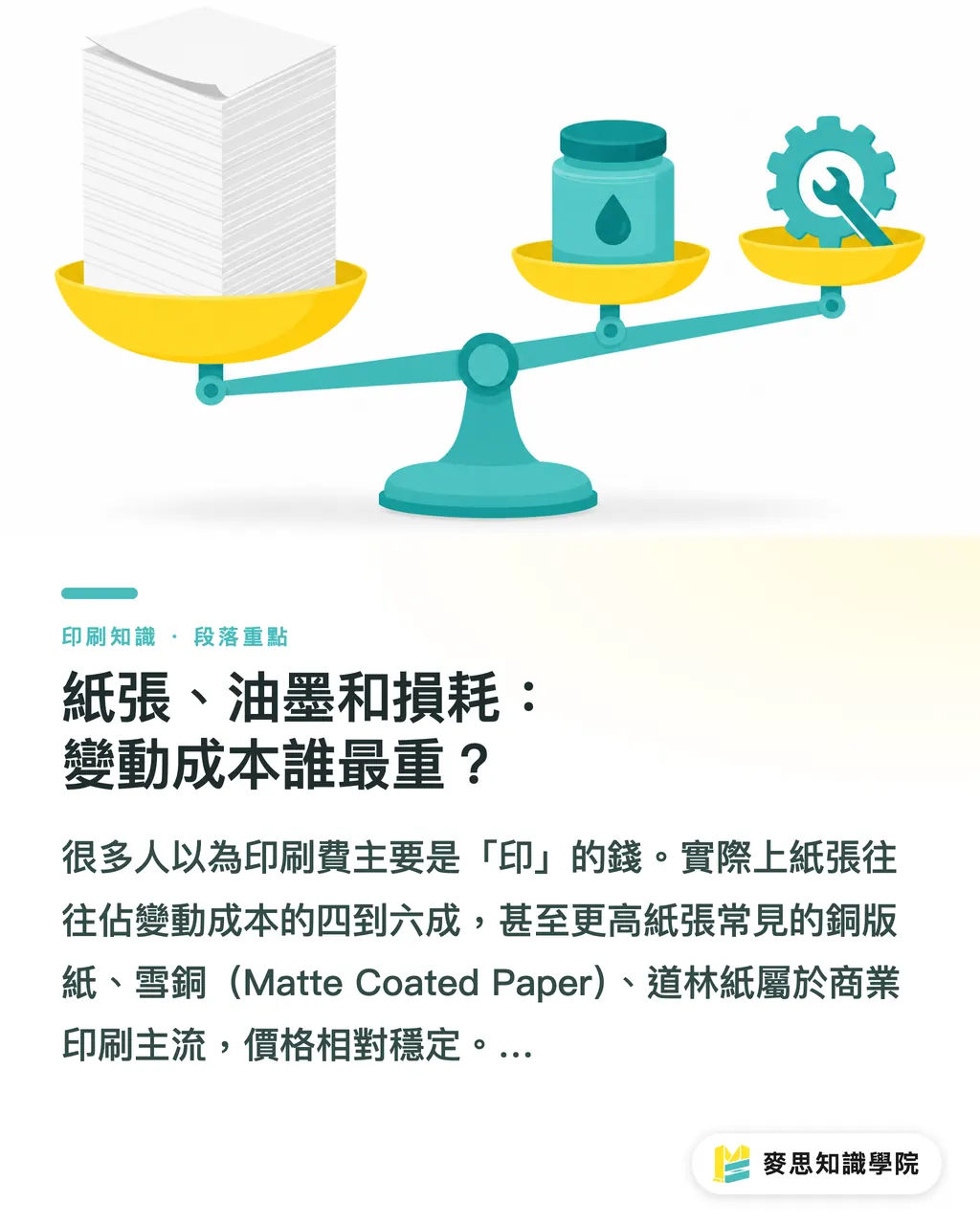
Many people assume printing cost is mainly the money paid for the act of printing. In reality, paper often accounts for 40% to 60% of variable costs, or even more
Paper
Common coated paper, Matte Coated Paper, and woodfree paper are mainstream choices in commercial printing, with relatively stable pricing. Switching to specialty paper is a different story:
・Imported textured paper, such as Laid Paper, often costs more than twice as much per ream (500 sheets) as standard coated paper
・Synthetic Paper is water-resistant and tear-resistant, making it suitable for outdoor labels, but its unit price is higher
・Soft Touch Paper has a pleasant tactile finish, and the cost of that process is already built into the paper itself
Paper weight also directly affects cost. Switching the same coated paper from 105g to 200g can nearly double the material cost, while also increasing the difficulty of folding and creasing in finishing. Some printers will charge additional processing fees for this
Ink and number of colors
Standard CMYK four-color printing is the most economical setup. Every additional spot color means one more plate and one more press pass, pushing up both fixed and variable costs. Foil stamping in gold or silver is calculated separately; it is a finishing process with a completely different cost structure and should not be mixed into ink color count calculations
Waste
Press calibration and machine adjustments consume a batch of paper, and printers usually prepare a buffer quantity. In general commercial printing, the waste rate is between 3% and 8%; it may be higher for special processes or small runs. If you order 1,000 copies, the printer may actually use materials for 1,050 to 1,080 copies, and this cost is already reflected in the quote
How Heavy Are Finishing Costs? Often More Than the Printing Itself
This is the part of a quote that most often surprises people
Almost every finishing process has its own fixed cost and process fee:
・Coating, UV or aqueous: adds gloss or protection, requires an additional machine pass, and carries machine setup costs
・Lamination: gloss film, matte film, and soft-touch film are separate processes, calculated by area or sheet count
・Gold or silver foil stamping: requires making a foil stamping die, with die fees usually ranging from a few hundred to several thousand dollars; for small runs, this becomes expensive per copy
・Embossing, debossing, and die-cutting: these also require tooling, and mold-making is a one-time fixed expense
A premium business card with gold foil, matte lamination, and custom die-cutting often costs three to four times as much as a standard card of the same size. More than half of the cost may come from finishing, while the printing itself becomes secondary
When designers do not explain finishing costs clearly during a proposal, it is often the most common reason the final budget breaks down. Before estimating costs for a client, this part must be confirmed with the printer first
Which Specifications Most Easily Send Costs Out of Control?
After years of working with projects across many specifications, these choices most often make the final cost noticeably higher than expected:
・Adding colors: every extra spot color or fluorescent color adds plate fees and press time, which is especially noticeable on small runs
・Non-standard sizes: if the job cannot be efficiently arranged through Imposition, paper waste rises, which means you are paying for discarded material
・Specialty paper: small quantities often cannot be purchased by the full ream, making the unit material cost higher, with a higher waste rate as well
・Rush jobs: inserting a job into the schedule carries press-related costs. In general commercial printing, rush fees range from 20% to 50% of the original price, and extremely urgent deliveries, such as next-day completion, can cost even more
・Multiple revisions after production begins: making changes after proofing or plate-making means plates must be remade, and plate fees are charged again. This is also why online ordering platforms such as MYS Printing (MYS) generally do not accept changes after artwork approval
The concept of Imposition is worth calling out. Printing paper comes in standard sheet sizes, such as full sheet, half sheet, and Kiku half sheet. If the finished size can be cleanly arranged within a standard sheet size, one large sheet can produce multiple finished pieces, improving paper use. With unusual sizes, you still pay for the material left over after trimming, which means spending extra money beyond the bleed

Key Takeaways
・A printing quote is built from three stacked layers: fixed costs, variable costs, and back-end costs. For small runs, the dilution effect of fixed costs is the most obvious. This is not a printer problem; it is a structural issue
・Paper often accounts for the largest share of variable costs, and switching to specialty paper usually affects pricing far more than most people expect
・Each finishing process has its own tooling and setup fees. The cost of premium packaging often comes from finishing, while the printing itself is secondary
・Rush fees, repeated revisions, and non-standard sizes are the three decision points most often underestimated, yet they are also the easiest ways for costs to exceed expectations
・When requesting a quote, clarify whether press setup, proofing, and finishing fees are charged separately. That is the real starting point for meaningful price comparison
Further Considerations
For designers, aligning specifications and budget during the proposal stage is the most cost-effective move in the entire process. If paper, color count, and finishing are decided when the direction is confirmed, the chance of late-stage revisions drops, and the cost estimate becomes more accurate. If you have a regular print partner, it is worth asking the sales representative to list the fixed cost items for commonly used specifications. Future budget estimates will become much faster
For procurement teams, comparing total prices alone is not meaningful. The right question is how each cost item is structured under the same specifications. Ask whether the press setup fee is included, whether proofing is charged separately, and whether finishing is itemized. Once these three questions are clear, quotes can truly be compared
For companies that frequently run commercial printing projects, standardizing the specifications of common items is the most direct way to reduce hidden costs. Non-standard sizes, frequent paper changes, and a high share of rush orders are three areas where tighter control can save a significant amount over a year. For high-end fully customized needs, you are welcome to request a quote from MINDS Printing (MS); clear specifications are what make a quote truly useful. For needs that lean toward standard specifications, small quantities, and fast turnaround, the online ordering process at MYS Printing (MYS) can more quickly provide a reference range
FAQ
- Why is small-run printing so expensive per copy?
- Printing involves fixed costs such as plate-making and press setup fees, which must be paid regardless of quantity. The smaller the print run, the less effectively those fixed costs are spread out, so the unit price naturally rises. Once quantity increases, fixed costs are diluted, and materials and processing become the main expenses. This is a structural issue, not necessarily a sign that someone is overcharging you
- Roughly how much do finishing costs account for?
- There is no fixed percentage, but gold foil stamping requires tooling, lamination is charged by area, and die-cutting has mold-making fees. When these processes are combined, finishing costs for premium packaging or gift boxes can sometimes exceed the cost of printing itself. Before presenting a design proposal, confirm whether the budget includes finishing; otherwise, cost gaps can appear easily
- How much more expensive is specialty paper?
- Imported textured paper, Soft Touch Paper, and Synthetic Paper usually start at twice the material cost of standard coated paper. For small-quantity purchases, full ream ordering may not be possible, which pushes the unit price even higher. Specialty paper also tends to have a higher waste rate, and that is reflected in the quote as well
- How much is usually added for a rush job?
- In general commercial printing, rush fees range from 20% to 50% of the original price, depending on scheduling difficulty and delivery requirements. Extremely urgent jobs, such as next-day completion or production that requires after-hours machine scheduling, cost even more. Finalizing artwork early and avoiding rush orders is one of the fastest ways to control printing costs
- If I want to revise the design after production begins, how are plate fees calculated?
- If changes are made after plates have already been produced, the plates must be remade. The original plate fee is not refunded, and the new plate fee is charged again. This is why repeated revisions can make costs grow quickly. Online ordering platforms such as MYS Printing (MYS) generally do not accept changes after artwork approval for the same reason
Related articles





The Print × AI weekly
The print and AI know-how designers, brands and enterprises can use before they commit — one email, every week
MINDS Free Tools
Spine width and imposition calculators — skip the manual math, free in your browser.
MINDS Group
Need actual printing or gifting services?
From premium printing to online ordering and festive gifts — the MINDS Group sister brands take it from here.