

Why Do Quotes for the Same Business Card Range from NT$300 to NT$2,000?
I often encounter clients who go price-shopping with the same design file and return furious, asking why the price gap is so massive. In reality, they are usually comparing gang-run printing with custom-run printing
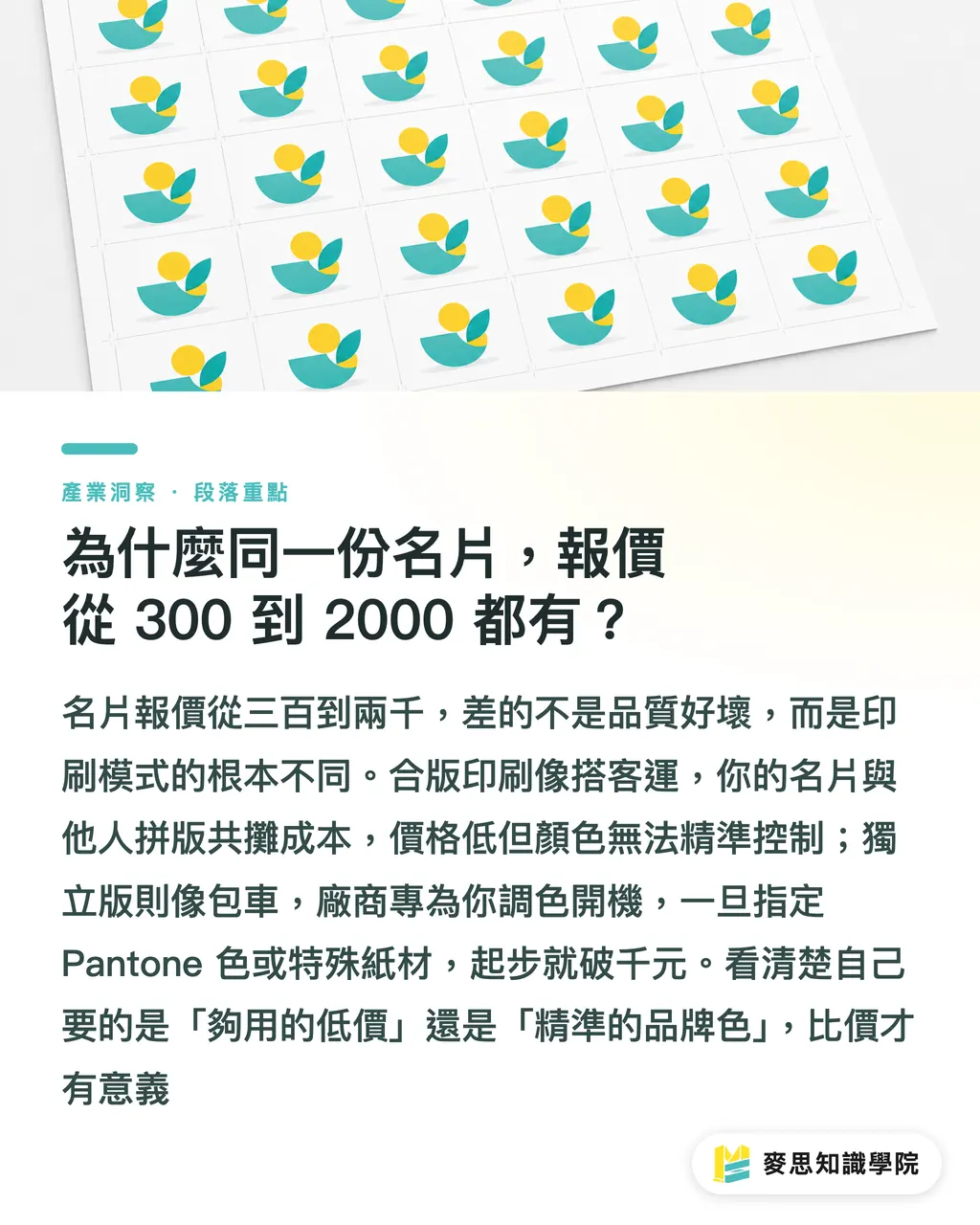
Gang-run printing is like taking a bus: your business cards are ganged up on the same printing plate with those of dozens of others. Since everyone shares the fixed costs of plate-making and machine setup, three boxes of business cards might only cost NT$300. The trade-off, however, is that there may be slight color variations, and you cannot request color proofs or adjustments
If you require precise corporate identity colors (Pantone colors) or choose a special heavyweight art paper, the printer must set up a custom run for you. This is equivalent to renting a private car: a skilled technician is dedicated to adjusting the colors and machines just for you. The starting setup cost alone can easily exceed NT$1,000, so a final quote of NT$2,000 is perfectly normal
Why Do People Often Run into Pitfalls When Using Business Card Templates?
Beginners sourcing print jobs are most likely to make mistakes with dimensions and bleed. To save trouble, many download free business card templates from online stock libraries, fill in their information, and send them straight to print. The final product often ends up with cut-off text or white edges
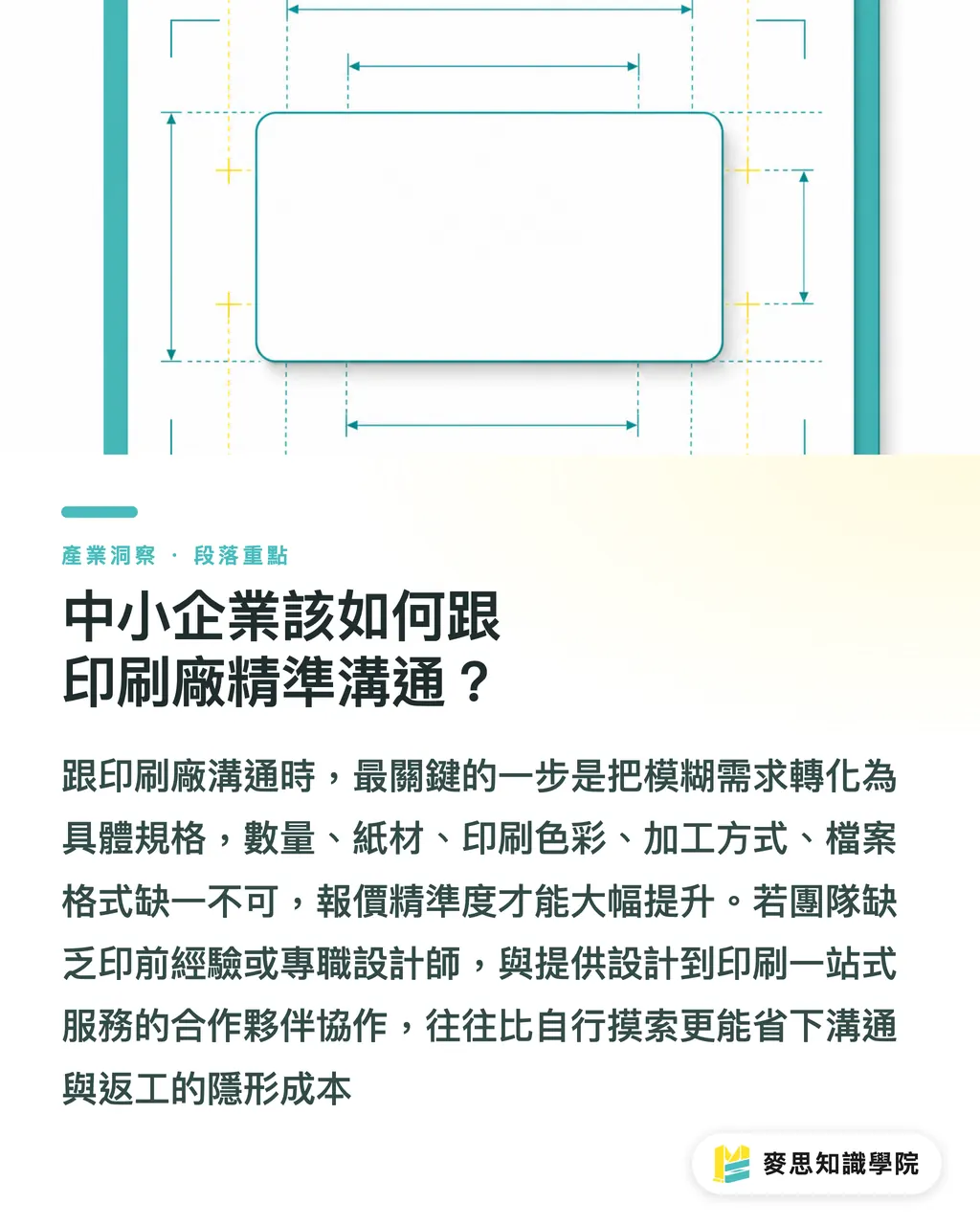
In Taiwan, the standard finished size for business cards is mostly 90x54mm. To prevent trimming errors, the file must include a 2mm bleed on all four sides. This means your design file dimensions should be 94x58mm, and your background color or image must extend to the edges of this 94x58mm area
I highly recommend that instead of randomly grabbing templates online, you request a standard layout template directly from your intended printer. Cutting safety margins and custom shapes can vary slightly from one printing shop to another, and using their template is the best way to ensure no errors occur during prepress
How to Pair Paper Stock and Finishing Options Without Wasting Money?
Paper stock and finishing options are the lifeblood of a business card's texture and feel. Although there are thousands of paper types on the market, knowing a few classic combinations will allow you to achieve a premium look on a reasonable budget
・Premium coated cardstock with double-sided matte lamination: This is the safest bet. The smooth surface combined with the matte lamination provides a solid, non-reflective feel, making it suitable for most business scenarios
・Ivory cardstock or Linen paper: These uncoated fine papers are highly absorbent, resulting in slightly more muted, sophisticated colors. They feature the tactile feel of natural paper fibers, making them ideal for creative designs or brands that want to convey warmth
・Spot UV and Foil stamping: To emphasize your logo, you can layer spot UV on top of matte lamination to create a slightly raised, glossy contrast. If you want foil stamping, embossing, or debossing, you will need to pay for a custom metal or zinc plate. Each finishing step adds a basic setup fee
More finishing isn't always better. I often see business cards that combine foil stamping, embossing, and die-cutting all at once. In the end, the design loses its focus, and the paper may even warp due to excessive pressure
How Can SMEs Communicate Precisely with Printing Companies?
The only way to minimize quote discrepancies and reprinting disasters is to translate your needs into concrete technical specifications. When you only ask how much it costs to print three boxes of business cards, the printer can only offer the most basic estimate
Try listing your specs like this:
・Quantity: 3 boxes (100 cards per box)
・Paper Stock: 300g premium cardstock
・Printing: Double-sided color (CMYK)
・Finishing: Double-sided matte lamination, single-sided holographic silver foil stamping
・File: Print-ready AI vector file with 2mm bleed
By clarifying these five points, the accuracy of the quotes you receive will skyrocket. If your team lacks pre-press file handling experience or doesn't have a dedicated designer, working with a team that provides one-stop integrated services, such as MINDS Printing, to bridge the gap from design to print can save you significant communication and troubleshooting costs
Key Takeaways
・Price gaps usually stem from the choice between gang-run and custom-run processes. Cheaper options carry color variation risks, whereas precise matching requires paying for dedicated setup fees
・When designing business cards, request a standard layout template directly from your printer to ensure that the 94x58mm bleed area and safety margins are correct
・Each finishing step adds layout/plate fees. Use foil stamping or spot UV moderately to enhance visual appeal, and avoid overloading the card with too many elements
・Translating vague requests into five specific specifications, paper stock, weight, printing method, finishing, and quantity, is key to getting an accurate quote
Further Thoughts
The future of print procurement should move past the swamp of price-shopping. While SaaS and automation tools can solve layout alignment and fast quoting, the tactile feel of physical papers and finishing details still relies on professional experience and judgment. As businesses adopt digital tools, they should treat print as an extension of the brand experience. Using integrated services to reduce communication costs is the key to improving marketing ROI
FAQ
- Why do the colors of my printed business cards look different from what's on the screen?
- Screens use RGB light emission, while printing relies on CMYK ink layering, and their color gamuts differ. Combined with differences in paper base color and ink absorbency, visual variations are inevitable. For critical jobs, it is recommended to request a physical proof from the printer first
- Is bleed absolutely necessary for business cards? Can't we just trim off the white edges?
- Paper cutters always have a physical deviation of 1 to 2mm. If you don't leave bleed for the background color to extend, even a slight shift in trimming will expose the raw white edges of the paper, making the finished product look very unpolished
- What is the difference between foil stamping and printing in gold?
- Printing in gold uses CMYK halftones to simulate a yellowish-brown appearance, which lacks metallic luster. Foil stamping, on the other hand, uses high heat and pressure to stamp real metallic foil onto the paper, creating clear reflections and a slightly raised texture. It offers a much higher quality feel but requires a custom plate
- Why won't printers accept an order for only 50 business cards?
- Setting up a printing press consumes a fixed amount of test paper and ink. A run of only 50 cards cannot cover these fixed setup costs. Generally, 100 cards (one box) is the minimum cost-effective print run. While some digital printers accept small-volume orders, the per-card cost will be significantly higher
Related articles





The Print × AI weekly
The print and AI know-how designers, brands and enterprises can use before they commit — one email, every week
MINDS Free Tools
Spine width and imposition calculators — skip the manual math, free in your browser.
MINDS Group
Need actual printing or gifting services?
From premium printing to online ordering and festive gifts — the MINDS Group sister brands take it from here.