

What Are You Actually Paying For in Business Card Design?
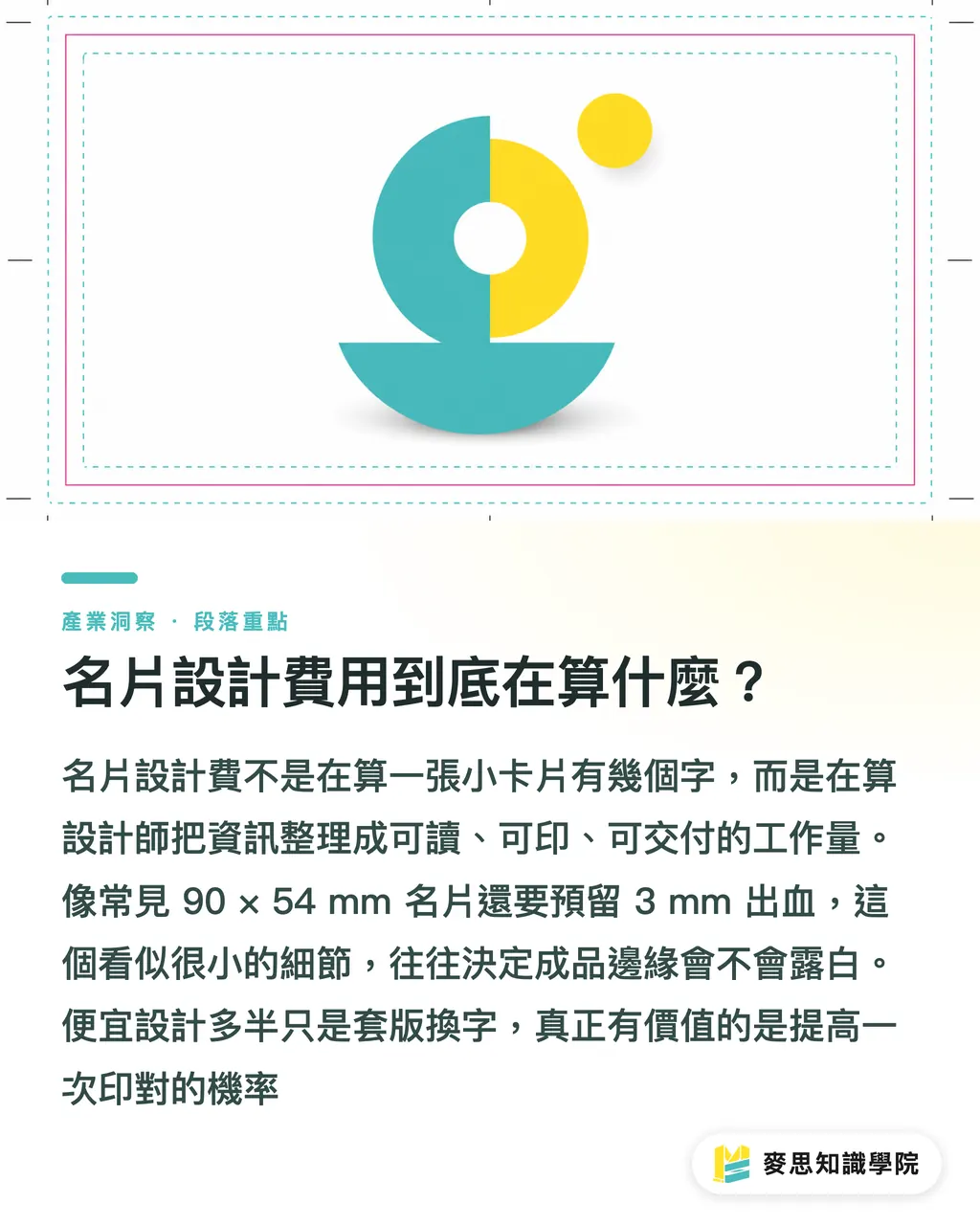
Business card design fees aren't calculated by how many words are on a tiny card. You're paying for the workload it takes a designer to organize information into something printable, readable, and ready to deliver
Standard business cards in Taiwan usually measure 90 × 54 mm, and print files require an extra 3 mm bleed. That 3 mm looks tiny, but in practice, it often decides whether your final cards end up with unwanted white edges
I usually break business card design down into 4 tasks:
・Information layout: Name, title, phone, email, address, social handles, and QR codes. Deciding what goes on the front versus the back
・Layout design: Font sizes, line spacing, white space, visual focus, and logo placement. A 90 × 54 mm space gets crowded fast
・Prepress prep: Bleeds, crop marks, safe zones, CMYK, outlined fonts, and image resolution. These directly dictate whether the job prints smoothly
・File delivery: Handing off AI, PDF, or printer-specific formats, adjusting for paper stock and finishing options when needed
The cheapest business card design is usually just swapping text inside a template. Higher-priced design starts addressing brand tone, paper pairing, and print risks
Bottom line: Business card design fees aren't for buying pretty visuals. You're paying for the guarantee that it prints right the first time
Why Is Logo Design So Much More Expensive Than a Business Card?
Logos cost more because a logo isn't just a graphic. It's a set of recognition rules
If a business card has a flaw, you reprint 100 or 200 copies. If a logo has a flaw, every sign, package, website, uniform, flyer, and social avatar that follows will be wrong
That is the core reason for the price gap
・Business card design: The scope is usually 1 size, 1 or 2 layouts, and 1 specific print use case
・Logo design: The scope extends to brand naming feel, typography style, color systems, black-and-white variations, horizontal/vertical layouts, and multiple media
・Business card design: The focus is laying out existing brand details clearly and printing them reliably
・Logo design: The focus is helping a brand stay recognized correctly over 3 years, 5 years, or longer
That's why I don't put logo design and business card design on the same scale
A business card is like the name tag on a suit, while a logo is the company's name and face. Both matter, but they carry very different decision weight
What Makes a Fair Business Card Design Quote?
A fair business card design quote depends on project complexity, not just asking 'how much per card.'
In practice, I usually assess pricing across 4 levels:
・Template updates: Fixed template in place, swapping only name, phone, title, and QR code. Ideal for bulk sales reps or internal staff
・Basic layout: Logo and brand colors exist, requiring a clean arrangement of front and back info. Ideal for SMBs making their first official card
・Custom visuals: Building a distinct style, custom graphics, and unique layouts. Ideal for retail stores, consultants, agency services, and founders
・Design and print integration: Handling paper stock, paper weight, foil stamping, spot UV, embossing, rounded corners, and final artwork together. Ideal for high-impact business settings
The real question isn't 'is it cheap,' but whether the quote clearly defines the scope of deliverables
A quote should outline at least 6 items:
・Whether front and back designs are included
・Whether it includes logo work or just applies an existing logo
・How many revision rounds are included
・Whether print-ready artwork is included
・Whether paper and finishing recommendations are included
・Whether editable source files are included
If a quote simply says 'Business Card Design (1 concept)' without clarifying these 6 points, the friction later won't be about price. It will be about accountability

What Drives Up Business Card Design Costs?
Higher costs usually come from increased risks, not a larger card size
The 90 × 54 mm dimensions stay constant, but information volume, brand expectations, material finishing, and revision rounds quickly expand the workload
I've seen many projects start out as a simple card design, only to reveal no vector logo, undefined brand colors, undersized QR codes, overly long addresses, and requests for foil stamping. At that point, it's no longer just basic layout work
Extra costs typically stem from 5 main areas:
・No usable logo file: Only screenshots or low-res JPGs available, forcing the designer to redraft or rebuild the vector file
・Too much content: Cramming 2 phone numbers, 3 social handles, 2 addresses, and QR codes onto one card requires careful layout trade-offs
・Specialty paper stocks: Cotton paper, black cardstock, heavy paper, or linen paper affect color output and fine detail
・Finishing touches: Foil stamping, embossing, spot UV, debossing, rounded corners, or custom die-cuts all require separate file prep rules
・Excessive revision rounds: Without a defined brand direction up front, 3 revisions easily spiral into 8 back-and-forth rounds
Design fees aren't meant to punish having complex requirements. They reflect the additional calls and accountability behind each request
Should SMBs Build Their Logo or Business Card First?
If you have no brand identity at all, sort out your logo and core brand rules first before touching business cards
If you already have a usable logo and just need to fix outdated cards, incorrect info, or inconsistent print quality, update the card first
The decision process is straightforward:
・No logo at all: Start with the logo. You need at least a wordmark, primary color, black-and-white version, and basic usage rules
・Logo exists only as an image file: Prepare proper vector files first, securing AI, PDF, SVG, or high-res PNG formats
・Logo and brand colors ready: Go straight to business card design, keeping focus on content hierarchy and prepress accuracy
・Planning special finishes: Consult the printer about paper stock, finishing limits, and minimum line widths before designing
・Designing for the whole team: Create a business card template first so future employee onboarding only requires swapping text, keeping costs predictable
With connected services like MINDS that span design, file prep, and printing, the real value goes beyond sending files to press. It lies in catching 'looks good on screen but unprintable' issues early on
A lot of costly reprints happen because no one took 5 minutes to ask questions up front

Key Takeaways
・Business card design fees cover layout, prepress, and delivery accountability, not the physical dimensions of a small card
・Logo design costs more than card design because it sets how your brand is recognized long-term
・Card quotes should clearly address front/back designs, revision rounds, file prep formats, paper finishing, and source file handoffs
・Low-cost templates fit static contact details, while custom design suits business contexts where building trust matters
・Define your logo, brand colors, and print constraints early so costs don't balloon mid-project
Final Thoughts
For SMBs, the most practical approach is treating the business card as the first physical test of your brand system. Gather your logo files, brand colors, contact details, and intended use cases, then have both the designer and printer review dimensions, bleeds, paper stock, and finishing constraints together
For designers, AI can assist with layout directions, style inspiration, and missing information checks, but the final calls still come down to prepress specs and physical paper assessment
For SaaS and print service providers, the real value isn't just letting clients build layouts online. It's turning real-world issues like 3 mm bleeds, CMYK color spaces, QR code legibility, foil stamping limits, and file handoffs into built-in workflow prompts that save clients from expensive reprints
FAQ
- What factors usually determine business card design costs?
- Business card design fees mainly depend on front and back layouts, whether a logo already exists, revision limits, prepress artwork, paper stock, and finishing requirements. Even for the same 90 × 54 mm card, swapping text in a template takes a completely different amount of work than a custom design
- Why is logo design more expensive than business card design?
- A logo is the core of a brand identity, appearing across business cards, signage, websites, packaging, social channels, and documents over a much longer lifespan than a batch of cards. Business card design usually involves building a single printed item on top of an established brand foundation
- Do I need a logo before designing a business card?
- It's best to have a usable logo ready, ideally as a vector file or high-resolution graphic. If you only have a screenshot or blurry JPG, the designer may need to rebuild the file, adding to both cost and timeline
- Can I design my own business card using Canva or templates?
- Yes, but you need to verify dimensions, 3 mm bleeds, safe zones, CMYK colors, fonts, and image resolution. The most common issue with DIY templates isn't how they look on screen, but cutting errors or color shifts once sent to press
- Should I have the printer handle both design and printing?
- If your project involves specialty paper, foil stamping, spot UV, embossing, or bulk team cards, working with a team that understands prepress from design through production is much safer, as finishing constraints and reprint risks get addressed right from the start
Related articles





The Print × AI weekly
The print and AI know-how designers, brands and enterprises can use before they commit — one email, every week
MINDS Free Tools
Imposition calculator and preflight file check — free prepress tools, right in your browser.
MINDS Group
Need actual printing or gifting services?
From premium printing to online ordering and festive gifts — the MINDS Group sister brands take it from here.