

Overview
To make a paper bag durable, the core solutions are 'toughness of the paper's long fibers + structural reinforcement for the handles + a base board that matches the object's center of gravity.' Once you get these three variables right, you can fundamentally prevent the disasters of bottom blowouts and snapped cords
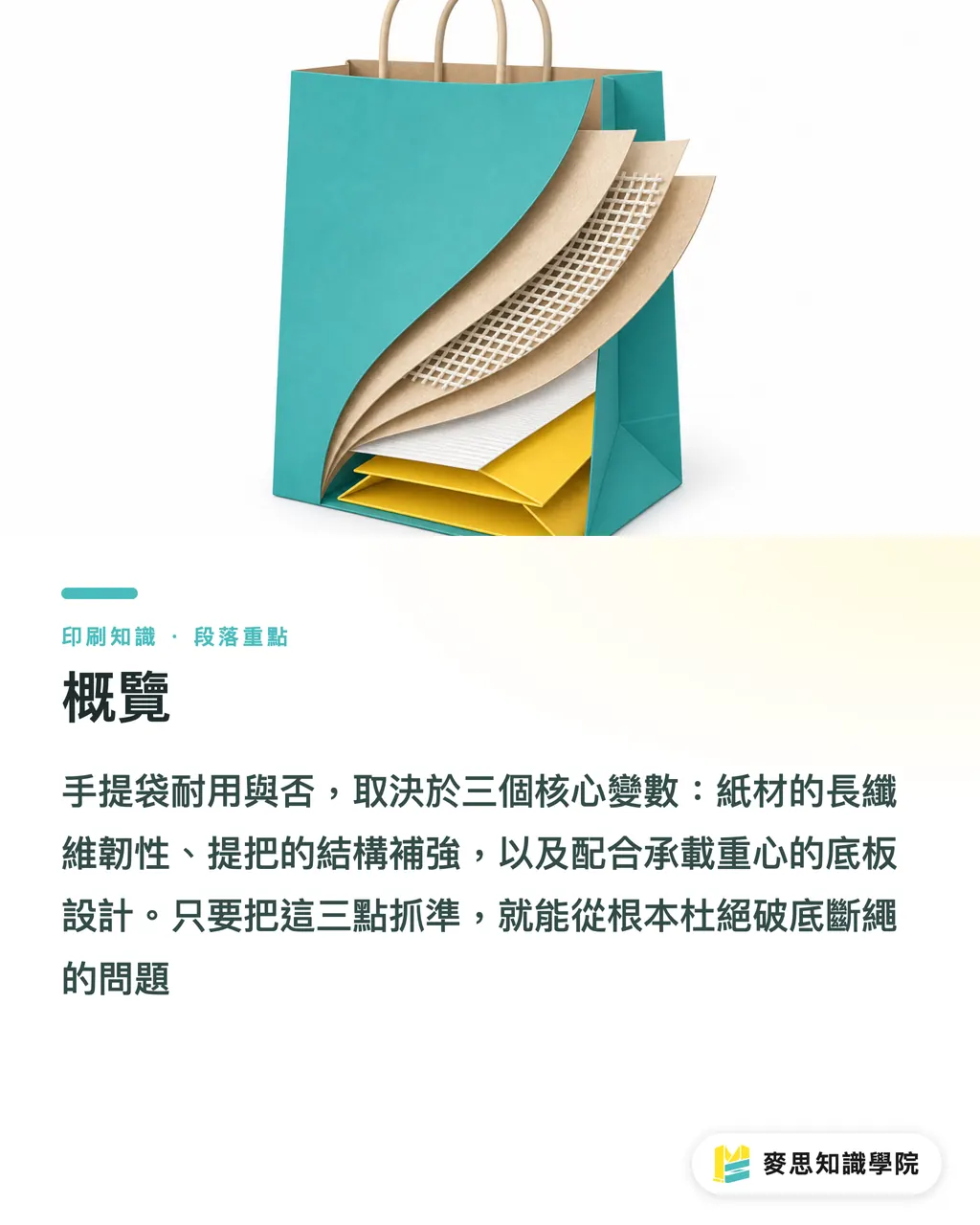
Why do paper bags always break at the bottom or snap their handles?
Many designers mistakenly believe that increasing the paper weight (GSM) will prevent breakage; this is actually the most common myth on the printing floor
Paper is made of interwoven plant fibers. When we fold a sheet of paper into a bag, the fibers at the fold lines are already subjected to compression and tension
If heavy items are inserted (for example, a standard 750ml bottle of wine, which weighs about 1.3kg including the glass), gravity directly challenges the glued edges of the bag's bottom and the punch holes of the handle cords
Once there is no structural reinforcement at the stress points, or if the paper itself lacks sufficient toughness, tearing at these points is only a matter of time
This is just like making a bento box: if the oil-proof coating and structural sealing are not done well, it will become soft and leak. The physical load-bearing capacity of packaging is always the first line of defense in design
Is higher GSM always better? How to choose paper bag materials?
The key to choosing materials lies in the fiber length of the paper and post-processing conditions, not just thickness
Overly thick coated paper (e.g., cardstock over 300g) can easily burst at the corners and show white edges during folding if not properly creased
・Kraft Paper (Natural/White): Because they retain longer wood pulp fibers, even at a weight of only 120g to 150g, they still have excellent tensile toughness, making them perfect for bags requiring durability
・Coated Paper and Single-Sided Coated Paper: This type of paper has a smooth surface suitable for exquisite full-color printing, but the fibers are shorter. It is generally recommended to use 200g to 250g, and the surface must be laminated with matte or gloss film
This layer of plastic film significantly enhances the paper's tear resistance by tightly binding the fragile short fibers
How to design handles and bottoms to support heavy loads?
The handles and the opening are where the most stress is concentrated. Punch holes without protection will cause the paper to tear upon pulling
In practice, for bags bearing more than 3kg, thick cardstock (reinforcement board) must be added to the folded-back part of the opening to distribute the pulling force
・Cotton Cords and Ribbon Punching: Besides inserting a reinforcement board inside the opening, it is recommended to add metal eyelets (grommets) so the knot rests against the metal ring, avoiding direct friction with the paper
・Eco-friendly Paper Cords: These are usually machine-attached to a paper patch, which is then glued to the inside of the opening. This method provides a larger load-bearing area and is actually more effective than simple punch-hole cord threading
・Bottom Reinforcement: No matter how thick the paper is, a base board of at least 250g must be placed at the bottom to average out the weight of the items and prevent the glued bottom seams from being punctured at a single point
How to determine dimensions to avoid wasting paper and ensure ease of use?
Dimension setting is directly related to product capacity and the printing plant's layout costs
Paper bags are printed flat before being die-cut and folded; if the flat dieline size exceeds a standard full-sheet format (approx. 100x70 cm) by even a few centimeters, you must switch to a larger paper size, which can instantly double paper costs
To find the most economical size, I usually advise clients to first measure the length, width, and height of their largest product
・Width and Depth: Add 2 to 3 cm to the actual product dimensions to ensure smooth access without getting stuck at the opening
・Height Setting: In addition to the product height, leave space for the folded-back opening (about 4 to 5 cm) and for tying the handle cords
Once you have the preliminary dimensions, hand them to the printer to calculate the unfolded layout. They can adjust by a few millimeters to fit the design into the most cost-effective layout, saving budget that can then be used for spot hot stamping or embossing

Key Takeaways
・The durability of a paper bag comes from fiber toughness and stress-bearing structure, not just paper thickness
・Coated paper over 200g must be laminated to use the film's tensile strength to prevent bursting at fold lines
・Adding reinforcement boards to the folded-back opening and the bottom is the physical solution to preventing bottom blowouts and snapped cords
・Unfolded dimensions affect paper layout costs; always confirm the most efficient imposition specifications with the printer before designing
Further Reflection
From business cards and bento boxes to paper bags, every physical print product is a balance between 'physical limitations' and 'user experience.'
Designers and brands are advised to actually fold paper materials and test them with heavy loads while conceptualizing packaging, rather than relying solely on 3D simulations on a screen
For integrated service providers like MINDS Printing, getting involved early in the client's dimension planning and material testing can help them avoid reprinting risks and demonstrate the value of a professional consultant
Further Reading
・How to Make Durable Paper Bags: A Guide to Material, Handle, and Dimension Selection
FAQ
- Why do the corners of my paper bag always crack and lose color?
- This happens because the paper is too thick or the fibers are too short, damaging the coating on the paper surface during folding. The solution is to choose thinner paper, ensure proper creasing, or apply lamination to protect the surface
- How should I choose handles for heavy items like wine bottles?
- The top choice is to use reinforced reinforcement boards at the opening, punched with metal eyelets, and combined with thick cotton cords; alternatively, use thick paper cords adhered to a large area inside the opening, which effectively distributes localized stress
- Will kraft paper bags break easily without lamination?
- Kraft paper itself retains longer natural fibers, offering excellent tensile toughness. A thickness of 120g to 150g is usually sufficient for daily load-bearing, so lamination is not strictly necessary
- Can the dimensions of a paper bag be fully customized?
- They can be customized, but if the unfolded size exceeds the limits of the printing press or standard paper specifications, costs will increase significantly. It is recommended to first determine the minimum inner dimensions required for the product, then ask the printer to fine-tune the exterior dimensions for maximum paper efficiency
Related articles



The Print × AI weekly
The print and AI know-how designers, brands and enterprises can use before they commit — one email, every week
MINDS Free Tools
AI background removal, a LINE sticker maker, spine & imposition calculators — all free, right in your browser, no upload.
MINDS Group
Need actual printing or gifting services?
From premium printing to online ordering and festive gifts — the MINDS Group sister brands take it from here.