
Is a canvas tote actually greener?
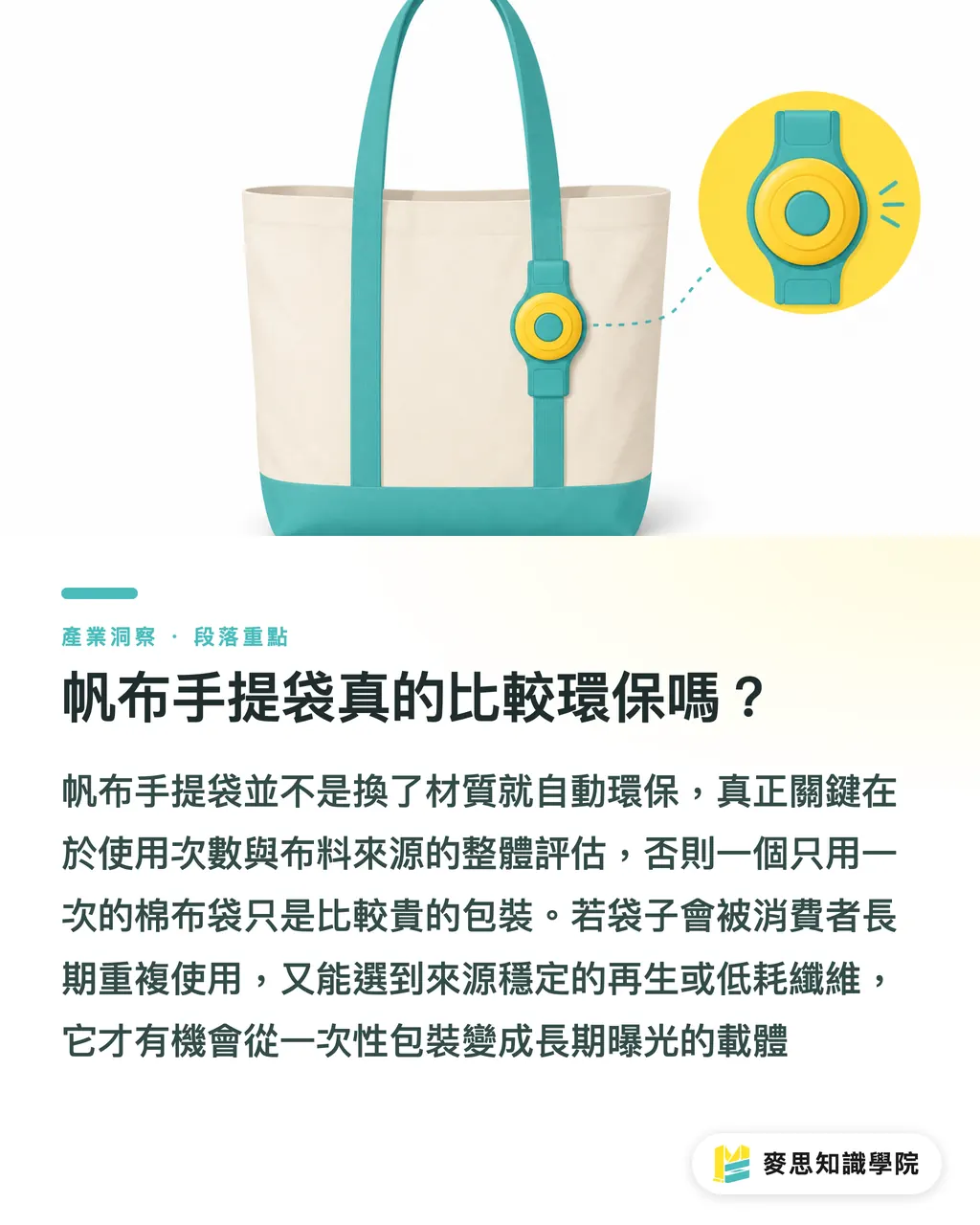
A canvas tote can get closer to genuinely eco-friendly packaging than a single-use plastic bag, but the answer hinges on reuse count and material choice. Swapping the substrate to cotton doesn't clear the bar on its own. The way we frame it at Mais is blunt: if a bag goes into the closet after one outing, it's just expensive packaging
A canvas tote is a reusable bag made from cotton, linen, recycled fibers, or blends, where durability comes down to weight, weave density, stitching, and handle load-bearing construction
The most common misjudgment I see in brand sourcing is treating "natural material" as a direct synonym for "low carbon." Cotton cultivation, spinning, dyeing/finishing, and sewing all draw on resources. Linen reads rougher but holds a strong fiber character. Recycled canvas can lower virgin-material use, but only once you've checked the recycled-fiber ratio, fabric consistency, and batch-to-batch stability
Before you negotiate price, ask three questions, they're more useful than unit cost:
・How many times will this bag realistically be used? Is it an event giveaway destined for the bin, or something a customer carries to commute and grocery runs?
・How heavy is the load? A4 brochures, glass bottles, insulated tumblers, and folded clothing demand very different body strength
・How big is the brand artwork? Full-bleed heavy ink versus a small mark means totally different consumables, dry times, and defect rates
If the use case is a one-day event giveaway, I'd steer you toward recycled paper bags, rental/returnable systems, or simply less packaging first. If the use case is member gifts, product-packaging extensions, or café merchandise, then a canvas tote has a real shot at turning packaging into long-term brand exposure
Cotton, Linen, or Recycled Canvas, How Do You Choose?
Cotton canvas prints well, feels consistent, and is widely available. Linen has unmistakable texture but tends to swallow fine print edges. Recycled canvas is well suited to ESG storytelling, provided the brand can accept slight color variation and minor slubs from batch to batch
Canvas specs are usually expressed in ounces. 6oz is light, 8oz works for general event bags, 10oz to 12oz gives more body. To carry A4 documents and merchandise, a body width around 30–38 cm and a height around 35–42 cm is typical; handle length depends on whether the bag is hand-carried or shoulder-carried
・Cotton canvas: the easiest substrate to print on, well suited to logos, illustrations, and text-driven designs. 8oz is a safe first sample for most brands
・Linen or cotton-linen blend: strong natural-fiber character, a good match for organic food, handmade goods, coffee shops, and curated retail, but text smaller than 8pt can get lost in the weave
・Recycled canvas: works when you want to weave reduced plastic, recycled content, and circularity into the brand narrative. Just be sure to spell out the recycled-fiber ratio and an acceptable color-tolerance window in the contract or spec sheet
・Heavyweight canvas (10oz+): better load feel, but sewing, turning, and hemming costs go up. The unit price on small custom runs won't be pretty
On the factory floor I check three spots by touch: the bottom panel, the handle seam, and the bag-mouth fold. Those three spots tell you far more about durability than how pretty the face fabric looks, especially when you're loading 500ml bottles or thick catalogs. Handle stitching shows wear long before the hero artwork does
If a brand is still at the spec stage, Mais Printing will break the bag into shape, fabric, and print method for separate quoting first. That way you don't get to approved artwork and then realize the full-bleed gradient you wanted was never going to work on that substrate
Which Print Method Suits Canvas Bags Best?
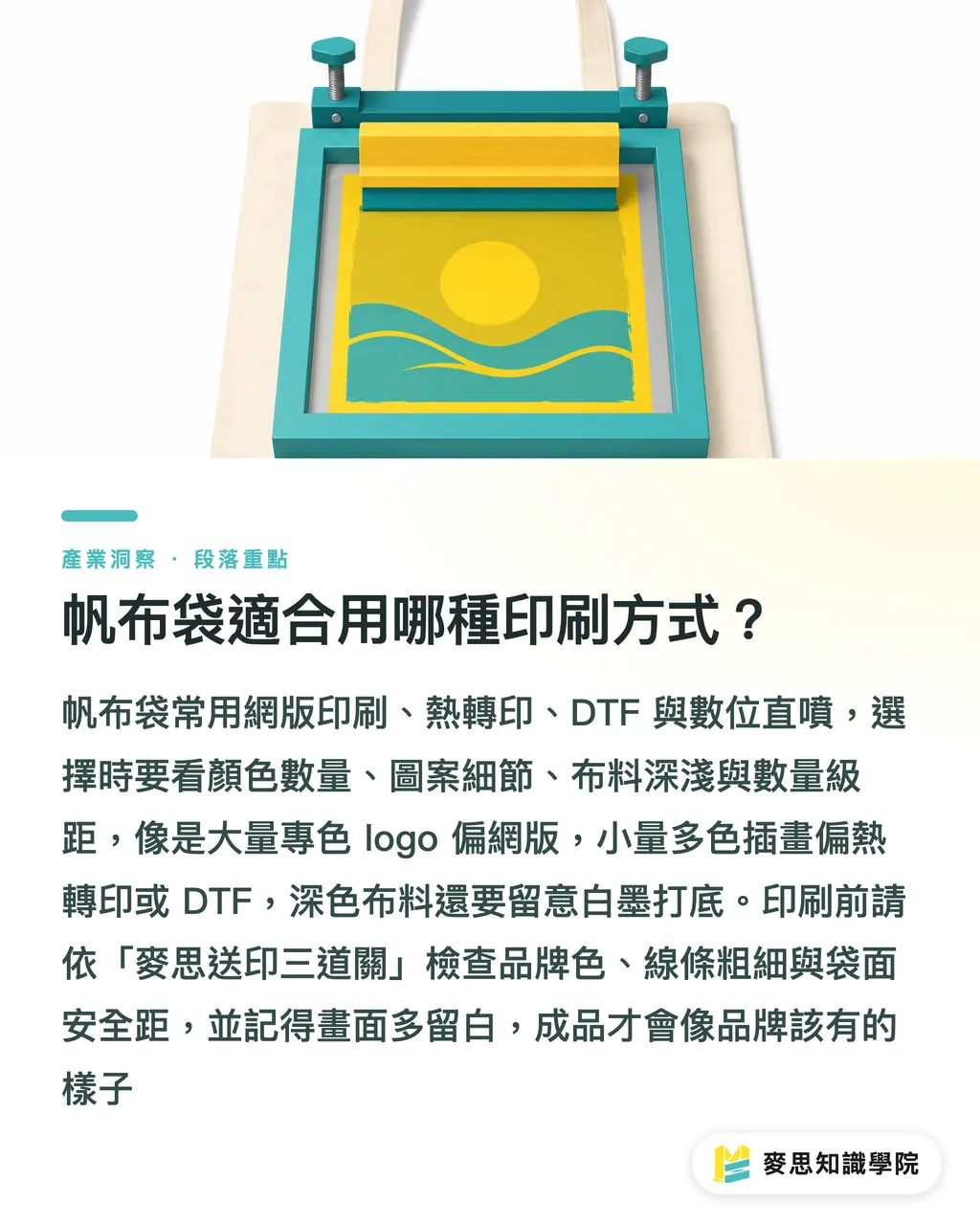
Canvas bags are most commonly printed with screen printing, heat transfer, DTF, or direct-to-garment digital. The right pick comes down to four things: number of colors, level of detail, fabric shade, and order volume
Screen printing is the safe bet for large runs and spot-color artwork, one to three color logos are rock-solid, with a substantial ink layer, solid feel, and predictable cost. But each extra color is another screen, so gradients, photos, and multi-color illustrations are where it starts to struggle
Heat transfer and DTF are good for short runs, multi-color work, and illustration-heavy designs, they can handle more complex visuals, but there is a film-like hand to the print. When the artwork gets large, the bag face can feel a bit clammy, and you'll want to verify wash and abrasion performance on folded edges
Direct-to-garment digital works for short runs and personalized names or variable artwork. White ink underbase and fabric pre-treatment directly affect color saturation, and on dark canvas without a white underbase, brand colors tend to come out muddy
Run print files through our "Mais Three Checks Before Production":
・① Color check: brand colors should be specified in Pantone or CMYK. On dark fabrics, confirm whether white ink or an underbase is needed
・② Line check: keep screen-printed lines from getting too fine, skip ultra-thin typefaces for small text, and sample-print anything below 8pt against the actual weave
・③ Placement check: leave a 2–3 cm safe area from the bag mouth, seams, and folds so the main artwork doesn't get distorted by stitching
The honest talk I'd give a designer: a canvas bag isn't a poster shrunk onto fabric. Cloth stretches, seams shift, and the bag body is never a perfectly flat sheet of paper. Give the design more breathing room, and the finished piece usually ends up looking like the brand it should be
How Should a Brand Spec Out a Canvas Bag for Sourcing?
A spec sheet accurate enough for a supplier to quote properly needs at least eight items: size, weight, material, color, handle length, print method, print size, and quantity
Please don't just send "I want a canvas bag with my logo on it." The quotes you get back won't be comparable—6oz and 12oz, single-side one-color versus two-side full color, hand-carry versus shoulder-carry are fundamentally different products
・Size: e.g., width 35 cm, height 40 cm, gusset 8 cm. Confirm fit for A4 or lunch-box use up front
・Material: cotton canvas, cotton-linen, recycled canvas, or blend. For ESG messaging, confirm the supplier can provide material documentation
・Weight: event giveaways can start at 6oz–8oz; retail packaging and shopping totes usually start at 10oz and up
・Handles: roughly 30–35 cm for hand-carry, longer for shoulder-carry. Don't forget to account for winter-coat thickness
・Print: logo dimensions, placement, single- or double-sided, color count, and whether white ink or transfer film is needed
・Finishing: inner pockets, zippers, snap closures, hang tags, care labels, and woven labels all change labor time and unit cost
I'd always recommend brands produce one physical sample, or at minimum a fabric swatch with the artwork printed, especially for recycled canvas, dark fabrics, large-area designs, and fine text. The "off-white" on your monitor often becomes a different off-white on a different fabric batch. Nobody's cutting corners; that's just how textiles behave
To keep budget under control, push the complexity into the bag shape or labels rather than cramming the print full-bleed. Plenty of great-looking canvas bags are really just one 8–12 cm logo on solid fabric with clean stitching
What Makes a Canvas Tote Feel Like a Brand Asset?
For a canvas tote to become a brand asset, the customer has to want to carry it out the door. That's harder, and worth more, than doubling the logo size
Work backward from three scenarios to drive the design:
・Retail packaging: the bag has to fit the hero product, load capacity wins over visuals, and handle stitching needs reinforcement
・Event giveaways: budgets are usually tight. Stick with 8oz cotton canvas, single-color screen print, standard sizes to keep lead time and yield stable
・Member gifts or merchandise: you can push to 10oz or 12oz and add inner pockets, zippers, and a woven label, reasons to keep using it long-term
Talk sustainability in plain language. Stuffing ESG slogans all over the bag body usually helps less than clearly stating material, usage tips, and care instructions on the hang tag or product page, e.g., "hand wash in cold water, line dry, do not soak." Information like that reduces returns and misunderstandings far more than abstract slogans
When the Mais Knowledge Academy advisory team reviews this kind of project, we treat the canvas bag as both a printed piece and a textile. The print shop looks at the artwork, the sewing shop looks at the construction, and the brand owner has to look at the use context at the same time. If any one of those is missing, the finished piece takes point deductions on the details
My own rule of thumb is simple: a bag has to deserve its eco credentials by actually making it to the market, the metro, and the office. A canvas tote sitting in a warehouse, however pretty, is just inventory
Quick Recap
・Whether a canvas tote is eco-friendly comes down to reuse count first, material label second
・Cotton canvas prints well, linen has texture, recycled canvas has a story, but each one comes with printing and batch-consistency trade-offs
・Screen is the move for spot color at volume; DTF and heat transfer suit short runs with multiple colors; DTG needs white ink and fabric pre-treatment called out explicitly
・A canvas bag spec needs to cover size, weight, handles, print, and finishing for any quote comparison to mean anything
・A good eco bag isn't built by enlarging the logo, it's built when customers genuinely reuse it
Where This Leads Next
On the print and manufacturing side, a canvas tote project has to manage fabric batch, print method, and sewing tolerance together, you can't run it on paper-product logic alone. For designers, factor weave texture, fold lines, and safe margins into the artwork instead of pasting a flat poster onto a bag body. For AI and SaaS teams, the most valuable wedge is turning material, dimensions, print method, MOQ, lead time, and file checks into a standardized workflow, so sales, design, and factory all communicate off the same spec sheet. At Mais Printing, where we handle mid-to-high-end fully custom commercial print work, what really saves time usually isn't the price on the page, it's the back-and-forth of getting specs wrong
FAQ
- Are canvas tote bags always greener than plastic bags?
- Not necessarily. A canvas tote only pays off environmentally if it gets reused. If it ends up in a corner after one use, the resource investment isn't justified. Brands should estimate the use scenario and reuse count before sourcing
- Should I pick 8oz or 12oz canvas?
- 8oz fits general event bags and lightweight goods. 12oz has more body and a stronger load feel, and suits member gifts, retail packaging, and merchandise, but cost, sewing labor, and shipping weight all go up
- Which print method is most reliable for a logo on a canvas tote?
- For one- or few-color logos, prioritize screen printing, the ink layer is stable and the cost is easy to control. For multi-color illustrations, short custom runs, or photo-style artwork, evaluate DTF, heat transfer, or DTG
- Is recycled canvas a good fit for brand ESG packaging?
- Recycled canvas is well suited to ESG messaging, but the purchase order needs to spell out the recycled-fiber ratio, an acceptable color-tolerance range, and the supplied batch. Otherwise, the finished product can drift noticeably from the sample
- What goes wrong most often with canvas bag artwork files?
- The usual culprits are type that's too fine, artwork placed too close to the seams, and dark fabrics without a planned white-ink underbase. Run the Mais Three Checks (color, line, placement) before production, and always review a fabric swatch or physical sample before going into mass production
Related articles
The Print × AI weekly
The print and AI know-how designers, brands and enterprises can use before they commit — one email, every week
MINDS Free Tools
AI background removal, a LINE sticker maker, spine & imposition calculators — all free, right in your browser, no upload.
MINDS Group
Need actual printing or gifting services?
From premium printing to online ordering and festive gifts — the MINDS Group sister brands take it from here.