

Overview
Send the same print file to three different printers, and you will often get quotes that differ by two or three times. This usually comes down to differences in equipment scale, plate-making logic, and how each shop calculates waste
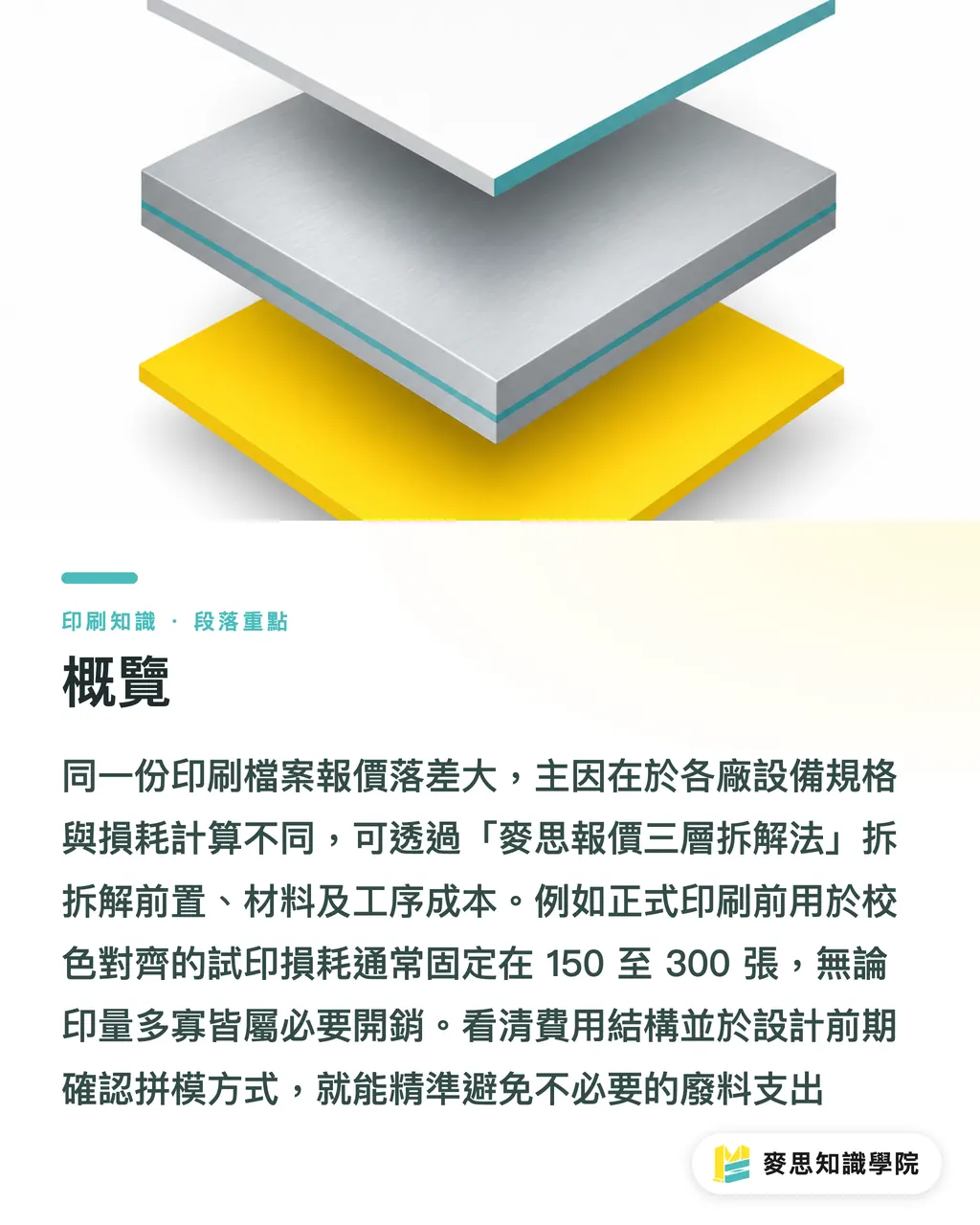
To figure out where the charges come from, you can analyze them with the 'MINDS Printing (MS, mid-to-high-end fully custom commercial printing) Three-Layer Cost Breakdown Method': ① Fixed Setup Layer (including CTP plate-making and die-cut tool fees), ② Variable Materials Layer (paper imposition cuts and ink), and ③ Processing Layer (make-ready waste and binding finishing)
Once you understand this three-layer cost structure, you can precisely cut unnecessary material waste when requesting quotes and setting up your layouts
Make-ready sheets: This refers to the test sheets that a press must consume before actual printing to calibrate color, align registration, and balance ink flow. The number is usually fixed between 150 and 300 sheets, and it gets factored into the cost no matter how small your print run is
If you are unsure about specs early in the design stage, reach out for a fully custom commercial print consultation with MINDS Printing to confirm layout gang-printing methods with prepress engineers before finalizing your files
Why Do Three Printers Give Quotes That Differ by Two to Three Times for the Same File?
In my over ten years on the press floor and handling print procurement, the biggest trap I see people fall into is looking only at the bottom-line total
For example, printing 1,000 copies of an A4 brochure (210x297mm), Printer A quotes 12,000 TWD while Printer B quotes 28,000 TWD. Printer B looks far more expensive
Break open the details and you find Printer A used combo-run printing on 100g coated paper, while Printer B set up a dedicated custom run using 150g imported Japanese fine paper with spot UV and steel die-cutting
The two are calculated on completely different baselines, from CTP (Computer to Plate) plate counts to color-proofing make-ready waste
Don't rush
Before comparing prices, you must first check whether a supplier is listing shared combo-run costs or dedicated machine costs for a custom run
How Are CTP Plate Fees and Make-Ready Sheets Calculated on a Quote?
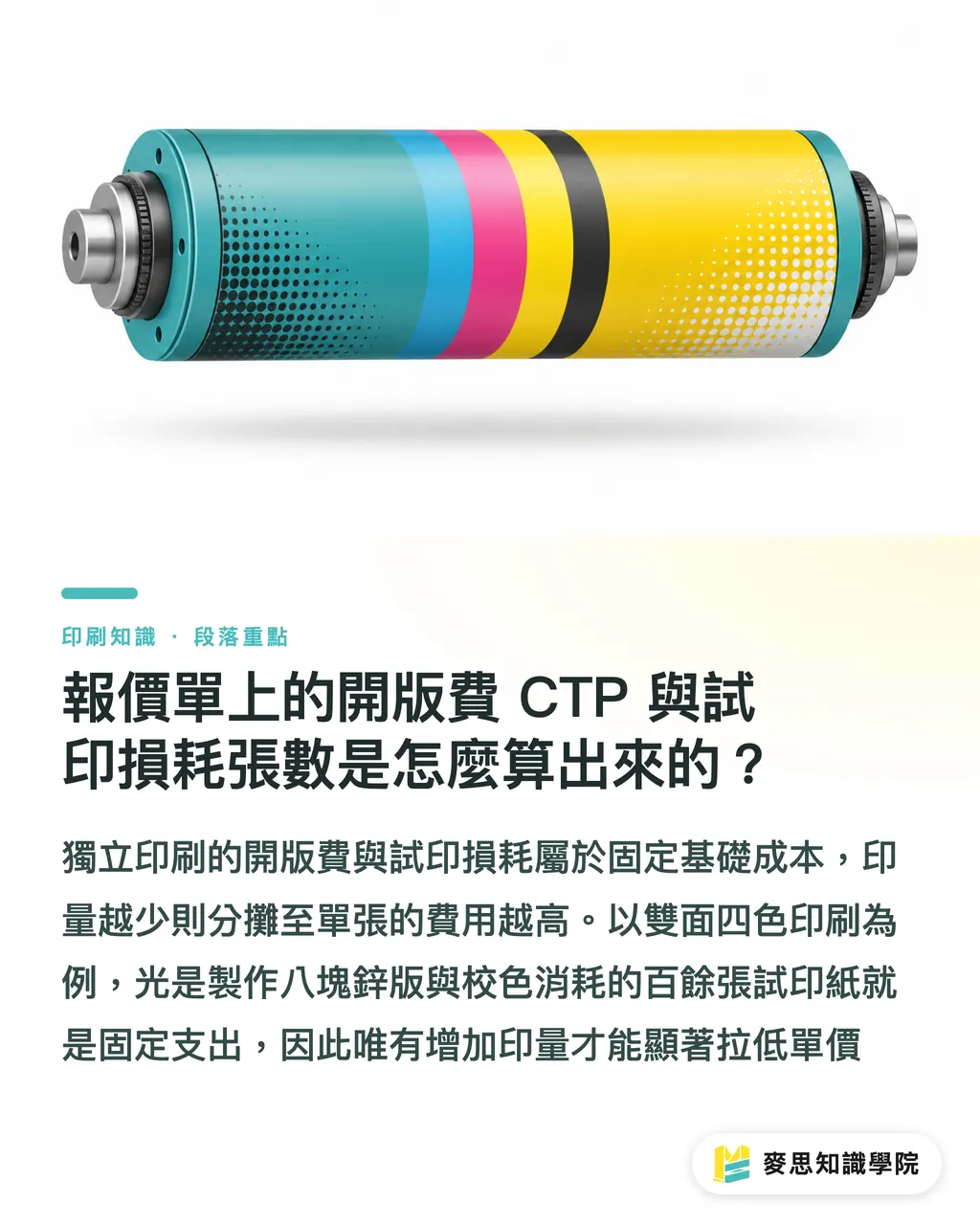
Base costs for dedicated printing are mainly set by plate-making fees and press make-ready waste
Four-color printing (CMYK) requires at least four CTP zinc plates. Double-sided printing takes eight plates, and adding spot colors (Pantone) increases plate fees accordingly
Traditional 4K CTP zinc plates run about 300 to 500 TWD per plate, while 2K plates fall between 600 and 800 TWD
On top of plate fees, the make-ready sheets used while running color checks on press are another fixed expense
Just running ink on a four-color 2K press to check color variations and registration accuracy burns through 150 to 200 sheets of paper
If your print order is only 500 sheets, those 200 waste sheets eat up 40% of your material cost. But if you expand the order to 10,000 sheets, the waste cost per sheet becomes tiny
Additionally, steel die tooling fees required for post-processing like foil stamping or die-cutting are one-time tooling costs charged on the first run, which naturally inflates the unit price for small orders
Choosing Between Kikuzen and 4K Paper Sizes: How Layout Imposition Sets Your Unit Price
Paper costs typically make up 30% to 50% of a print quote, and paper efficiency depends on how you plan your cuts
The two main parent paper sizes in Taiwan are Kikuzen (889x1194mm) and 4/6 Full Sheet (788x1091mm)
If your design dimensions ignore parent sheet cutting ratios, you end up creating massive edge waste
For instance, standard A4 size (210x297mm) fits 16-up (Kiku 16K) on a Kikuzen sheet, keeping paper waste under 5%
If a designer stretches the size to 230x310mm, a Kikuzen sheet can only fit 9-up, and paper efficiency drops straight below 65%
That means for the same paper money, one-third of your paper turns straight into scrap paper on the factory floor
Brands with high volume print needs across online and offline channels can use the online fast estimator at MINDS to enter different size cuts and instantly compare paper cost differences
How Designers and Buyers Can Adjust Dimensions to Maximize Paper Efficiency
The most direct way to cut print waste and unit costs is to align with the printer's imposition cuts right at the design source
Here are three quick-check strategies you can apply before sending files out:
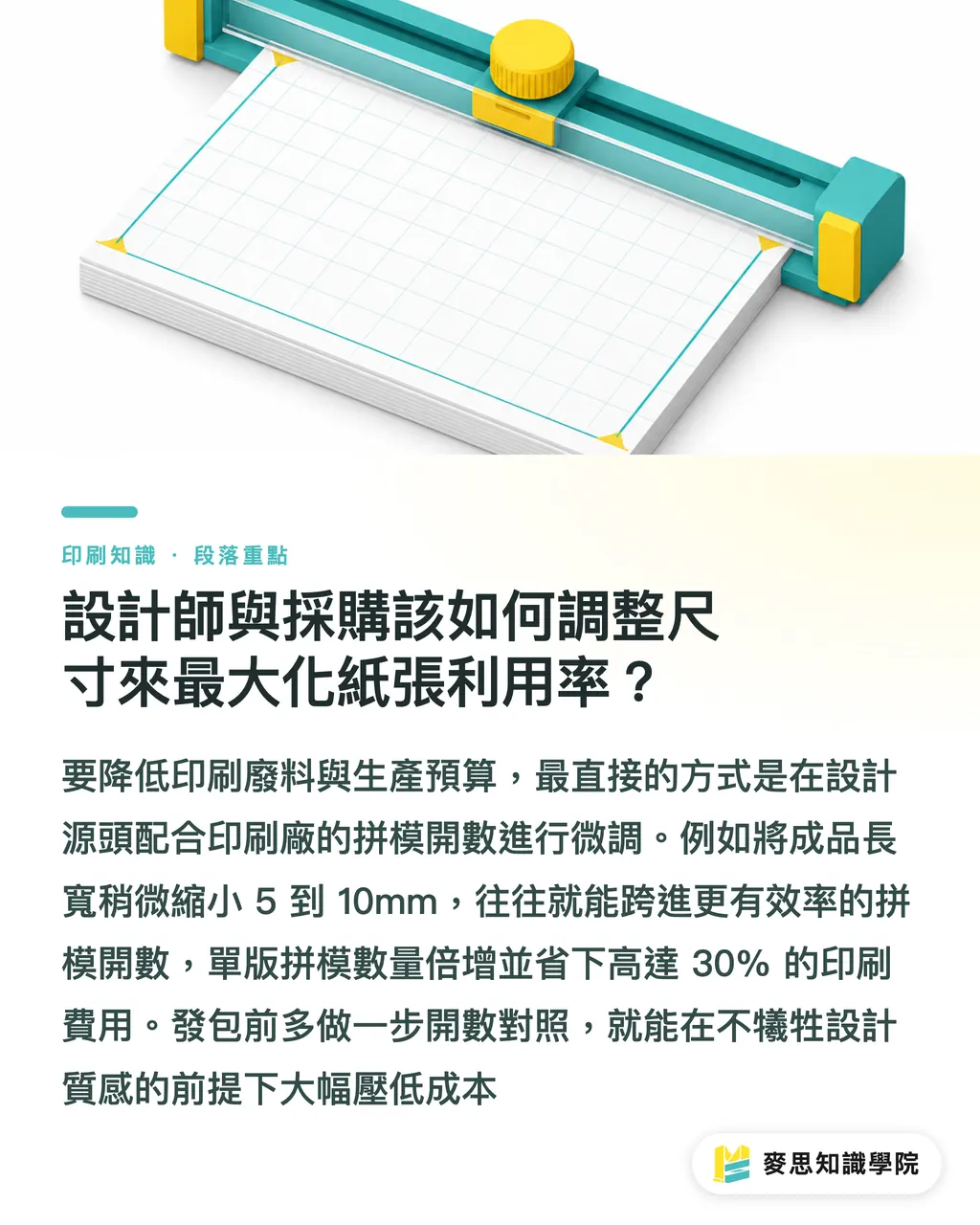
・Adjust finished dimensions: Trimming non-standard sizes by 5 to 10mm often lets you jump from 4K to 8K imposition, doubling the items per sheet and instantly cutting print costs by 30%
・Use bleed and shared cut lines wisely: Keep standard 3mm bleed during imposition, and design with shared cut lines at the gripper edge to trim cutting passes and edge waste
・Group jobs on the same plate: Combine flyers or business cards using the same paper stock and weight onto a single CTP plate to share make-ready waste and fixed plate costs
That is all it takes
Just take one extra step to check sheet cuts before sending files, and you can slash production budgets significantly without sacrificing design quality
Key Takeaways
・Gaps in total print price often stem from differences between custom runs and combo runs. Confirm machine type and specs baseline before placing orders
・CTP plate-making and make-ready waste are fixed setup costs. The larger your run, the lower the per-sheet cost
・Parent sheet sizes like Kikuzen and 4/6 set your imposition limits. Shifting design dimensions by just 5mm can boost paper usage efficiency dramatically
・Make good use of shared cut lines and grouping jobs of identical specs on one plate to cut material waste while preserving design quality
Further Considerations
Looking at print industry digitization and AI-assisted prepress trends, quote transparency and imposition efficiency will increase significantly in the future
For graphic designers and buyers, building prepress logic into the design process early has become a necessity
Building your own paper size specification library and confirming die line cuts and imposition with prepress technicians before final approval is the most practical first step for companies to cut costs and boost efficiency
FAQ
- Why is the unit price for small print runs so much more expensive than large print runs?
- CTP plate fees and machine make-ready sheets are fixed setup costs. When a print run is only a few hundred sheets, these fixed costs get spread across every finished piece, driving up the unit price sharply
- What is the main difference in quotes between combo-run printing and custom runs?
- Combo-run printing places files from multiple clients onto the same CTP plate to share plate-making and waste costs, keeping prices very cheap. A custom run gives a single client exclusive use of the entire plate and press, allowing custom paper and spot colors, but the client must cover all setup costs alone
- Can a size difference of just a few millimeters really affect print costs?
- Yes. Parent sheets like Kikuzen (889x1194mm) have fixed cut yields. If your finished size exceeds imposition boundaries by even a few millimeters, your yield per sheet could drop from 16-up down to 9-up, sharply reducing paper efficiency and adding waste cost
- Is the die fee on a quote a one-time charge or billed every time you print?
- Steel die tooling fees are usually a one-time charge. As long as dimensions and structures remain unchanged for re-runs, most printers will hold the die tool for clients so you don't have to pay for the tool again on future orders
Related articles



The Print × AI weekly
The print and AI know-how designers, brands and enterprises can use before they commit — one email, every week
MINDS Free Tools
Spine width and imposition calculators — skip the manual math, free in your browser.
MINDS Group
Need actual printing or gifting services?
From premium printing to online ordering and festive gifts — the MINDS Group sister brands take it from here.