
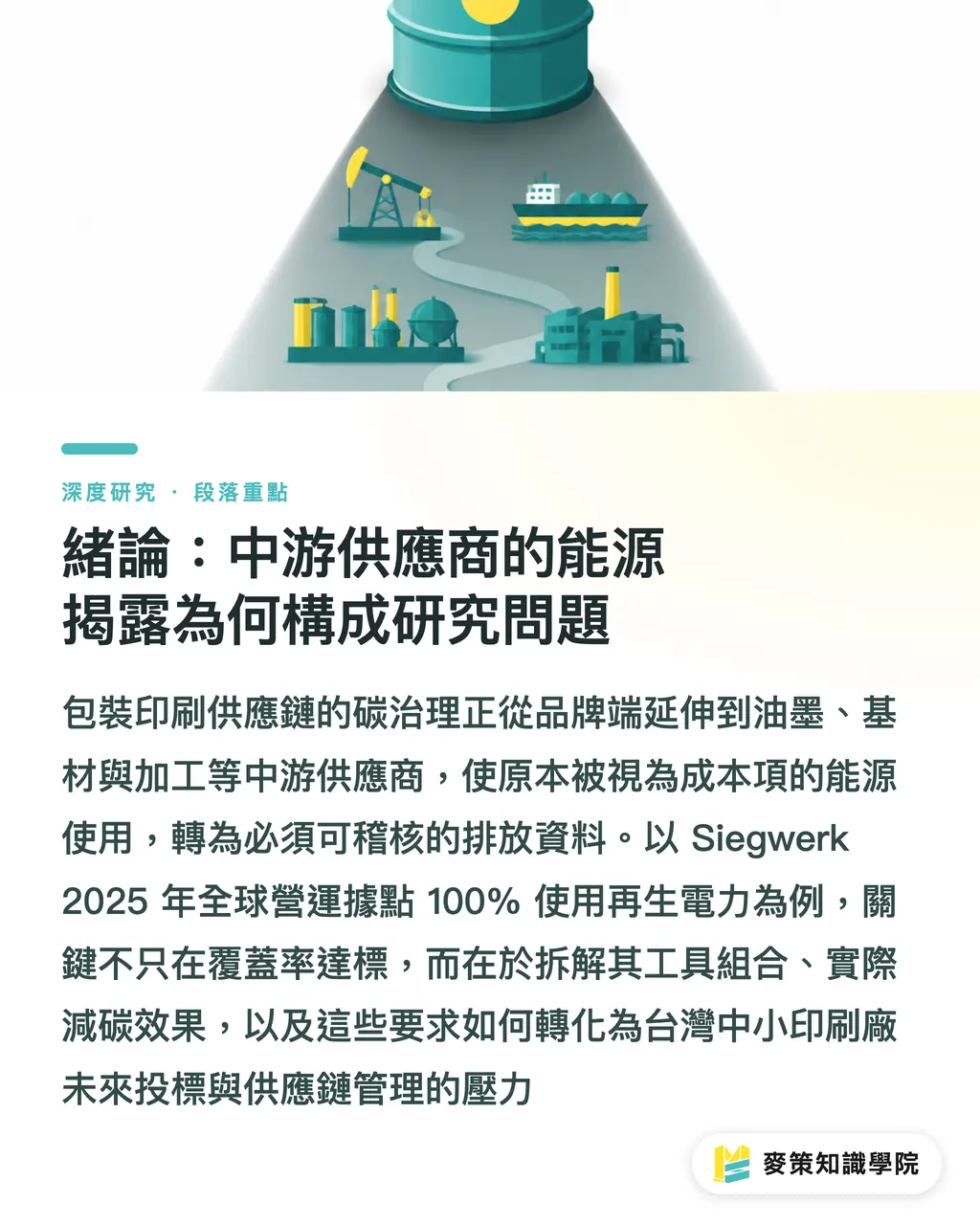
Introduction: Why Midstream Supplier Energy Disclosure Matters as a Research Problem
The center of carbon governance in packaging and printing supply chains is shifting down from brand owners to midstream material suppliers and converters. The direct consequence of this shift is that steps traditionally treated as pure cost centers, like inks, substrates, and print finishing, now have to supply auditable energy and emissions data. A case released in August 2026 shows ink manufacturer Siegwerk confirmed its global operational sites were powered by 100% renewable electricity in 2025, sustaining this coverage level for the third year in a row [1]
This issue holds both industrial and academic weight. On the industry side, an ink supplier's Scope 2 performance cascades down the supply chain. When print shops buy ink, the upstream power mix directly feeds into the printer's Scope 3 footprint. On the academic side, existing sustainability management literature mostly fixates on brand-level strategic narratives and procurement scoring scorecards, lacking mechanism-level breakdowns of how midstream manufacturers assemble their renewable electricity pathways
This study identifies three research gaps:
・First, existing literature lacks a clear distinction between renewable electricity coverage and absolute emissions reduction, leading many to misread 100% coverage as mission accomplished on decarbonization
・Second, the toolkit used to hit 100% coverage (on-site solar, green power tariffs, renewable energy providers, and unbundled certificates) differs in decarbonization substance, yet few case studies analyze this mix structure
・Third, for small and medium print shops in Taiwan, there is still no systematic discussion on how the energy transition of global suppliers translates into concrete bidding requirements
This paper outlines three main contributions, each corresponding to a section below:
・Unpacking the toolkit and timeline of the Siegwerk case, clarifying how coverage metrics and absolute reduction targets divide labor (corresponding to the 'Toolkit Mix and Division of Metrics' section)
・Synthesizing brand sustainability strategies and procurement scoring models in existing literature to pinpoint the research gap at the midstream supplier tier (corresponding to the 'Literature and Current State Review' section)
・Translating these mechanisms into actionable steps, complete with workflows and timelines, for Taiwan's small and medium printers, designers, and brand owners (corresponding to the 'Implications for Taiwan's Design and Printing Industry' section)
Literature and Current State Review: Three Strands and One Gap
Existing discussions fall into three clusters. Each touches on this topic from a different angle, but none directly addresses the energy governance mechanisms of midstream ink suppliers
Cluster 1: Organizational analysis of brand-level sustainability strategies. This body of literature focuses on major consumer goods companies, examining how sustainability pledges get embedded into corporate strategy and operations, such as case studies on Unilever's sustainability strategy [3]. These studies excel at revealing the internal drivers and governance behind brand-level climate targets, but their unit of analysis stops at the brand itself. Upstream supply chain execution is mostly treated as an external given. This paper differs by shifting the unit of analysis down to the supplier, examining what energy tools upstream suppliers must assemble to respond when brand commitments hit the ground
Cluster 2: Green procurement and supplier scoring models. This research focuses on how buyers use standardized tools to screen suppliers, such as studies evaluating green procurement in infrastructure projects via the EcoVadis framework [5]. The value here lies in highlighting how sustainability performance turns into comparable scores that influence purchasing decisions. The limitation is that scoring models are demand-side screening tools, they do not explain how suppliers actually achieve those evaluated results. This paper bridges that gap by breaking down implementation pathways from the perspective of the evaluated supplier
Cluster 3: Industry literature on ink technology and processes. Past publications on Siegwerk mostly focus on production technology and regional operations, such as the rollout of volume production for waterless web offset [2] and reports on the company's South African subsidiary [4]. This literature confirms Siegwerk's long-term investments in ink tech, but these studies date back to 2008 and 2009, centering on technology and markets rather than energy structure. This paper pivots from process technology to energy procurement structures, filling in the company's recent governance developments
The collective gap left by these three literature strands is clear: there is no mechanism-level breakdown of how midstream suppliers structure their 100% renewable electricity mix and the substantive differences in carbon reduction across these tools. This paper addresses this gap through the Siegwerk case
Definition of Terms
To maintain consistency throughout this paper, three key terms are defined below and used uniformly
・Scope 2 emissions: Indirect greenhouse gas emissions generated from an organization's purchased electricity, steam, heating, and cooling. Electricity used for printing presses, drying, and climate control in print shops falls under this category
・Renewable electricity coverage: The share of an organization's annual power consumption matched by renewable energy attribute claims. A 100% coverage rate means all electricity consumption is matched on paper with renewable attributes, but it does not mean every kilowatt-hour entering from the physical grid comes from renewable sources
・Unbundled energy attribute certificates: Renewable energy attribute certificates traded independently of physical power delivery. Their real-world decarbonization impact remains controversial in both research and practice, as they do not necessarily trigger newly added renewable generation capacity
Toolkit Mix and Division of Metrics: Unpacking the Four Approaches
The core value of the Siegwerk case lies in showing that 100% renewable electricity coverage comes from assembling several distinct tools, rather than relying on a single method. This section breaks down the toolkit mix first, then analyzes how coverage and absolute reduction targets divide labor
A four-track toolkit mix. According to primary sources, Siegwerk launched its renewable power transition in 2021, achieved 100% renewable electricity coverage globally for the first time in 2023, and maintained it through 2025 for three consecutive years [1]. Its implementation combines four tracks: on-site solar installations, renewable energy tariffs, power purchased from renewable energy providers, and unbundled energy attribute certificates [1]
These four tools present a clear hierarchy in actual decarbonization impact, based on this paper's analysis. On-site solar directly adds new renewable capacity, making a tangible change to the power grid. Renewable tariffs and supplier contracts come next, depending on whether the contracts support newly built capacity. Unbundled certificates have the weakest real-world impact because they can be completely decoupled from physical consumption locations and timeframes. Given the two-year timeline from kickoff in 2021 to completion in 2023, building on-site assets alone across multinational operations could not have hit that deadline so quickly. It is reasonable to deduce that certificates and tariff options carried heavy weight in establishing initial coverage. This represents an analytical deduction based on timeline constraints, as primary sources did not disclose the breakdown across tools
Hitting coverage targets still leaves absolute reductions to solve. Siegwerk set a goal to cut Scope 1 and Scope 2 emissions by 60% by 2030 against a 2020 baseline while maintaining 100% renewable electricity coverage every year [1]. Pairing these two metrics holds institutional significance. A 60% absolute cut is a volume commitment, while 100% coverage is an attribute commitment. You cannot hit the former purely through the latter
Siegwerk's Chief Sustainability Officer, Alina Marm, stated clearly that meeting these targets requires driving energy efficiency, operational improvements, and behavioral initiatives beyond renewable electricity coverage [1]. The analytical takeaway here is an acknowledgment that coverage tools have hit their ceiling. Once paper coverage reaches 100%, any further Scope 2 reductions must come from using less actual power, not buying more attributes
Institutional design: Dedicated funds and annual reaffirmations. Siegwerk established a dedicated green fund to accelerate sustainability and emissions reduction projects across its global sites, including energy efficiency and renewable energy investments [1]. Setting up a dedicated fund pulls decarbonization out of annual budget battles, lowering the risk of budget cuts during economic downturns, based on this paper's interpretation
Another key detail is phrasing it as 'three consecutive years' [1]. Defining coverage as an annual reaffirmation rather than a one-off achievement reflects the annual scoring cycle of disclosure frameworks like CDP and EcoVadis. Hitting the mark for a single year does not translate into lasting procurement competitiveness
Transmission Mechanisms: How Supplier Scope 2 Becomes Table Stakes for Print Shops
This section analyzes how upstream supplier energy performance cascades down the supply chain into real barriers for print operations. The arguments here represent this paper's analysis, built upon the factual foundation provided by primary sources
First, the shift in scope categorization. An ink supplier's Scope 2 emissions become Scope 3 purchased goods and services in a print shop's carbon inventory. Meanwhile, the print shop's Scope 2 emissions become Scope 3 for brand clients. This cascading structure means carbon cuts at any stage improve the numbers for downstream players, while data gaps at any stage create disclosure roadblocks down the line
Next, the standardization of procurement tools. Green procurement literature points out that supplier sustainability performance enters buying decisions through standardized scoring models [5]. When scorecards become table stakes rather than bonus points, the differentiator is no longer whether a supplier cares about sustainability, but whether they can submit formatted data on time. This analysis argues that the pressure on small and medium converters is fundamentally administrative and data-driven, not a capital investment squeeze
Finally, asymmetric risk distribution. Brand-level sustainability pledges are highly public [3], and hitting or missing them directly impacts corporate reputation. By contrast, midstream converters that fail to provide data face lost orders rather than public relations fallout. This asymmetry gives brands a strong incentive to push disclosure obligations onto suppliers, leaving suppliers with little bargaining power
A comparative observation. As a multinational ink group, Siegwerk has the resources to set up dedicated funds and procure green power across borders [1]. Most print shops in Taiwan are small and medium enterprises, lacking cross-border power purchasing capabilities and dedicated sustainability staff. Their rational strategies naturally diverge: the former can pursue attribute procurement first and follow up with physical improvements. If local print shops blindly copy unbundled certificate purchases, they will incur costs without earning equivalent bidding advantages, because scoring models give limited credit to certificate-only claims without real reduction numbers
Implications for Taiwan's Design and Printing Industry
This section translates these mechanisms into actionable steps for three stakeholder groups, focusing on separating what is urgent from what can wait
For small and medium print shops: Build your data baseline first before evaluating green power procurement
・Phase 1 (Months 1 to 3, labor cost only): Build a monthly power consumption baseline. Use utility bills as source data to separate facility power (air conditioning, lighting) from production power (printing presses, dryers, finishing), accumulating at least 12 months of data. This step requires zero equipment investment, but serves as the prerequisite for all future reporting
・Phase 2 (Months 3 to 6): Request sustainability documentation or carbon footprint declarations from primary ink and paper suppliers. If a supplier has already achieved 100% renewable electricity coverage [1], that data directly improves your shop's Scope 3 figures, delivering an improvement on paper at zero cost
・Phase 3 (Months 6 to 12): Evaluate the cost-benefit ratio of rooftop solar or green power purchasing based on your actual baseline. Do not reverse this order. Buying green power without a baseline makes it impossible to prove reduction progress on client questionnaires
・Prepress and production workflow integration: Add a 'sustainability documentation archive' checkpoint to existing prepress checks alongside bleed dimensions, color profiles, and font outlining, archiving supplier sustainability file versions and dates with each job. The cost is near zero, yet it compresses response times from weeks to days when clients request sudden audits
For designers: Specification choices directly impact print energy consumption
Decisions made during design regarding color count, spot colors, coating, and foil stamping directly dictate press power consumption and plate changeovers. Designers do not need to calculate carbon coefficients, but they should build an instinct: every decorative choice that adds a press pass should tie back to clear functional or brand value. When brand clients have sustainability disclosure requirements, confirming simplified print alternatives early preserves design integrity far better than making rushed edits after final artwork handoff
For brand owners: Look beyond contract clauses to evaluate a supplier's actual data capabilities
If brand sustainability commitments are merely pushed down via contract clauses [3] without assessing supplier data capabilities, the result is formal compliance paperwork rather than genuine carbon reductions. Brands should evaluate suppliers across two dimensions: current performance levels, and their ability and timeline to deliver auditable data. The latter is far more revealing for smaller suppliers and better reflects long-term partnership viability
Conclusions and Limitations
Addressing the research questions. Using the Siegwerk case to examine how midstream suppliers achieve 100% renewable electricity coverage, this paper draws three conclusions
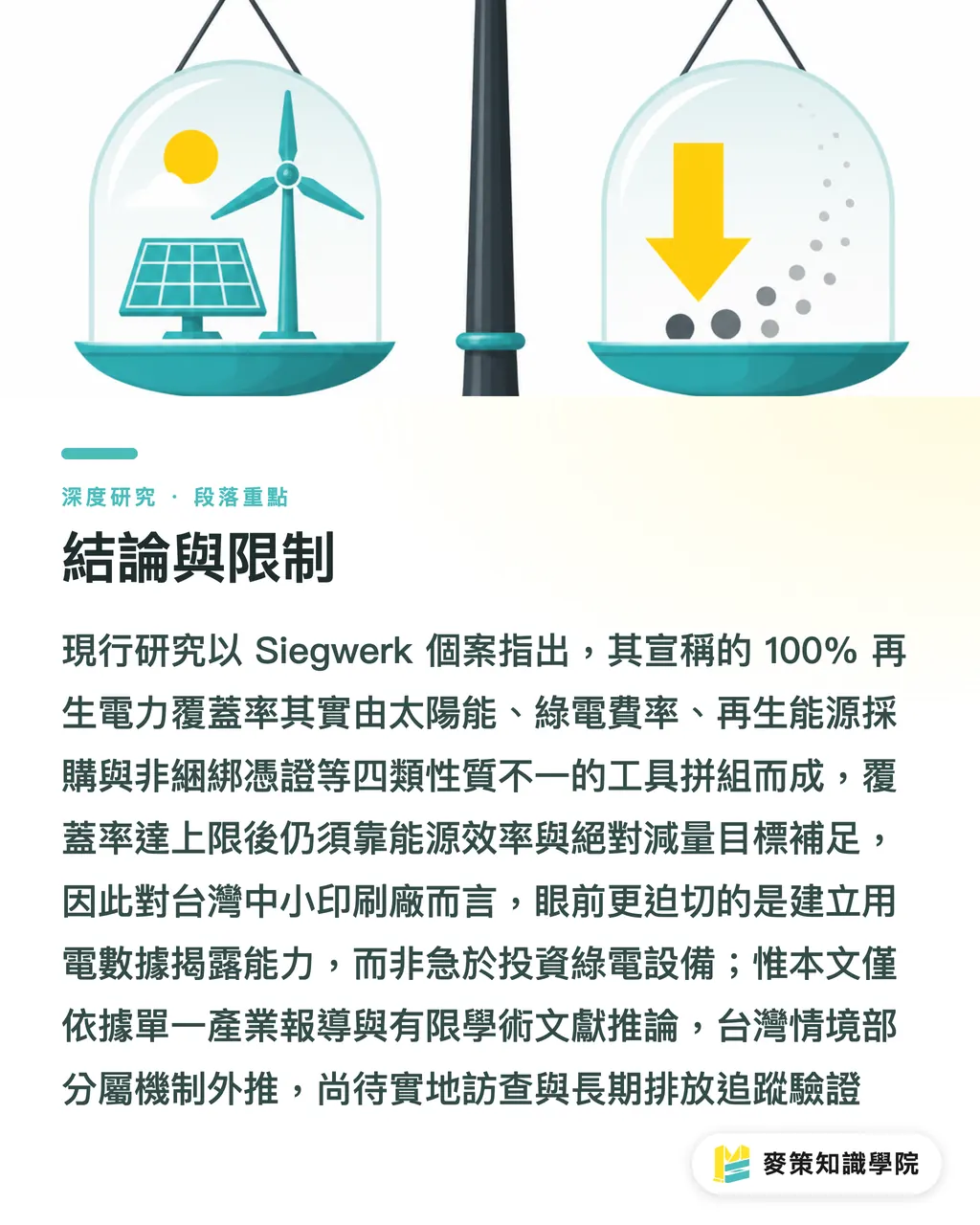
First, 100% renewable electricity coverage is assembled from four distinct tools: on-site solar, renewable power tariffs, renewable energy provider contracts, and unbundled energy attribute certificates [1]. These tools vary in real decarbonization impact, meaning a single coverage percentage should not be taken as a complete measure of climate performance
Second, coverage metrics and absolute reduction targets divide labor. Siegwerk's twin commitments to cut Scope 1 and Scope 2 emissions by 60% by 2030 from a 2020 baseline and maintain 100% annual coverage [1] show that once coverage hits 100%, ongoing reductions must come from energy efficiency and operational gains [1]
Third, for Taiwan's small and medium print shops, this trend creates immediate pressure on data reporting rather than capital equipment. The logical priority is establishing an electricity baseline before evaluating green power procurement
Limitation 1: Reliance on a single primary trade report without third-party verification. Factual descriptions of Siegwerk in this paper rely on a single industry media report [1]. The report does not disclose the proportion of each tool within the total coverage, the certificate vintage or market of origin, nor third-party audited emissions data. As a result, this paper cannot evaluate the exact balance between physical reductions and attribute purchases within that 100% figure. Inferences regarding tool weightings are analytical judgments based on project timelines rather than empirical findings
Limitation 2: Skewed literature coverage and uneven time horizons. Academic literature citing Siegwerk is concentrated between 2008 and 2009, focusing on process technology and regional operations [2][4]. This leaves an approximate fifteen-year gap leading up to 2025 energy topics, making it impossible to trace the full evolution of the company's sustainability governance. Literature on brands and procurement [3][5] draws from consumer goods and infrastructure, meaning conclusions must be applied to printing with care
Limitation 3: Extrapolated mechanisms without empirical testing in Taiwan. Recommendations for Taiwan's print shops are derived from supply chain transmission theory rather than field surveys of local printers. Timeline and cost estimates reflect practical industry assessments rather than measured figures
Future research directions. Three specific paths emerge:
・First, survey or interview Taiwan's small and medium print shops to measure how often they receive customer questionnaires, the question types, and response costs, testing the proposition that data pressure outweighs capital pressure
・Second, compare supplier scores across standardized evaluation models [5] for different renewable power toolkits to quantify the procurement value of each option
・Third, track Siegwerk's annual emissions toward its 2030 targets to examine where absolute reductions actually originate once 100% coverage is in place
Key Takeaways
・Siegwerk maintained 100% renewable electricity coverage across its global operations for the third consecutive year in 2025 by running four parallel tracks: on-site solar, green tariffs, renewable energy providers, and unbundled energy attribute certificates
・A 100% renewable electricity coverage rate is an attribute commitment, while cutting Scope 1 and Scope 2 emissions by 60% by 2030 is an absolute commitment. The latter cannot be achieved through the former alone
・An upstream supplier's Scope 2 performance directly feeds into a downstream printer's Scope 3 numbers, making supplier sustainability documentation a zero-cost improvement on paper
・For Taiwan's small and medium print shops, the immediate pressure is data disclosure rather than capital spending. The logical path is building a 12-month power consumption baseline first, then evaluating green power procurement
・Design choices regarding color count, coating, and foil stamping are energy consumption decisions. Alternatives that cut press passes should be evaluated before final artwork handoff, not after
Further Thoughts
For print manufacturing, this case highlights annual reaffirmation as an institutional norm. Sustainability performance is shifting from a one-off project into an annual deliverable, requiring printers to build repeatable data workflows rather than relying on one-time consultant reports. For designers, carbon considerations are pulling production decisions forward into the design phase, giving technical specification instincts fresh value. For AI integration and SaaS development, a clear product gap exists: small and medium printers lack tools to automatically compile utility bills, production work orders, and supplier files into client-ready reporting formats, an ideal use case for structured data extraction and form generation. Two open questions remain. First, weightings for different renewable power tools in mainstream scoring models lack transparency, making cost-optimal investments difficult for suppliers. Second, empirical data on the actual reporting burden facing Taiwan's small and medium printers is missing, leaving policy and tooling design without a solid baseline
References
[2] Siegwerk starts volume production for waterless web offset. Pigment & Resin Technology. DOI: 10.1108/prt.2008.12937eab.020
[3] Sustainability at Unilever. Cases in Strategy. DOI: 10.1093/hebz/9780198943402.003.0009
[4] Ink, Heart & Soul from Siegwerk South Africa. Pigment & Resin Technology. DOI: 10.1108/prt.2009.12938dab.015
[5] Green Procurement and Sustainability in Infrastructure Projects: Employing the EcoVadis Model. Journal of Procurement & Supply Chain. DOI: 10.53819/81018102t2539
FAQ
- How did Siegwerk achieve 100% renewable electricity?
- Siegwerk launched its transition in 2021, reached 100% renewable electricity coverage globally in 2023, and sustained it through 2025. Its strategy combined four tracks: on-site solar installations, renewable energy tariffs, contracts with renewable power suppliers, and unbundled energy attribute certificates. The company has not published the specific breakdown across these tools
- Does 100% renewable electricity coverage mean zero emissions?
- No. Renewable electricity coverage only addresses purchased electricity under Scope 2, excluding direct fuel emissions in Scope 1 and supply chain emissions in Scope 3. Siegwerk's separate absolute target to cut Scope 1 and Scope 2 emissions by 60% by 2030 against a 2020 baseline shows that hitting coverage goals still requires ongoing cuts through energy efficiency and operational improvements
- What should Taiwan's small and medium print shops do first?
- Start by building a 12-month electricity consumption baseline, using utility bills to separate facility power from production equipment. This step requires no capital investment, yet serves as the foundation for customer reporting. Next, request sustainability data from ink and paper suppliers to improve your Scope 3 calculations directly. Rooftop solar or green power purchasing should only be evaluated after this baseline is set
- Why does an ink supplier's green power performance affect a print shop's ability to win orders?
- An ink supplier's Scope 2 emissions are categorized as Scope 3 purchased goods and services in a print shop's carbon inventory, and the printer's data feeds directly into the brand client's Scope 3 total. Global brands use standardized supplier scoring models to push disclosure requirements down through the tiers. If a print shop cannot supply this data, the immediate risk is lost orders rather than brand damage
- What is the difference between unbundled energy attribute certificates and on-site solar?
- On-site solar adds new generation capacity directly, making a tangible change to the power grid. Unbundled energy attribute certificates are traded separately from physical electricity and can be decoupled from where and when power is consumed, offering weaker real-world climate impact. While both count equally toward paper coverage rates, they are treated differently in most procurement scoring frameworks and carbon impact assessments
Related articles



The Print × AI weekly
The print and AI know-how designers, brands and enterprises can use before they commit — one email, every week
MINDS Free Tools
AI background removal, a LINE sticker maker, spine & imposition calculators — all free, right in your browser, no upload.
MINDS Group
Need actual printing or gifting services?
From premium printing to online ordering and festive gifts — the MINDS Group sister brands take it from here.