
Introduction: Why a Single Plant Closure Warrants Industry Research
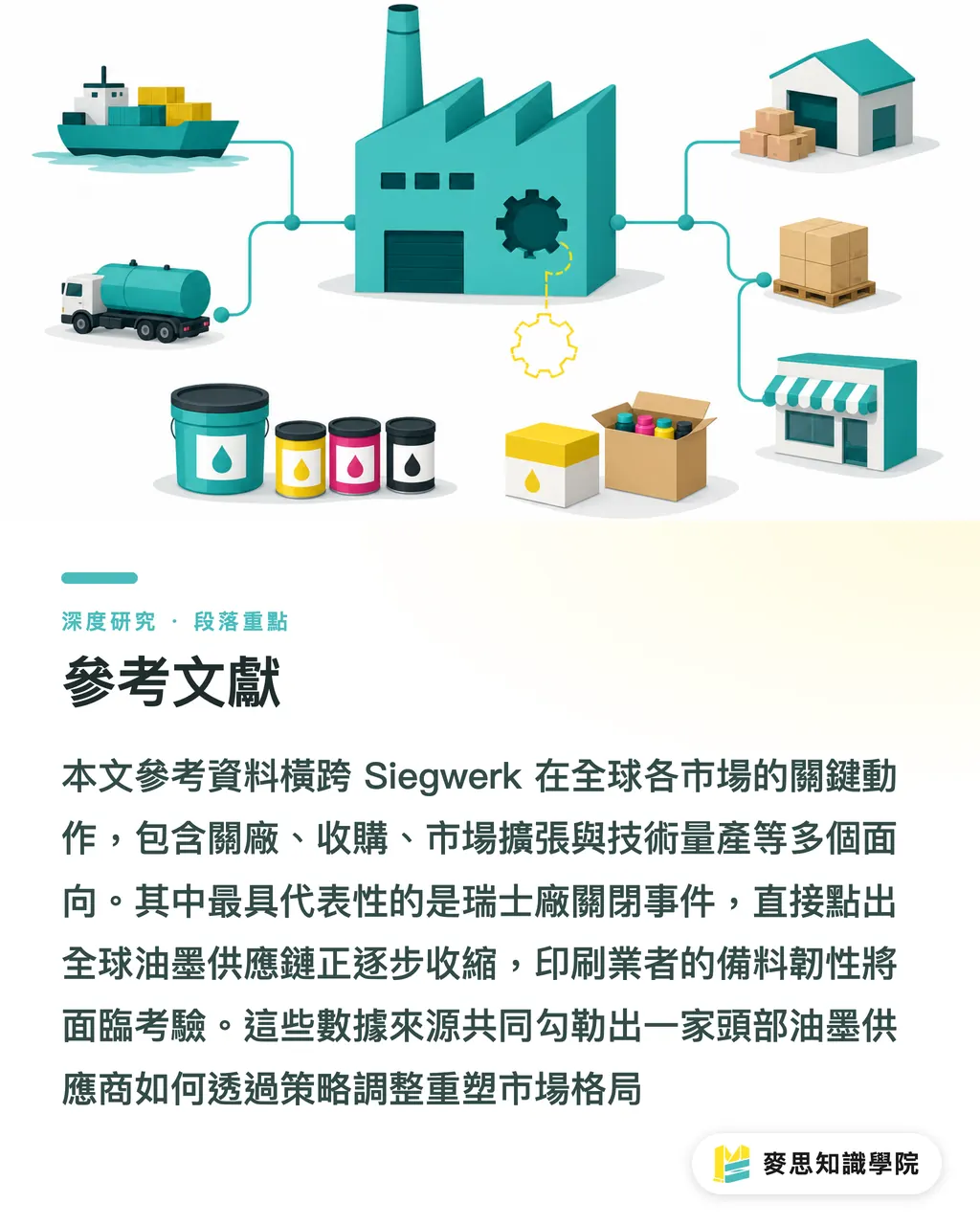
Ink represents a low share of total printing process value yet offers extremely limited substitutability as a critical input. When Siegwerk, one of the world's leading printing ink manufacturers, announced the closure of its Swiss Bargen production facility and the consolidation of capacity into Tuzla, Turkey, this seemingly localized capacity adjustment touched on a more fundamental question: the geographic center of gravity of the global ink supply chain is shifting, and whether downstream printers have adequate awareness of this risk [1]
This article addresses three core questions:
・First, where does this closure sit within the evolution of Siegwerk's own global footprint, is it an ad hoc decision or the continuation of a long-term trend?
・Second, how do the structural pressures facing European ink manufacturing transmit through capacity transfers to downstream procurement?
・Third, for Taiwan's printing and packaging operators who primarily import European specialty inks, such as food-safety-grade and solvent-free UV systems, what are the practical implications for lead times, pricing, and quality consistency, and what actionable responses are available?
This question has real-world importance for Taiwan's industry. Taiwan's printing and flexible packaging sector is highly dependent on imported specialty inks for high-end applications, and such inks are characterized by high supplier concentration, stringent certification barriers, and significant switching costs. When upstream capacity is reallocated, downstream operators are typically the last to know yet the first to bear the brunt of delivery volatility. This article's contribution lies in placing a single industry news item within the long-term documentary context of the enterprise and translating a macro-level supply chain shift into an actionable inventory decision framework for downstream operators
Literature and Current Situation Review: A Two-Decade Trajectory from Expansion to Consolidation
This section first reviews Siegwerk's publicly documented development over the past two decades, then narrows its focus to the gaps in existing discussion that this closure has exposed
From existing literature, Siegwerk displayed a clear global expansion curve during the first decade of the twenty-first century. In 2004, the group acquired Color Converting Industries, strengthening its position in specific ink categories and regional markets [6]. Around 2008, the group moved rapidly: it secured a major foothold in India, entering a fast-growing emerging market [2]; at the same time, its CEO Herbert Forker was elected Chairman of the European Printing Ink Association (EuPIA), underscoring the company's weight within European industry governance [3]. On the technology front, the group launched volume production of waterless web offset inks in 2008, reflecting its commitment to process innovation [4]. In 2009, operations in South Africa were also reported, continuing its narrative of penetration into Africa and emerging regions [5]
Grouping these fragments by theme reveals two parallel threads. The first is geographic market expansion: emerging markets such as India [2] and South Africa [5] were clearly identified growth targets at the time. The second is the accumulation of technical and industry standing: volume production of waterless web offset [4] and the EuPIA leadership role [3] jointly underpinned its technical legitimacy in core European markets. Notably, these two threads were not in conflict at the time, Europe remained the center of technology and governance, while emerging markets served as the source of incremental growth
However, this closure reveals that tension has emerged between the two threads. According to firsthand reporting, the reasons Siegwerk cited for closing its Bargen, Switzerland plant include: high production costs in Switzerland, erosion of competitiveness by the strong Swiss franc, and declining demand in certain printing ink markets [1]. The group is consolidating production in Tuzla and explicitly states that its primary growth momentum comes from Eastern Europe, the Middle East, and Africa, which can be served most cost-effectively from Tuzla [1]. In other words, the emerging markets that once served as 'sources of incremental growth' [2][5] are now progressively becoming the 'center of gravity' for capacity allocation, while high-cost European sites are retreating from the core to become candidates for closure
This is precisely where the gap in existing public discussion lies. Existing literature largely documents Siegwerk's expansion and technical achievements [2][3][4][5][6], with little analysis linking recent consolidation moves to downstream procurement risk. This article argues that the plant closure news itself only provides the upstream decision outcome and does not explain the supply implications for specific downstream regions such as Taiwan, and that is the analytical space this article aims to fill
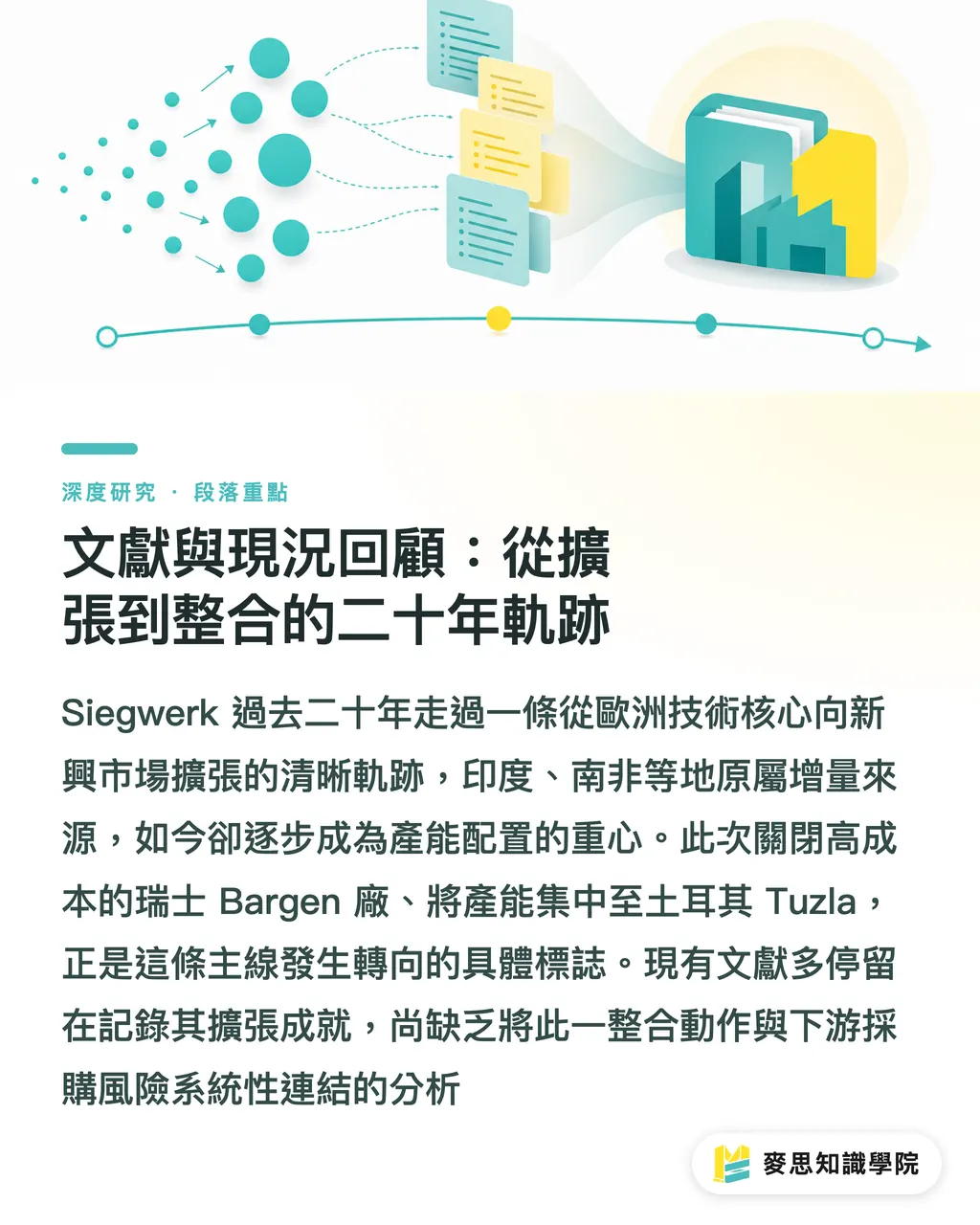
Core Analysis I: The Economic Logic of the Closure and the Mechanism of Eastward Capacity Migration
This section argues that Siegwerk's closure is a rational decision driven by cost structure and consistent with its long-term positioning, rather than a reactive crisis response
Looking at the decision drivers, the three reasons cited in the firsthand source are mutually reinforcing. High production costs in Switzerland and the strong Swiss franc are two sides of the same structural problem: production costs denominated in Swiss francs are further amplified by the exchange rate in export-oriented competition, causing the Swiss site's cost ranking within the group to deteriorate persistently [1]. The third reason is declining demand in certain ink markets [1], which is consistent with a broader trend: in some traditional printing segments, structural demand has not returned to previous levels, and overcapacity inclines companies to consolidate high-cost sites
Looking at capacity absorption, Tuzla was not a last-minute choice. Reports indicate that the Tuzla plant underwent a major modernization in 2020, boosting capacity by 20% and adding 20 positions to bring total headcount to 130 [1]. This article argues that this investment, made years before the closure, indicates that the eastward capacity migration was a long-planned strategic path rather than a hasty cost escape; expanding the receiving end before decommissioning the high-cost end is the classic sequence of capacity redistribution
From a geographic strategy perspective, the group explicitly states that its growth focus lies in Eastern Europe, the Middle East, and Africa, and Tuzla, located near Istanbul, sits at precisely the intersection of these three regions [1]. Reading this alongside the expansion trajectory of two decades ago reveals a coherent logic: the penetration of emerging markets such as India [2] and South Africa [5] back then, and today's anchoring of production in Turkey to serve the EEMEA region, represent different phases of the same long-term strategy of 'aligning the center of gravity with growth markets.'
It is worth emphasizing the limits of this adjustment. The closure affects over one hundred positions; the group has negotiated severance arrangements for affected employees and is retaining its technical activities in Switzerland [1]. Retaining technical functions while transferring production signals that the group's adjustment is a selective contraction of 'de-Europeanizing production while keeping R&D in Europe' rather than a full withdrawal. This article argues that this pattern has a dual implication for downstream operators: the continuity of technical support may be maintained, but the geographic and logistics pathway for physical supply has changed
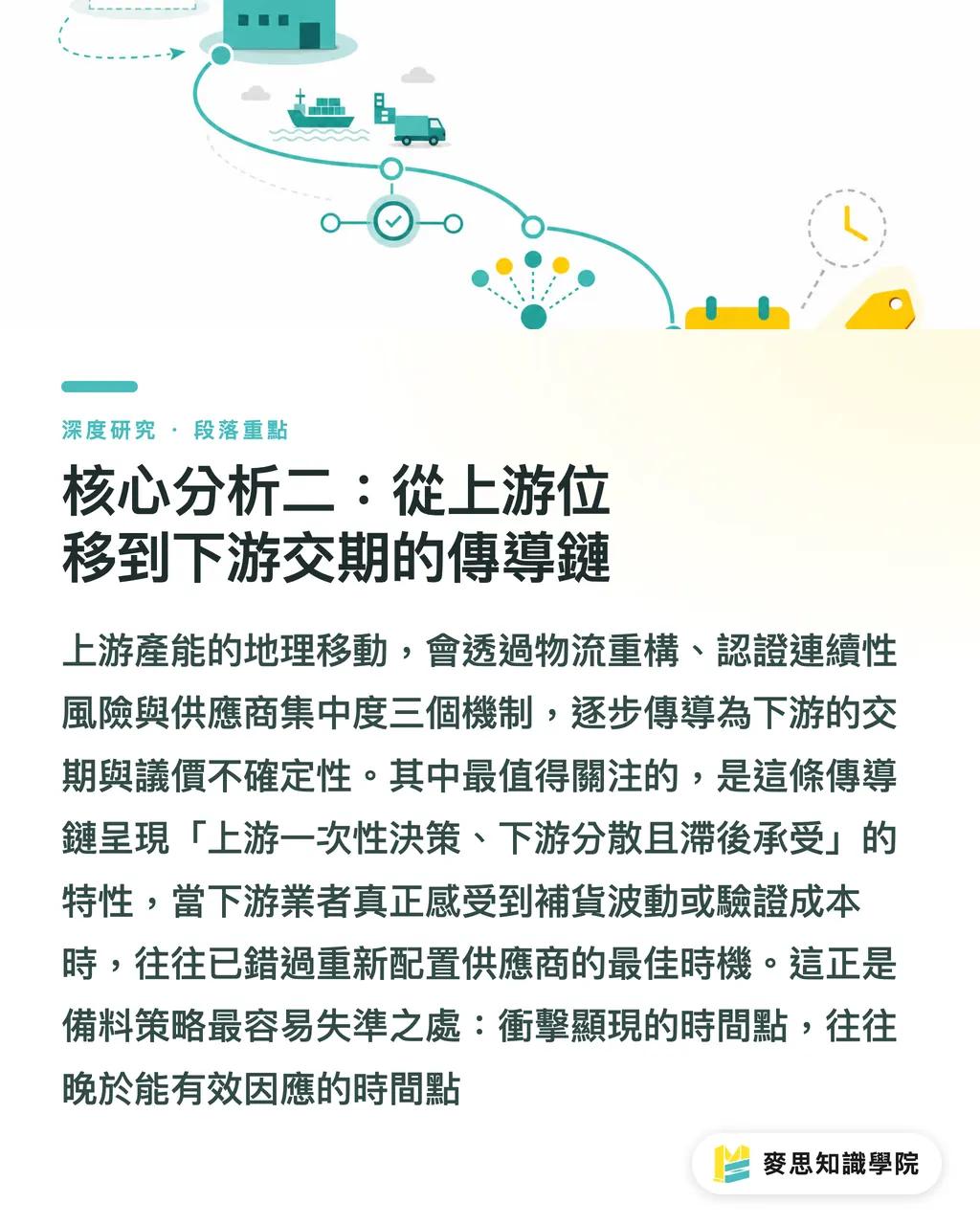
Core Analysis II: The Transmission Chain from Upstream Displacement to Downstream Lead-Time Impact
This section argues that the geographic shift of upstream capacity transmits to downstream lead-time and pricing uncertainty through three mechanisms: logistics pathway restructuring, certification continuity, and supplier concentration
The first mechanism is logistics pathway restructuring. When the supply source shifts from Switzerland to Tuzla, Turkey, the transportation routes, customs clearance nodes, and lead times are all rearranged [1]. For Taiwanese importers sourcing from afar, the new shipping origin means that existing ordering rhythms and safety stock assumptions must be recalibrated; during the transition period, lead-time volatility is typically most pronounced. This article argues that this kind of transitional uncertainty rarely appears in upstream public communications and is instead felt by downstream operators when they actually reorder
The second mechanism is the risk to certification and formulation continuity. The core value of specialty inks such as food-safety-grade and solvent-free UV lies in their regulatory certifications and consistent batch-to-batch uniformity. When production relocates, even if formulations remain unchanged, downstream operators may still face hidden costs such as re-verification and batch variance comparison. This article must honestly acknowledge that the firsthand source does not specify which product lines are affected or whether specialty inks are involved, so the above is an inference based on industry convention rather than reported fact [1]
The third mechanism is the amplification of single-source risk by supplier concentration. When a leading global manufacturer consolidates its sites, downstream operators who were already heavily reliant on a single supplier or a single production origin will see their risk exposure simultaneously amplified. This article argues that this is the key to converting a macro-level event into a micro-level decision: the closure itself may not directly disrupt supply, but it prompts downstream operators to re-examine whether their critical inks have only one source and one origin
Taking the three mechanisms together, the characteristic of this transmission chain is 'upstream decisions are one-time; downstream impacts are dispersed and lagged.' Siegwerk's adjustment is a single announcement [1], but the lead-time, verification, and pricing impacts it triggers for different Taiwanese operators will surface progressively over several procurement cycles. This article argues that this time lag is precisely where inventory strategies are most prone to miscalibration: by the time downstream operators truly feel the impact, adjusting suppliers is often already too late
Core Analysis III: Structural Pressures on European Ink Manufacturing and the New Normal of Consolidation
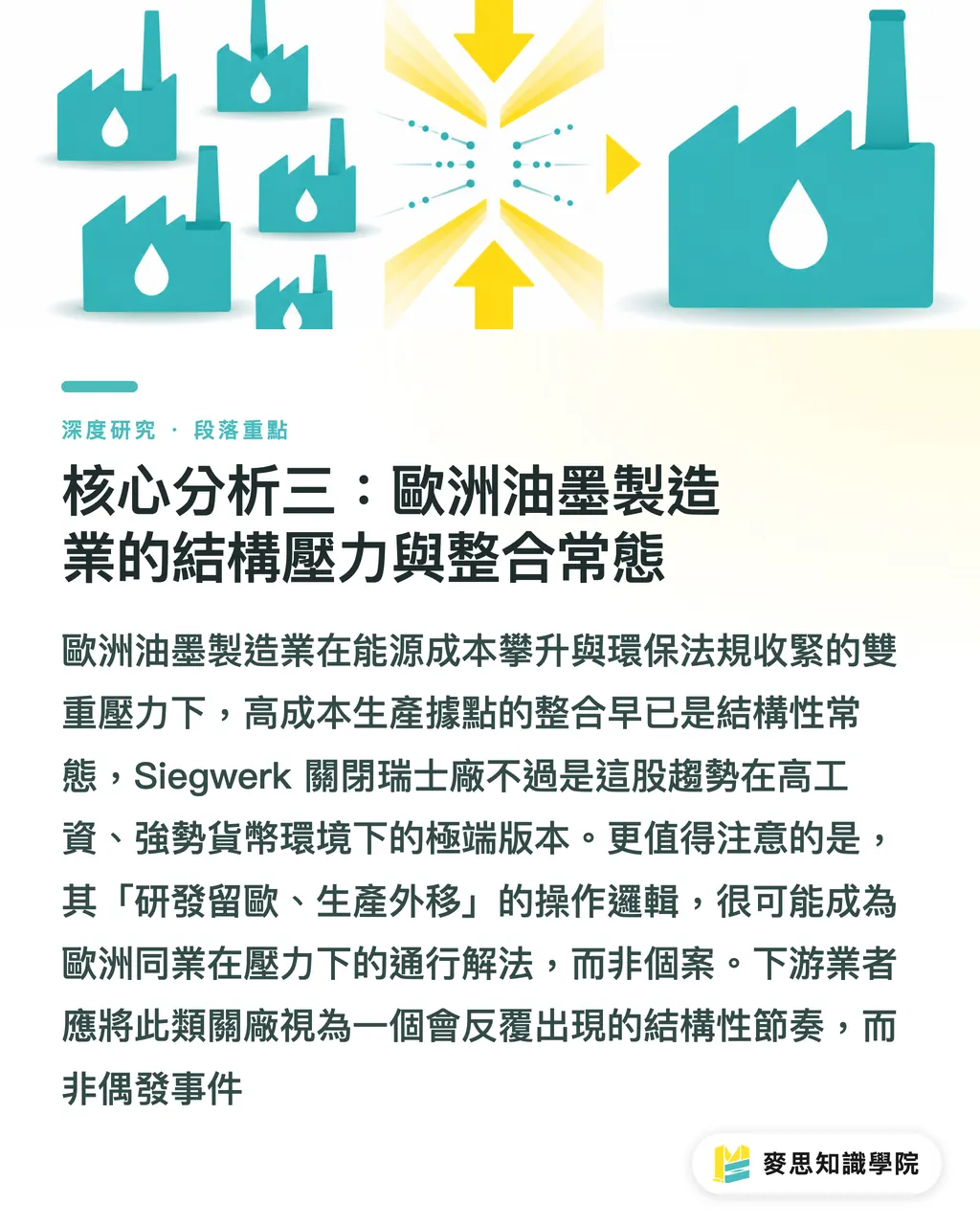
This section argues that Siegwerk's closure should be understood as the new normal of consolidation under broad pressure on European ink manufacturing rather than as an isolated corporate event
From a cost perspective, European ink manufacturers are simultaneously contending with the dual pressures of energy costs and environmental regulation. This structural backdrop makes the survival of high-cost sites increasingly difficult, and the high Swiss costs and franc appreciation that Siegwerk cited represent an extreme version of these pervasive pressures in a specific country [1]. This article argues that Switzerland, being outside the Eurozone and renowned for high wages and a strong currency, is often the first production location to be scrutinized under this type of cost pressure
From an industry governance perspective, Siegwerk has been deeply involved in European industry organizations, its former CEO served as EuPIA Chairman [3] — indicating that Europe has long been where its technical and policy voice resides. The current choice to 'retain technical activities in Switzerland while moving out production' [1] can be interpreted as a compromise between maintaining European technical legitimacy and reducing European production costs. This article argues that this model of 'keeping R&D in Europe while offshoring production' may become a common solution for European ink manufacturers under pressure
From a historical comparison perspective, Siegwerk's acquisitions and expansions over two decades [2][6] show that it is accustomed to using structural adjustments to respond to market changes. This closure is consistent in nature with the acquisitions [6] and new market entries [2][5] of earlier years, all part of the same corporate behavior of 'continuously restructuring to align with growth markets' — with the direction simply shifting from expansion to contraction. This article therefore argues that downstream operators should not treat a single closure as a one-off event but as a structural rhythm that will recur
The limitation of this section is that the pressures constituted by energy costs and environmental regulation represent this article's general interpretation based on industry context. The firsthand source only explicitly cites three drivers, costs, exchange rates, and demand [1] — and does not quantify the weight of each pressure. Therefore, this article's argument for 'consolidation as the new normal' is an interpretation at the level of trend rather than a quantifiable conclusion verifiable item by item
Implications for Taiwan's Design and Printing Industry
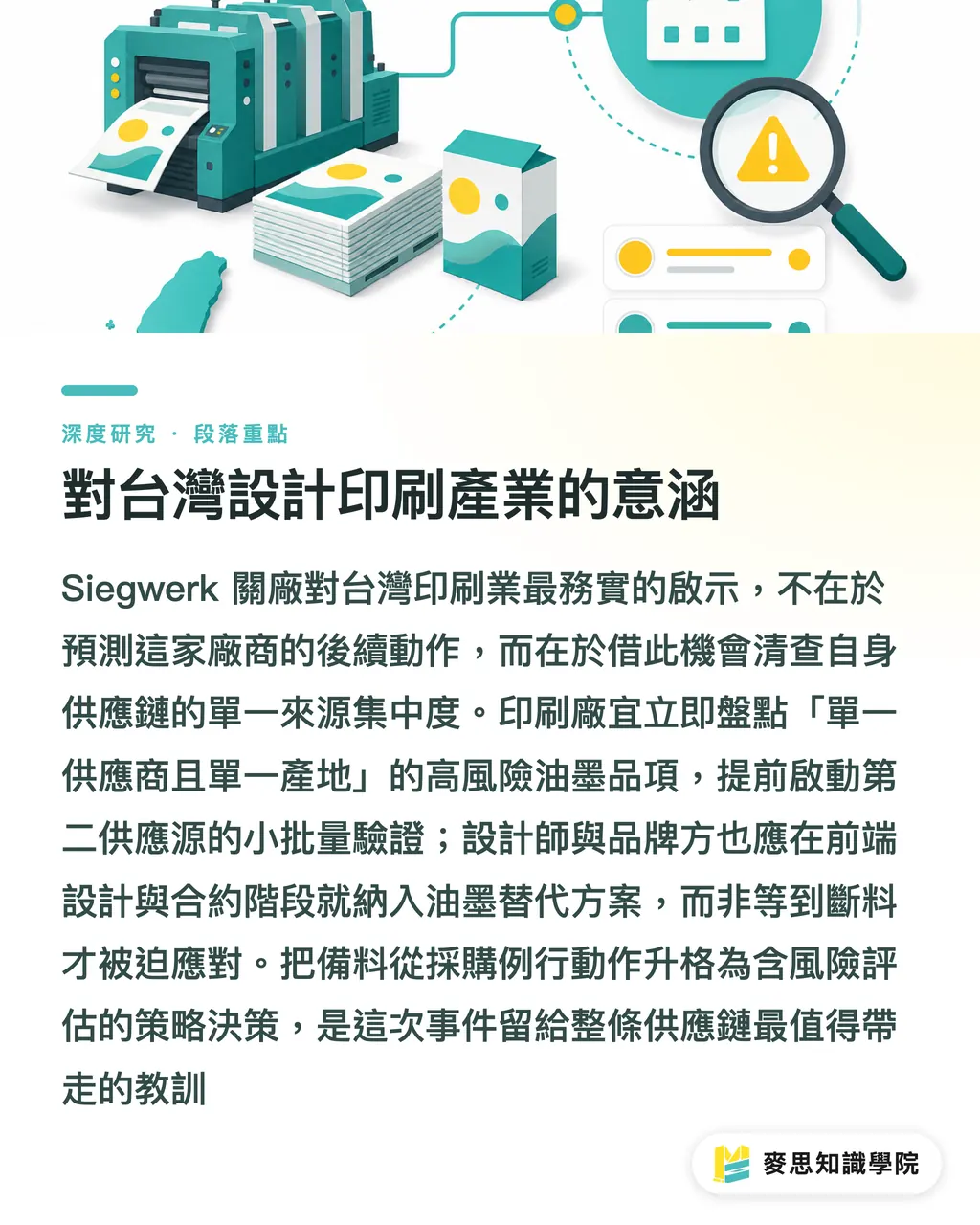
This section argues that the most practical value of this event for Taiwan's industry lies not in predicting Siegwerk's next moves but in prompting a systematic audit of single-source risk. The following outlines actionable approaches for three types of stakeholders
For small and medium-sized printers and flexible packaging operators, a three-step approach is recommended. Step one is an audit: list all critical ink items, note their supplier and origin, and flag whether qualified alternatives exist; any item with a 'single supplier and single origin' should be marked as high risk [1]. Step two is a buffer: for specialty inks that are high-risk and have long lead times, such as food-safety-grade and solvent-free UV, increase safety stock levels within cash flow constraints and revise lead-time assumptions toward a 'conservatively longer' estimate for transition periods. Step three is alternative verification: proactively initiate small-batch validation of a second source for critical items, paying the time cost of certification and proofing upfront rather than waiting until a stockout forces action
For designers and design studios, the implication is to consider ink availability during the front-end design phase. This article argues that when the supply stability of certain specialty inks declines, if the design side can retain alternative options in color, surface treatment, and material selection, it reduces the risk of being forced into costly revisions downstream due to material shortages. In quoting and scheduling communications, it is advisable to incorporate 'potential delays in specialty ink lead times' into timeline discussions with clients to avoid committing to delivery dates that cannot be guaranteed
For brand owners, the implication is to incorporate ink supply risk into the risk management of packaging and print outsourcing. Specific measures include: clarifying responsibility for lead-time changes in contracts with printing suppliers; for products highly dependent on specific specialty ink effects, such as particular metallic finishes or solvent-free food-safety specifications, confirming alternative solutions' visual and compliance equivalence with the supply chain in advance. This article argues that although brand owners are furthest from upstream, they are often the ones who suffer the greatest losses when material shortages cause launch delays, and therefore it is worthwhile for them to proactively engage
The shared takeaway across all roles is to elevate 'inventory preparation' from a routine procurement action to a strategic decision that incorporates risk assessment. The reason Siegwerk's closure warrants attention from Taiwan's industry is not that it has directly cut anyone's supply, but that it serves as a low-cost reminder for downstream operators to re-examine their supply chain concentration before any damage is done [1]
Conclusions and Limitations
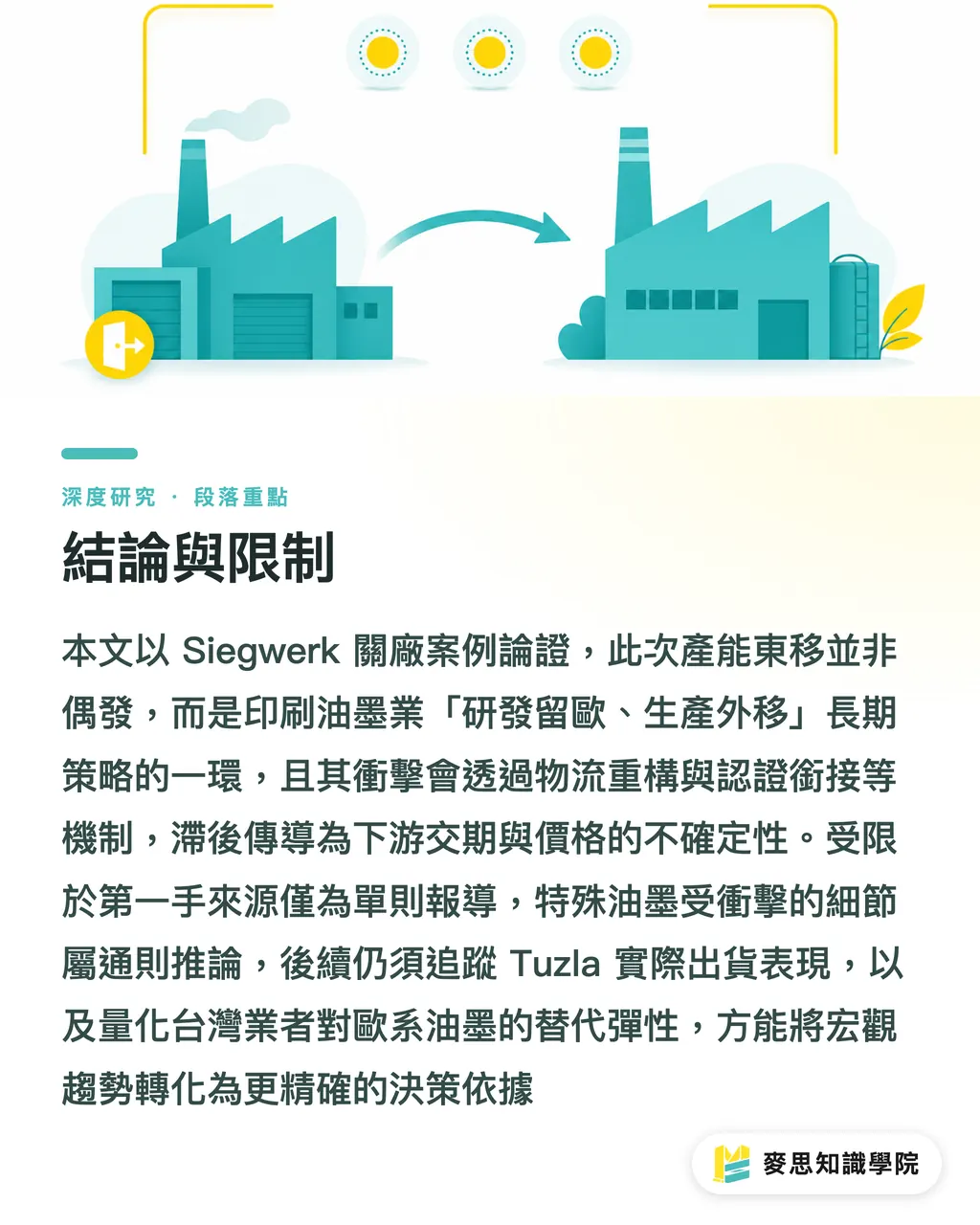
This article used Siegwerk's closure of its Bargen, Switzerland plant and the transfer of production to Tuzla, Turkey [1] to address the three questions raised in the introduction. On the first question, through longitudinal comparison with existing literature [2][3][4][5][6], the article argues that this closure is a continuation of the group's long-term strategy of 'aligning the center of gravity with growth markets' rather than an ad hoc decision. On the second question, the article proposes three mechanisms, logistics restructuring, certification continuity, and supplier concentration, to explain how upstream displacement transmits in a lagged and dispersed manner into downstream lead-time and pricing uncertainty. On the third question, the article proposes tiered audit, buffer, and alternative verification approaches, translating a macro-level event into actionable decisions for three categories of industry stakeholders in Taiwan
This article must honestly disclose several limitations:
・First, the firsthand source is a single industry report that provides only employment and capacity figures for Tuzla (20% capacity increase in 2020, 20 new positions, total headcount of 130) and three closure drivers [1], without covering the specific product lines affected; therefore, this article's discussion of specialty ink impacts constitutes general inference rather than reported fact
・Second, structural pressures such as energy costs and environmental regulation represent this article's interpretation based on industry context and have not been quantified item by item
・Third, the historical references cited are largely concentrated in the 2004–2009 period [2][3][4][5][6], creating a time gap with the current situation; they can only support trend-level comparisons and should not be used to infer recent specifics
Three directions for further research are identified: first, tracking actual post-transition delivery lead times and quality consistency from Tuzla to verify the transmission mechanisms proposed in this article; second, quantifying Taiwan's high-end printing and packaging sector's dependence on European specialty inks and the elasticity of substitution; third, comparing the capacity allocation moves of other major ink manufacturers to test whether 'keeping R&D in Europe while offshoring production' has already become the industry's prevailing model
Key Takeaways
・Siegwerk closed its Bargen, Switzerland plant and transferred production to Tuzla, Turkey, citing high costs, the strong Swiss franc, and declining demand in certain markets, affecting over one hundred positions
・The Tuzla plant had already expanded capacity by 20% in 2020, indicating that the eastward capacity migration was a long-planned strategic arrangement rather than a hasty cost escape
・The upstream shift transmits, in a lagged and dispersed manner, into downstream lead-time and pricing uncertainty through three mechanisms: logistics restructuring, certification continuity, and supplier concentration
・The practical value for Taiwan's operators lies in using this event as a prompt to audit single-source risk: identify critical inks with a 'single supplier and single origin' and proactively initiate alternative validation
・The firsthand source does not specify the affected product lines; the specialty ink impact is a general inference, and downstream operators should respond with strategic inventory preparation rather than panic stockpiling
Further Reflections
For printing manufacturing and design, the true lesson of this closure is not 'European ink prices are going up' but that supply chain concentration is itself a risk that needs to be managed, one worth incorporating simultaneously into procurement, design, and quoting decisions. The implication for AI and SaaS is that if supplier, origin, certification, and lead-time data for inks and consumables can be structured, it would enable automated single-source risk alerts and alternative product recommendations, converting judgment that currently resides in the experience of individual procurement staff into indicators that can be tracked systematically. The outstanding question is that downstream operators lack real-time visibility into upstream capacity allocation; how to detect shifts in the supply center of gravity early, without relying on upstream voluntary disclosure, is the challenge that supply chain resilience tools must answer next
References
[2] Siegwerk Gains Major Foothold in India. Pigment & Resin Technology. DOI: 10.1108/prt.2008.12937bab.015
[3] Siegwerk CEO Herbert Forker elected Chairman of EuPIA. Pigment & Resin Technology. DOI: 10.1108/prt.2008.12937dab.004
[4] Siegwerk starts volume production for waterless web offset. Pigment & Resin Technology. DOI: 10.1108/prt.2008.12937eab.020
[5] Ink, Heart & Soul from Siegwerk South Africa. Pigment & Resin Technology. DOI: 10.1108/prt.2009.12938dab.015
[6] Siegwerk acquires Color Converting Industries. Focus on Pigments. DOI: 10.1016/s0969-6210(04)00226-7
FAQ
- Why did Siegwerk close its Swiss plant?
- According to firsthand reporting, the primary reasons were high production costs in Switzerland, erosion of competitiveness by the strong Swiss franc, and declining demand in certain printing ink markets. The group is consolidating production in Tuzla, Turkey to serve Eastern European, Middle Eastern, and African markets more cost-effectively
- Will this closure directly affect ink supply in Taiwan?
- The firsthand source does not specify the affected product lines, so a direct supply disruption cannot be confirmed. However, for Taiwanese operators relying on a single European supplier and a single production origin, lead-time and pricing uncertainty may increase during the production transition period, making a proactive risk audit worthwhile
- How should Taiwanese printers respond to this type of upstream plant closure?
- A three-step approach is recommended: first, audit all critical ink items by supplier and origin and flag single-source high-risk items; second, increase safety stock for specialty inks with long lead times; third, proactively initiate small-batch validation of a second source for critical items
- Is the Tuzla plant capable of absorbing the capacity transferred from Switzerland?
- The Tuzla plant underwent a major modernization in 2020, increasing capacity by 20% and adding positions to reach a total headcount of 130, indicating that the absorption was a long-planned arrangement developed over several years rather than an improvised redeployment
- Has Siegwerk completely withdrawn from Switzerland?
- No. Reports indicate that the group has only moved out production while retaining its technical activities in Switzerland, reflecting a selective contraction model of 'keeping R&D in Europe while offshoring production.'
References
- Siegwerk 關閉瑞士廠:全球油墨供應鏈又少一顆螺絲,你的備料策略夠穩嗎 · printindustry.news
- Siegwerk Gains Major Foothold in India · doi.org
- Siegwerk CEO Herbert Forker elected Chairman of EuPIA · doi.org
- Siegwerk starts volume production for waterless web offset · doi.org
- Ink, Heart & Soul from Siegwerk South Africa · doi.org
- Siegwerk acquires Color Converting Industries · doi.org
Related articles


The Print × AI weekly
The print and AI know-how designers, brands and enterprises can use before they commit — one email, every week
MINDS Free Tools
Spine width and imposition calculators — skip the manual math, free in your browser.
MINDS Group
Need actual printing or gifting services?
From premium printing to online ordering and festive gifts — the MINDS Group sister brands take it from here.