

Executive Summary
The global print industry is undergoing both a demand restructuring and a technology leap. Smithers projects that the global inkjet printing market will hit $177 billion by 2031, powered by twin engines: demand for personalization and industrial inkjet applications [1][7]. Digital corrugated printing has moved past capability trials and entered volume production, reshaping packaging competition [3]. This white paper finds that the competitive axis is shifting from hardware specs to servitization, software-defined operations, and ecosystem integration. Quocirca's first ACT framework report highlights that companies turning one-off hardware sales into recurring service revenue will lead the market [22][32]. On the demand side, Gen Z has not abandoned print. Expected to make up 30% of the global workforce by 2030, this generation provides a solid upward revision to long-term print demand [27][37]. Risks remain concentrated in supply chains and compliance. Conflicts in the Middle East and petrochemical supply disruptions in Japan are driving up raw material and logistics uncertainty [54][41]. Meanwhile, EU and UK rules like PPWR, EPR, and mandatory electronic invoicing create real trade barriers for export-oriented businesses [12][24]. For Taiwan, four levers offer the greatest impact over the coming year: automation driven by labor shortages, finishing bottlenecks, color management certification, and AEO marketing [51][57][42][2]. Print providers should push their transformation along four main lines: pairing press investments with finishing upgrades, adopting cloud workflows, building green supply chains, and shifting to Answer Engine Optimization
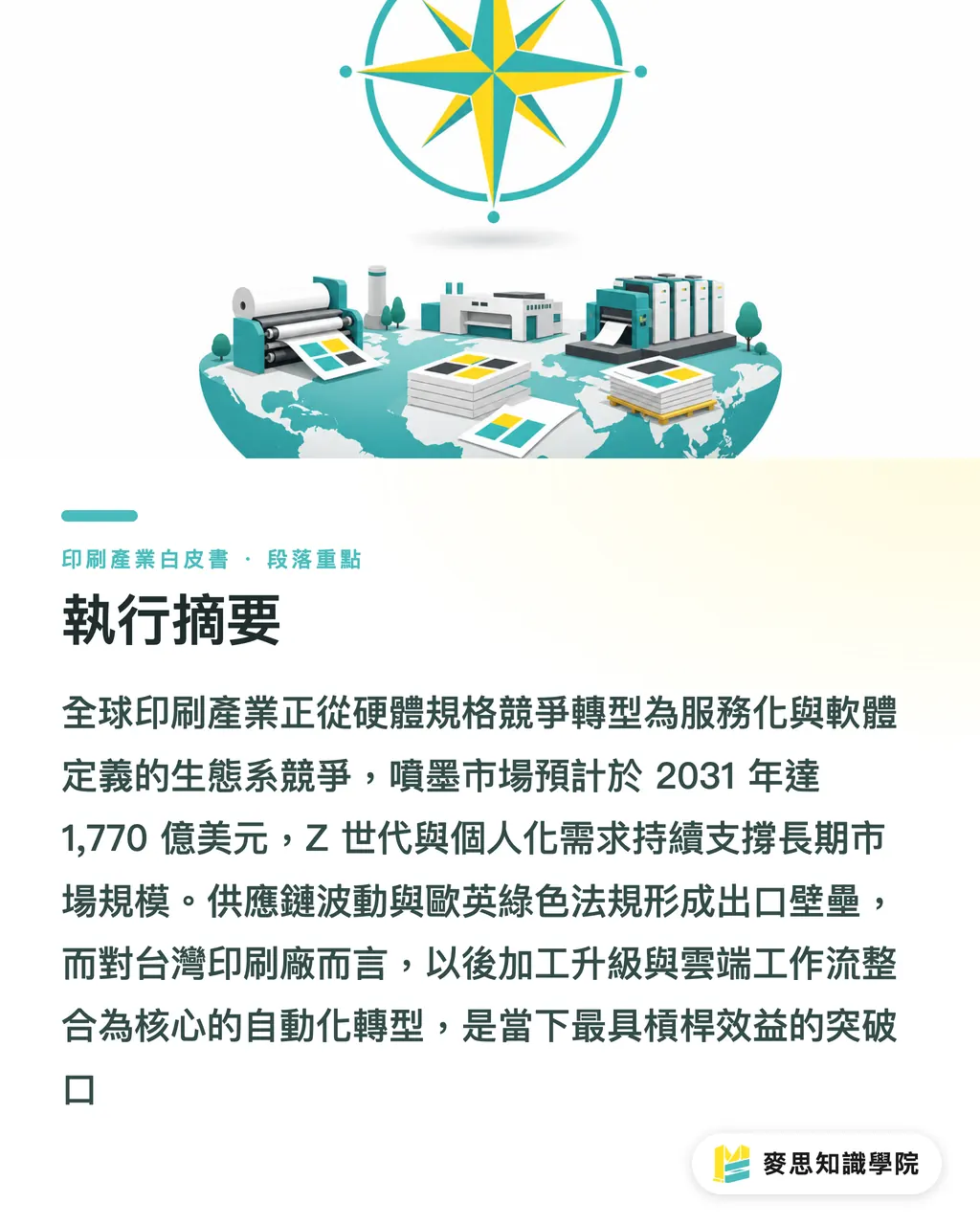
1. Market Landscape and Data Anchors: Growth Concentrated in Digital and Packaging
Global print demand is shifting from a narrative of decline to structural stabilization, with growth momentum heavily concentrated in digital and packaging. The Smithers report, 'The Future of Inkjet Printing to 2031,' tracks a ten-year trajectory from 2021 to 2031, projecting a $177 billion market. The main growth drivers include digital demand, personalized print, eco-friendly inks, and inkjet expansion into manufacturing and textiles [1][7]. This forecast provides a clear ten-year roadmap for capital allocation and technical upgrades across Taiwan's inkjet supply chain [1]
Signals on the packaging front are just as clear. Digital corrugated box printing has moved beyond early technical trials straight into volume production, as brands shift short-run, personalized packaging orders into digital pipelines [3]. The American Forest & Paper Association's April 2026 packaging papers report showed shipments rebounding, capacity operating rates hitting a 13-month high, and inventories falling at the same time, three positive indicators pointing up together [48]. This white paper suggests these trends could support international paper prices in the short term. Taiwanese converters relying on imported packaging paper should adjust their purchasing timelines and inventory strategies early [48]
Demand patterns show an important long-term correction. Quocirca's 'Future of Work 2030' study overturns the assumption that younger generations do not use print. It shows that Gen Z's willingness to use paper media is significantly higher than expected, with a clear preference for physical print during high-focus tasks like deep reading and document review. Gen Z will also make up an estimated 30% of the global workforce by 2030 [27][37][44]. Japan offers parallel proof: among 18 publicly traded print companies reporting for the fiscal year ending March 2026, 11 saw revenue gains and 9 grew their profits. This marks the end of a multi-year slump and confirms a tangible recovery [65]. The central takeaway from Japan is that this recovery is not a simple rebound of legacy print, but a structural shift as printers transform from manufacturers into integrated solution providers
2. Technology Drivers: Industrial Inkjet, AI Workflows, and Finishing Bottlenecks
The primary technology trend is inkjet expanding its reach into industrial uses, while AI and cloud tools reshape daily workflows. Roland DG's CEO outlined a major expansion plan at FESPA, targeting high-margin niches like industrial parts marking and printed electronics [55]. Inkcups introduced the Helix High Throw UV cylindrical printer, which produces seamless 360-degree designs on irregular containers and lowers the barrier to printing on curved objects [50]. Fujifilm announced its flagship digital production press, the REVORIA PRESS PC2120, across Europe and North America with a brand-new color processing engine, showing that high-end color production equipment is iterating faster than ever [67]
AI adoption is branching into two distinct tracks: production automation and business intelligence paired with marketing channels. Profectus brought a deep AI analytics engine to its industry-specific Print Business Advisor software, unifying production, financial, and order data to identify operational bottlenecks and forecast demand [21]. At HP Imagine 2026, HP introduced the HP IQ intelligence layer, an edge computing setup that puts on-device AI right into printers and PCs without relying on the cloud [24]. On the marketing side, senior advisors note that AI recommendation engines evaluate print shops based on four pillars: clear service descriptions, extensive customer reviews, structured technical specs, and consistently updated content. Print shops must pivot from SEO to Answer Engine Optimization (AEO) [2]. Cloud workflows are also showing concrete gains: UK graphics provider Time 2 Display lifted overall production efficiency by 15% after adopting HP PrintOS [8], and EyeC launched a fully cloud-based prepress inspection SaaS, letting small and mid-sized shops access high-grade quality control without expensive hardware [40]
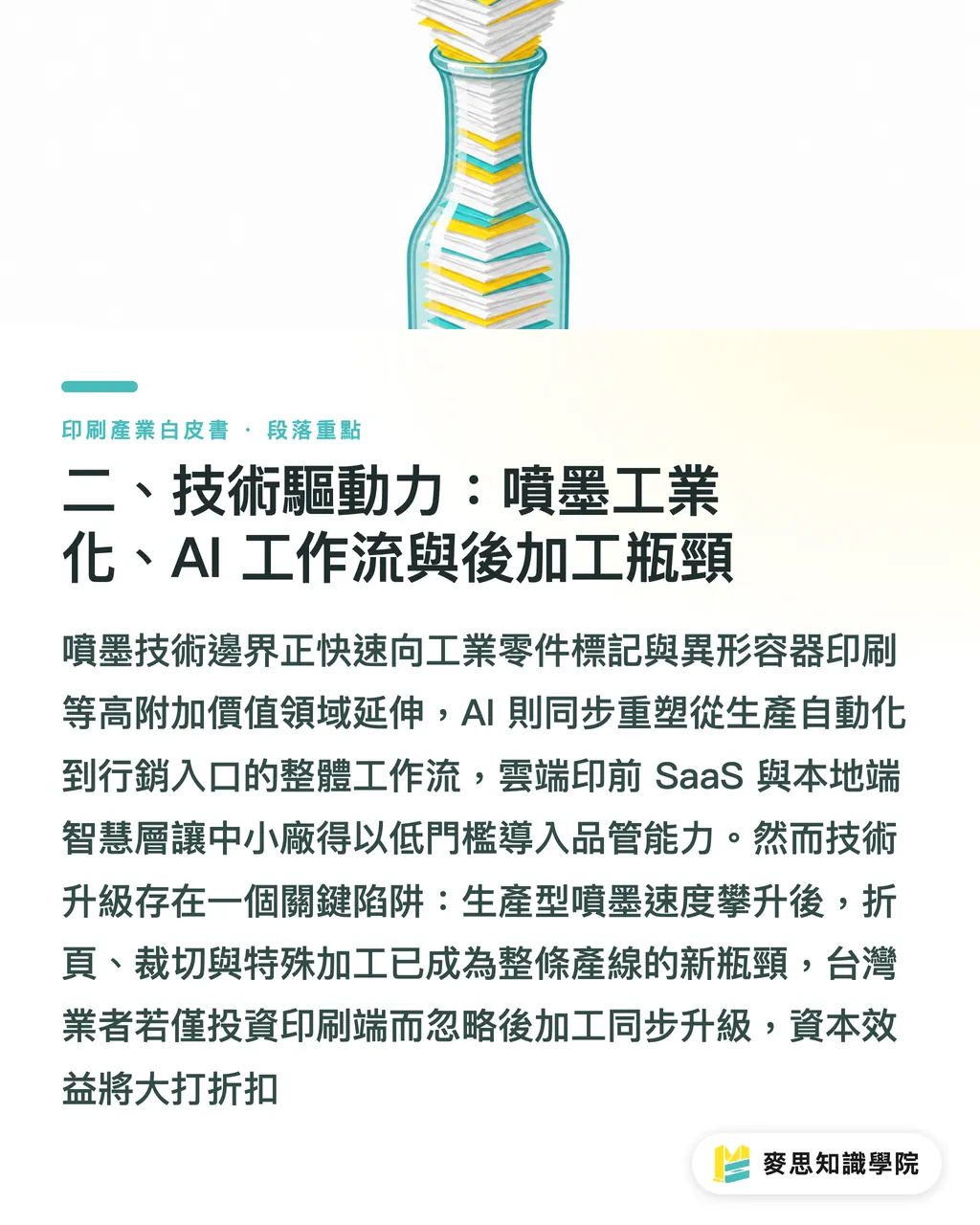
Yet one major bottleneck remains overlooked. PIWorld research shows that as production inkjet speeds climb, finishing has become the new pinch point in the shop. Folding, cutting, binding, and embellishment struggle to match the speed and flexibility demanded by short-run, diverse orders [57]. This represents the easiest capital expenditure trap for Taiwanese shops: upgrading the press while ignoring the finishing line leaves expensive capacity sitting idle [57]. Practical answers are emerging. The Scodix Ultra 7000 SHD serves as the first digital embellishment press for corrugated board and rigid substrates [47]. Meanwhile, Skandacor and Taktiful teamed up to combine 3D foil embossing with soft proofing, cutting the cost of physical proofing runs [71]. Automated prepress imposition is also evolving from ExtendScript and UXP scripts toward generative AI assistance, becoming an essential piece of the digital workflow transition [4]
3. Supply Chain and Sustainability: Dual Pressures of Regulation and Geopolitics
Supply chain resilience and environmental compliance have shifted from nice-to-have extras into baseline survival requirements. On the geopolitical front, Middle East conflicts have disrupted Red Sea shipping routes, forcing Asia-Europe trade around the Cape of Good Hope. Surging freight rates and delivery delays have graduated from short-term shipping headaches into long-term supply chain realignment pressures [54][70]. In Japan, ongoing petrochemical supply disruptions threaten the production of petroleum-based inks, coatings, and packaging films, pushing the industry to hunt for alternatives [41][75]. For Taiwanese manufacturers with capacity in bio-based inks and water-based coatings, this creates an immediate export opening into Japan. In Russia, a government mandate requiring 30% domestic content for public printer procurement is pushing international brands to pivot their focus toward Asia, indirectly intensifying hardware competition across Taiwan [69]
Regulatory timelines are tightening fast. A Two Sides report outlines sweeping regulatory changes across the EU and UK for print, paper, and packaging. These include revisions to the Packaging and Packaging Waste Regulation (PPWR), broader Extended Producer Responsibility (EPR) mandates, and stricter rules around FSC and PEFC chain-of-custody certifications [12]. The report warns that non-compliant packaging materials will face market entry bans in the EU, creating an immediate non-tariff barrier for Taiwan's export packaging printers [12]. France is rolling out mandatory B2B e-invoicing under EU VAT digitalization plans, starting with large corporations before expanding to SMEs, which will further cut into traditional paper invoice print volumes [18][24]. Carbon pricing is also picking up speed across the Asia-Pacific region. Singapore backed its carbon market with $15 million and helped form a private carbon buyer alliance [9]. This institutional momentum will soon place indirect but tangible pressure on carbon accounting across Taiwanese supply chains [10]
Sustainability brings genuine commercial upside, not just overhead costs. Two Sides data shows European graphic paper recycling rates now exceed 70%, ranking among the highest recycling rates of any material in the world. That gives printers solid evidence to push back against the claim that digital is always greener than paper [5]. Material innovation is moving quickly as well: Fedrigoni secured some of the Italian paper industry's first long-term biomethane supply contracts, covering roughly 40% of its natural gas needs and cutting its carbon footprint [46]. High-barrier paper packaging is expanding into pet food, answering the call to phase out plastics [25]. In academic research, nanocellulose superhydrophobic coatings offer a direct path to replace PFAS, helping businesses dodge incoming chemical bans [17][22]. Solvent-free UV curing systems reduce VOC emissions while maintaining film durability. Natural alternatives like algae-based inks have rolled out B2B marketing kits, moving into full commercial adoption [19][26][28]
4. Industry Consolidation and Talent: Survival Challenges Amid Market Concentration
The global print industry is consolidating at a rapid pace, caught between economies of scale and succession challenges. In labels and flexible packaging, CCL Industries completed its buyout of shrink sleeve specialist Sleever International, one of the sector's largest recent deals, cementing CCL's market lead [33][45]. In the UK, three major transactions closed in a single week: WBC acquired packaging supplier Transpack, Pureprint rescued Simpson Group from administration, and the BPIF sold its training division to a private entrepreneur [68]. In North America, Worth Higgins & Associates acquired B&B Printing to expand capacity [59]. This market concentration will squeeze independent small and mid-sized printers even harder. Strategic acquisitions and regional alliances have become necessary tools for staying competitive [47][59]
Supplier concentration among European paper mills calls for equal caution. Paper giants UPM and Sappi finalized their graphic paper joint venture agreement with committed financing, marking one of the largest consolidation moves in European papermaking [69]. This concentration shifts pricing power toward a handful of massive mills. Commercial printers need to re-examine their paper sourcing strategies and long-term contract structures [69]
Structural strain on talent development is breaking into the open. The BPIF's sale of its training arm, responsible for vocational apprenticeships and technical qualifications, reflects a deeper crisis: rapid technological shifts are making traditional training curricula obsolete, while trade associations face tightening budgets [23][33]. In Taiwan, the Department of Graphic Communication Arts at National Taiwan University of Arts and the Department of Graphic Communication at National Taiwan Normal University continue to develop cross-disciplinary talent across print and visual communications [31][75]. Meanwhile, the Printing and Communication Xingcai Foundation is pushing X-Rite Pantone FOCA color management certification training, building on momentum from the TIGAX trade show [32]. Financial risk controls also sounded an alarm: following ColorArt's bankruptcy, clients filed lawsuits alleging that millions in postal funds had vanished, exposing weak fund-safeguarding protocols when print service providers handle large-scale corporate contracts [43][58]
Strategic Implications for Taiwan's Design and Print Industry
Taiwanese operators face a three-part challenge: rising production costs, fragmented demand patterns, and tightening compliance bars. Each segment of the industry must respond with targeted steps
For print shop owners, the top priority is full-chain thinking for capital investments. When planning digital press additions, automated finishing must be budgeted at the same time, covering modular cutters, smart folders, and integrated inspection systems. Doing so prevents expensive press capacity from sitting idle behind finishing bottlenecks [57]. Given severe labor shortages, automation is no longer just for massive plants. Small and mid-sized shops should evaluate the right time to introduce robotics and automated handling [51][66]. Color management gives Taiwanese printers a clear path to win high-end brand business. Earning international certifications like FOCA reduces reprint rates from color variance, while applying colorimetric benchmarks between conventional and digital proofs sharpens approval workflows [32]. Cloud workflows, such as PrintOS and cloud-based prepress inspection SaaS, deliver clear productivity gains with relatively low upfront capital [8][40]
For graphic designers, AI is both a shock and an opportunity. Generative AI tools have shrunk work for smaller creative agencies, but designers who combine design craft with physical print expertise, offering tangible solutions that AI cannot replace, are winning new accounts [60][45]. Designers should expand their skillsets into structured content and automated layout, bridging the connection between generative AI output and Adobe InDesign workflows [4]
For brand owners, supply chain resilience and environmental compliance are the new baselines for vendor selection. Brands should require their print partners to deliver carbon footprint tracking, certified recycled stocks, and low-carbon materials, while building a diversified supplier base to hedge against geopolitical shocks [12][70][9]. In terms of purchasing discovery, because AI recommendation engines are becoming the primary gateway for B2B sourcing, both brands and print shops need to invest in Answer Engine Optimization (AEO). Service descriptions, technical specs, and case studies must be structured so AI agents can parse and recommend them accurately [2]
Outlook and Action Checklist
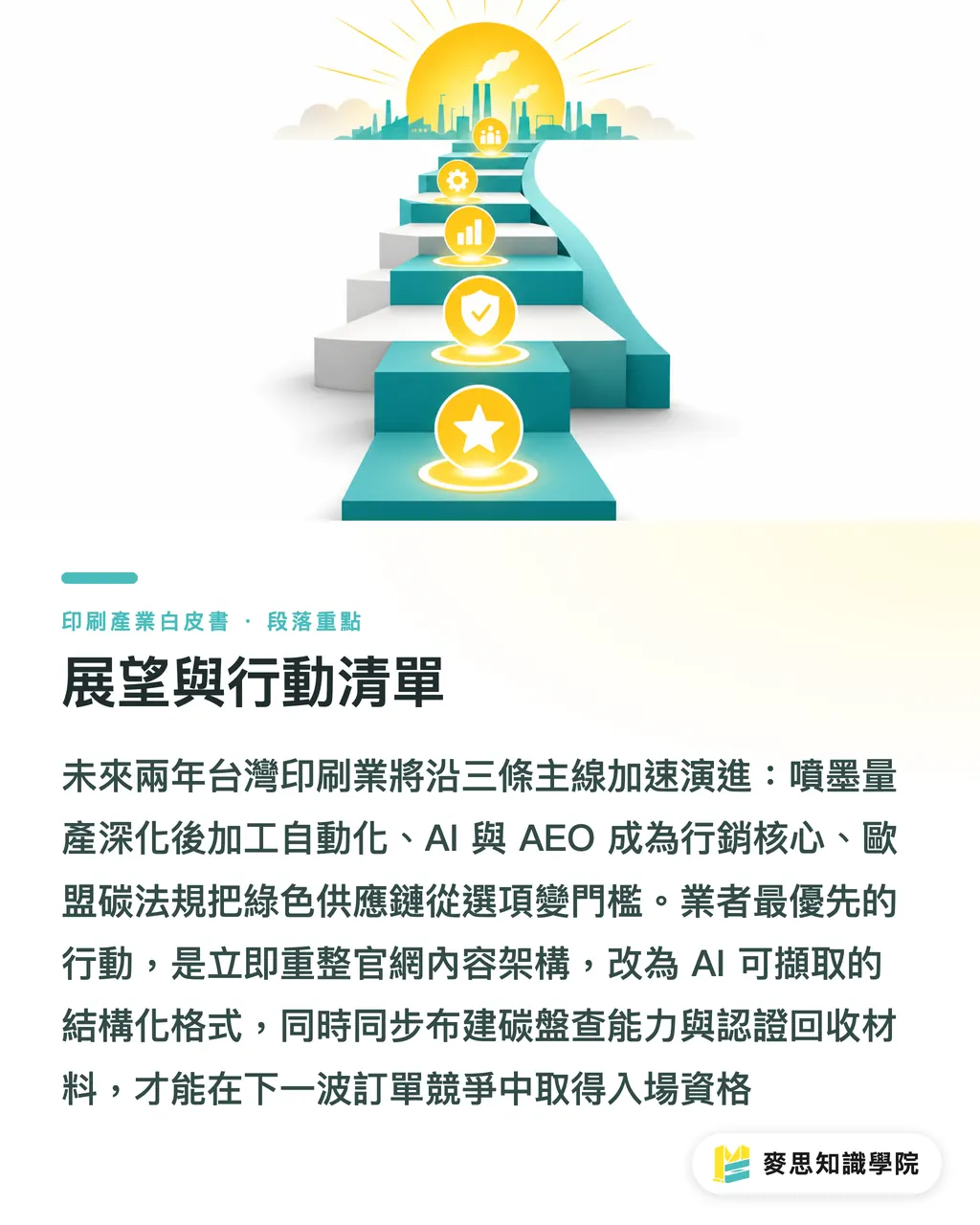
Over the next 12 to 24 months, this white paper expects Taiwan's print industry to develop along three main axes:
・First, industrial inkjet adoption and digital packaging production will scale up, shifting equipment investment from presses to automated finishing and embellishment [1][3][57]
・Second, AI and cloud systems will transition from isolated pilot projects to core operations, while inbound marketing shifts decisively from SEO to AEO [21][2]
・Third, sustainability regulations and carbon pricing timelines will tighten, turning green supply chain management from an optional credential into an absolute requirement for European export contracts [12][9]
Print providers should take action on five priorities immediately:
1. Plan equipment across the full workflow: Any digital press expansion should include an automated finishing budget. Evaluate investments based on MIS integration efficiency and total long-term maintenance costs rather than press purchase price alone [13][57]
2. Launch an AEO marketing overhaul: Review website service descriptions, technical specifications, and case studies. Rebuild them into structured, AI-readable content with a steady update schedule [2]
3. Build green supply chains and carbon accounting capabilities: Assess PPWR and EPR compliance costs and timelines early. Introduce certified recycled papers along with bio-based or water-based alternatives, and share verified carbon footprint data with brand clients [12][5][46]
4. Diversify supply chains and secure alternative materials: Audit ink and substrate sources. In light of petrochemical supply risks in Japan, explore export opportunities for bio-based substitutes [41]
5. Invest in color management and staff certification: Pursue international certifications such as FOCA. Build partnerships with university graphic communication departments to deepen technical bench strength for the digital transition [32][31][75]
Key Takeaways
The global inkjet market is projected to reach $177 billion by 2031, powered by personalization and industrial uses. Taiwan's inkjet supply chain should position itself early [1][7]
The competitive center of gravity is moving from hardware specs to servitization, software-defined operations, and ecosystem integration. Businesses that convert equipment sales into recurring service models will lead the market [22][32]
Finishing has emerged as the true bottleneck in production inkjet. Upgrading presses without matching finishing investments leaves capital underperforming [57]
Tighter PPWR, EPR, and e-invoicing rules in the EU and UK create real trade barriers and tight compliance deadlines for Taiwanese packaging exporters [12][24]
AI recommendation engines are becoming the primary entry point for B2B buyers. Print providers must transition from SEO to Answer Engine Optimization (AEO) to stay discoverable [2]
Further Reflections
For Taiwan's print sector, the true dividing line in this transformation is not whether a shop buys the latest digital press. It is whether the business can overhaul its finishing operations, production workflows, and marketing channels in tandem. Automated finishing determines whether press investments pay off [57], cloud and on-device AI workflows determine operating speed and regulatory resilience [8][24], and AEO decides whether new buyers can find the business through AI sourcing queries [2]. For software providers, industry-specific operational intelligence tools and cloud prepress inspection point to a distinct vertical opportunity [21][40]. Groups like MINDS, which combine printing production with software capabilities, are positioned to capture the high ground by blending design integration, physical print, and digital workflows [60]. The remaining challenge: while Taiwan has solid foundations in color management certification and green materials, automated finishing equipment, carbon accounting, and AEO content architecture still require systematic investment. That is the exact capability gap worth tackling in the coming year
References
[4] Technology Trends: From InDesign Scripts to Generative AI: A Complete Guide to Automated Imposition
[11] Top News: UK's Micropress Doubles Down on Kodak with Two Magnus Q800 Platesetters
[12] Top News: Sweeping EU and UK Regulatory Shifts Hit Print, Paper, and Packaging
[13] Top News: BPIF Printing Outlook Q2 2026: Structural Concerns Amid Recovery Signals
[18] Top News: France Sets Mandatory E-Invoicing Rollout, Pushing SMEs to Accelerate Digital Shifts
[20] Technology Trends: PrintLINER: A New Solution for Screen Masking That Ends Tape Residue Hassles
[34] Top News: Print-Tech Pioneer CoCoCo Moves Global HQ to German AI Hub to Lead Industry 5.0
[35] Top News: Pureprint Rescues Simpson Group from Administration, Protecting POS Display Operations
[42] Top News: New Research: Finishing Is the Next Big Bottleneck in Production Inkjet
[44] Top News: Worth Higgins & Associates Acquires B&B Printing to Boost Capacity and Plant Efficiency
[51] Taiwan Industry: Labor Shortages Accelerate Packaging Automation Across Small and Mid-Sized Plants
[53] Top News: UPM and Sappi Confirm Graphic Paper Joint Venture with Secured Financing Agreements
[54] Top News: How the Middle East Conflict Is Disrupting Global Packaging Supply Chains
[56] Technology Trends: How Augmented Reality (AR) Is Transforming Interactive Label Experiences
[60] Market Trends: JAGAT Launches Online Course on Fundamentals and Practical Color Management
[61] Top News: Fretwell Eyes Expansion with New Heidelberg Versafire LP to Grow Short-Run Capacity
[62] Top News: Konica Minolta Hosts Webinar Helping Printers Cut Downtime and Protect Margins
[64] Market Trends: BPIF Publishes Printing Outlook Q2 2026 Report
[65] Top News: Japanese Listed Printers Rebound Financially, Posting Collective Profit Growth
[73] Market Trends: PACK PRINT INTERNATIONAL 2027 Preview: Taiwanese Exhibitors Advised to Plan Early
[74] Taiwan Industry: CAGST Releases Printing Industry Weekly Newsletter for June 8, 2026
FAQ
- How large will the global inkjet printing market be by 2031?
- According to Smithers' 'The Future of Inkjet Printing to 2031' report, the global inkjet printing market is projected to reach $177 billion by 2031, powered by personalization demand and industrial inkjet applications as primary growth engines [1][7]
- What is AEO, and why must commercial printers care about it?
- AEO stands for Answer Engine Optimization. It refers to structuring website content so AI tools like ChatGPT and Google AI Overviews can directly pull and cite clear, accurate answers. Because AI recommendation engines are becoming the main gateway for B2B buyers, these engines evaluate printers across four criteria: clear service descriptions, customer reviews, structured technical specs, and regular content updates. Without AEO, even the best print shops will struggle to get discovered by new corporate buyers [2]
- How do new EU and UK print and packaging regulations affect Taiwanese providers?
- The EU and UK are tightening rules around the Packaging and Packaging Waste Regulation (PPWR), Extended Producer Responsibility (EPR), and forestry certifications. Packaging materials that fail to meet these standards will face EU market entry bans, creating an immediate trade barrier for Taiwanese export packaging printers. Businesses must track regulatory milestones early and account for compliance costs in advance [12]
- What do Taiwanese printers most commonly overlook when investing in digital equipment?
- They most commonly overlook matching investments in post-press finishing. Research highlights that finishing (folding, cutting, binding, and special embellishments) has become the new bottleneck for production inkjet. Upgrading press capacity while ignoring finishing automation leaves substantial capital underperforming [57]
- Are younger generations really abandoning print?
- Not at all. Quocirca research reveals that Gen Z's willingness to use paper media is much higher than expected. They prefer physical print for high-focus tasks like deep reading and document review. With Gen Z projected to represent 30% of the global workforce by 2030, their habits provide a positive long-term correction to print market demand [27][37][44]
References
- 重點新聞:全球噴墨打印市場預計2031年達1,770億美元,十年複合成長動能強勁 · cagst.org.tw
- 重點新聞:AI推薦引擎改變印刷業B2B採購入口,業者必須掌握四大能見度關鍵 · pine.org
- 重點新聞:數位瓦楞紙箱印刷從技術驗證邁向規模量產,包裝印刷業競爭格局重塑 · fespa.com
- 技術趨勢:InDesign腳本到生成式AI:自動組版技術全路徑解析 · jagat.or.jp
- 技術趨勢:紙張循環回收率居材料之冠,Two Sides數據挑戰「數位比紙更環保」迷思 · twosides.info
- 技術趨勢:英國Fretwell導入Heidelberg Versafire LP,打造數位膠印混合生產線 · printmonthly.co.uk
- 市場動態:HP PrintOS導入後英國廣告輸出商整體效率提升15%,雲端生產管理獲具體驗證 · printmonthly.co.uk
- 市場動態:FESPA全球印刷博覽會2026巴塞隆納:廣幅輸出、個人化印刷、永續方案三大主軸 · fespa.com
- 台灣產業:新加坡注資1,500萬美元建構碳市場,亞太碳交易機制加速對台灣供應鏈形成壓力 · cagst.org.tw
- 學術研究:澱粉基上漿技術對靜電照相印刷色彩量測影響之研究 · onlinelibrary.wiley.com
- 重點新聞:英國Micropress加碼投資兩台Kodak Magnus Q800 CTP製版機 · printmonthly.co.uk
- 重點新聞:歐英監管變革全面衝擊印刷、紙張與包裝產業 · twosides.info
- 重點新聞:BPIF英國印刷業2026年第二季景氣展望:復甦訊號中的結構性隱憂 · twosides.info
- 技術趨勢:印度客製化T恤印刷市場快速崛起的數位商機 · imagingsolution.in
- 市場動態:Print Island與PRINTING United Alliance聯合推出跨國通訊合作計畫 · ipia.org.uk
- 學術研究:光聚合物樹脂於高效能功能性複合材料的增材製造應用 · link.springer.com
- 重點新聞:地緣政治衝擊供應鏈,AI 治理與邊緣落地成企業轉型核心 · cagst.org.tw
- 重點新聞:法國電子發票制度即將上路,中小企業加速數位轉型 · cagst.org.tw
- 技術趨勢:Living Ink 推出藻類油墨行銷套件,讓永續印刷主張看得見 · screenprinting.com
- 技術趨勢:PrintLINER:絹印框架遮蓋新方案,終結膠帶殘膠困擾 · screenprinting.com
- 重點新聞:Profectus 推出 AI 驅動版 Print Business Advisor,強化印刷廠智慧決策能力 · piworld.com
- 重點新聞:Quocirca 發布印刷業首份 ACT 框架報告,揭示自動化、雲端與生態圈如何重塑產業領導力 · quocirca.com
- 重點新聞:BPIF 訓練部門被創業家 Fiona Hudson-Kelly 收購,英國印刷培訓市場迎來私有化新局 · printmonthly.co.uk
- 技術趨勢:HP 發布 HP IQ 智慧層,將本地端 AI 整合至印表機、PC 與協作空間 · quocirca.com
- 技術趨勢:紙漿包裝取代塑膠加速,高阻隔紙材新方案拓展至寵物食品市場 · twosides.info
- 技術趨勢:Mark Andy 推出 SmartPress 預配置計畫,標籤印刷機交機時間縮短至 8 週 · labelsandlabeling.com
- 市場動態:Quocirca:Z 世代並未放棄印刷,2030 年將佔全球勞動力 30% 並支撐列印需求 · quocirca.com
- 市場動態:Xerox 啟動通路再造計畫,試圖突破硬體品牌遺產轉型至服務生態圈 · quocirca.com
- 市場動態:FSEA 印刷表面加工研討會 6 月於納什維爾登場,聚焦品牌包裝加工全流程案例 · labelsandlabeling.com
- 台灣產業:中國對非洲多國實施零關稅,台灣印刷業者需正視全球競爭格局變化 · cagst.org.tw
- 台灣產業:國立台灣藝術大學圖文傳播藝術學系持續深耕印刷與視覺傳達跨域人才培育 · gca.ntua.edu.tw
- 台灣產業:印刷傳播興才文教基金會推進 X-Rite Pantone FOCA 色彩管理認證培訓,接續 TIGAX 展後能量 · gcf.org.tw
- 重點新聞:CCL Industries完成收購Sleever International,全球收縮膜標籤版圖大幅重塑 · labelsandlabeling.com
- 重點新聞:印刷科技新創CoCoCo遷總部至德國AI重鎮,搶攻工業5.0先機 · ipia.org.uk
- 重點新聞:英國Simpson Group瀕臨破產,由Pureprint收購延續POS展示印刷業務 · printmonthly.co.uk
- 技術趨勢:印刷廠AI實戰工作坊:去除炒作、建立務實導入框架 · ideformatimpressions.com
- 技術趨勢:FINAT 2026永續獎項開放徵件,聚焦環境減量、回收優化與再生材料 · labelsandlabeling.com
- 技術趨勢:Inkcups推出Helix High Throw UV圓柱體印刷機,實現360°順暢直接印物 · piworld.com
- 市場動態:WrapFest 2026精彩回顧發布;page2027主題確定並公開徵求海報視覺提案 · fespa.com
- 市場動態:EyeC推出全雲端印前檢測SaaS,印前品管市場邁向低門檻普及化 · labelsandlabeling.com
- 台灣產業:日本石油產品供應不安擴大,台灣印刷業替代材料與供應鏈韌性需求升溫 · cagst.org.tw
- 重點新聞:新研究:生產型噴墨印刷的下一個瓶頸在後加工 · piworld.com
- 重點新聞:ColorArt 破產後客戶指控郵政資金失蹤,對 JAL Equity 提起訴訟 · ideformatimpressions.com
- 重點新聞:Worth Higgins & Associates 收購 B&B Printing,擴充產能與生產效率 · piworld.com
- 技術趨勢:AI 衝擊小型創意代理商,印刷業者迎來介入新機會 · printmediacentr.com
- 技術趨勢:Fedrigoni 簽署義大利紙業首批長期生物甲烷供應協議,削減碳足跡 40% · labelsandlabeling.com
- 技術趨勢:Scodix Ultra 7000 SHD 問世:全球首款瓦楞紙板與硬質基材數位燙印解決方案 · printmonthly.co.uk
- 市場動態:美國 2026 年 4 月包裝用紙出貨量回升,產能利用率創 13 個月新高 · piworld.com
- 市場動態:Mimaki 擴大 3M MCS 保固認證範圍,寬幅業者可為客戶提供長效保固 · ideformatimpressions.com
- 市場動態:UKPackaging Expo 2026 確認於利物浦舉行,英國包裝產業年度盛會第二屆登場 · ipia.org.uk
- 台灣產業:勞動力短缺加速包裝自動化發展,中小型工廠同步跟進 · cagst.org.tw
- 學術研究:大規模 3D 列印革命:技術進展、挑戰與工業應用 · link.springer.com
- 重點新聞:UPM 與 Sappi 正式簽署圖形用紙合資協議並確認融資安排 · printmonthly.co.uk
- 重點新聞:中東衝突如何衝擊全球包裝供應鏈 · cagst.org.tw
- 重點新聞:Roland DG 執行長於 FESPA 揭示重大擴張策略:跨入工業印刷新版圖 · printmonthly.co.uk
- 技術趨勢:擴增實境(AR)如何重塑標籤印刷的互動體驗 · twosides.info
- 技術趨勢:PrintGRIP 可重複使用平台黏合膜:網版印刷降低耗材成本的實務升級方案 · screenprinting.com
- 市場動態:日本石油產品供應不安擴大,替代材料與供應鏈韌性需求升溫 · cagst.org.tw
- 市場動態:State Graphics 與 Broadnax 21C 引進新款海德堡設備;ColorArt 陷入百萬郵資糾紛 · piworld.com
- 市場動態:JAGAT 推出線上「色彩基礎與運用管理」研修課程 · jagat.or.jp
- 重點新聞:Fretwell 投資新型海德堡數位印刷機,擴大短版生產能力 · printmonthly.co.uk
- 重點新聞:Konica Minolta 舉辦營運效率研討,助印刷廠降低停機時間保護利潤 · ipia.org.uk
- 技術趨勢:Antalis新增Burgo優質紙板,強化高端包裝方案 · ipia.org.uk
- 市場動態:BPIF第二季印刷市場前景報告發佈 · twosides.info
- 重點新聞:日本上市印刷企業財務復蘇,集體創利潤成長 · jagat.or.jp
- 重點新聞:Ryonet團隊在教室與實務間搭起橋樑,解決印刷現場真實課題 · screenprinting.com
- 重點新聞:富士軟片旗艦數位生產印刷機 REVORIA PRESS PC2120 歐美同步正式發布 · imagingsolution.in
- 重點新聞:英國印刷業單週三起購併:WBC 收購 Transpack、Pureprint 接手 Simpson Group、BPIF 訓練部門易主 · printmonthly.co.uk
- 重點新聞:俄羅斯規定政府採購印表機須達 30% 國產比例,地緣政治重塑全球印刷設備供應格局 · cagst.org.tw
- 技術趨勢:EFI Reggiani ecoTERRA Titan 平台將於 ITM 2026 展示永續紡織印刷新方案 · ideformatimpressions.com
- 技術趨勢:Skandacor 與 Taktiful 整合 3D 壓紋加工與軟打樣技術,降低特殊加工驗樣成本 · piworld.com
- 市場動態:Canon 美國任命生產印刷行銷資深總監,強化高端設備市場競爭佈局 · piworld.com
- 市場動態:PACK PRINT INTERNATIONAL 2027 亞洲包裝印刷展預告,台灣業者宜提早規劃參展 · pack-print.de
- 台灣產業:中華印刷科技學會發布 2026-06-08 印刷產業新聞週報 · cagst.org.tw
- 台灣產業:台灣師範大學圖文傳播學系持續推動印刷傳播跨域人才培育 · gac.ntnu.edu.tw
- 台灣產業:印刷人雜誌社持續承辦 TIGAX 台北國際印刷機材展,發布演色表色彩標準 · printers-tw.com
- Adding Media in Indesign · doi.org
- InDesign Workspace · doi.org
- Adobe InDesign Server CS2 · doi.org
- Adding Media in InDesign · doi.org
- Introducing: Animation in InDesign! · doi.org
Related articles




The Print × AI weekly
The print and AI know-how designers, brands and enterprises can use before they commit — one email, every week
MINDS Free Tools
AI background removal, a LINE sticker maker, spine & imposition calculators — all free, right in your browser, no upload.
MINDS Group
Need actual printing or gifting services?
From premium printing to online ordering and festive gifts — the MINDS Group sister brands take it from here.