

Overview
You probably aren't planning a trip to Barcelona, but someone is going to ask you: "Should we replace that press next year or not?"
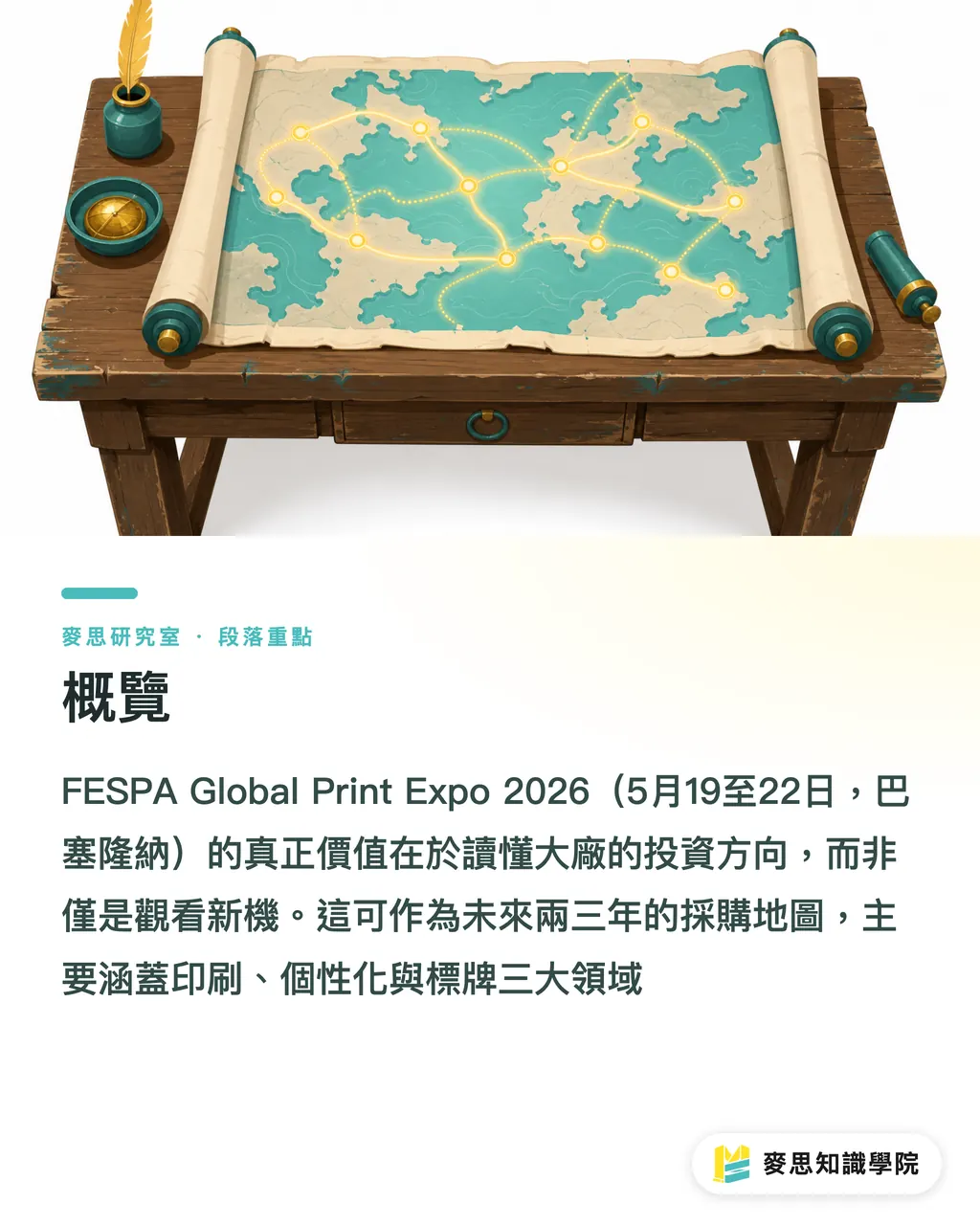
That is the real value of industry trade shows. It isn't about touching new hardware, but seeing where the big players are placing their bets. FESPA Global Print Expo 2026 runs May 19 to 22 at Fira de Barcelona, with exhibits spanning print, personalisation, and signage [1]. Treating it as a roadmap for procurement over the next two to three years is far more useful than wandering the booths
Here is a breakdown of that roadmap through four questions you will actually ask
Why Is Everyone Talking About Wide-Format Inkjet, and Does It Matter to You?
The short answer: wide format inkjet isn't new, but its position has shifted this year from a dedicated signage tool to an all-rounder spanning industrial parts and interior decor
FESPA has always been Europe's benchmark show for screen, digital, and wide format printing [1], and the organizers explicitly listed wide-format inkjet among the overall highlights this year [2]. The point isn't how much higher the resolution went, but how it is expanding into short-run industrial parts, home furnishings, and packaging prototypes. In other words, one machine can handle a much wider variety of jobs
For small and medium print shops in Taiwan, this is a structural signal. In the past, buying a wide-format machine meant printing posters, signage, and exhibition backdrops. Today, the real question is: "What jobs can this bring in that I couldn't touch before?" The payback calculation shifts from single-use amortization to multi-use amortization, which directly changes whether you should pull the trigger now
My take: if your mindset on wide-format equipment is still stuck strictly on signage, the problem isn't old hardware. Your business model is falling behind
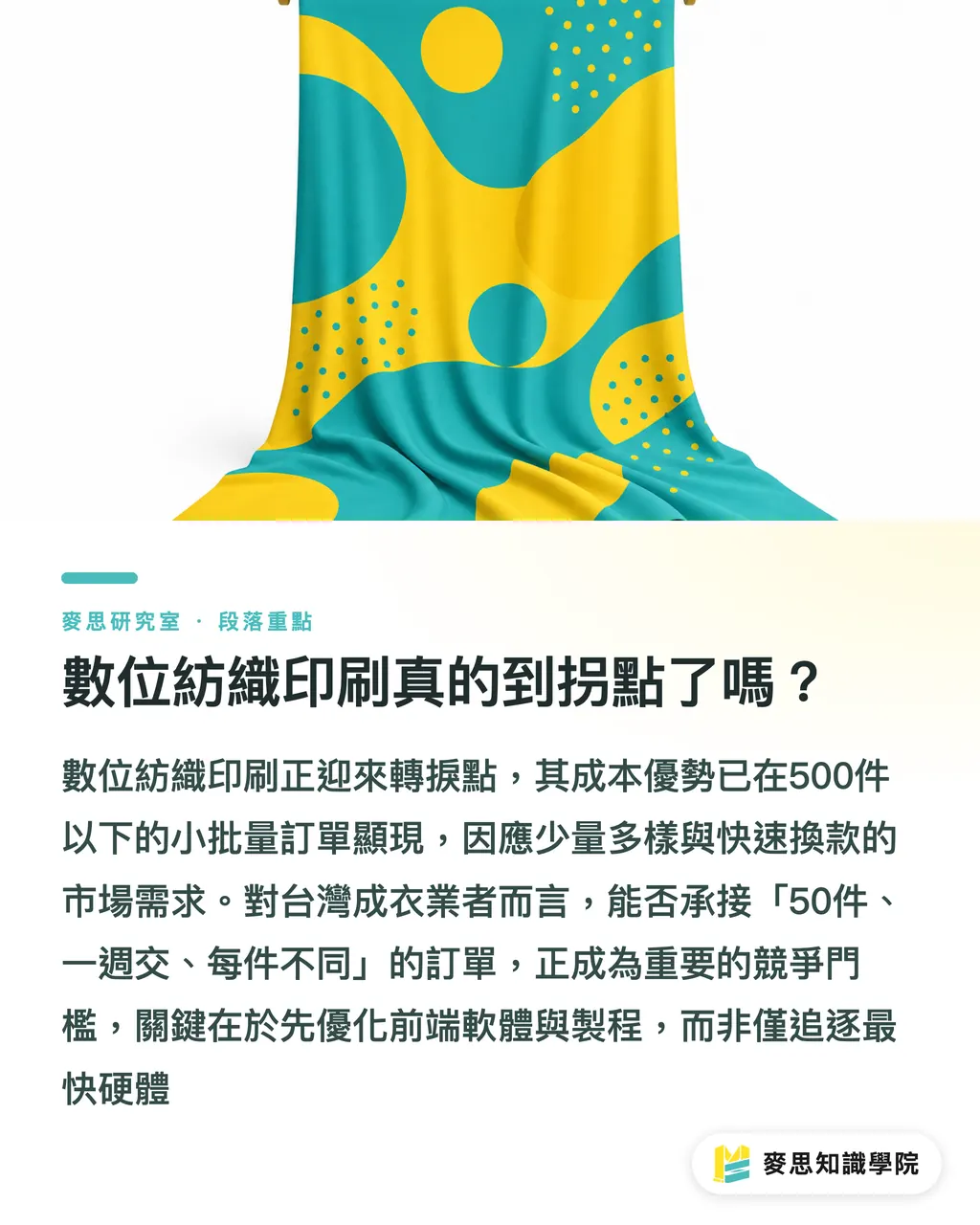
Has Digital Textile Printing Really Hit an Inflection Point?
It is worth taking seriously. FESPA 2026 put digital textile printing right into its core showcase [1][2]. This isn't just a buzzword thrown onto a banner, it is where major manufacturers are directing their resources
From my long-term observations, the real turning point for digital textile isn't in mass production. It is that the cost curve for orders under 500 pieces is flipping. This is an analytical perspective I developed by combining equipment advances, the maturity of eco-friendly inks, and rising demand for short runs, rather than an official number stated by the expo. Traditional screen printing burns money on plate fees, proofing, and color changeover time on short runs. Digital has virtually no minimum order threshold. As brands demand smaller batches, greater variety, and faster turnarounds, the crossover point on that curve keeps climbing
For Taiwan's apparel, home furnishings, and merchandise printers, this means one thing: being able to handle an order of "50 unique pieces delivered in one week" is turning into the baseline cost of entry, not a nice-to-have bonus. When evaluating the show, don't just stare at the fastest machine. Look for the workflow that stays profitable at the lowest minimum order quantities
In practice, that means getting your front-end RIP, color management, and proofing workflows dialed in before the machine even matters. Fix your software and process first, then talk hardware
Are Sustainable Materials Just Marketing Hype, or Do They Belong on Your Purchase List?
A bit of both, but the scale is tipping toward "real." FESPA 2026 clearly positioned circular materials and sustainability as central themes [1][2]
The key isn't environmentalism for its own sake, but how it connects to high-margin niches. This year's expo reveals a clear divergence: major global exhibitors are concentrating resources on high-value niches like personalised packaging and sustainable materials, pulling away from bulk commodity commercial printing [1]. In other words, sustainability isn't just a compliance cost anymore. It is becoming a premium selling point, especially with brand clients
The takeaway for Taiwanese businesses is straightforward: instead of treating recyclable substrates, mono-materials, and de-inkable solutions as passive regulatory burdens, package them proactively into "Brand ESG Solutions" when quoting jobs. Clients don't just want a sheet of eco-friendly paper. They want a story they can write into their sustainability report
Keep in mind that Taiwan's material supply chain is not fully mature yet, and switching everything overnight brings supply chain risks. A more practical approach: pick one or two flagship clients, run small-scale trials, lock down your cost and yield numbers, and then decide whether to scale up
Once You See the Trends, What Should Taiwan's Print Shops Actually Do First?
The easiest mistake is assuming you have to chase all five trends. You don't. The real signal from the expo is divergence. Major manufacturers are using niche markets to separate themselves from traditional commercial printing [1]
Step one isn't buying machines. It is picking a side. You need to be clear about which margin profile you want to pursue: do you keep competing on volume and unit price, or do you pivot toward high-margin niches like customisation, textiles, and sustainable solutions? That decision dictates which one or two trends deserve your focus, rather than spreading yourself thin
Step two is resource allocation. Once your direction is set, build up your software and process capabilities first (color management, proofing, short-run workflows) before committing to hardware investments. This sequence lets you test market demand with your existing equipment before sinking serious capital into new presses
One final pragmatic thought: the value of an event like FESPA is seeing the paths global players have already validated so you don't have to make every mistake yourself [2]. Your job isn't to copy their answers word for word. It is to look at your own customer base and pick the one or two opportunities you can actually deliver on

Key Takeaways
・FESPA 2026 (May 19-22, Fira de Barcelona) highlights center on wide-format inkjet, digital textiles, personalised packaging, and circular materials [1][2]
・The evaluation logic for wide-format inkjet needs to shift from single-use amortization to multi-use amortization, directly affecting whether you should upgrade now
・The real battleground for digital textiles is short-run production. Solidify your RIP, color management, and proofing workflows before talking hardware
・Sustainable materials are shifting from a compliance cost to a premium brand selling point, but start with small-scale pilot runs to verify cost and yield
・The core takeaway from the expo is divergence: pick your side first (volume vs. high-margin niches), then allocate resources instead of chasing everything at once
Further Thoughts
For print manufacturers, the divergence signal at FESPA 2026 means that one-size-fits-all production lines are losing pricing power. Capacity needs to be redirected toward niches that command a premium, such as textiles, sustainable materials, and custom packaging. For designers and brands, this opens the door to quoting complete solutions around sustainable substrates and short-run custom packaging rather than selling machine hours. For AI adoption and SaaS, the true bottleneck sits at the front end. In short-run digital printing, speed limits rarely come from the print engine itself, but from the workflow efficiency of color management, automated imposition, proofing, and estimating. Whoever turns that gap into scalable software services will capture the niche margin bonus. The open challenge: Taiwan's sustainable material supply chain and recycling infrastructure are still developing. Delivering on that premium brand story without running into material shortages will be the most practical test over the next two to three years
References
[2] Worldwide S. (2026). FESPA 2026: Everything You Need to Know About the Global Print Expo. DOI: 10.55277/researchhub.auzfba6r
FAQ
- Where and when is FESPA 2026 taking place?
- FESPA Global Print Expo 2026 takes place from May 19 to 22, 2026, at Fira de Barcelona in Spain. It is Europe's benchmark exhibition for screen, digital, and wide format printing [1]
- What are the major trends at FESPA 2026?
- Core highlights focus on wide-format inkjet, digital textile printing, personalised packaging, and circular (sustainable) materials, reflecting a shift by major manufacturers toward high-margin niche markets [1][2]
- Should print shops in Taiwan rush to replace their equipment based on these trends?
- Don't rush to replace anything. First decide whether you are competing on volume or targeting niches. Next, strengthen your software and process workflows (color management, proofing, short-run setups), and only then evaluate hardware investments. This keeps your risk as low as possible
- Is digital textile printing a viable move for smaller print shops?
- Yes, but the real opportunity is in short-run orders. With virtually no minimum order requirement, it lets you handle varied, fast-turnaround jobs. The key is getting your front-end RIP and color management in place first
- Are sustainable materials just marketing hype?
- Not anymore. FESPA 2026 made circular materials a core pillar tied directly to high-margin niches. It is shifting from a compliance cost into a premium selling point for brands, though running small-scale pilot tests to verify cost and yield first is strongly recommended [1][2]
References
- FESPA 2026 展覽五大趨勢:寬幅噴墨、數位紡織與永續材料全面開花 · fespa.com
- FESPA 2026: Everything You Need to Know About the Global Print Expo · doi.org
- Online News Displaces Print Newspaper: Media Students' Preferences and Perceptions · doi.org
- US Image in Print Media Cartoons: Framing Analysis of The News and The Nation · doi.org
- Global Digital & Print Media Review · doi.org
- Nations, publics, and the print news media · doi.org
Related articles





The Print × AI weekly
The print and AI know-how designers, brands and enterprises can use before they commit — one email, every week
MINDS Free Tools
Spine width and imposition calculators — skip the manual math, free in your browser.
MINDS Group
Need actual printing or gifting services?
From premium printing to online ordering and festive gifts — the MINDS Group sister brands take it from here.