
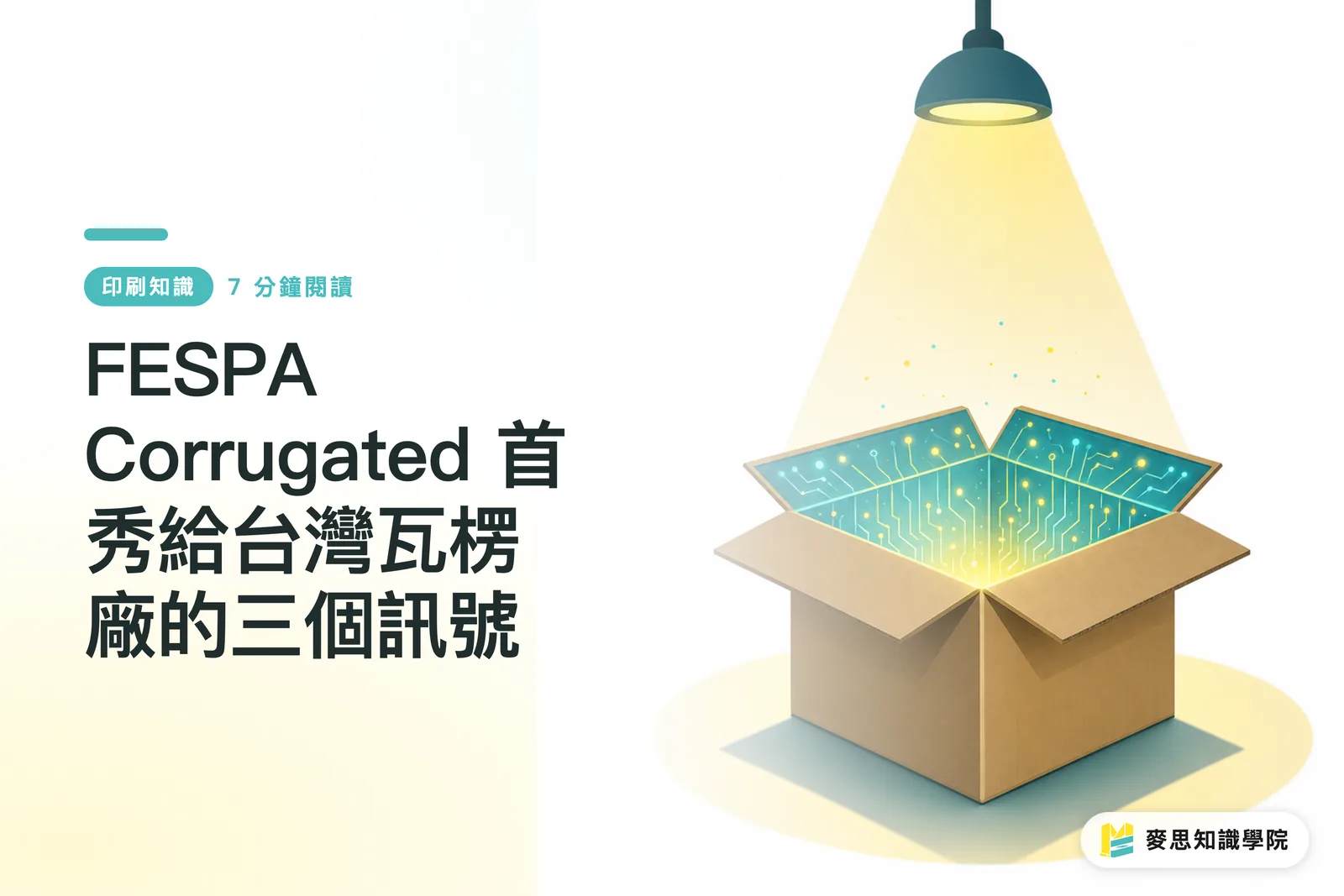
Why FESPA Created a Dedicated Corrugated Zone
This year's FESPA Global Print Expo ran for four days at Fira de Barcelona, May 19 to 22, with six co-located shows: FESPA Global Print Expo, European Sign Expo, Personalisation Experience, WrapFest, Textile, and the debut Corrugated. It marked the first time FESPA pulled corrugated out of its role as "just one application area under wide-format printing" and gave it a standalone show
The underlying signal is unmistakable. Corrugated used to be the turf of major paper mills and tier-one box plants, where a single press could run into the tens of millions and the conversation felt distant for most mid-sized printers. But over the past few years, digital inkjet corrugated presses have scaled all the way down from B1 and B2 to compact sheet-fed footprints, so much so that a UV digital press paired with a flatbed cutter is now enough to stand up a short-run line. FESPA spotted the gap: a show where mid-sized corrugated converters can "explore new opportunities without having to walk into the big international paper-mill circus."
Key numbers (released by FESPA):
・The Corrugated zone attracted 1,257 professional buyers from 40 countries
・71% of attendees were directors, CEOs, owners, or managers
・71% held final decision-making authority
・The collective median purchasing budget reached €177M
Even FESPA didn't anticipate this kind of density from a first-year sub-show. Corrugated ambassador Nick Kirby said publicly after the event: "I've been waiting for this show for a long time, and judging by the turnout, we've delivered a very successful debut."
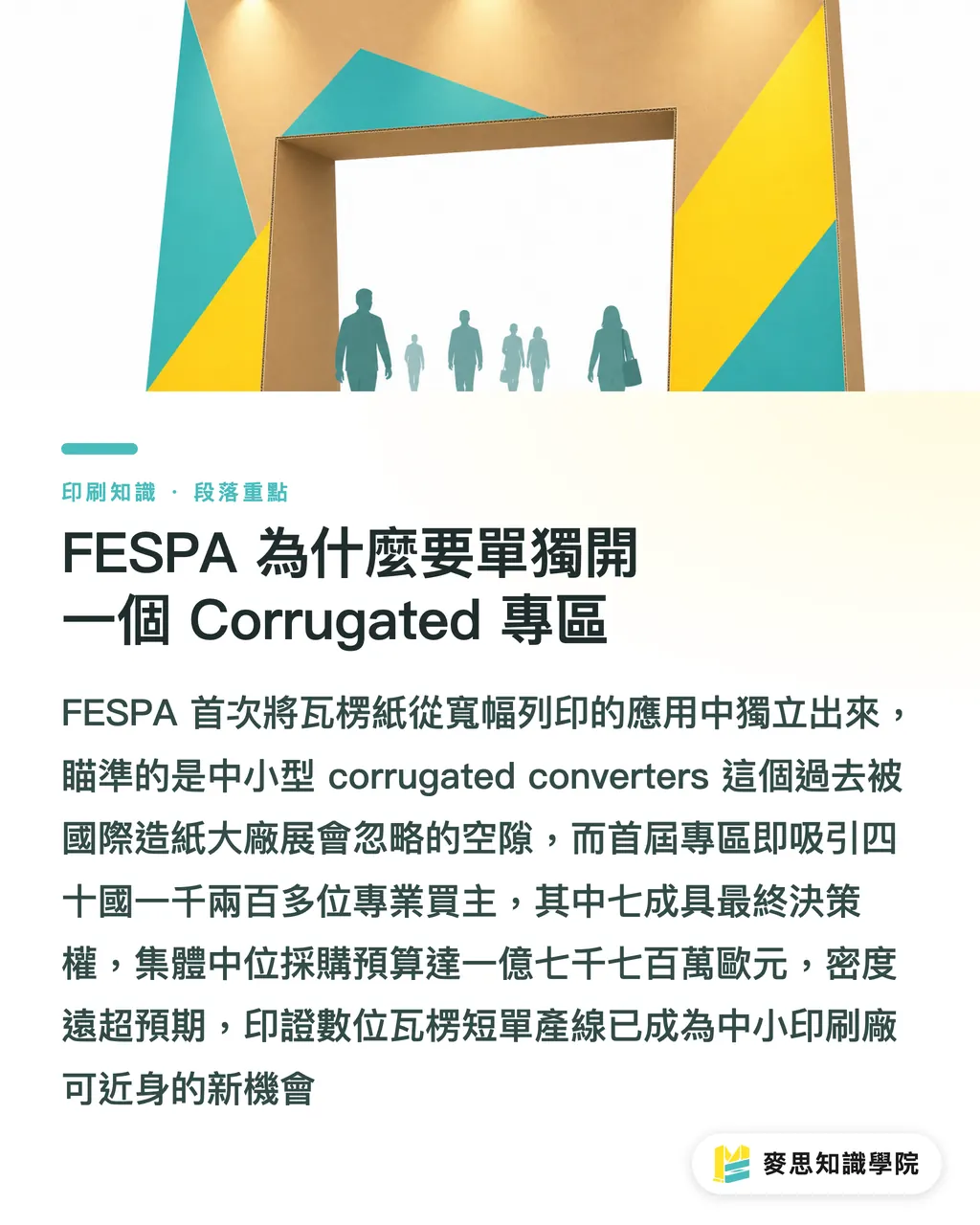
What Pain Points in the Traditional Workflow Does Digital Corrugated Actually Solve?
Anyone who has run a conventional corrugated box plant knows the pain:
・Plates mean proofing, color matching, and waiting for anilox delivery, which makes short runs uneconomical
・Minimum order quantities routinely run into the thousands, so brands running A/B packaging tests, region-specific SKUs, or seasonal short runs simply can't play
・From sign-off on the design to a physical box in hand: two weeks if you're fast, a month if you're not
・POS/POP displays, which demand design quality, structural integrity, and fast iteration, are essentially out of reach for conventional flexo
Once digital corrugated entered the picture, the changes became structural:
・No plates: inkjet direct printing eliminates proofing and anilox costs
・No MOQ: single-unit prints are viable, perfect for samples, limited editions, and event runs
・No long waits for platemaking: sign-off to press can be compressed to 24 to 48 hours
・Variable data: every box can carry a different serial number, promotional message, or regional version, and the press never stops
That is why the digital press makers already embedded in the FESPA community, Canon, Durst, EFI, HP, and Kongsberg Precision Cutting Systems, all showed up this year. Traditional corrugated heavyweights such as Bobst, Koenig & Bauer, ePS, and Advantive also came in. Digital and conventional having that conversation in the same hall is the single image most worth remembering from Corrugated's debut
Bobst's marketing and communications manager Frederic Goudard put it plainly: "It is a key platform for exchanging insights, exploring trends, and strengthening the relationships that are shaping the future of packaging."
What Do These Signals Mean for Taiwan's Mid-Sized Printers and Box Plants?
Translating those 1,257 buyers, the €177M budget, and the 71% senior decision-maker share into a Taiwan context, I see three signals:
Signal one: the market center of gravity is shifting from volume to value
For the past decade-plus, Taiwan's corrugated converters have chased high-volume, low-margin OEM work, with margins so thin that survival depends on paper and freight prices. The buyer profile FESPA drew tells a different story: European and U.S. brand owners are now willing to pay a premium for speed-to-market, design quality, and variable data. Scodix COO Amit Shvartz said it on the floor: the reason they exhibited was to "build connections with key decision-makers, strengthen customer relationships, and showcase the latest innovations." When a digital finishing vendor treats the corrugated show as a flagship booth, it tells you the market is buying value-added services, not the box itself
Signal two: the entry barrier for digital corrugated presses has dropped into range for mid-sized converters
The machines Canon, Durst, and EFI pushed at FESPA were predominantly UV digital corrugated presses in mid-sized footprints, paired with Kongsberg flatbed cutters, essentially one press plus one cutter equals a short-run production line. For Taiwan's mid-sized shops, the capital barrier is no longer the old "grit your teeth and spend tens of millions of NTD" level. It has come back down to the scale of a UV direct printer plus ancillary equipment
Signal three: the door from carton OEM to branded packaging is now open
POS/POP displays traditionally split work between box plants handling structure and printers handling the skin, with each side owning its piece before final assembly. Digital corrugated lets a single vendor print both structure and skin in one pass, and the intermediate steps disappear. What that means for Taiwan's mid-sized players: you don't have to fight the big box plants for volume; you have to win brand owners over to a "design-to-shelf, one-stop" workflow. Canon EMEA marketing and innovation director Mathew Faulkner summed it up well on site: "FESPA is the best stage for showcasing how digital printing's on-demand productivity spans multiple vertical markets."

How Taiwan's Players Can Respond Over the Next 24 Months
Don't read FESPA as news; read it as an order-signal map. Concrete moves that can land:
・Run a health check on your existing UV flatbed or UV roll-to-roll press: can it be re-inked, re-plated, or re-headed, and fitted with a heavy-stock feeder, to take on corrugated skin printing? Many of these machines share common platforms, and a heavy-stock transport kit is often enough to add corrugated capability
・Pick 2 to 3 local brand customers and pilot limited editions, event runs, and region-specific short-run packaging. Don't buy a machine first; outsource the work to validate the per-unit economics
・Invest in a flatbed cutter paired with your existing line, and make "print and cut POS/POP displays in one pass" a hero product. It is the sweet spot that traditional box plants find hardest to enter and digital printers find easiest to win
・Build an internal workflow from design intake to press in parallel. Compressing the "client revision to press" cycle to under 24 hours is the real competitive moat in digital corrugated, more important than the machine itself
・Track sustainability and FSC-certified substrates. European buyers' demands for recycled content and low-carbon coatings will only tighten, so the earlier you map your substrate supply chain, the smoother orders will flow
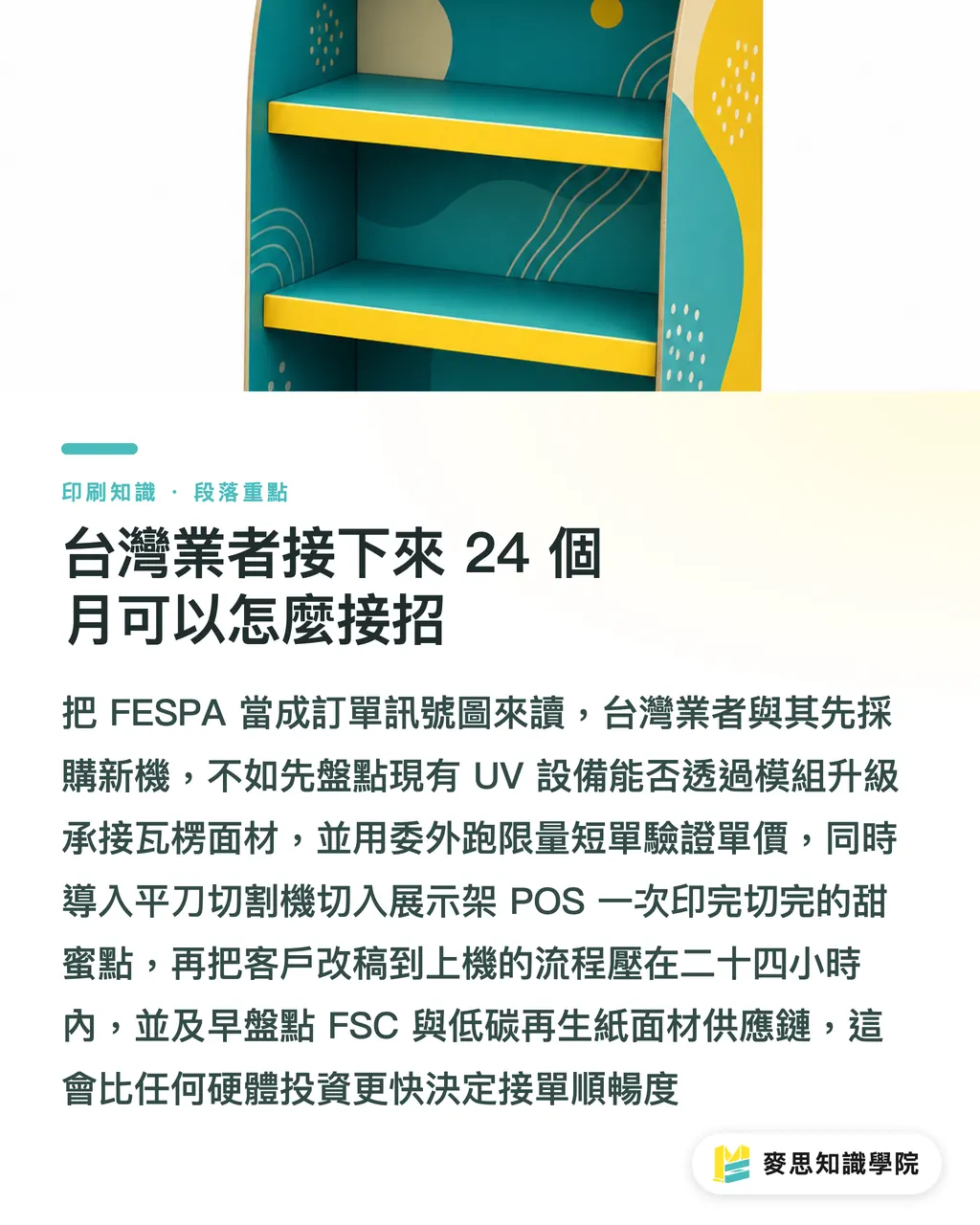
Key Takeaways
・Digital corrugated opens short-run, limited-edition, and variable-data packaging to mid-sized converters for the first time, and the old platemaking barrier no longer holds
・FESPA Corrugated's debut drew 1,257 buyers, 71% senior decision-makers, and a €177M median budget, evidence that European and U.S. brand buyers are shifting procurement focus from volume to value
・A digital corrugated press paired with a flatbed cutter is now within reach of mid-sized shops. The differentiator is not the hardware but the "design-to-press in 24 hours" workflow
・The opportunity for Taiwan's converters is not chasing big carton volume but owning the new workflow around displays, branded packaging, and short runs
・Sustainable and certified substrates are the hidden ticket for landing European and U.S. orders, and the earlier you map them, the better
Further Reflections
From what I've seen on production floors and on the client side, this wave of corrugated digitalization will not stop at the print stage; it will pull upstream as well. Brand-side design teams need to retrain their instincts for a workflow where there is no longer a proof-and-plate wait before going on press. Package designers will need to start thinking about "how does this artwork jet onto heavy stock instead of coated paper?" Print shops will need to redefine themselves from "OEM" to "brand packaging consultant." For MINDS, this is exactly the right moment to integrate front-loaded design, prepress file prep, digital corrugated printing, and flatbed cutting into one end-to-end service, turning "find three vendors" into "find one." For Taiwan's mid-sized converters, now is not the time to sit on the fence. It is the time to run one or two brand short-run pilots at the smallest viable scale, validate per-unit economics and delivery commitments, and build a track record. By the time European and U.S. buyers fold digital corrugated into their regular supply chains around 2027, shops without a pilot case under their belt will find themselves locked out
Further Reading
FAQ
- What is FESPA Corrugated, and why was it launched this year?
- FESPA Corrugated is a dedicated corrugated zone debuting at FESPA Global Print Expo 2026 in Barcelona, running May 19 to 22 alongside five other co-located shows. It is designed to give mid-sized corrugated converters their own platform, with a focus on the growth opportunity for digital printing in high-value, short-run packaging and point-of-sale displays
- How is digital corrugated printing better than traditional flexo?
- Digital corrugated uses inkjet direct printing, so there are no plates, no proofing, and no minimum order quantity. Design sign-off to press can be compressed to 24 to 48 hours, and every piece can carry different variable data, which makes it ideal for limited editions, region-specific runs, A/B test packaging, and short-run POS displays
- Is it too early for Taiwan's mid-sized printers to jump into digital corrugated now?
- Based on the mid-sized UV digital corrugated presses Canon, Durst, and EFI featured at FESPA this year, the entry cost has come down to the level of one UV direct printer paired with a flatbed cutter. The recommended path is to outsource 2 to 3 brand short-run pilots first to validate per-unit economics before committing to a machine purchase
- Why are POS/POP displays the sweet spot for digital corrugated?
- Displays demand design quality, structural integrity, and fast iteration, which conventional flexo struggles to deliver. Digital corrugated lets a single vendor print and cut both skin and structure in one pass, eliminating the handoff cost between box plants and print shops, and making it the easiest high-value category for mid-sized converters to enter
- What should converters watch for when taking on European and U.S. digital corrugated orders?
- Beyond press model and line configuration, the priority is mapping out the supply chain for sustainable and FSC-certified substrates up front. European buyers' requirements for recycled content and low-carbon coatings will only get stricter, and substrate readiness is the hidden ticket to winning those orders
References
- FESPA Corrugated 首秀成功:數位印刷如何重塑瓦楞包裝與展示架價值鏈 · fespa.com
Related articles



The Print × AI weekly
The print and AI know-how designers, brands and enterprises can use before they commit — one email, every week
MINDS Free Tools
AI background removal, a LINE sticker maker, spine & imposition calculators — all free, right in your browser, no upload.
MINDS Group
Need actual printing or gifting services?
From premium printing to online ordering and festive gifts — the MINDS Group sister brands take it from here.