

Overview
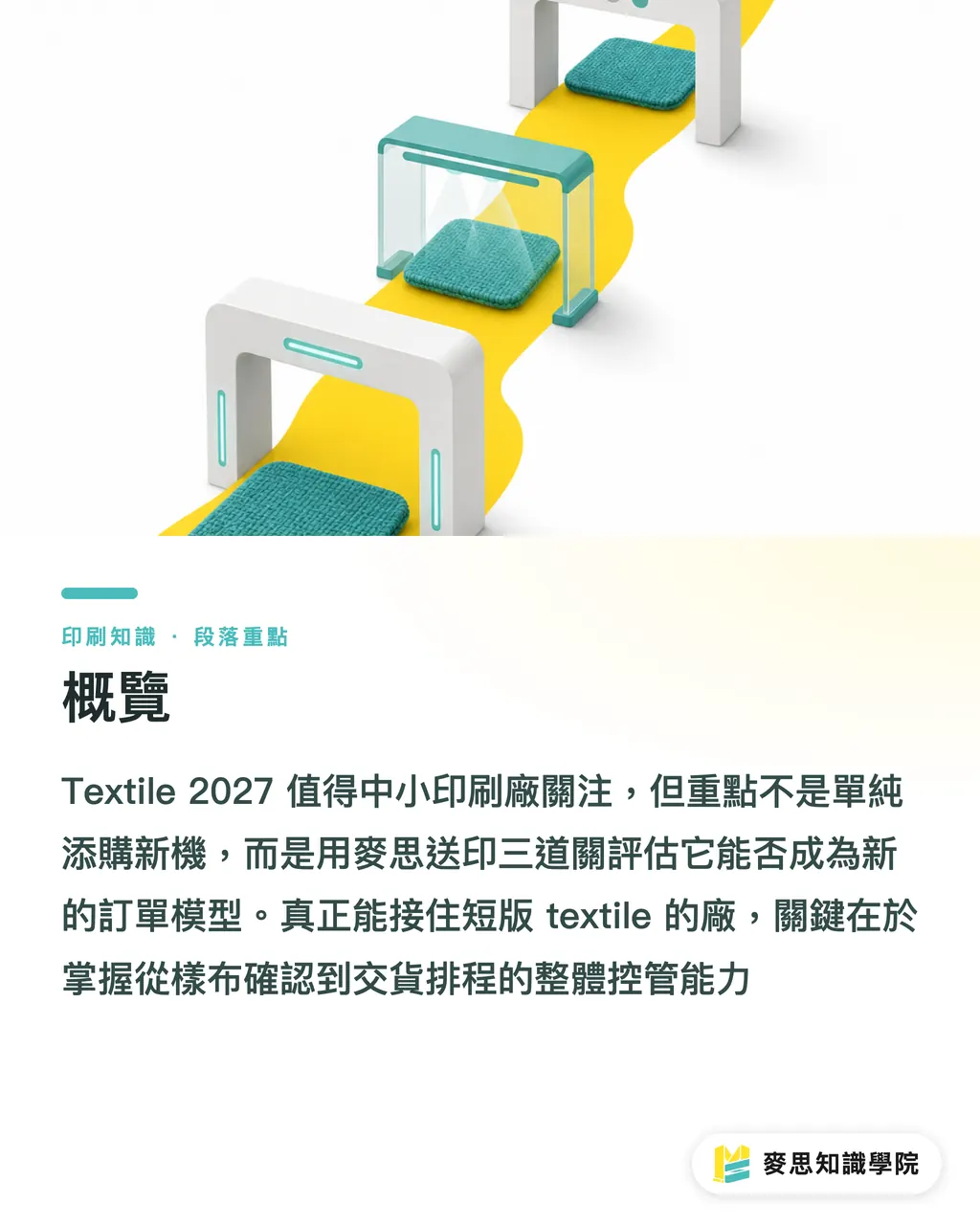
Small and mid-sized print shops should pay attention to Textile 2027. But first, use the MINDS (MS, mid-to-high-end fully custom commercial printing) three-stage prepress checklist to evaluate it as a new order model, rather than equating Textile 2027 directly with buying a new machine. Shops that succeed with short-run textiles win on their ability to control the process from swatch sampling all the way to delivery
Why Should Small and Mid-Sized Print Shops Care About Textile 2027?
In Why You Should Exhibit at Textile 2027, FESPA pitches Textile 2027 as an event that needs to convince buyers to show up on its own merits. To me, that is a clear industry signal: textile printing has shifted from a side exhibit at massive trade shows into a sector that demands its own dedicated procurement language
The official marketing targets both exhibitors and visitors, which means at least 2 key groups will be on the floor:
・Suppliers: looking to showcase textile printing equipment, inks, pre-treatment, and finishing solutions
・Buyers: looking for solutions in short-run apparel, soft signage, home decor, and branded merchandise
I have noticed a similar trend among clients recently. The short-run merchandise brands want looks less and less like traditional promotional swag. Common requests usually fall into these 3 categories:
・50 staff shirts
・100 event tote bags
・1 fabric backdrop for an exhibition booth
All these requests ask the exact same question: can the print shop turn a graphic design into a product that will be worn, touched, and washed?
How Is Textile Printing Actually Different from Standard Inkjet?
Digital textile printing sprays graphics onto fabrics or transfer media, followed by pre-treatment, color fixation, and finishing so the final piece holds up to end-user demands
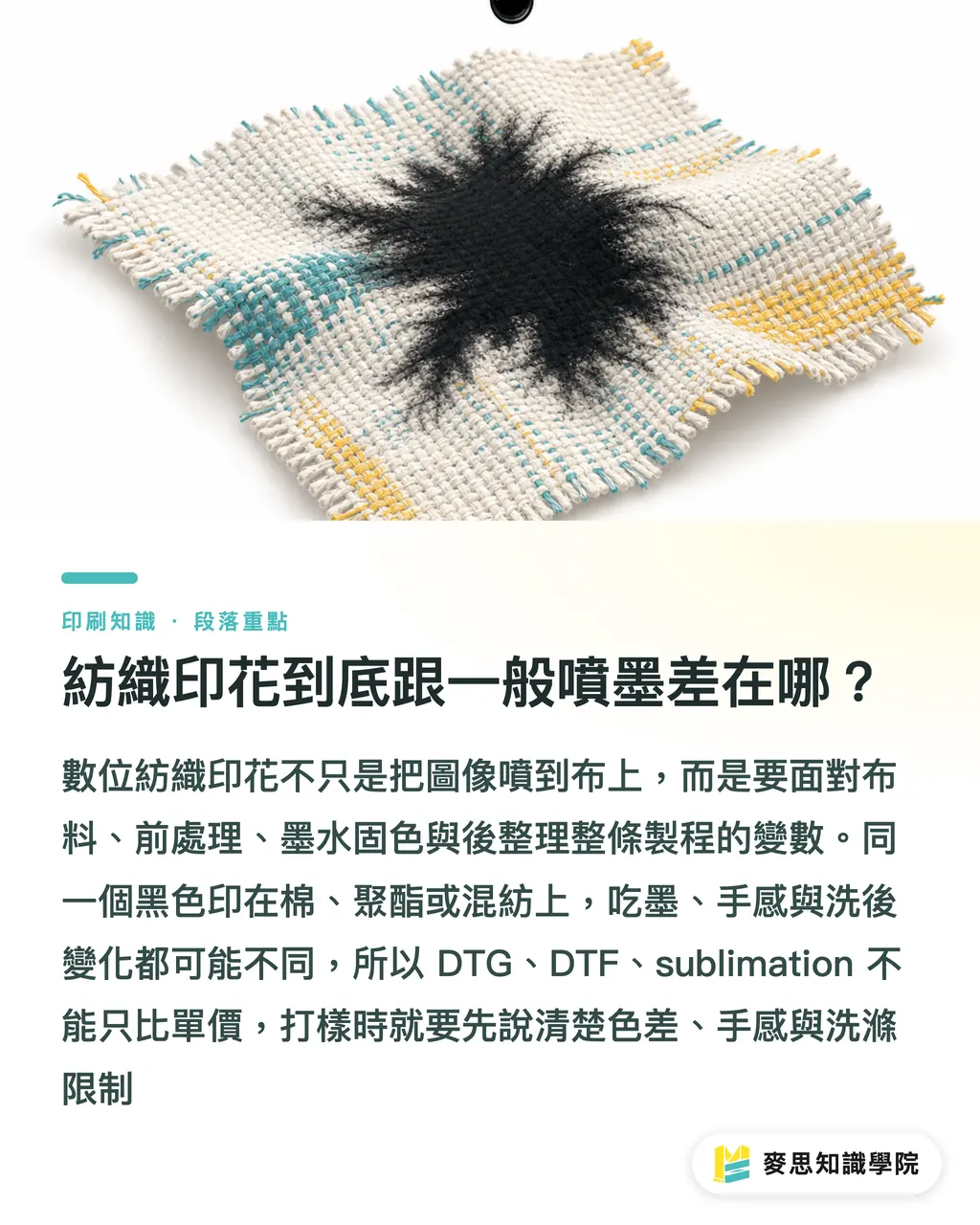
Paper gives you a relatively stable flat surface, while fabric brings material quirks. The exact same black will show different ink absorption, hand feel, and post-wash behavior across cotton, polyester, and blends
Risks in textile printing usually bottleneck at 4 stages:
・Fabric: The same artwork shifts in hue and hand feel across different fabric types
・Pre-treatment: If the fabric surface is poorly prepped, dark tones will look faded or patchy, and fine lines will feather
・Inks and fixation: DTG, DTF, and dye sublimation differ in cost, hand feel, and durability requirements
・Finishing: Outsourcing cutting, sewing, heat pressing, or packaging can easily drag out turnaround times
This is why you cannot compare DTG, DTF, and dye sublimation on unit price alone. If a client wants to test the market with 30 T-shirts, the print shop must clarify hand feel, color tolerance, and washing limitations right at the sampling stage
Which 5 Thresholds Should Small and Mid-Sized Shops Check First?
When evaluating textile printing investments, I start with 5 core thresholds. Buying machinery comes later
・Equipment threshold: Can your current space, power supply, ventilation, and staff handle textile production workflows?
・Ink threshold: Which fabrics does the ink work on? Clarify color gamut and durability specs upfront
・Pre-treatment threshold: If pre-treatment is inconsistent, no printhead quality can save the output
・Finishing threshold: Heat pressing, curing, cutting, sewing, and packaging dictate final delivery quality
・Order-intake threshold: Short-run custom jobs require fast quoting, sampling, artwork adjustments, and production scheduling
Under 500 pieces is the short-run baseline I frequently use. This number is not an ironclad market rule, but a reminder to shop owners that the most overlooked costs in short-run jobs hide in back-and-forth communication and floor scheduling
The MINDS (MS) three-stage prepress checklist can be applied to Textile 2027 trade show visits and investment reviews like this:
・① Material gate: Lock down 1 fabric type and 1 primary printing method first. Do not try to accept every job right out of the gate
・② Color gate: Set up swatch sampling, color delta tolerances, and client sign-off workflows early
・③ Delivery gate: Bake finishing, packaging, and lead times directly into your quotes, rather than renegotiating after problems crop up
For high-ticket commercial print projects paired with soft goods, MINDS (MS) recommends narrowing down production-ready specifications to 1 or 2 SKUs. If a project is just testing the waters, MYS is ideal for running low-volume, standardized merchandise to test templates, artwork files, and ordering habits
How Can Brand Clients Put Short-Run Textiles to Work?
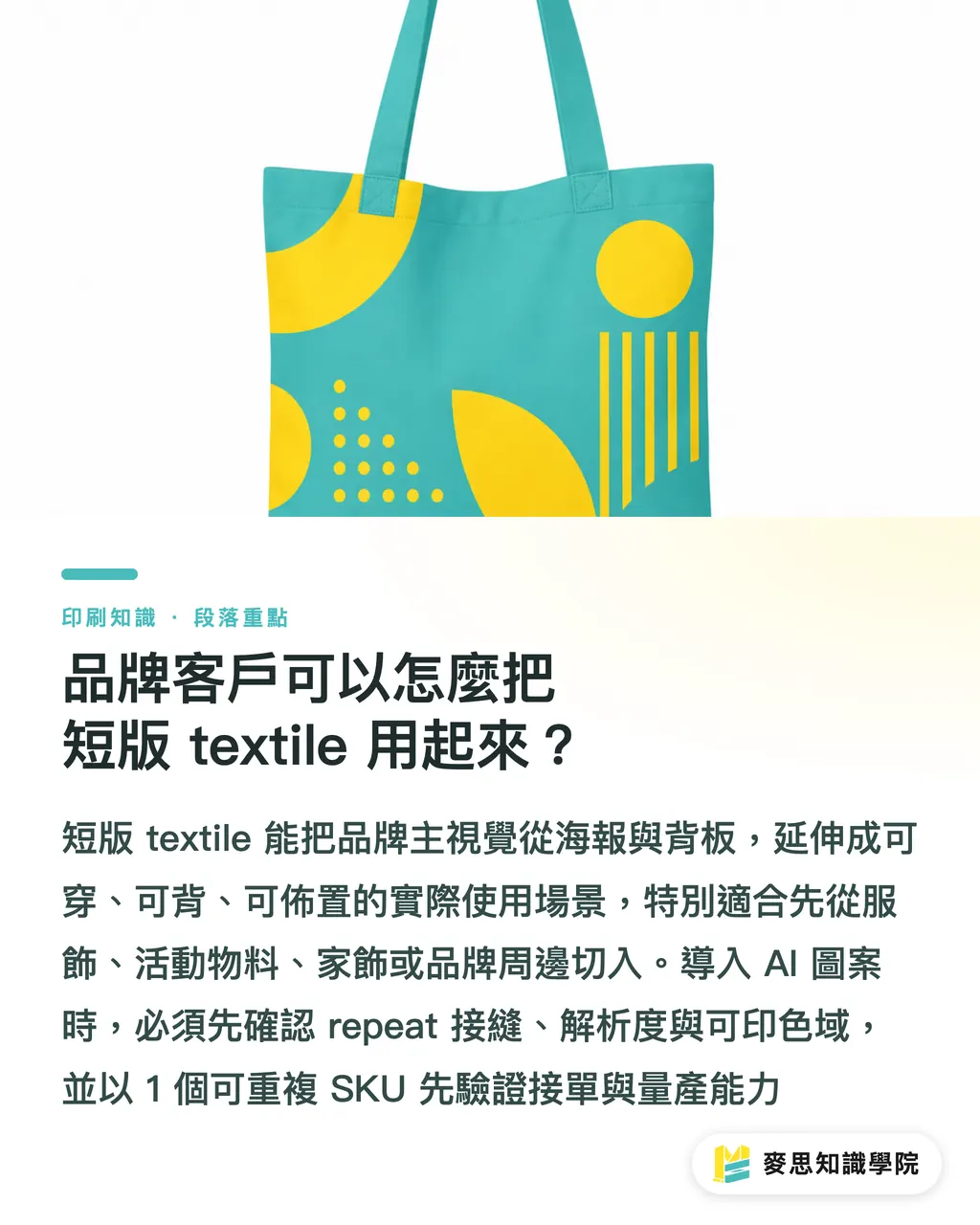
For brand clients, the real value of textile printing lies in extending design from a visual identity into everyday use cases. An event key visual that once lived only on posters and foam boards can now turn into products people wear, carry, or place in a room
Short-run textiles fit best across 4 project types first:
・Apparel: Staff uniforms, event T-shirts, limited-edition tops
・Event materials: Fabric banners, tablecloths, soft backdrops for exhibitions
・Home decor: Cushion covers, wall tapestries, low-volume interior soft furnishings
・Branded merchandise: Canvas tote bags, drawstring pouches, VIP member gifts
AI-generated patterns help brands create rapid pattern variations and mockups, but textile printing magnifies artwork flaws. Before feeding AI graphics into textile print production, I ask designers to review at least 3 things:
・Pattern repeat seams must be seamless; do not rely on a single isolated preview
・Resolution must hold up at actual printed dimensions
・Check the printable color gamut against the fabric and printing method instead of mistaking screen brightness for final product color
When prioritizing budget, I put regulatory compliance, sustainable materials, and yield rates on existing lines first. Textile 2027 fits well as a secondary growth curve heading into 2027, using 1 repeatable SKU to prove your production capabilities first
Key Takeaways
・Textile 2027 is worth watching because FESPA has positioned textile printing into its own standalone sourcing arena
・As textile printing heats up, the real test is whether you can reliably repeat the process from swatch sampling to delivery
・For short-run jobs under 500 pieces, factor in sampling time first. An attractive unit cost alone is rarely enough
・Brand clients want deliverable SKUs, not just the shiniest print samples on a trade show floor
・Run prepress checks before sending AI patterns to textile production; do not leave rework to the shop floor
Further Considerations
Practical advice for print production, design, AI implementation, and SaaS teams boils down to this: turn 1 textile SKU into a clear workflow for quoting, sampling, and delivery. The print shop locks down fabrics and printing methods, designers incorporate pattern repeats and gamut limits into their artwork checklists, AI tools focus on pattern variations and mockups, and SaaS platforms turn materials, MOQs, lead times, and finishing options into selectable parameters. Moving textile printing from manual estimating to a manageable product lineup does not start with massive capital investment. It starts with pinning down the specifications
Further Reading
FAQ
- Should small and mid-sized print shops visit Textile 2027?
- Yes, but treat Textile 2027 as a trade show for evaluating textile order fulfillment models, not just equipment specs. First verify whether you can reliably handle sampling, quoting, and delivery for short-run fabric jobs
- What is the difference between digital textile printing and standard wide-format printing?
- Digital textile printing involves ink absorption, pre-treatment, color fixation, and finishing on fabric. Standard wide-format printing mostly focuses on flat dimensions and output media. The primary operational risks sit in entirely different places
- Which textile products should brand clients start with?
- Brand clients should start with low-volume textile merchandise for a single event or sales channel. Validate the design, hand feel, lead time, and reorder interest first before scaling up
- Can AI-generated patterns be sent straight to textile printing?
- No, AI-generated patterns cannot go directly to print. Designers need to check resolution, pattern repeats, and the printable color gamut first. Otherwise, an image that looks great on screen may fail during heat pressing or wash testing
- How should clients choose between MINDS and MYS?
- For highly customized commercial jobs requiring material consulting and specialty finishing, work with MINDS (MS). For low-volume, standardized merchandise to test the market, start with MYS
Related articles


The Print × AI weekly
The print and AI know-how designers, brands and enterprises can use before they commit — one email, every week
MINDS Free Tools
Spine width and imposition calculators — skip the manual math, free in your browser.
MINDS Group
Need actual printing or gifting services?
From premium printing to online ordering and festive gifts — the MINDS Group sister brands take it from here.