
Executive Summary
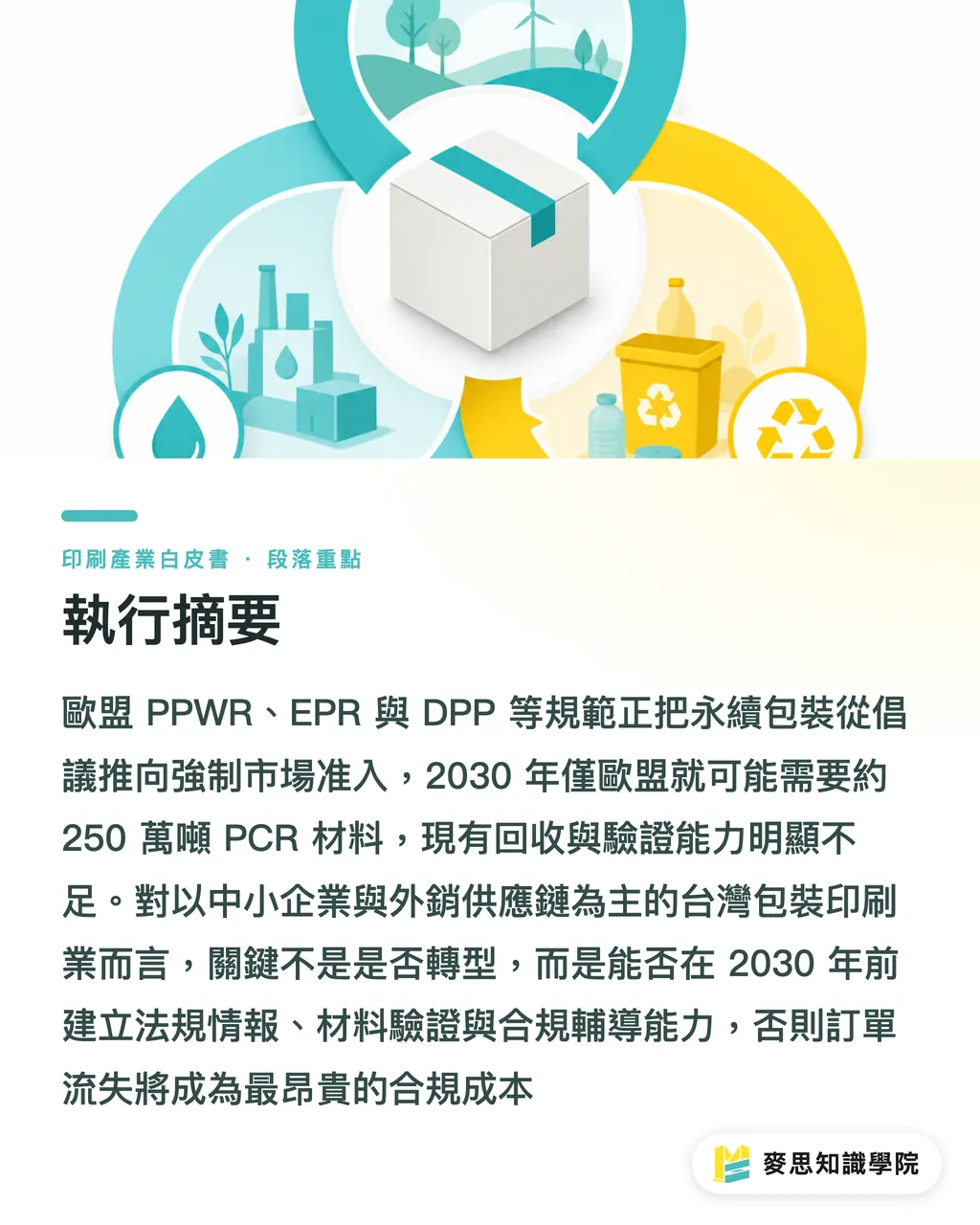
The EU Packaging and Packaging Waste Regulation (PPWR) and Extended Producer Responsibility (EPR) schemes have shifted from policy initiatives into binding timelines, becoming the most mandatory market access hurdles for the global packaging and printing industry over the next decade. A recent CEFLEX report indicates that merely meeting the PPWR 2030 recycled content target will require roughly 2.5 million tonnes of post-consumer recycled (PCR) materials in the EU market, climbing to 5.9 million tonnes by 2035. Current recycling infrastructure and supply fall far short [28]. Meanwhile, the EU Digital Product Passport (DPP) has targeted textiles and apparel for early mandatory compliance, pushing the label sector from supplying raw materials to offering integrated digital services [66]. The EU Deforestation Regulation (EUDR) also puts compliance pressure on Taiwan's export paper supply chain [84]. Taiwan's packaging and printing sector is made up mostly of SMEs and relies on export supply chains as its lifeline, yet it lacks a unified regulatory intelligence system, domestic PCR verification capacity, and affordable compliance guidance. This white paper argues that between 2026 and 2030, the government should establish a three-track policy framework spanning regulatory intelligence, material verification, and transformation support, run jointly by the Industrial Development Administration under the Ministry of Economic Affairs, the Ministry of Environment, and industry associations. Inaction means that when PPWR recycled content mandates take full effect in 2030, Taiwanese plants unable to provide certified proof of recycled content and recyclable design will lose orders in the EU and following markets. The cost of non-compliance will hit industry output and jobs through lost business rather than guided investments. Five priority actions stand out: set up a sustainable packaging regulatory intelligence and early-warning platform, advance domestic PCR testing to align with global standards, roll out dedicated SME compliance support, build technical service capabilities for Digital Product Passports, and integrate packaging reduction and waste management into industrial competitiveness benchmarks
Policy Problem Definition
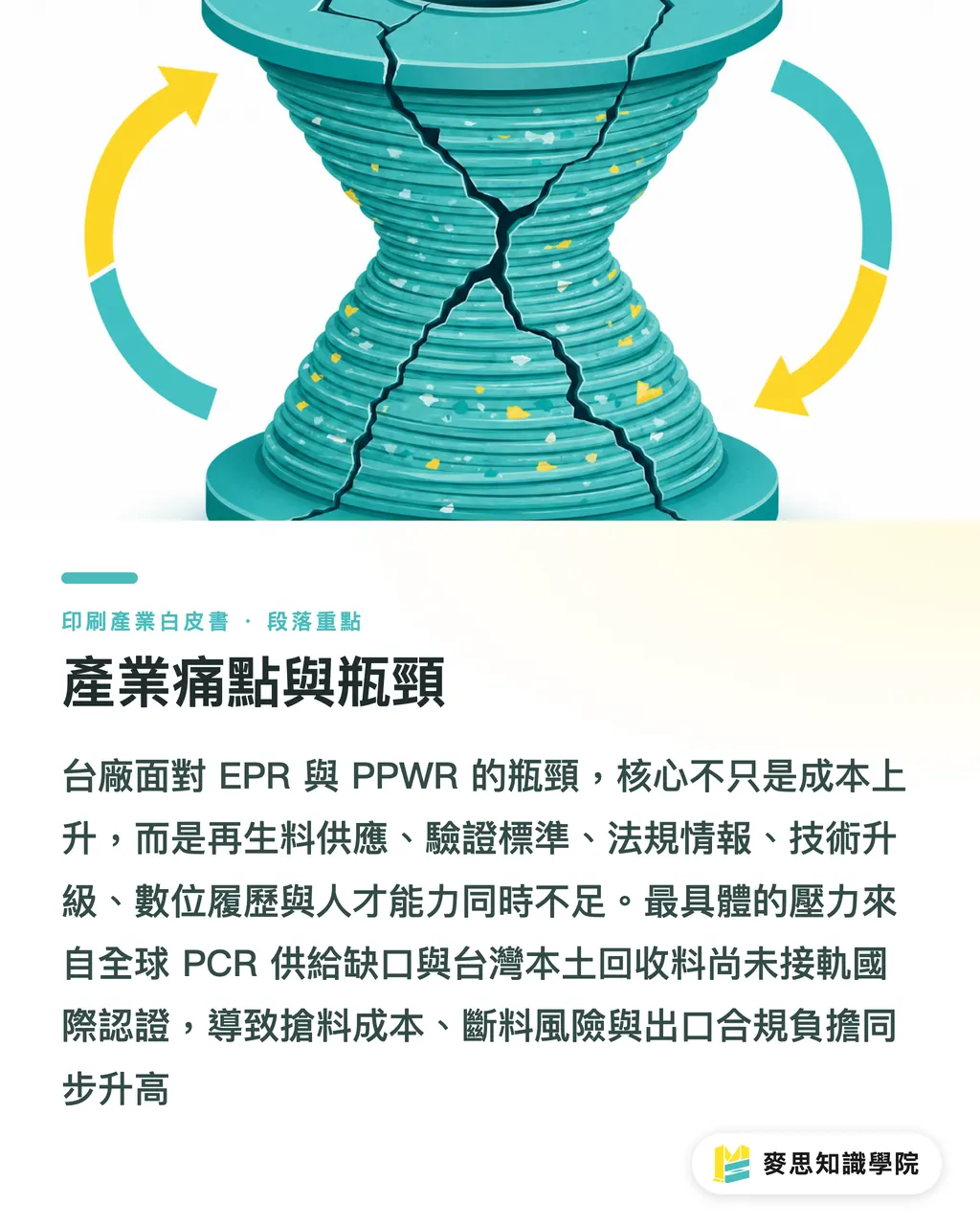
The core policy issue defined here is clear: international sustainable packaging rules are turning mandatory faster than Taiwan's packaging and printing industry, especially its SMEs, can handle on its own
Here is the breakdown of the problem. PPWR sets legally binding targets and timelines for recycled content, design for recycling, and packaging reduction, while EPR frameworks internalize end-of-life packaging treatment costs into producers and brand owners [28][53]. These obligations cascade down through procurement clauses, landing on midstream packaging printers and label converters. Most Taiwanese operators are not directly subject to EU jurisdiction, yet they bear the actual burden of compliance, creating a split structure where offshore regulations generate domestic costs
Five dimensions drive this problem. On the market side, brand demand for recyclable packaging is surging, and material specs are shifting fast. For example, wash-off label adhesives have become a mandatory entry ticket in the wine and spirits market [53]. On the technical side, high-PCR films, barrier coatings, and design for recycling carry high technical barriers, leaving Taiwanese SMEs without independent R&D muscle. On the supply chain side, global PCR materials face severe shortages, with a 2.5-million-tonne deficit projected by 2030 [28]. Taiwanese plants hold little bargaining power in the global race for feedstock. Regional conflict in the Middle East has also driven up petrochemical raw material and logistics costs, adding procurement volatility [32][24]. On the information side, legal texts are scattered across the EU, member states, and following nations. SMEs cannot track these changes alone and currently rely on sporadic updates from trade groups, such as CAGST warnings on EUDR [84]. On the digital side, DPP requires digital traceability across the product lifecycle, but RFID and digital ID integration among Taiwanese label makers remains concentrated in just a few large players [66]
Intervention is necessary for three reasons:
・First, regulatory intelligence and standards verification are non-excludable public goods, meaning single-firm investments cannot be kept private, which leads to chronic market under-supply
・Second, SMEs make up the overwhelming majority of Taiwan's printing industry, and individual compliance costs far exceed what they can afford, creating a classic market failure in green transitions
・Third, packaging and printing serves as the shared backbone for major export industries including food, cosmetics, and electronics. Its compliance capability generates cross-industry externalities, making it essential infrastructure for national export competitiveness
Industry Landscape and Trends
This section maps how sustainable packaging regulations ripple through the industry supply chain, using data to anchor key trends
Supply chain tiers face distinct impacts. Upstream (paper, inks, films, adhesives, and machinery): Materials absorb the most direct regulatory shock. Major global suppliers have already staked out turf with technical innovations. Fedrigoni launched label adhesives that deliver both permanent adhesion and clean bottle wash-off to satisfy PPWR and EPR requirements [53]. Living Ink brought carbon-negative algae black pigments into food packaging [5]. INX and Koenig & Bauer teamed up on LED-UV technology that cuts curing energy and carbon emissions [43]. Midstream (prepress, printing, and finishing): Greener production processes have become battlegrounds for certification. Asahi Photoproducts won the FIA UK Gold Award for Environmental Sustainability with its closed-loop flexo plate wastewater recycling system, showing that effluent management is now scored in procurement [37]. Downstream (brands, food, beverages, e-commerce, and textiles): Brand owners take the initial hit from compliance rules, passing EPR fees and PPWR technical specs onto suppliers through purchasing agreements [53][66]. Support systems (trade groups, research institutes, testing bodies, and vocational training): Taiwanese organizations like CAGST currently interpret incoming regulations [84][49], but they lack systematic funding and resources
Three key data points define the scale of this shift:
・First, the recycled material gap: EU PPWR recycled content targets represent a demand for roughly 2.5 million tonnes of PCR by 2030 and 5.9 million tonnes by 2035. Severe supply shortages will drive up feedstock prices and accelerate the market for recycled plastics [28]
・Second, technical feasibility is proven: An Alliance to End Plastic Waste report confirmed that post-consumer flexible plastics processed through advanced mechanical recycling can yield over 30% recycled content, proving suitable for demanding films such as shrink sleeves and labels [52]
・Third, a material shift toward fiber: Recent research projects that fiber-based food packaging will grow from 37% global market share today to 42% by 2045, surpassing plastic as the dominant category. Breakthroughs in barrier coatings, stricter environmental rules, and consumer preferences are driving this change [67]
Globally, sustainability is moving from carbon footprint declarations to measurable circular economy metrics, with waste reduction emerging as a deciding factor in buyer procurement [18]. AI-assisted design has cut packaging material usage by up to 55%, proving that reduction mandates can align with cost-cutting goals [59]. Regionally, the European label sector names agility, sustainability, and differentiation as its three core strategic capabilities in post-recovery growth [7], while the UK BPIF industry outlook lists regulatory pressure as a primary market variable for 2026 [81]. Across Asia, Shanghai rolled out local standards for remanufactured consumables, signaling that China is turning green printing from an advocacy topic into formal rules that could set the tone across the Asia-Pacific [10], which directly affects Taiwanese exporters
Industry Pain Points and Bottlenecks
This section breaks down nine bottlenecks Taiwanese manufacturers face under EPR and PPWR across five elements: position, target group, root cause, impact, and policy intervention viability
・Recycled material supply bottleneck: Occurs in upstream material sourcing. Affects flexible packaging and label converters. Root cause is the global PCR deficit (2.5 million tonnes by 2030) alongside Taiwan's domestic recyclate lacking international accreditation [28]. Impact includes soaring feedstock costs and supply interruption risks. Policy intervention viability is high, achievable by aligning domestic collection with international certification
・Material testing and standards bottleneck: Occurs within support systems. Affects all export-oriented converters. Root cause is the lack of local testing capacity in Taiwan for PPWR recycled content and design-for-recycling metrics, forcing converters to send samples abroad. Impact involves high testing fees and long lead times. Policy intervention viability is high, representing a classic public infrastructure project
・Regulatory intelligence bottleneck: Occurs within support systems. Affects mainly SMEs. Root cause is that regulatory texts are published in multiple languages, updated constantly, and currently rely on piecemeal summaries from trade groups [84]. Impact leads to passive responses and missed grace periods. Policy intervention viability is high with low capital outlay
・Technical upgrade bottleneck: Occurs in midstream production. Affects conventional flexo, gravure, and screen printers. Root cause is that green processes like low-migration inks, LED-UV, and closed-loop wastewater systems require substantial capital expenditure [43][37]. Impact is the gradual loss of qualified supplier status. Policy intervention viability is medium-high through equipment replacement incentives
・Digital traceability bottleneck: Occurs at the downstream interface. Affects label converters and textile supply chain players. Root cause is that RFID, digital ID, and data platform integration for DPP are dominated by major global players [66]. Impact is that Taiwanese shops stay locked into low-margin material conversion. Policy intervention viability is medium, requiring cross-agency data governance policies
・Talent bottleneck: Spans the entire value chain. Root cause is that vocational training programs largely ignore sustainability compliance, lifecycle assessment (LCA), and circular design, focusing instead on conventional color management. Impact is that compliance capabilities never get embedded in-house. Policy intervention viability is high by expanding existing training and certification tracks
・Cost and financing bottleneck: Hits SMEs hardest. Root cause is that geopolitical tensions inflate energy and petrochemical prices [32][24], squeezing the cash flow needed for transformation. Impact is that green investments get put off indefinitely. Policy intervention viability is medium-high
・Data disclosure bottleneck: Occurs at the brand-converter interface. Root cause is the absence of standardized formats for material composition and recyclability data, resulting in redundant audits. Impact drives up transaction costs. Policy intervention viability is high
・Competitive landscape bottleneck: Plays out across regional markets. Root cause is aggressive investment in green upgrades by China's printing and packaging plants [85], paired with Chinese paper overcapacity that undercuts prices and disrupts supply stability [2]. Impact leaves Taiwanese printers squeezed from both ends if they rely solely on price. Policy intervention viability is medium, demanding differentiation and compliance credibility
Stakeholders and International Benchmarks
This section maps stakeholder needs and policy expectations, then examines four international reference cases
Stakeholder analysis is outlined below
・Small and medium packaging printers and label converters: Needs center on low-cost access to regulatory analysis, material alternatives, and certification services. Pain points include information asymmetry and high capital hurdles. Policy expectations involve consulting support and equipment upgrade incentives
・Brand owners and export manufacturers: Needs focus on reliable supply chain delivery of compliant packaging and digital traceability data [66]. Pain points include inconsistent compliance readiness among local suppliers. Policy expectations involve an industry-wide supplier upgrade to prevent offshoring
・Material and equipment suppliers: Needs involve clear standards signals to guide R&D investments [53][43]. Policy expectations focus on domestic certification systems recognized internationally
・Trade associations and research institutes: Needs center on official mandates and funding to interpret regulations and run training programs [84][49]. Policy expectations call for institutionalized funding rather than short-term project grants
・Government agencies (Ministry of Economic Affairs, Ministry of Environment, Bureau of Standards, Metrology and Inspection): Needs focus on safeguarding export momentum against offshore regulations. Pain points involve fragmented inter-agency responsibilities
・Recyclers and waste management operators: Needs center on steady feedstock volumes and quality grading systems. Policy expectations involve matchmaking mechanisms between recyclers and packaging converters
Four international benchmark directions are highlighted below
・European Union: The EU uses PPWR to set scheduled recycled content and waste reduction mandates, while industry alliances like CEFLEX produce cross-value-chain roadmaps that turn regulatory pressure into shared technical consensus [28][52]. Taiwan can adopt this governance model that runs regulatory targets alongside industry alliances
・United Kingdom: Trade groups track regulatory pressure as a regular feature in quarterly industry outlooks [81], while organizations like the IPIA turn waste reduction into workable competitive strategies for print shops [18]. Taiwan can learn from this trade-group-led compliance knowledge transfer
・China (Shanghai): Shanghai introduced local standards for remanufactured consumables, shifting green printing from voluntary advocacy to auditable rules [10]. This first-mover standards strategy serves as a competitive warning for Taiwan. If Taiwan does not establish its own say in standards, it will be forced to accept external rules
・Germany: Germany established a procurement certification system covering energy efficiency, emissions, and recyclability through the Blue Angel eco-label, turning it into a competitive differentiator for equipment and consumables vendors [69]. Taiwan can study this label-driven green procurement model. Specific details on EPR fees and packaging reduction systems in Japan and South Korea require further data collection
Policy Goals and Options
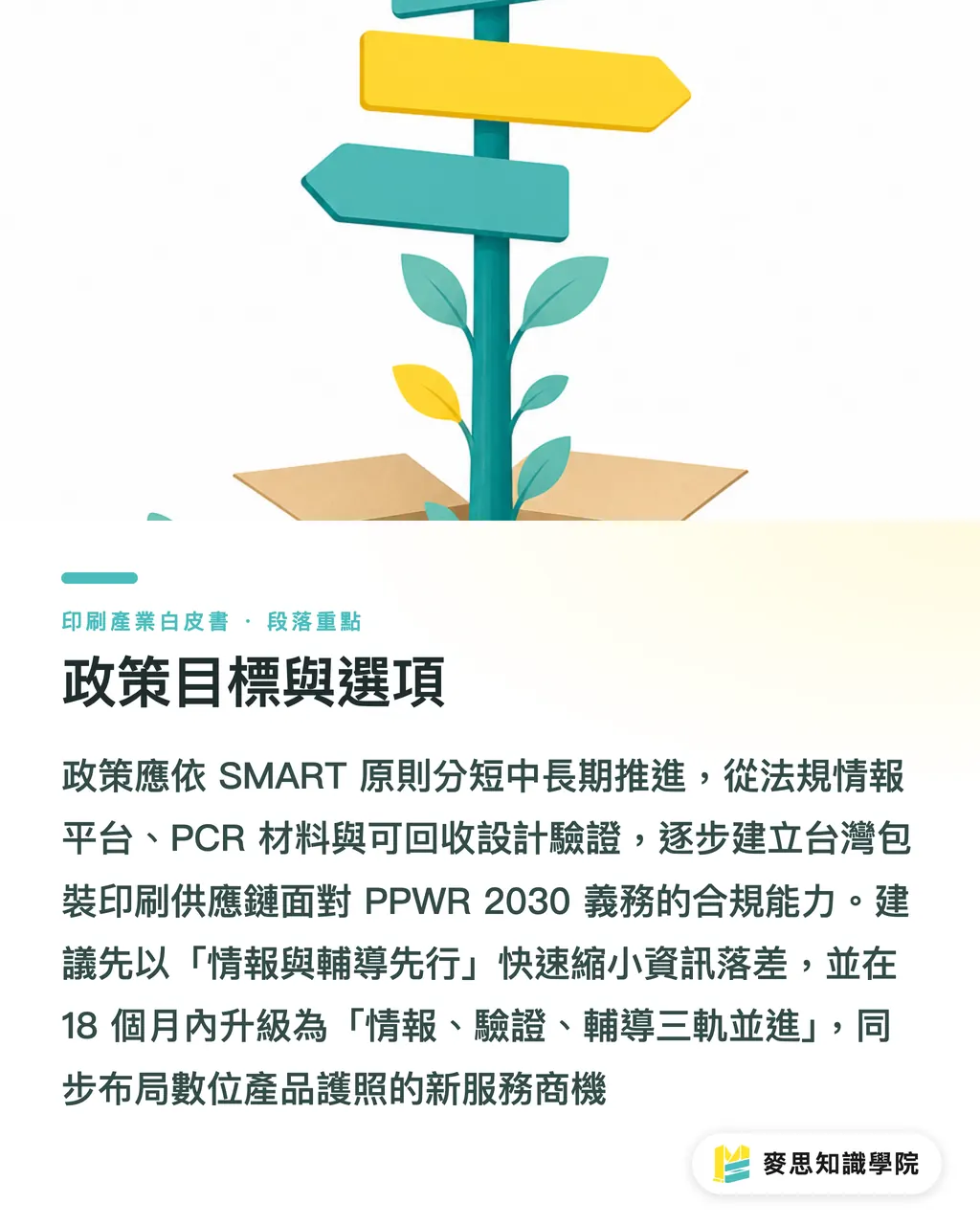
Policy goals are set across three phases following SMART principles. Short term (2026-2027): Complete the sustainable packaging regulatory intelligence platform covering four major domains: PPWR, EPR, EUDR, and DPP, with the number of served businesses and update frequency as measurable metrics. Medium term (2027-2029): Establish domestic testing capacity for PCR materials and design for recycling, while completing standards alignment with key export markets, and guide a designated share of export-oriented packaging printers through compliance audits. Long term (2029-2031): Ensure Taiwan's packaging and printing supply chain is ready for PPWR 2030 mandates, establishing Digital Product Passport services as a new revenue stream for label converters [66]
Policy options are compared below
・Option 1 (Status Quo): Lowest fiscal cost, relying solely on voluntary translation by trade groups [84]. Benefits are minimal and unevenly distributed. The risk is widespread loss of export orders when 2030 mandates take effect, paying the cost of compliance through industrial contraction. Low priority, not recommended
・Option 2 (Intelligence and Consulting First): Government funds a regulatory intelligence platform and an SME support system without investing in testing infrastructure yet. Low-to-medium cost with quick returns. The benefit is an immediate narrowing of the information gap. The risk is that without domestic testing capacity, converters remain dependent on foreign labs, keeping compliance costs high. Medium-high priority, recommended as Phase 1
・Option 3 (Three-Track Synchronized Rollout): Build intelligence, testing, and consulting simultaneously, while laying groundwork for DPP technical services. Highest cost, requiring cross-agency coordination. The benefit is building complete compliance infrastructure and standards influence, with positive spillovers into food, cosmetics, and electronics export sectors. The risk lies in execution complexity and stretched administrative bandwidth. Highest priority. We recommend starting with Option 2 and upgrading to Option 3 within 18 months
Policy Recommendations
This section outlines six actionable recommendations grounded in the public interest of the industry
・Recommendation 1: Establish a sustainable packaging regulatory intelligence and early-warning platform. Policy goal is to eliminate information asymmetry for SMEs. Addresses the regulatory intelligence bottleneck [84]. Proposed lead agency is the Industrial Development Administration of the Ministry of Economic Affairs, co-organized by TAITRA and relevant printing trade associations. Execution involves commissioning research institutes to continuously monitor PPWR, EPR, DPP, and EUDR updates and issue tiered alerts. Expected public benefit is providing the entire industry with a shared compliance buffer. The main risk is that intelligence becomes mere aggregation without localized analysis, which can be mitigated by setting up an industry advisory desk. Timeline is short term (months 0-12). KPIs include registered businesses, alert delivery speed, and user satisfaction
・Recommendation 2: Develop domestic PCR testing capacity and align with international standards. Policy goal is to lower testing costs and gain influence in standards-setting. Addresses testing bottlenecks and recycled material supply constraints [28][52]. Proposed lead agency is the Bureau of Standards, Metrology and Inspection, supported by the Ministry of Environment and institutes like ITRI. Execution involves surveying current lab capabilities, formulating testing methods for recycled content and design for recycling, and pursuing mutual recognition with EU frameworks, while tracking Shanghai consumable standards to ensure regional compatibility [10]. Expected public benefit is localizing verification and eliminating export hurdles. The main risk is prolonged negotiations over mutual recognition, which can be mitigated by adopting established international protocols during the transition. Timeline is medium term (months 6-30). KPIs include the number of certifiable testing categories and percentage reduction in converter testing costs
・Recommendation 3: Launch a dedicated sustainable packaging compliance and transition program for SMEs. Policy goal is to correct market failure in SME green transitions. Addresses financing and technical upgrade bottlenecks [43][37]. Proposed lead agency is the Small and Medium Enterprise and Startup Administration of the Ministry of Economic Affairs, assisted by trade associations. Execution involves tiered consulting covering compliance audits, material substitution assessments, and process improvements, while expanding existing machinery replacement subsidies to include green processes like LED-UV and wastewater recovery. Expected public benefit is preserving SME jobs and supply chain integrity. The main risk is subsidy capture by a few repeat applicants, which can be mitigated by transparent records and milestone evaluations. Timeline is short-to-medium term (months 6-36). KPIs include assisted firms and the percentage of firms completing compliance audits
・Recommendation 4: Build technical service capabilities for Digital Product Passports (DPP). Policy goal is to help Taiwan's label sector upgrade from material conversion to integrated digital services [66]. Addresses the digital traceability bottleneck. Proposed lead agency is the Ministry of Digital Affairs, co-organized by the Ministry of Economic Affairs along with textile and printing associations. Execution involves creating DPP data format guidelines and helping label printers deploy integrated RFID and digital ID solutions, prioritizing early-mandate supply chains like apparel and textiles. Expected public benefit is securing high-value positions for Taiwanese firms in traceable packaging chains. The main risk is unsettled international platform standards, which can be mitigated by adopting open standards that maintain integration flexibility. Timeline is medium-to-long term (months 12-48). KPIs include converters offering DPP services and the share of DPP-related revenue
・Recommendation 5: Turn packaging reduction and waste management into industrial competitiveness tools. Policy goal is to translate reduction mandates into cost-saving advantages. Addresses weak incentives for green investment. Grounded in evidence that AI-assisted design cuts material use by up to 55% [59], while waste reduction is becoming a key differentiator in buyer purchasing decisions [18]. Proposed lead agency is the Industrial Development Administration, supported by research institutes. Execution involves promoting AI structural optimization and material estimation tools, alongside voluntary disclosure formats for waste management performance. Expected public benefit is cutting carbon and costs simultaneously. The main risk is adoption barriers for new tools, which can be mitigated by integrating this into the support framework from Recommendation 3. Timeline is medium term. KPIs include adoption counts for reduction tools and average material reduction rates
・Recommendation 6: Strengthen compliance resilience across paper and fiber-based packaging supply chains. Policy goal is to capture the long-term shift toward fiber-based packaging [67] while addressing EUDR traceability requirements [84] and market disruptions from Chinese paper overcapacity [2]. Proposed lead is the Forestry and Nature Conservation Agency of the Ministry of Agriculture in coordination with the Ministry of Economic Affairs. Execution involves setting up deforestation traceability guidance for imported paper stocks and supporting collaborative R&D on high-value barrier coatings. Expected public benefit is ensuring compliance while building differentiation for export paper packaging. The main risk is the pass-through of traceability costs, which can be mitigated by phased implementation. Timeline is medium-to-long term. KPI is the percentage of imported paper stocks with completed traceability records
Implementation Roadmap and KPIs
This section consolidates the six recommendations into a four-phase roadmap
・Phase 1 (Months 0-6): Complete requirements scoping and procurement for the regulatory intelligence platform, launch a baseline compliance census among SMEs, and establish an inter-agency sustainable packaging task force. KPIs are platform launch and survey completion rate
・Phase 2 (Months 6-18): Transition the intelligence platform to regular operations, release the first Taiwan edition of PPWR and EPR compliance guidelines, launch transition support cases, and finalize testing protocols to start pilot verification. KPIs include supported firms, alert response speed, and completed pilot verification cases
・Phase 3 (Months 18-36): Bring testing capacity into full operation and pursue mutual recognition agreements, expand DPP adoption support across the label sector, and bundle AI-driven reduction tools into consulting packages [59]. KPIs include the share of domestic testing cases, the number of converters offering DPP services, and average material reduction rates
・Phase 4 (Years 3-5): Align with the full rollout of PPWR 2030 mandates, audit total compliance rates across export packaging supply chains, and evaluate compatibility strategies between Taiwanese standards and Asia-Pacific frameworks, including developments in China [10]. KPIs span four categories: Industrial Upgrade (share of export converters completing compliance audits and testing), Sustainability (average recycled content and material reduction rate among supported firms), Workforce (number of certified packaging sustainability professionals), and Diffusion (active platform users and guideline downloads)
Conclusion and Data Gaps
EPR and PPWR are not distant foreign regulations. They are market access conditions with concrete timelines, pressing down on Taiwanese suppliers through brand purchasing contracts. A 2.5-million-tonne recycled material shortfall [28], proven technical pathways for 30% recycled content [52], structural shifts toward fiber packaging [67], and mandatory Digital Product Passports [66] together define new competitive rules leading into 2030. Taiwan's choice is not whether to comply, but who pays the bill: will government and industry share the cost during the grace period by building infrastructure, or will individual SMEs bear it alone through lost orders once mandates hit? This white paper urges policymakers to start with Option 2 and advance within 18 months to the three-track Option 3, turning regulatory pressure into a competitive differentiator for Taiwan's packaging and printing supply chain
Data points that still require further research include: The share and dollar value of Taiwan's packaging and printing exports directly exposed to PPWR and EPR (further data needed). Specific eco-modulation fee structures across EU member states and their rate differentials for label materials (further data needed). EPR fee rates and enforcement outcomes for packaging in Japan and South Korea (further data needed). Annual domestic production capacity and quality grading status for Taiwan's PCR materials (further data needed). A directory and capacity audit of Taiwanese labs accredited for international packaging recyclability testing (further data needed). Empirical cost baselines for SME compliance, including average audit and testing expenditures per plant (further data needed)
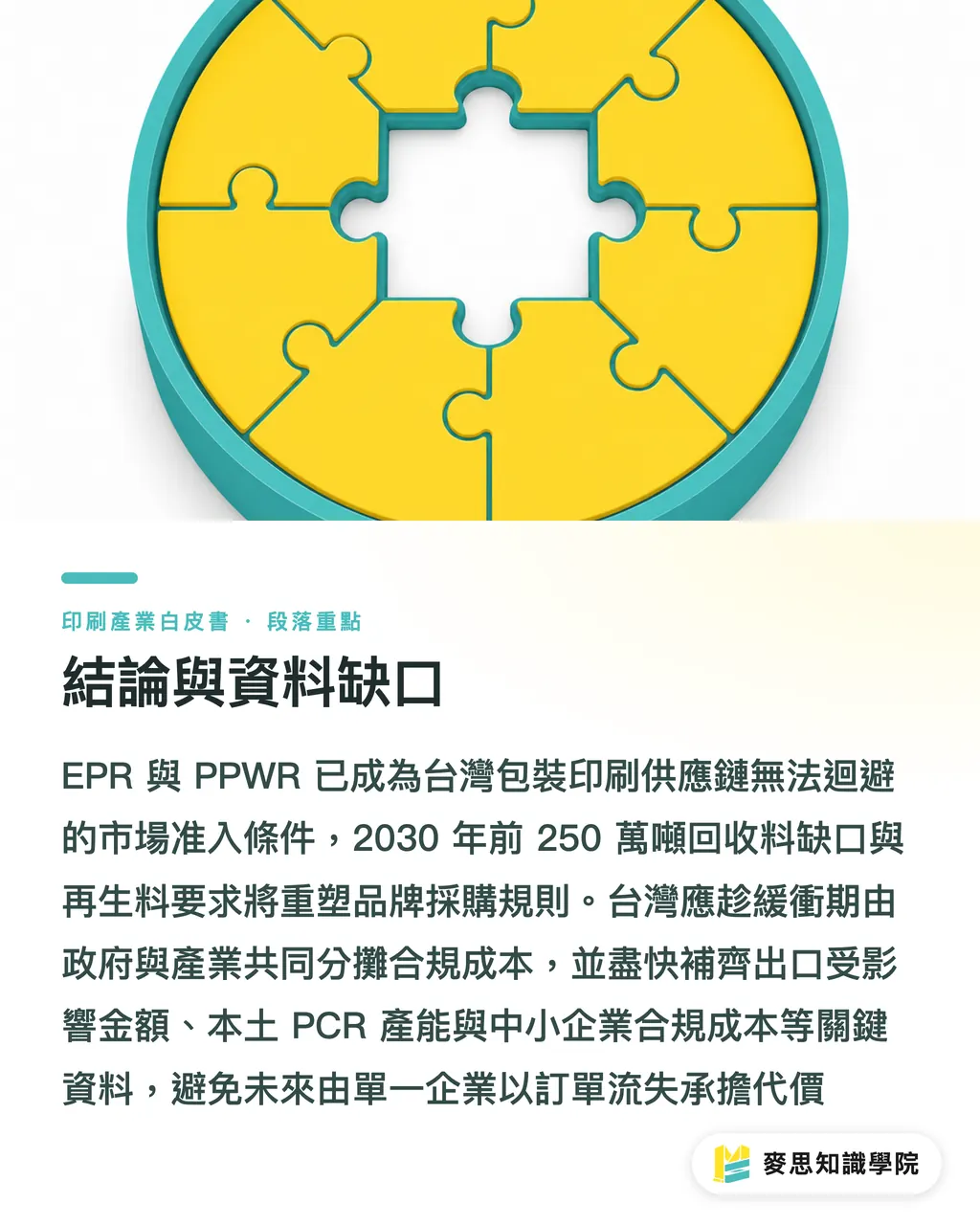
Key Takeaways
・PPWR recycled content targets create a deficit of roughly 2.5 million tonnes of PCR materials in the EU by 2030, directly driving up material costs and supply cut-off risks for Taiwanese export packaging
・Compliance pressure cascades through brand procurement terms. While Taiwanese printers are not directly under EU jurisdiction, they bear the actual burden, creating an offshore rule, domestic cost dynamic
・Advanced mechanical recycling can already achieve over 30% recycled content in flexible plastics. The technical pathway exists. Bottlenecks lie in testing infrastructure and supply chain readiness rather than scientific feasibility
・Taiwan should advance a three-track approach covering regulatory intelligence, material testing, and transition support, upgrading from an intelligence-first start to complete compliance infrastructure within 18 months
・The price of inaction is not money saved on consulting budgets, but payments made in lost orders and supply chain flight once 2030 mandates take effect
Further Considerations
The broader takeaway for the industry is that sustainability compliance is moving from marketing speak to mandatory specifications on purchase orders. For print manufacturers, green processes like recycled material compatibility, LED-UV, and closed-loop wastewater systems must be viewed as investments in order qualification rather than pure cost centers. For design, value is pivoting toward design for recycling and precision material budgeting. AI-assisted structural optimization has shown that waste reduction and cost savings can go hand in hand, offering the most compelling business case for adopting AI. For SaaS and digital service providers, the opportunity lies in the data layer unlocked by Digital Product Passports. Label converters that integrate RFID, digital IDs, and traceability platforms can move up from commodity material vendors billing per unit to solution integrators billing for data services. The urgent question is whether Taiwan can build domestic PCR supplies and certification capacity before 2030 mandates kick in, while balancing compatibility and influence between EU and Chinese standards frameworks. That requires concrete resource commitments from government, trade groups, and manufacturers over the next 18 months
References
[2] Top News: EMGE Report: Chinese Paper Oversupply Poses Competitive Threat to Global Paper Markets
[5] Tech Trends: Algae Black Carbon-Negative Pigment Enters Australian Food Packaging and Print Market
[6] Tech Trends: Epson Launches 100ppm High-Speed Color MFP WorkForce Enterprise AM-C10000
[11] Taiwan Industry: Idealliance Taiwan Guides Chien Hua Group to G7 Colorspace Facility Certification
[12] Taiwan Industry: GCF Hosts 2026 X-Rite Pantone FOCA Color Quality Control Certification Training
[13] Academic Research: JAGAT 66th DTP Expert Exam Adds Color Management and Prepress Design Modules
[17] Tech Trends: Epson SureColor G9070 Wide-Format Direct-to-Film Printer Now Available
[21] Market Dynamics: PRINTING United Expo 2026: 10 Must-Do Highlights Guide
[22] Top News: Small Creative Agencies Hit Hard by AI, Print Providers Step Up as Vital Allies
[23] Top News: FESPA Global Print Expo 2026 Overall Highlights Officially Released
[27] Top News: Belmark Breaks Ground on $121 Million Expansion Project
[28] Top News: CEFLEX Report Flags Over 2.5 Million Tonne Recycled Content Deficit in the EU by 2030
[29] Top News: Nilpeter Cincinnati Open House Highlights Automation and AI Capabilities
[30] Tech Trends: HiFlow Adds AI Invoice Processing Module to Speed Up Accounts Payable
[31] Tech Trends: Avery Dennison Launches Pathfinder Edge Handheld Label Printer
[32] Taiwan Industry: Impact of Middle East Geopolitical Conflict on Global Packaging Supply Chains
[34] Top News: Nazdar Acquires Fujifilm Screen and Flexographic Ink Business in North and Latin America
[35] Top News: Fujifilm Officially Unveils Flagship Revoria Press PC2120 in North America
[39] Market Dynamics: Kyocera: Why Light Production Print Is the New Battleground in Digital Equipment
[40] Market Dynamics: UK Hickling & Squires Installs First Konica Minolta AccurioJet 30000 in the UK
[42] Taiwan Industry: CAGST Releases Printing Industry Weekly News Report for Week 26, 2026
[43] Top News: INX and Koenig & Bauer Advance LED-UV Printing to Boost Efficiency and Sustainability
[45] Tech Trends: Graphco Fold Stream Extended Folder-Gluer Wins 2026 Pinnacle Award
[48] Market Dynamics: Preparations Begin for 11th PACK PRINT INTERNATIONAL 2027
[55] Top News: Nazdar Acquires Fujifilm Screen and Flexographic Ink Business
[56] Top News: Konica Minolta Launches AccurioPress C5080 Series Entry-Level Production Presses
[57] Top News: Fiery Announces Micah Kornberg as New CEO
[58] Tech Trends: Sheridan Upgrades HP PageWide Platform to Advance Digital Book Print Quality
[59] Tech Trends: AI and Data Analytics Drive 55% Reduction in Packaging Material Usage
[60] Tech Trends: UK Route 1 Print Invests £2M in ABG Digital Finishing Equipment for Label Production
[61] Market Dynamics: Indian Commercial Printing Market Continues Steady Growth
[62] Market Dynamics: Kyle Chapman Elected Barry-Wehmiller Board Chair
[64] Taiwan Industry: Japan JAGAT Hosts Seminar on the Path to Smart Printing Factories on July 28
[65] Top News: Xerox Unveils First Hardware Lineup Following Lexmark Integration
[67] Top News: Study Forecasts Fiber-Based Food Packaging to Surpass Plastic as Leading Category by 2045
[70] Tech Trends: Epson Launches 76-Inch 8-Head Industrial Dye-Sublimation Printer SureColor SC-F20000
[74] Taiwan Industry: CAGST Releases Printing Industry Weekly News Report for Week 25, 2026
[75] Top News: Heidelberger Druckmaschinen Acquires Production of POLAR Cutting Systems and Equipment
FAQ
- What is PPWR, and how does it affect Taiwanese printing and packaging converters?
- PPWR is the European Union's Packaging and Packaging Waste Regulation, which establishes legally binding targets and timetables for recycled content, design for recycling, and packaging reduction. While Taiwanese converters fall outside direct EU jurisdiction, international brand clients pass these rules down through purchasing contracts, demanding verified proof of recycled content and recyclability as conditions for export market entry
- How large is the projected EU recycled material deficit in 2030?
- According to a CEFLEX report, meeting the PPWR 2030 recycled content targets will require roughly 2.5 million tonnes of post-consumer recycled materials, surging to 5.9 million tonnes by 2035. Existing supply and recycling infrastructure fall far short, which will push up recycled feedstock prices and intensify competition for raw materials
- Can flexible plastic labels realistically achieve high recycled content?
- Yes. Research by the Alliance to End Plastic Waste confirms that post-consumer household flexible plastics processed through advanced mechanical recycling can achieve recycled content above 30%, proving viable for demanding film applications like shrink sleeves and labels. The technical pathway is proven. The real hurdle is supply chain readiness and certification systems
- What should the Taiwanese government prioritize right now?
- The top priority is establishing a sustainable packaging regulatory intelligence and early-warning platform to close the information gap for SMEs. Within 18 months, this should expand into a three-track policy framework combining intelligence, verification, and consulting support to complete supply chain compliance infrastructure before PPWR 2030 mandates take full effect
- What is the difference between EPR and PPWR?
- EPR (Extended Producer Responsibility) is a policy mechanism that internalizes end-of-life packaging waste treatment costs into producers and brand owners, while PPWR is a specific EU regulation mandating recycled content, design for recycling, and reduction targets. The two go hand in hand: PPWR dictates technical specifications, and EPR decides who pays. Both ultimately cascade down to printing and packaging suppliers through brand purchasing contracts
References
- CEFLEX:PPWR 2030 回收內容目標需約 250 萬噸軟包裝後消費回收材料 · ceflex.eu
- EU must derive 440,000 tonnes of PCR per year from flexibles to meet PPWR targets · packagingeurope.com
Related articles


The Print × AI weekly
The print and AI know-how designers, brands and enterprises can use before they commit — one email, every week
MINDS Free Tools
AI background removal, a LINE sticker maker, spine & imposition calculators — all free, right in your browser, no upload.
MINDS Group
Need actual printing or gifting services?
From premium printing to online ordering and festive gifts — the MINDS Group sister brands take it from here.