
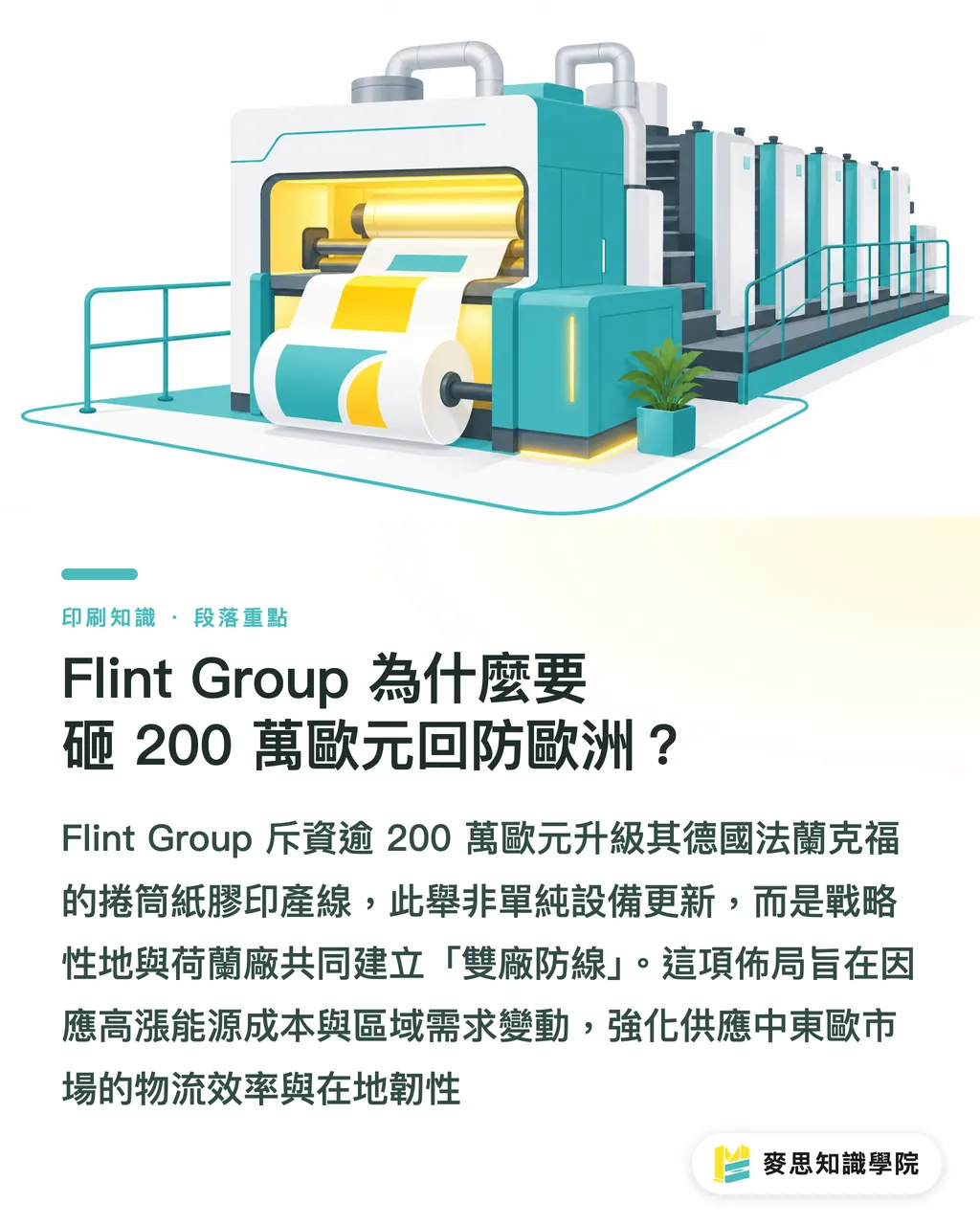
Why Is Flint Group Spending 2 Million Euros to Shore Up Europe?
Flint Group recently announced an investment of more than 2 million euros to fully upgrade its Web Offset production line in Frankfurt, Germany
The new plant, which only opened in January 2026, centers on energy-saving varnish equipment and a hybrid manufacturing platform
From what I have seen in more than a decade of watching the strategic moves of major European ink makers, this is not simply about replacing old equipment
Think back to Siegwerk closing its Bargen plant in Switzerland and shifting capacity to Tuzla, Turkey. The logic is almost identical
Under the double pressure of rising energy costs and shifting regional demand, Flint Group is using its German plant together with its existing Dutch plant to build a two-site defensive line focused on supplying Central and Eastern Europe. What it wants is logistics efficiency and local resilience against risk
As the Global Ink Supply Chain Reshuffles, Will Asia-Pacific Move Down the Priority List?
The answer is yes. Global ink supply is quickly retreating from globalized division of labor back toward regional defense
When Flint Group puts 2 million euros of capital expenditure into Europe, it means multinational ink giants are adjusting the priority order of global supply
From several large domestic packaging projects I have been involved with recently, international ink makers are no longer as firm as they used to be on delivery commitments to Asian markets
Taiwan's printing manufacturers have long relied on high-quality imported inks. Once European original suppliers run into tight capacity or logistics bottlenecks, Asia-Pacific is often the region sacrificed when output needs to be reallocated
This affects more than stocking cycles. In the future, local printing plants will also be in a relatively passive position on bargaining room and price stability
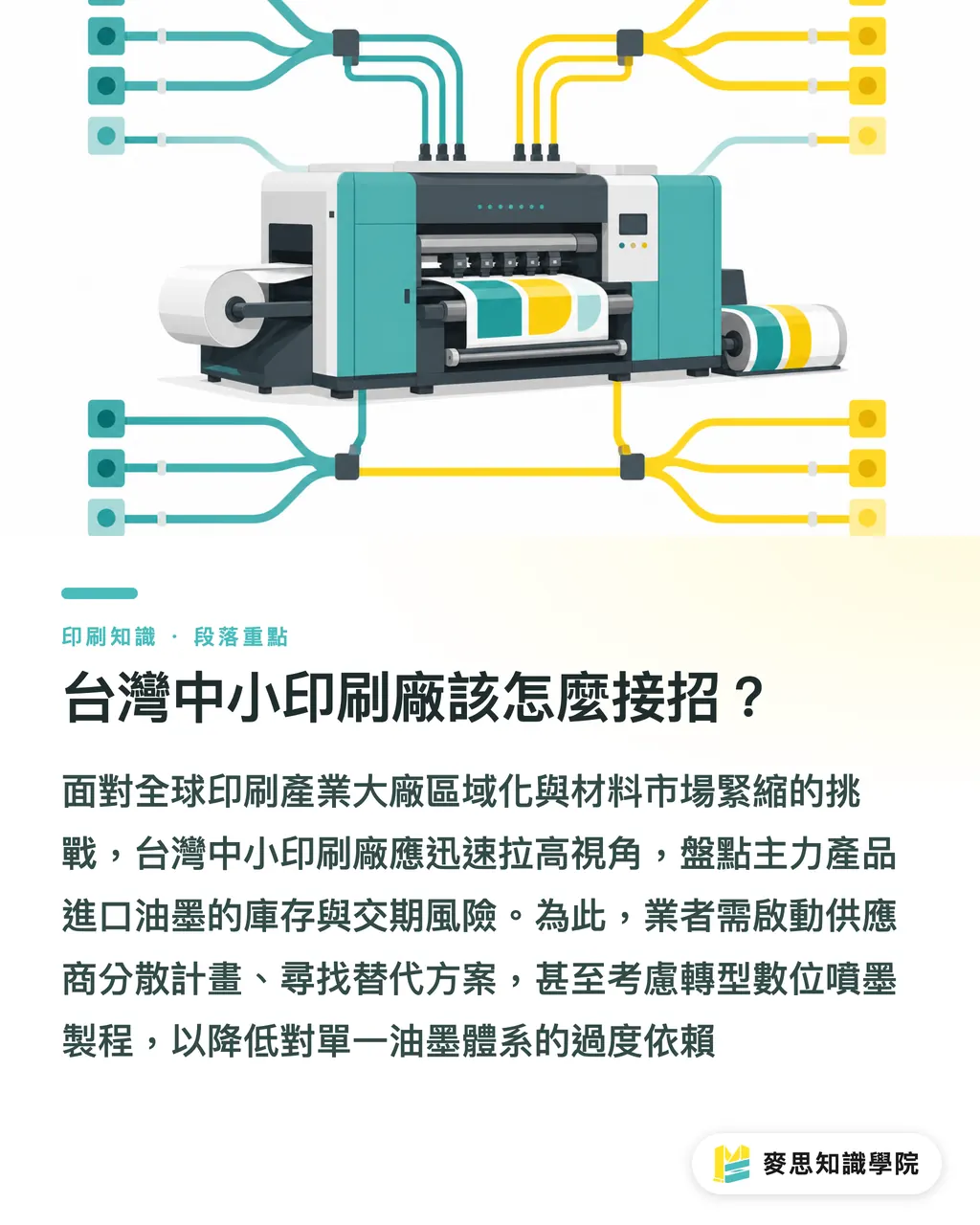
How Should Small and Mid-Sized Printing Plants in Taiwan Respond?
Facing this open regionalization strategy from major suppliers, printing business owners in Taiwan can no longer treat placing an order and waiting for the ship schedule as normal daily practice
We need to raise our vantage point and review risk from the perspective of the whole materials market tightening
For example, North American containerboard capacity has contracted sharply by 5.1% this year. Base paper supply is already tight. If ink also runs into trouble, the cost of stopping a production line will be extremely high
Recently, I have been strongly advising clients to take the following concrete steps immediately:
・Take inventory of the imported inks used in the top three core products, then recalculate current safety stock against the longer delivery gap
・Start a supplier diversification plan, look for Asia-based substitute inks with quality certifications, and begin testing them on non-urgent jobs in the plant
・Assess process shifts beyond traditional offset printing, such as the digital inkjet process, a market valued at 177 billion dollars globally, and use technology transfer to reduce overdependence on a single ink system
Key Takeaways
Multinational ink makers are accelerating regional supply strategies, keeping capacity and resources focused first on their European home base
Taiwanese printing plants that rely heavily on imported inks are very likely to face the double squeeze of longer lead times and price swings
Beyond finding alternative ink suppliers in Asia, they should also use this moment to review base paper supply and assess process shifts such as digital inkjet
Further Thoughts
Over the past few months, while advising several long-established printing plants in central and southern Taiwan, the question I have asked most often is, What is your Plan B for ink?
When we see market signals like Flint Group expanding capacity in Europe, we cannot treat them as someone else's news
SaaS providers and printing plant procurement managers should sit down together and use their systems to identify which special-spec imported inks are high-risk items
Do not wait until materials actually run out before looking for substitutes. Safety stock levels should be raised now, and more flexible delivery terms should be negotiated in the next procurement contract
Further Reading
FAQ
- What are the main equipment upgrades at Flint Group's German plant?
- The company has introduced energy-saving varnish equipment and a hybrid manufacturing platform at its Frankfurt plant, mainly for the Web Offset market, to increase production flexibility and shorten lead times
- Why are major European manufacturers moving their production focus back home?
- After the pandemic and geopolitical shocks, major manufacturers have been shifting toward regional defense to avoid logistics risk and swings in energy costs. By setting up nearby dual-site capacity, they can protect service resilience for core customers
- Will European ink become more expensive for Taiwanese printing plants?
- There is a high chance it will. When multinational suppliers concentrate resources in Europe, the volume allocated to Asia-Pacific becomes limited. Add cross-border logistics costs on top, and Taiwanese companies that rely on imported inks will face real pressure on both price and lead time
- What can small and mid-sized plants do now as the ink supply chain reorganizes?
- They should immediately review safety stock for commonly used and special-spec imported inks, then find qualified alternative brands in Asia for on-press testing. The goal is to avoid supply-chain breakage from relying on a single source
References
- Flint Group Web Offset expands European capabilities with €2m investment · thepackagingportal.com
Related articles



The Print × AI weekly
The print and AI know-how designers, brands and enterprises can use before they commit — one email, every week
MINDS Free Tools
Spine width and imposition calculators — skip the manual math, free in your browser.
MINDS Group
Need actual printing or gifting services?
From premium printing to online ordering and festive gifts — the MINDS Group sister brands take it from here.