

Introduction: An Industry Turning Point Revealed by Capital Expenditure
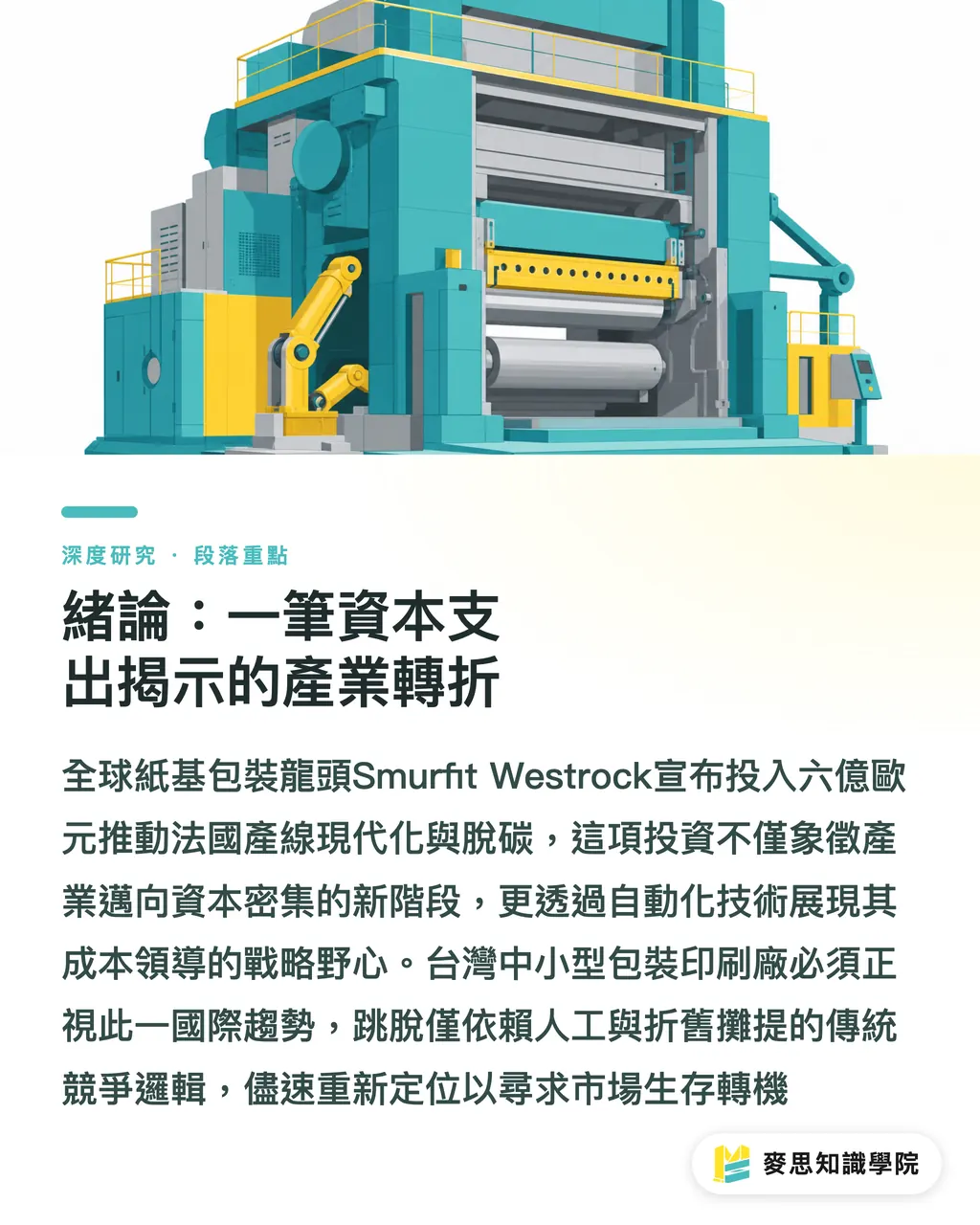
When one of the world's leading paper-based packaging groups announces a 600 million euro investment in a single country, it is no longer just a simple equipment upgrade, but a signal regarding the industry's entire cost structure. On June 1, 2026, Smurfit Westrock announced it will invest 600 million euros over the next three to five years to modernize its French industrial sites and further drive operational decarbonization [1]. The significance of this decision must be understood within the context of the 2024 merger between Smurfit Kappa and WestRock, as it represents a concentrated capital deployment in a key European market following the merger [1]
The core question this article seeks to answer is: As the corrugated board industry enters a phase of capital intensification and accelerated consolidation, should Taiwan's small and medium-sized packaging printing firms view the large-scale investments of industry leaders as a warning signal or a potential opportunity for market restructuring? This question carries practical urgency for the Taiwanese industry. The packaging and printing industry in Taiwan is dominated by small and medium-sized firms that generally rely on manual scheduling and the amortization of existing equipment to maintain price competitiveness. Once international leaders continue to drive down the unit cost of standard corrugated products through automation, local firms relying on cost-based competition will be the first to bear the brunt
This article contributes in three ways:
・First, it places an investment announcement within the long-term context of industry consolidation, identifying the logic of the cost-leadership strategy behind it
・Second, it combines the group's historical evolution with existing evidence on production automation to deconstruct the mechanism of 'how capital expenditure translates into a downward shift of the cost curve'
・Third, it proposes actionable strategic positioning suggestions from the three levels of SMEs, designers, and brand owners, while honestly defining the boundaries of inference for this analysis
Literature and Status Review: From Family Business to Capital-Intensive Oligopoly
This section first defines Smurfit Westrock's historical coordinates, then synthesizes existing discussions on industry consolidation and production automation, and finally positions the research gap addressed by this article
Regarding the group's historical context, existing biographies and directories present a clear evolutionary line. The group's roots can be traced back to the paper and packaging business of the Smurfit family in Ireland, with the entry for founding generation member John Jefferson Smurfit found in the Dictionary of Irish Biography [5][6]. Subsequently, Michael Smurfit long dominated the group's development and served as Chairman of the Smurfit Kappa Group between 2005 and 2007 [2][3]. This history illustrates a key fact: the 'capital-intensive oligopoly' seen today was not born, but is the result of decades of mergers and acquisitions and integration by a family business, gradually accumulating to a multinational scale. In other words, the 2024 merger of Smurfit Kappa and WestRock is a continuation of this long-term integration path, not a rupture
Regarding production-side automation and the circular economy, existing industrial research provides specific technical side-evidence. A study on the automation of waste paper input quality control at Smurfit Kappa's Belgrade site reveals how large groups shift raw material inspection processes from manual interpretation to automated workflows [4]. The value of this literature lies in its demonstration of the specific path taken by large-scale groups in pursuing cost and quality consistency: automation appears not only in finished product lines but also permeates upstream raw material management. This is consistent with the direction of the French investment, which covers 'automated production lines, energy efficiency upgrades, and digital integration systems' [1]
In summary, existing data are complementary rather than divergent on these two topics. Historical biographical literature explains 'why it moved towards concentration,' while automation research explains 'how it operates after concentration.' However, there is a clear gap in existing discussions: these materials mostly start from the perspective of the group itself or technical implementation, and rarely answer 'how small and medium-sized firms at the other end of the value chain should respond when industry leaders reshape the cost curve through capital expenditure.' This article addresses this gap, reinterpreting the implications of this investment from the perspective of SMEs affected by integration pressure
Core Analysis 1: The Cost Leadership Position Bought with 600 Million Euros
This section argues that the essence of this investment is to consolidate a cost-leadership position, rather than a simple environmental upgrade
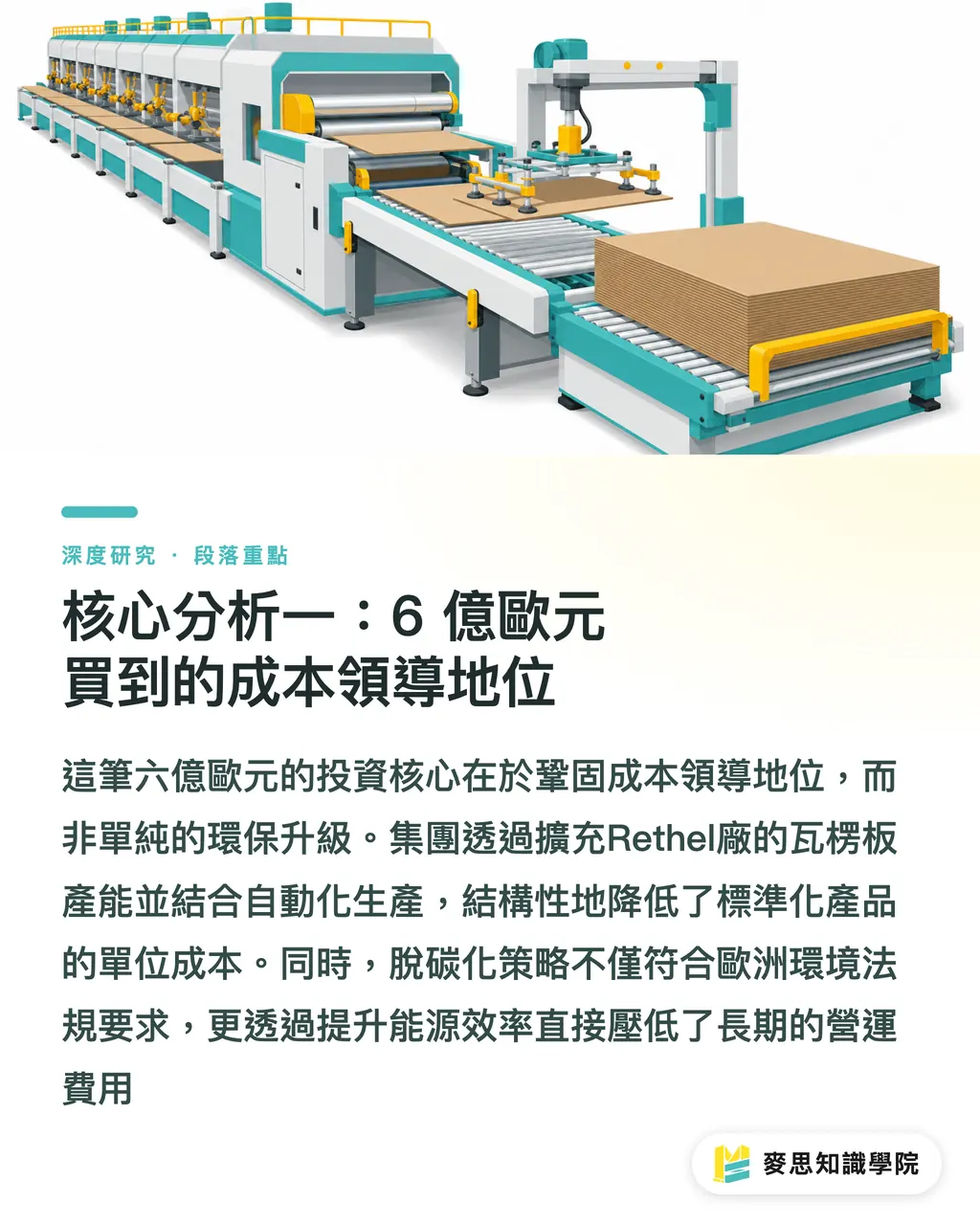
The strategic intent can be seen from the specific allocation of the investment. France is one of the group's major European industrial hubs, and this 600 million euro investment is not an isolated event; the group has invested more than 500 million euros in French operations over the past five years to modernize facilities and expand capacity [1]. Two consecutive five-year periods of capital investment totaling over 1.1 billion euros show that this is a long-term and continuous track of capital deployment, rather than a one-off headline expenditure
Specific projects further confirm the cost- and capacity-oriented nature. Identified projects include the Épernay site in the Marne region, which will receive a 40 million euro expansion and modernization plan; the Rethel plant in Ardennes is planned for 20 million euros to further develop its corrugated board production [1]. In fact, the investment in Rethel points explicitly to corrugated board capacity, which is the product line that directly overlaps with Taiwan's SMEs. As industry leaders continue to expand scale through automation in standard corrugated products, the unit cost and quotes for this category will be structurally driven downward
Decarbonization plays the role of 'an extension of cost leadership' here, rather than its opposite. Andrew Coffey, the group's Managing Director for France, views the environmental performance of production sites as a logical extension of paper-based packaging manufacturing and points out that achieving carbon neutrality is a good foundation for further advancement [1]. The group currently operates four carbon-neutral plants in France and one nearly completely carbon-free paper mill [1]. This analysis argues that carbon neutrality has dual benefits here: on the one hand, it responds to increasingly stringent European environmental regulations and the ESG procurement requirements of brand clients; on the other hand, energy efficiency upgrades themselves represent a long-term reduction in operational costs. Therefore, decarbonization is not mutually exclusive with cost leadership, but two sides of the same capital strategy
Core Analysis 2: How the Downward Shift of the Cost Curve Transmits to SMEs
This section argues that the automation investments of industry leaders indirectly squeeze the profit margins of SMEs through a 'standard product price anchoring' mechanism
The first link in the transmission is the reduction of unit costs due to large-scale automation. As shown by the aforementioned study on waste paper input automation at the Belgrade site, large groups can integrate raw material inspection, production scheduling, and even digital integration systems into a consistent workflow [4]. Comparing this to the French investment, which also covers automated production lines and digital integration systems [1], it can be inferred that the effect is to reduce human reliance and quality variance in unit output. For firms relying on manual scheduling and older equipment, this means the cost baseline of competitors is systematically shifting downward
The second link in the transmission is price anchoring. This analysis suggests that when industry leaders achieve a clear cost advantage in standard corrugated products, market expectations for the 'reasonable price' of this category will be revised downward accordingly. Even if SMEs are not directly competing for the same orders as industry leaders, their quoting room will still be squeezed by the overall market price anchor. This is an indirect but continuous pressure: the more standard a standard product is, the easier it is to be replaced by large-scale production, and the thinner the profit margin
The third link in the transmission is the narrowing of survival space amid accelerated integration. Background data indicates that the European paperboard market is entering a period of accelerated consolidation, with the survival space for small and medium-sized firms narrowing [1]. From the long-term M&A trajectory of the group's history [2][5], consolidation is not a short-term fluctuation, but a structural trend in the industry. This analysis suggests that for Taiwanese firms, if the response is limited to 'lowering prices to keep orders,' it is equivalent to a head-on collision on the cost dimension where competitors have the greatest advantage, which is unsustainable in the long run
However, the boundaries of inference must be honestly defined here. The evidence for the above transmission mechanism mainly comes from the European market and the group's own investment behavior [1][4]; whether the Taiwan market will synchronize, and the speed and magnitude of this transmission, are still regulated by factors such as local demand structure, freight and tariffs, and customer concentration. This article cannot claim that European price dynamics will be replicated in Taiwan in direct proportion, but merely points out that directional competitive pressure is worth vigilance
Core Analysis 3: Conditions and Limitations of Differentiation as a Defensive Strategy
This section argues that differentiation (customized services, fast delivery) is a defensible territory for SMEs, but its effectiveness has prerequisites and is not a panacea
The feasibility of differentiation stems from the inherent limitations of large-scale production. The optimal economic range for large-scale automation is standard products with large batches, stable specifications, and few changes; its switching costs (changing plates, changing specifications, small-batch trial production) are relatively high. This analysis believes that this is precisely the structural opportunity for SMEs: in the face of demands for small batches, multiple specifications, urgent orders, and high communication density, flexible SMEs actually possess a reaction speed that is difficult for industry leaders to match. When competitors use capital to consolidate cost leadership in 'large-volume standard products,' SMEs should proactively exit this battlefield and turn to the value dimension of 'flexibility and service'
But the effectiveness of differentiation has clear conditions:
・First, differentiation must be convertible into a premium that customers are willing to pay; otherwise, it only increases costs rather than improving profit margins
・Second, fast delivery and customized services themselves require the support of process digitalization and scheduling capabilities. If they rely solely on piling up manpower, this will fail rapidly during scale expansion
・Third, the competitive threshold for differentiation will be eroded as competitors' digital integration capabilities improve. As mentioned earlier, the group included digital integration systems in the scope of its investment [1], which means that industry leaders are also shortening their own weaknesses in 'flexibility.' Therefore, differentiation is a dynamic, not a static, advantage and requires continuous investment in maintenance
This analysis suggests that the more strong strategy is not the binary opposition of 'flexibility versus scale,' but an integration path of 'supporting high-flexibility services with local digitalization.' SMEs do not need to, nor do they have the capacity to, replicate the full-factory automation of industry leaders, but they can introduce lightweight digital tools in the most critical bottleneck links (such as quoting, scheduling, prototyping, and customer communication), and invest limited capital in nodes that can directly shorten delivery times and reduce communication costs
Implications for Taiwan's Design and Printing Industry
This section discusses the practical significance and actionable practices of this consolidation wave for small and medium-sized printing firms, designers, and brand owners in layers
For small and medium-sized corrugated packaging firms, the core action is 'proactively choosing the battlefield':
・First, take inventory of the existing order structure to identify which are standard large-volume products susceptible to erosion by scale, and which are customized products with high variability and high communication requirements, and gradually tilt production capacity and business focus towards the latter
・Second, prioritize the investment of limited capital into bottleneck links that shorten delivery times, rather than chasing full automation; for example, replacing manual scheduling with digital scheduling, and shortening confirmation cycles with online prototyping
・Third, concretize 'fast delivery' and 'customization capability' into commitments to customers (such as guaranteed prototyping timelines and small-batch ordering flexibility), turning differentiation from a slogan into a service that can be priced
For designers, changes in the industry cost structure will alter feasible design options. As the cost of standard corrugated structures continues to decline, the value of creativity will be more concentrated on structural innovation, surface treatment, and brand narrative, rather than just layout. This analysis suggests that designers should more actively understand the cost boundaries of materials and manufacturing processes, collaborate with printing firms during the design phase, avoid designing solutions that are cost-unreasonable under small-batch production, and make good use of the flexibility of SMEs to realize limited or customized designs that large firms find difficult to accept
For brand owners, supply chain strategies need to be re-evaluated. Standardized bulk packaging can benefit from the cost reductions brought by the scale of industry leaders, but the bargaining power and flexibility risks brought by increased supplier concentration need to be assessed. This analysis believes that for product lines that require rapid market launch, frequent revisions, or limited-edition marketing, establishing cooperation with local SMEs still has irreplaceable value. At the same time, the group's use of decarbonization as an investment focus [1] means that ESG and carbon footprint will gradually become substantive thresholds for packaging procurement, and brand owners should incorporate this into supplier assessments early
Conclusion and Limitations
This article takes Smurfit Westrock's decision to invest 600 million euros in France [1] as a starting point to respond to the research question posed in the introduction: Is this wave of capital-intensive consolidation a warning or an opportunity for Taiwan's SME printing firms?
The research finds that the answer depends on the firm's strategic choices. Regarding 'standard large-volume corrugated products,' industry leaders are consolidating cost leadership through continuous capital investment [1], and lowering the cost curve through automation and digital integration systems [1][4], which is indeed a clear warning signal for SMEs that rely on cost competition. But regarding the demand for 'high flexibility, high communication, and customization,' the inherent limitations of large-scale production actually reserve defensible value territory for SMEs. The key lies in proactively exiting the battlefield where competitors have the greatest advantage, and supporting differentiated services with localized digitalization
This study has several limitations that must be honestly disclosed:
・First, the first-hand evidence on which the analysis is based is concentrated on the investment announcement of a single group in a single market [1]. The speed and magnitude of its transmission to the Taiwan market are regulated by local demand, freight and tariffs, and customer structure; this article can only point out the direction and cannot quantify it
・Second, the evidence for group history and automation comes from biographical and technical literature [2][4][5][6], used to explain consolidation trends and technical paths, but does not constitute direct empirical evidence for the Taiwanese industry
・Third, the effectiveness of the differentiation strategy is highly dependent on the execution capability of individual firms; this article proposes a strategic framework rather than a prescription that guarantees results
Subsequent research can be deepened in three directions: First, collect time-series data on local corrugated packaging quotes and order structures in Taiwan to empirically test the transmission effect of price anchoring; second, conduct case studies on SMEs that have successfully transformed into 'flexible services' to identify replicable digitalization paths; third, assess the actual impact and timeline of ESG and carbon footprint thresholds on the Taiwanese packaging supply chain
Key Takeaways
Smurfit Westrock's investment of 600 million euros in France over three to five years is a strategic capital deployment to consolidate cost leadership post-merger, not just a simple equipment upgrade [1]
Combined with the over 500 million euros invested in the past five years, this indicates a continuous long-term capital trajectory, and the cost curve for standard corrugated products will shift structurally downward [1]
Automation by industry leaders indirectly squeezes the profit margins of SMEs through 'standard product price anchoring', and lowering prices to keep orders is unsustainable in the long run
The defensible territory for SMEs lies in small-batch, urgent orders, and high-communication customization requirements; limited capital should be invested in bottleneck links that shorten delivery times, rather than full automation
Decarbonization is an extension of cost leadership, not its opposite; ESG and carbon footprint will gradually become substantive thresholds for packaging procurement [1]
Further Reflections
For printing and manufacturing, the core message of this consolidation wave is 'do not compete on the cost dimension where competitors are strongest,' but rather precisely invest capital in nodes that can directly shorten delivery times, such as quoting, scheduling, and prototyping, to support high-flexibility services with localized digitalization. On the design side, the value of creativity will shift from layout to structural innovation and brand narrative, and designers need to intervene earlier in collaborations on manufacturing cost boundaries. For AI and SaaS adoption, the most used approach is not imitating the full-factory automation of industry leaders, but rather lightweight scheduling, automated quoting, and online prototyping tools oriented towards SMEs, turning 'flexibility' from manpower accumulation into a scalable capability. The unresolved questions are: just how fast is the price transmission speed in the Taiwan market, and which digitalization paths have the highest return on investment? These require localized empirical data to answer
References
[2] Smurfit, Sir Michael (William Joseph), (born 7 Aug. 1936), Chairman, Smurfit Kappa Group, 2005-07. Who's Who. DOI: 10.1093/ww/9780199540884.013.56137
[3] Smurfit, Sir Michael (William Joseph), (born 7 Aug. 1936), Chairman, Smurfit Kappa Group, 2005-07. Who's Who. DOI: 10.1093/ww/9780199540884.013.u56137
[4] Smurfit Kappa Beograd d.o.o, Beograd, Srbija, Juričić T.(2024). AUTOMATIZATON OF INPUT CONTROL OF WASTE PAPER IN SMURFIT KAPPA BEOGRAD COMPANY. Proceedings / XXV međunarodni simpozijum iz oblasti celuloze, papira, ambalaže i grafike. DOI: 10.46793/cpag24.129j
[5] Farmar T.(2009). Smurfit, (John) Jefferson. Dictionary of Irish Biography. DOI: 10.3318/dib.008163.v1
[6] Farmar T.(2009). Smurfit, John Jefferson. Dictionary of Irish Biography. DOI: 10.3318/dib.008163.a.v1
FAQ
- What is Smurfit Westrock doing with its 600 million euro investment in France?
- The group announced it will invest 600 million euros over the next three to five years to modernize its French industrial sites and drive operational decarbonization, covering automated production lines, energy efficiency upgrades, and digital integration systems, with the goal of consolidating its cost-leadership position in the European corrugated market [1]
- Is this investment a warning or an opportunity for Taiwan's small and medium-sized corrugated packaging firms?
- It is both. It is a warning for standard large-volume products that rely on cost competition, as automation by industry leaders will continue to drive down the cost curve; but it is an opportunity for high-flexibility, customized, and urgent-order demands, as large-scale production finds it difficult to flexibly accommodate these types of orders
- How should Taiwan's SME printing firms respond to the automation investments of large companies?
- They should proactively exit the cost battlefield of standard large-volume products, shift production capacity and business focus towards customization and fast delivery, and prioritize investing limited capital in bottleneck links that shorten delivery times, such as quoting, scheduling, and prototyping, rather than pursuing full-factory automation
- Why are decarbonization and cost leadership considered the same thing?
- Energy efficiency upgrades themselves represent a long-term reduction in operational costs, and carbon neutrality can simultaneously respond to European environmental regulations and the ESG procurement requirements of brand clients. Therefore, decarbonization is an extension of the cost-leadership strategy, not its opposite [1]
- Can differentiated services protect SMEs in the long run?
- Differentiation is a defensible territory but has conditions: it must be convertible into a premium customers are willing to pay, requires the support of process digitalization, and the competitive threshold will be eroded as the digital integration capabilities of large firms improve, so it requires continuous investment in maintenance rather than a one-off effort
References
- Smurfit Westrock砸6億歐元升級法國廠:瓦楞紙板產業整合潮下,台灣廠商該怎麼看? · printindustry.news
- Smurfit, Sir Michael (William Joseph), (born 7 Aug. 1936), Chairman, Smurfit Kappa Group, 2005-07 · doi.org
- Smurfit, Sir Michael (William Joseph), (born 7 Aug. 1936), Chairman, Smurfit Kappa Group, 2005-07 · doi.org
- AUTOMATIZATON OF INPUT CONTROL OF WASTE PAPER IN SMURFIT KAPPA BEOGRAD COMPANY · doi.org
- Smurfit, (John) Jefferson · doi.org
- Smurfit, John Jefferson · doi.org
Related articles



The Print × AI weekly
The print and AI know-how designers, brands and enterprises can use before they commit — one email, every week
MINDS Free Tools
Spine width and imposition calculators — skip the manual math, free in your browser.
MINDS Group
Need actual printing or gifting services?
From premium printing to online ordering and festive gifts — the MINDS Group sister brands take it from here.