
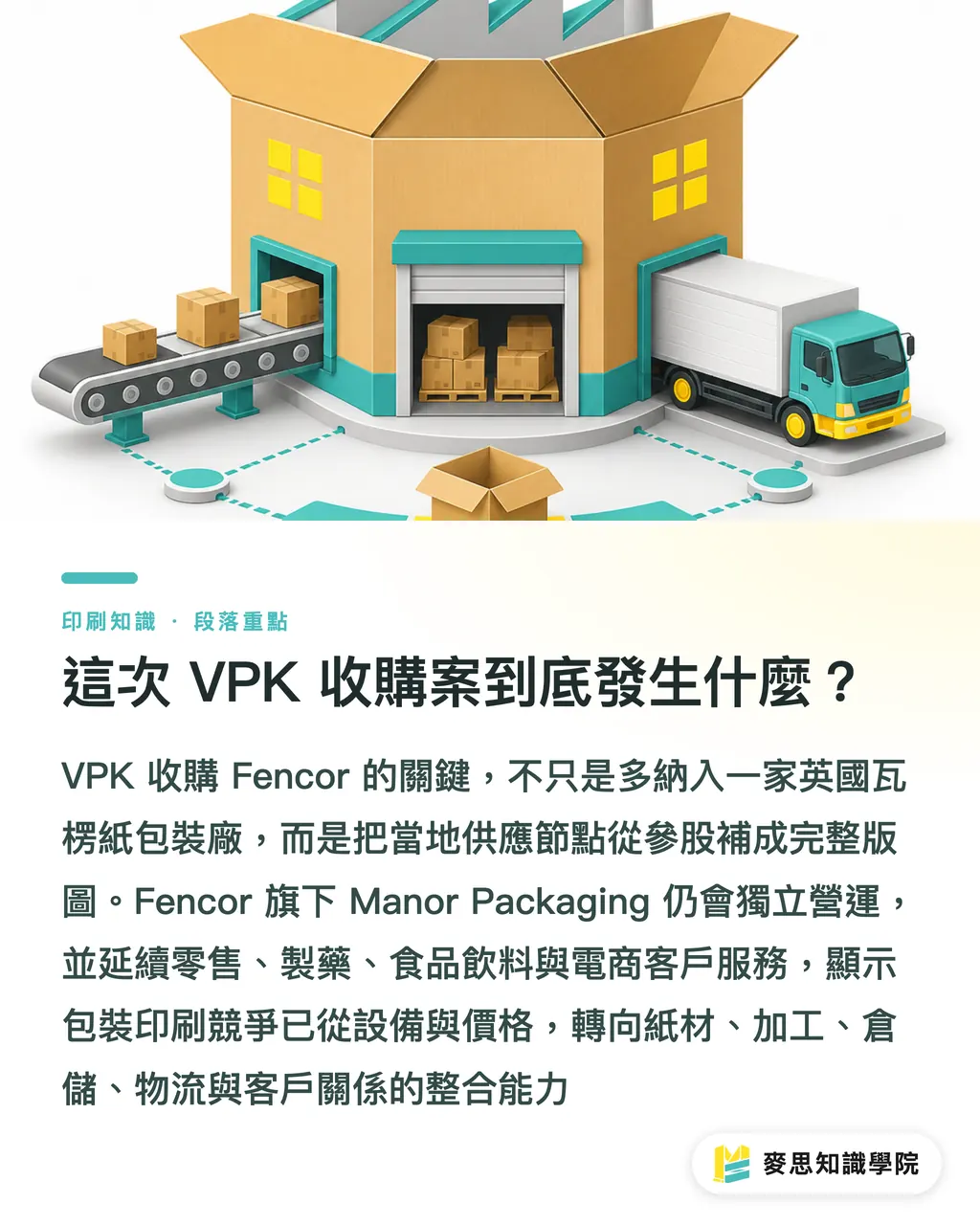
What exactly happened in this VPK acquisition?
Belgium's VPK Group acquired the UK-based Fencor Packaging Group, whose business includes Manor Packaging, a company focused on corrugated board packaging services
This is not VPK's first contact with the company. Since 2024, VPK has held a 28% minority stake in Fencor. This move takes it from partial ownership to full inclusion in its group structure
A few figures are worth keeping in mind for printing businesses:
・VPK Group currently operates 70 plants in 21 countries, with around 7,000 employees
・Fencor Packaging Group is expected to post 2025 revenue of GBP 14.8 million, about EUR 17.1 million
・Fencor is based in Cambridgeshire and combines production with warehousing and logistics
・Manor Packaging serves customers in retail, pharmaceuticals, food and beverage, e-commerce, and other sectors
・Manor Packaging will continue to operate independently after the acquisition
The key point in this deal, as I see it, is not "buying one more factory." It is about filling in supply nodes for corrugated packaging in the UK
Competition in packaging print stopped being a simple race over faster machines or lower quotes a long time ago. The real race now is who can place paper materials, converting, warehousing, delivery, and customer relationships on the same operating map
Why are major global players rushing into M&A and expansion now?
Over the past month or two, I have felt one thing very clearly on the industry floor: large groups are turning scattered capacity into networks they can dispatch and coordinate
VPK buying Fencor strengthens its geographic reach and customer access. Berlin Packaging's acquisition of BlueSky expands its UK market coverage, widening its distribution and service radius. BOBST's new cooperation project in Southeast Europe brings equipment, technology, and regional customers closer together
At the same time, on the graphic paper side, UPM and Sappi have a joint venture arrangement. On the digital production side, Fujifilm REVORIA PRESS PC2120 has been launched in Europe and the US, while UK-based Micropress has invested in two Kodak Magnus Q800 CTP platesetters
Seen together, these moves send a very clear signal:
・Paper materials: supply is becoming more concentrated, and negotiation power depends more on scale and long-term relationships
・Equipment: high-end digital printing and prepress automation keep moving forward
・Packaging: logistics, warehousing, and regional delivery capability are now competitive requirements
・Market: customers are not just buying printed products. They are buying reliable schedules and overall supply capability
North American pulp and paperboard capacity already saw a clear contraction in 2025, with containerboard down 5.1% in a single year. That pressure will travel all the way into packaging design, quotation cycles, and delivery management
In one sentence: big players are buying. Small players need to become nodes worth working with
Will small and midsize printers be pushed to the margins?
Yes, and no
The printers that will be pushed aside are those left with only one type of capacity, one customer base, and one quoting logic. Once paper materials, warehousing, and delivery schedules are integrated by large groups, pure subcontractors can easily be squeezed down into nothing but price competition
But small and midsize printers also have advantages that big groups cannot easily copy: fast response, short communication lines, and a willingness to handle non-standard jobs. This is especially obvious in Taiwan
Many brand customers in Taiwan are not placing one order for 100,000 boxes. They first make 300 sets to test the market, then revise, then add quantity, then launch an e-commerce campaign. That rhythm needs design, artwork finalization, proofing, printing, and finishing to move together
What small and midsize printers need to adjust is not their scale. It is their role:
・Move from order taker to early-stage consultant, getting involved sooner in box structure, materials, dies, and cost design
・Move from single print supplier to collaboration node, able to connect design, prepress, finishing, and logistics
・Move from low-price bidding to delivery credibility, helping customers understand which specs are stable and which carry risk
・Move from memory-based work to process records, so the same customer does not need to explain everything again on the second or third order
I find it interesting that VPK is keeping Manor Packaging independently operated. A major group is not just buying a signboard. It is also buying a local team and the stickiness of its customer relationships
That is a reminder for small and midsize printers in Taiwan: the truly valuable asset is not that machine. It is the customer understanding and delivery habits you have built over years

How should brand buyers and designers respond?
What brand customers most often underestimate is that packaging supply chain restructuring will affect design freedom
When paper supply tightens, regional capacity becomes concentrated, and large customers receive priority scheduling, small-batch brands that keep buying the old way can easily run into three problems:
・The design looks great, but the specified material is suddenly out of stock
・The quote looks cheap, but once finishing and logistics are calculated separately, the total cost is higher
・The launch schedule is tight, but artwork finalization, proofing, printing, and post-press processing were never scheduled together
My advice is simple. Do not wait until the artwork is finalized before asking the printer
For food, pharmaceuticals, cosmetics, and e-commerce packaging, these are exactly the types of customers Fencor serves. That means packaging suppliers are being asked to handle more complex requirements around regulations, display, protection, and delivery
Designers and brand teams can start with 4 things:
・Confirm material alternatives early in the design stage. Prepare at least 2 material routes that can be printed, processed, and delivered
・Before proofing, ask clearly about minimum order quantity, lead time, post-press limits, and logistics packaging method
・Treat packaging as a sales and delivery tool. Do not only look at the front-facing visual. Look at stacking, compression resistance, unboxing, and returns too
・Find partners that can integrate design, artwork finalization, proofing, printing, and finishing, so information gets distorted less between separate contact points
This is also where MINDS can create value: turning the brand idea in a customer's head into specifications that the print floor can deliver reliably
What should Taiwan's printing industry invest in next?
Seeing global M&A does not mean small and midsize printers in Taiwan should start buying companies too
The more practical investment is to first fix the links in your own workflow that break most easily
I would set the priorities like this:
・Customer structure review: identify the revenue, product types, lead times, and pain points contributed by the top 20% of customers. Do not judge only by memory
・Material alternative database: commonly used papers, thicknesses, processing limits, substitute materials, and historical quotes should be easy to find quickly
・Prepress standardization: artwork checks, color management, die versions, bleed, and font rules need to be fixed into clear standards
・Small-batch packaging capability: e-commerce, food, health product, and cultural and creative brands will keep needing small quantities with many variations
・Collaboration partner list: organize reliable finishing, logistics, design, digital printing, and large-format output partners into a network that can be deployed
If I could only do one thing first, I would choose prepress standardization
The reason is very practical: in the M&A era, the question is not who is best at firefighting. It is who can prevent one more mistake from happening
One wrong die, one mismatched color swatch, one unannounced material change. In the end, what gets eaten up is not paper cost. It is customer trust

Key Takeaways
・When large players acquire companies, they are buying geography, customers, logistics, and the right to coordinate capacity. It is not just one more factory
・The way forward for small and midsize printers is not to fight scale with scale. It is to become the most reliable collaboration node in the customer's supply chain
・Packaging design cannot wait until the artwork is finished before bringing in print. Materials, finishing, and lead time need to be calculated together from the early design stage
・Prepress standardization is the cheapest and most effective source of competitiveness. One fewer mistake means one more chance to keep trust
・Taiwan's demand for small quantities with many variations is still there. Teams that can integrate design, proofing, printing, and finishing will have better opportunities
Further Thoughts
For print manufacturers, the task now is not to chase every international M&A headline. It is to sort out their own supply capability: which items can be delivered steadily, which materials have alternative routes, and which partner factories are worth tying in for the long term
For designers and brand teams, packaging should not stop at the visual layout. It is the physical interface through which a product enters channels, logistics, and consumers' hands. The earlier printing conditions enter the design process, the fewer revisions, delays, and extra costs there will be later
For AI and SaaS teams, what the printing industry really needs is not flashy tricks. It needs quoting, artwork checks, version records, material substitution, and progress tracking turned into usable workflows, so the experience of senior craftsmen does not stay only in their heads but also lives in the team's working system
The next step for integrated services like MINDS is not to make themselves sound huge. It is to explain every printing decision clearly, so customers know why this material, this process, and this lead time are the most stable choice for the brand
Further Reading
FAQ
- What trend does VPK's acquisition of Fencor Packaging Group represent?
- It shows that the corrugated packaging market is moving toward regional integration. Large groups are connecting production, warehousing, logistics, and customer relationships, making delivery schedules and supply stability the core of competition
- Will small and midsize printers in Taiwan be affected by the global M&A wave?
- They will be affected indirectly, especially in paper supply, packaging costs, and brand customers' expectations for delivery schedules. Small and midsize printers need to improve stability through prepress standardization, material alternatives, and collaboration networks
- What should brand customers confirm early when developing packaging?
- They should confirm paper materials, processing methods, minimum order quantity, proofing time, and lead time early. If packaging design waits until the artwork is finalized before asking the printer, it often runs into material shortages, revisions, or costs that exceed expectations
- Why do designers need to understand printing supply chain restructuring?
- Because supply chain restructuring changes material availability, processing limits, and delivery rhythm. The earlier designers understand these conditions, the better they can create packaging that is both attractive and ready for mass production
- Which area is most worth investing in first for printing companies now?
- Prepress standardization is the most worthwhile first investment, including artwork checks, color management, die versions, and material records. Getting these basics right reduces errors and customer complaints more effectively than blindly buying more equipment
References
- VPK Group 收購英國瓦楞紙包裝企業 Fencor Packaging Group · printindustry.news
Related articles




The Print × AI weekly
The print and AI know-how designers, brands and enterprises can use before they commit — one email, every week
MINDS Free Tools
AI background removal, a LINE sticker maker, spine & imposition calculators — all free, right in your browser, no upload.
MINDS Group
Need actual printing or gifting services?
From premium printing to online ordering and festive gifts — the MINDS Group sister brands take it from here.