
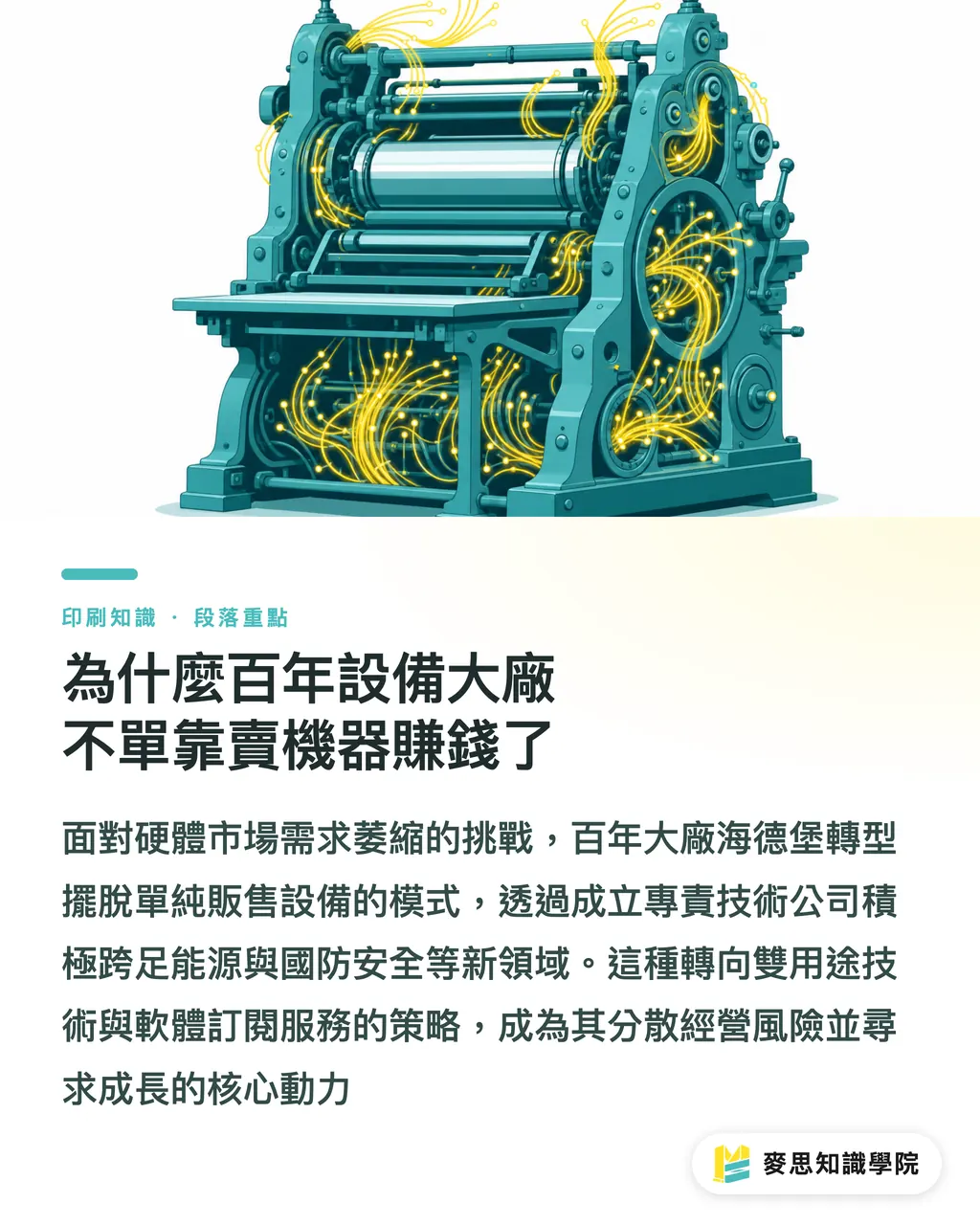
Why Century-Old Equipment Giants No Longer Rely Solely on Selling Machines
Working on the front lines with clients in recent years, I've clearly felt that simply competing on hardware specifications is no longer enough to persuade business owners to open their wallets
Looking at the figures for Heidelberg's 2025/2026 fiscal year, it's evident that while revenue saw a slight increase to 2.293 billion euros, geopolitical disruptions caused total annual orders to fall to 2.246 billion euros
The shrinking demand for hardware equipment is a structural pressure on the entire market, forcing Heidelberg to broaden its strategic front
They established HD Advanced Technologies GmbH to coordinate new technologies, expanding into energy, charging infrastructure, and even defense and security sectors
They are using dual-use technologies to diversify the risk of sluggish hardware sales and shifting their core focus toward software subscriptions, service contracts, and automated solutions
How Supply Chain Restructuring Will Affect Procurement for Taiwanese Printing Plants
The reshuffling of the supply chain brought on by geopolitics is not just happening in semiconductors; traditional printing manufacturing is experiencing it too
To optimize its cost structure, Heidelberg has fully shifted its Speedmaster CX104 production line to China and established new factory facilities in North Macedonia
The direct impact on small and medium-sized printing plants in Taiwan is that the machine's country of origin, the inventory of local maintenance parts, and remote software diagnostic capabilities will all be reshuffled when introducing new equipment in the future
When negotiating with the original manufacturer, our evaluation criteria can no longer just look at single-machine depreciation; we must also calculate the hidden costs of cross-border maintenance and software update binding conditions
Why Packaging Automation Has Become the Only Solution for Profit Growth
David Schmedding, Chief Technology and Sales Officer at Heidelberg, stated bluntly that the packaging market is their core growth engine
This aligns perfectly with my recent experience dealing with brand clients. Whether it's changing demographics or strict sustainability regulations on flexible films like California's SB 54, the supply chain is being forced to upgrade
To capture this market, Heidelberg has deepened its strategic partnership with Masterwork in post-press packaging, aiming to master the end-to-end value from substrate selection, printing, and post-press, to logistics
In fact, the reshuffling of the prepress workflow began long ago, such as when EyeC launched Proofiler Graphic Connect to insert automated quality control directly into the design finalization stage
In the future, equipment manufacturers will be selling a complete set of digital integration capabilities to help clients solve labor shortages and compliance issues, rather than just capacity at a single station
How Small and Medium-Sized Plants Should Respond to This Software Subscription Transition
When the business model of an equipment leader changes from one-time hardware sales to subscription services, the mindset of Taiwanese operators must shift accordingly
・Procurement negotiation use is changing: Previously used to slashing hardware prices, you must now fight for longer software licenses and guaranteed paths for digital upgrades
・Factory system integration requirements: The value of new machinery is built on data flow. Whether your existing MIS or ERP can connect with the manufacturer's ecosystem is key
・Edge computing implementation: Remote monitoring and predictive maintenance of equipment will become standard. The factory's network infrastructure and cybersecurity governance must be raised to the level of enterprise transformation
This is precisely where one-stop integrated services like MINDS can make an impact, using professional knowledge to help clients build smooth workflows between equipment, software, and design
Key Takeaways
・Hardware sales profits are bottoming out; software subscriptions and aftermarket service contracts have become the profit-sustaining lifeline for century-old equipment manufacturers
・Geopolitics has triggered a major reshuffling of production lines; moving the Speedmaster CX104 to China reflects the manufacturer's survival anxiety in trying to suppress construction costs
・Sustainability regulations and packaging demand are bolstering the market's foundation; end-to-end integration from prepress automated inspection to post-press processing is the future factory standard
・Procurement strategy must shift from simply measuring hardware depreciation to evaluating software licensing, data integration, and long-term warranty conditions
Reflections
The transformation of equipment suppliers is actually a wake-up call for the industry; the era of competing head-to-head on pure hardware performance is over
Small and medium-sized printing plants in Taiwan must realize that future competitiveness lies in whether their internal software and hardware data can communicate, and whether they can react quickly to increasingly stringent packaging specifications from brand owners
For AI and SaaS developers, this is also a perfect breakthrough point to enter the traditional manufacturing industry, helping those printing plants unable to build massive IT teams to cross the high walls set by original manufacturers using lightweight tools
By introducing MINDS's professional process organization, transforming complex digital transformation into stable daily production line operations is the way to survive and thrive
Further Reading
FAQ
- Why are printing press leaders like Heidelberg no longer focusing on pushing new hardware?
- Because global equipment demand is shrinking and geopolitical impacts are affecting order volumes, the manufacturer must rely on software subscriptions, automated solutions, and diversifying into dual-use technologies like energy and defense to stabilize profits
- What is the substantial impact of shifting production lines on Taiwanese buyers purchasing new equipment?
- Changes in the machine's country of origin will directly affect lead times and maintenance parts dispatching. The focus of future maintenance and warranty contract negotiations will shift from pure hardware repair to remote software diagnostics and system upgrade authorization
- What are the benefits of end-to-end prepress and post-press integration for small and medium-sized printing plants?
- Facing pressure from sustainability regulations like California's SB 54, combining EyeC automated inspection with Masterwork post-press processing integration can significantly reduce human rework and satisfy brand clients' compliance requirements
- What hidden costs should be paid attention to when purchasing new equipment now?
- Don't just look at the hardware buyout price; you must carefully calculate subsequent software module subscription fees, annual system licensing fees, and whether the factory system has the connectivity capability to interface with the new equipment
References
- 海德堡轉型加速:印刷機製造商如何押注軟體與服務求生 · thepackagingportal.com
Related articles
The Print × AI weekly
The print and AI know-how designers, brands and enterprises can use before they commit — one email, every week
MINDS Free Tools
AI background removal, brand stamping, and a LINE sticker maker — free design tools, right in your browser, no upload.
MINDS Group
Need actual printing or gifting services?
From premium printing to online ordering and festive gifts — the MINDS Group sister brands take it from here.