

What Is Fujifilm Trying to Do?
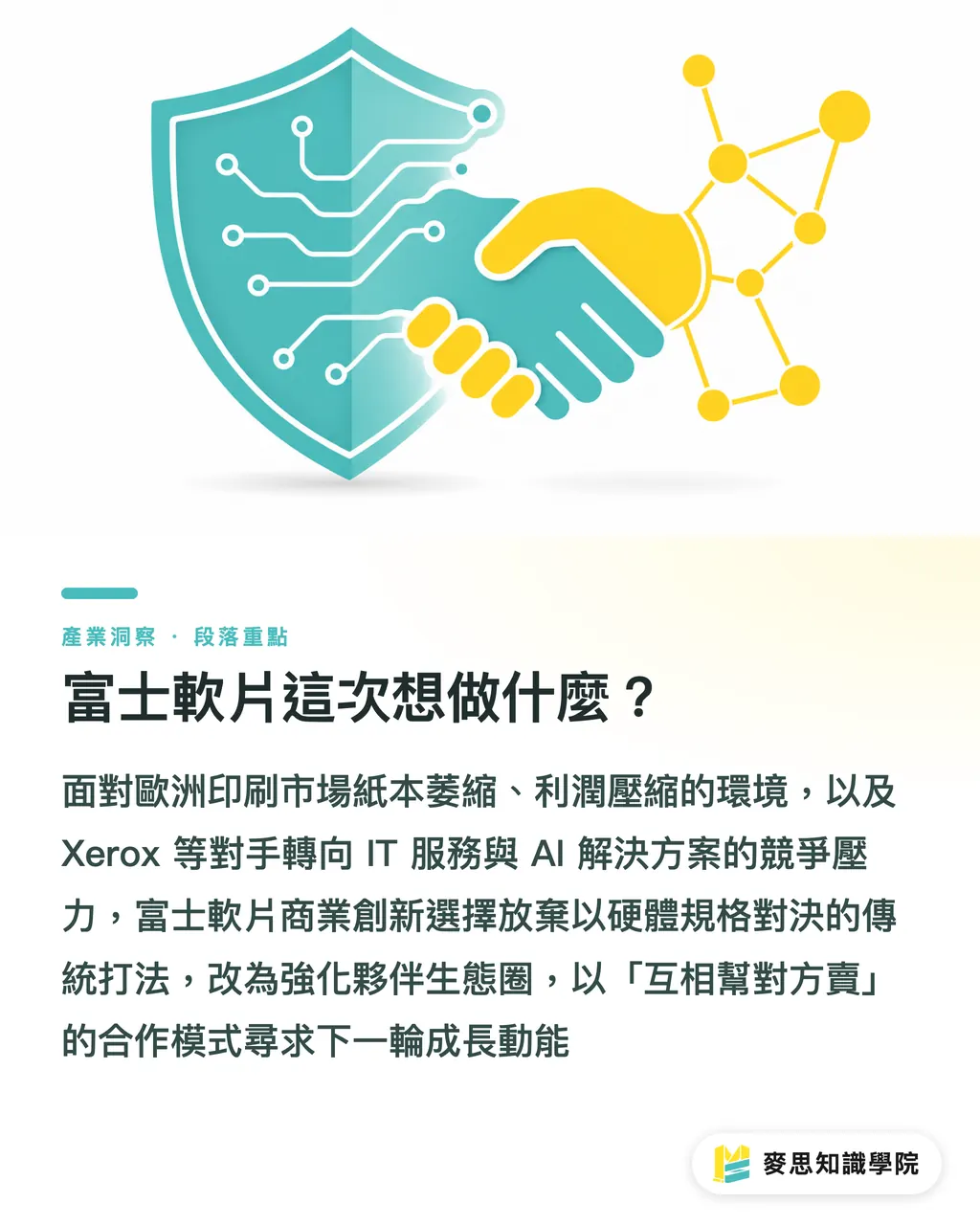
Trading hardware spec wars for partner ecosystem strategy
Fujifilm Business Innovation recently held a partner event in Europe with a clear signal: abandon traditional hardware competition based on ppm, resolution, and toner formulation. Instead, shift to a partner empowerment play, the idea that we help you sell, and you help us sell. Research firm Quocirca identified this strategic pivot in their analysis of Fujifilm's partner reinforcement in Europe's print market
This move is no accident. Europe's print market faces three simultaneous pressures: declining paper demand, shrinking print volumes, and margin compression. Meanwhile, competitors haven't been idle
・Xerox has explicitly repositioned itself from a 'print equipment manufacturer' to an 'IT services and AI solutions provider.' Xerox CEO Pastor outlined this trajectory directly in Quocirca's 100th episode interview
・Quocirca just released the ACT framework, Automation/AI, Cloud, Tech Ecosystem, identifying these three forces as structural variables determining which print companies survive. Read the full analysis in their ACT framework report
・The industry broadly senses that the era of pure machine sales is ending. Service contracts, process subscriptions, and cloud management are the next frontier for margin growth
Fujifilm's bet on partner ecosystems at this moment signals an acknowledgment: the ceiling on single-unit hardware sales has been reached
Why 'Partner Empowerment' Over Direct Sales?
The real barrier to service transformation isn't the product. It's the channel
Fujifilm's choice reflects two concrete structural reasons
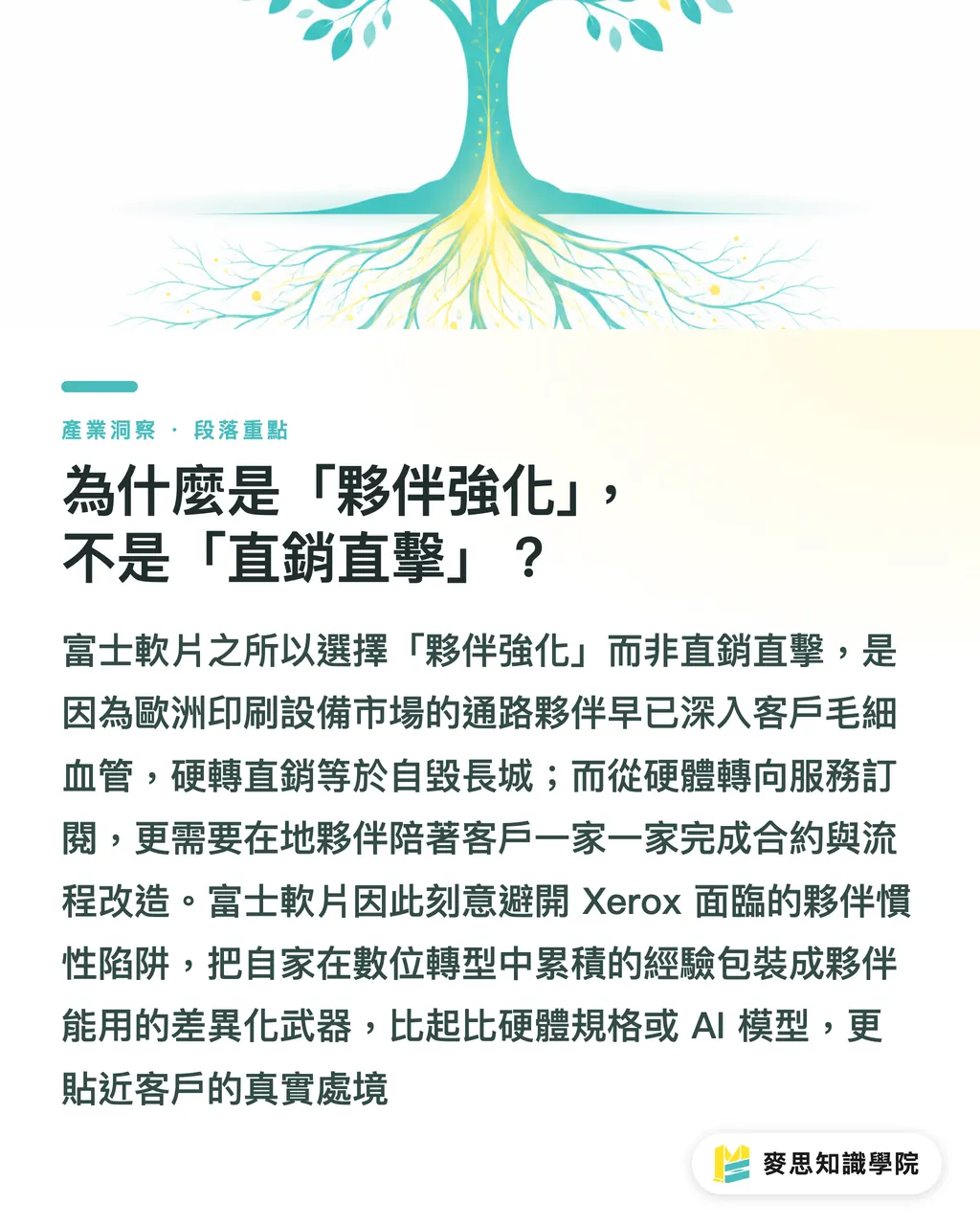
First, Europe's print equipment market has long relied on channel partners to handle sales and service, creating capillaries deeper and denser than any direct manufacturer-to-customer contact. If the manufacturer tried to go direct, it would destroy this network overnight, cutting off its own supply line
Second, moving from hardware sales to service subscriptions is something the manufacturer can pitch, but customer-side contract restructuring, cloud process migration, and AI tool rollout require local partners doing hands-on guidance, one customer at a time. Xerox has been tagged by Quocirca analysts for one of its three major execution challenges: persuading channel partners to shed their hardware-sales habits. Fujifilm appears consciously trying to sidestep that trap. Make partners the 'empowerment target' first, then customers the 'service target.'
In the partner event, Fujifilm shared real transformation cases, emphasizing that the experience it accumulated through its own digital transition is the core differentiator. That's harder to copy than 'our machines run faster' and closer to what customers actually experience
What This Means for Taiwan's Mid-Size Printers and Brand Buyers
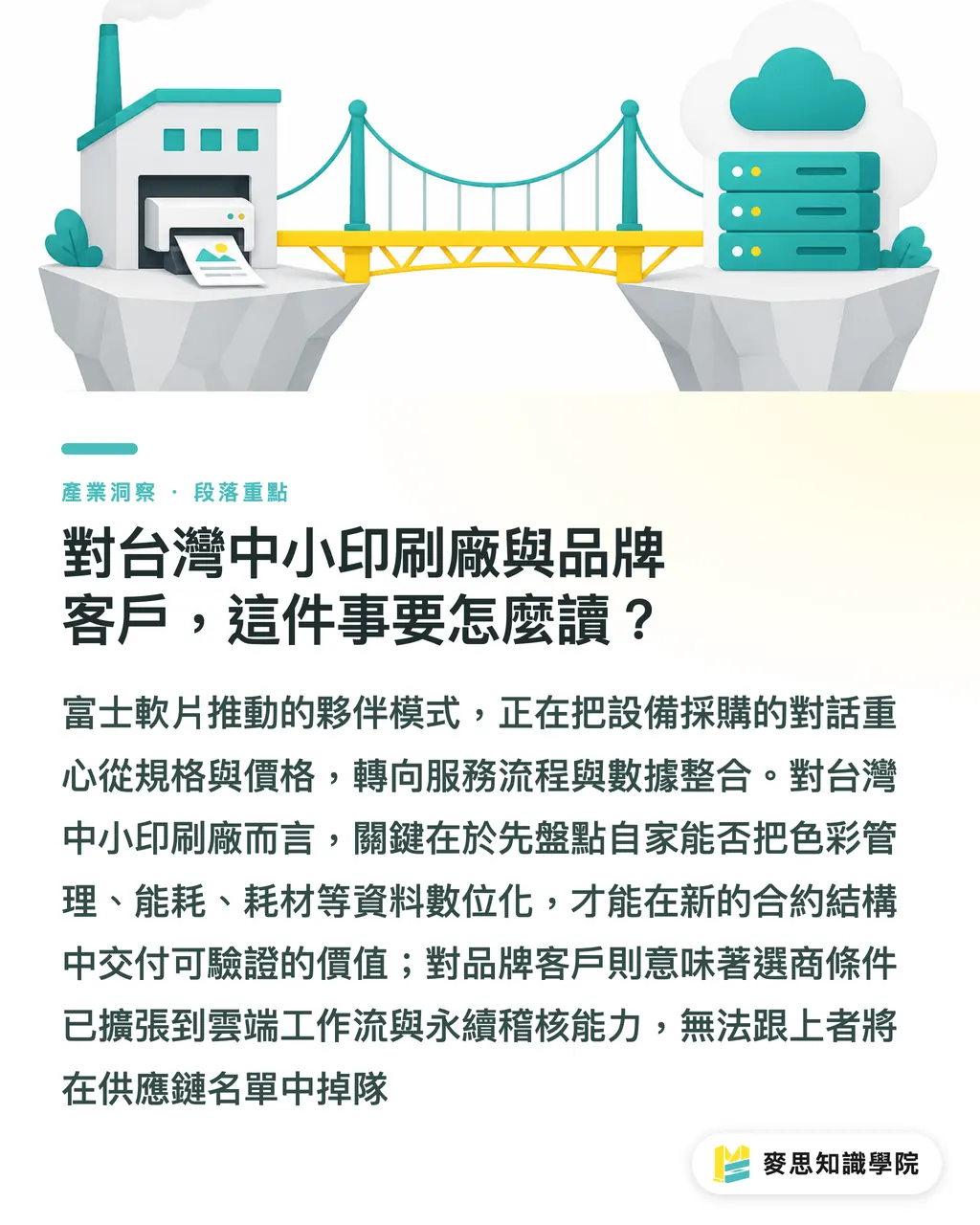
Partner model maturity will directly reshape your conversation with equipment vendors
Let me describe a pattern I've seen repeatedly in recent customer sites: many mid-sized print shops still open equipment upgrade discussions with sales decks highlighting ppm, resolution, and toner melting point. But actual buyers are already asking different questions: Once this equipment arrives, who helps me automate downstream workflow? Can customer work orders flow into my CRM? Can energy-consumption reports feed directly into my customer's ESG submission? This gap is precisely what Fujifilm's partner empowerment strategy is meant to fill
For Taiwan's mid-size printers, evaluate this from three angles:
・Equipment procurement negotiations should shift focus. Beyond price, specs, and warranty, add 'can the manufacturer supply implementable service workflow templates?' as a scoring criterion. Examples: standardized customer work-order templates, cloud backup architecture, cross-facility color management solutions
・Audit your own 'service capability.' If Fujifilm wants partners selling services, you need something to sell too. At minimum, digitize your own color management, print-time tracking, and material consumption data so you can deliver verifiable value in service contracts
・Renegotiate your channel relationships. Distributor roles will shift from 'moving machines and collecting warranty fees' to 'process consultant and AI application guide.' Contract structure and commission logic will have to move with it
For brand buyers (procurement side), the signal is equally clear:
・Your supplier-selection criteria are expanding. Beyond paper and print method, you now need to evaluate whether suppliers have cloud workflows, AI proofing, and automated file completion. See the Sharp Europe and Quocirca conversation on the 'AI confidence gap' for context
・Sustainability pressure is simultaneously rising. International brands are tightening supply-chain carbon audits. Details in this reporting via the Chinese Printing Technology Association. Print shops must be able to audit their own energy use and material flow as traceable data, or they'll drop off the qualified-supplier list
Meanwhile, These Other Signals Matter Too
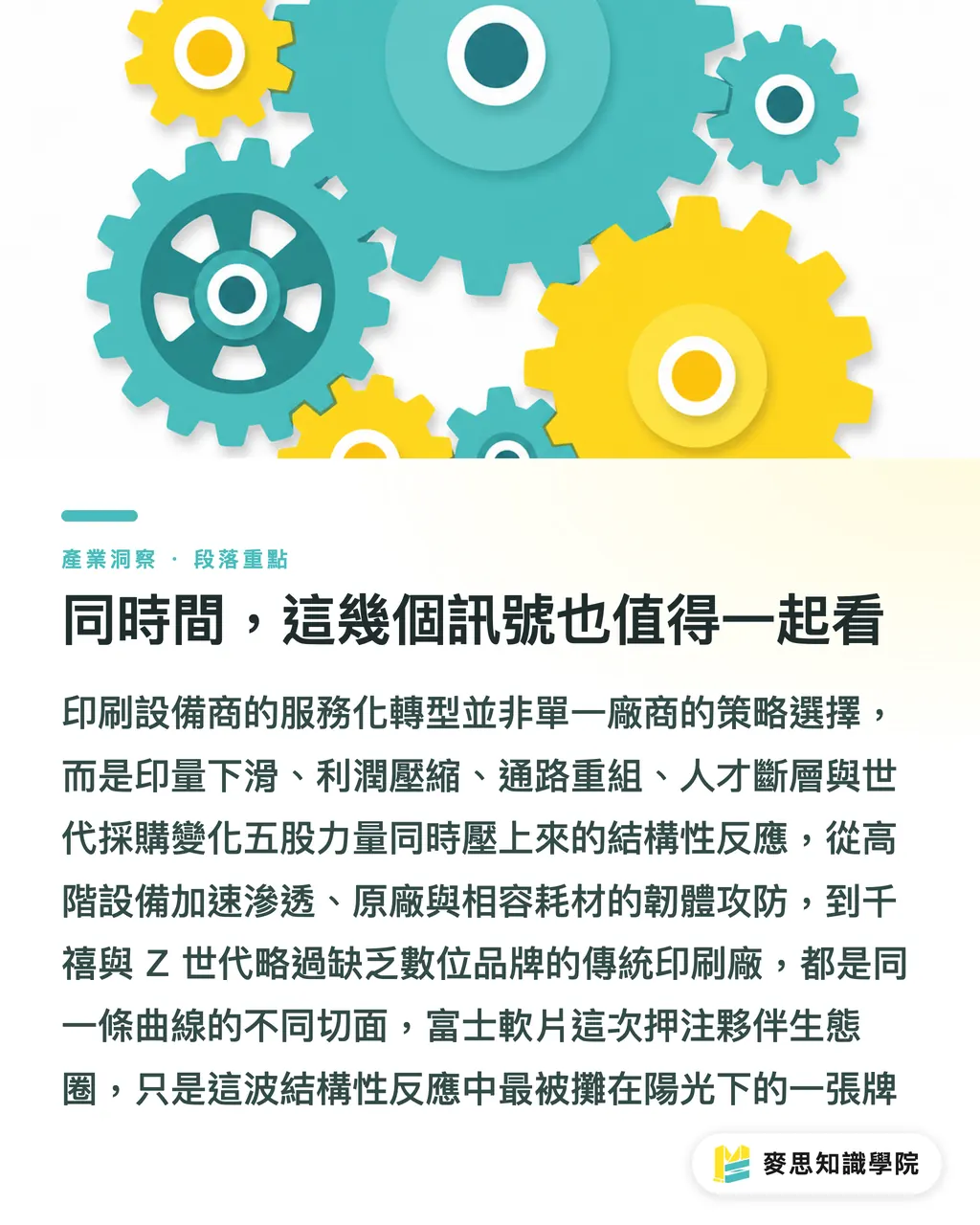
Equipment market transformation isn't Fujifilm acting alone, it's structural and simultaneous across vendors
・High-end machine adoption is accelerating. Konica Minolta installed its first AccurioJet 30000 in the UK—30,000 sheets per hour throughput. See Print Monthly. Meanwhile, Heidelberg retooled the Speedmaster CX 102 for UK printer ThreeFiveFour, doubling capacity and cutting print time in half. Case study in Print Monthly. An aftermarket refurbished-equipment ecosystem is forming
・Consumables warfare is heating up. Fujifilm, Ricoh, and Brother pushed firmware updates in May to block compatible chips, but Chinese vendor Zhono confirmed their chips tested unaffected. See Imaging Solution. The firmware arms race between OEM and third-party suppliers won't stop soon
・Sustainability and talent form two quiet undercurrents. UFlex (India) partnered with the UN Global Compact to advance plastic-packaging programs for waste workers in Delhi. See Labels & Labeling. Meanwhile, YPIPP (UK) warned that youth employment is at historic lows, a harbinger of long-term skill gaps in print and packaging. See Print Monthly
・A generational procurement breakdown is surfacing. PINE New England found that millennial and Gen Z buyers are actively skipping print companies without digital brand identity. See generational gap alert. This signal mirrors the other end of Fujifilm's partner-ecosystem curve
・Specialty printing is diversifying. Packaging, textiles, decorative veneers, tiles, and electronics all face simultaneous inkjet-infiltration pressure. See Industrial Print Magazine's practical guide
Stack these signals together, and a pattern emerges: equipment vendors' shift to services isn't one vendor's strategic choice, it's a structural response to five simultaneous forces: shrinking print volume, margin compression, channel restructuring, talent attrition, and shifting buyer generationality. Fujifilm's partner empowerment play is just the most publicly visible move in this wave
Key Takeaways
・Fujifilm stepping back from hardware specs and pivoting to partner ecosystems is a direct response to Europe's volume decline and margin compression, it's not a single-vendor marketing move
・Service transformation succeeds or fails on channel strength, not product; partner empowerment is more realistic than going direct
・Taiwan's printers need to shift equipment procurement from 'machine specs' to 'workflow templates and service capability,' or upgrades will stall halfway
・Brand buyers' supplier-selection criteria are expanding, sustainability and AI-process maturity have shifted from bonus points to baseline requirements
・Generational procurement discontinuity and youth skill gaps are two underestimated undercurrents that will reshape customer composition over the next three to five years
Extended Perspective
From Taiwan's vantage point, what Fujifilm's partner strategy teaches most valuably isn't the event itself, it's a redefined value split across four tiers: OEM, distributor, printer, and brand buyer. I'd suggest landing this in three moves:
・First, your print shop should run a 'service-readiness audit.' At minimum, digitize work-order flow, energy consumption, and material tracking. Otherwise, even if the OEM wants to empower you, it has nothing to empower
・Second, renegotiate the agreement between distributor and printer. Write in process-consulting fees, AI-tool deployment budgets, and cloud-subscription revenue splits, don't lock everything into hardware warranty
・Third, brand-buyer procurement teams should add 'does this supplier have cloud workflows, AI proofing, and traceable sustainability data?' to selection KPIs. Whether you do this or not determines whether you're still on the qualified list in three years. If you're stuck at any step in equipment upgrade or service transition, the Mai Strategy Knowledge Academy consulting team can audit your work-order pipeline, contract structure, and customer-side procurement window concretely. For mid-to-high-end customized commercial print output, MINDS can step in as a direct hands-on partner
Further Reading
・Fujifilm's Partner Reinforcement in Europe's Print Market
・Xerox CEO Pastor on AI Integration Strategy
・Quocirca ACT Framework Report
・Xerox Channel Reinvention: Three Major Execution Challenges
・Sharp Europe and Quocirca on the AI Confidence Gap
・Konica Minolta AccurioJet 30000 First UK Installation
・ThreeFiveFour Doubles Capacity with Refurbished Speedmaster CX 102
・Zhono Compatible Chips Resist May Firmware Update
・UFlex and UNGC Sustainable Plastic Packaging Initiative
・YPIPP Warns of UK Print Industry Skill Gap
・Generational Gap Alert: Young Buyers Overlook Traditional Print Brand Identity
・Industrial Print Practical Guide
・Carbon Pressure Rising: Sustainable Packaging as Required Curriculum
FAQ
- Why did Fujifilm choose partner empowerment rather than pivoting directly to an IT services business?
- Because Europe's print equipment channel has long relied on partners for sales and local service, a direct sales pivot would destroy that network. Partner empowerment makes sense because service transformation requires local partners to guide customers through contract restructuring, cloud migration, and AI tool rollout one by one. OEMs can't convince customers to make these moves alone; partners can
- What direct impact does Fujifilm's move have on Taiwan's print equipment distributors?
- Distributor roles will shift from moving machines and collecting warranty fees to becoming process consultants and AI application guides. Contract structure and commission logic will follow. Distributors need to start assessing whether they can deliver color-management digitization, cloud backup, and standardized work-order systems. If they can't, they risk falling out of the OEM's new partner tiers
- What's the most concrete change service transformation brings to mid-size print shops?
- Equipment procurement negotiation shifts from hardware specs to service-workflow templates and measurable value delivery. Print shops must digitize work orders, energy consumption, and material flow to deliver verifiable outputs in service contracts. Otherwise, you'll hit a wall halfway through upgrade
- What new scoring criteria should brand buyers add when selecting print suppliers?
- Beyond paper and print method, add cloud workflows, AI proofing capability, and traceable energy and material data to your scoring. Supply-chain carbon traceability is rapidly shifting from a nice-to-have to a baseline requirement. Suppliers without it will fall off international brand rosters
- In a partner-empowerment model, what's the single most important thing a print shop should do first?
- Digitize your work-order flow, energy consumption, and material tracking first. Without this foundation, no amount of OEM empowerment or contract restructuring will stick. It's the basic prerequisite for service-model transition
Related articles

The Print × AI weekly
The print and AI know-how designers, brands and enterprises can use before they commit — one email, every week
MINDS Free Tools
AI background removal, a LINE sticker maker, spine & imposition calculators — all free, right in your browser, no upload.
MINDS Group
Need actual printing or gifting services?
From premium printing to online ordering and festive gifts — the MINDS Group sister brands take it from here.