

Why Vendor-Specific Integrated Production Lines Are Becoming Increasingly Risky
Over the past few weeks, I have been closely monitoring the macroeconomic climate, with North American pulp and paperboard production capacity projected to shrink by 5.1%. Combined with the recent record high in the U.S. CPI in May, I deeply empathize with the anxiety print shop owners face regarding skyrocketing costs
In the past, the common practice when purchasing equipment was to rely on a single vendor for an end-to-end solution, seeking the convenience of unified maintenance and simplified integration
However, in the current fast-paced market environment, such closed systems often turn into procurement traps
If you listened to the panel discussion, How to scale Industrial Print production through modular systems and open connectivity, at the recently concluded exhibition, you would realize that global manufacturers are also re-evaluating this pain point
Once a vendor discontinues a specific module or imposes aggressive price hikes, your production line loses its bargaining power and room for upgrades
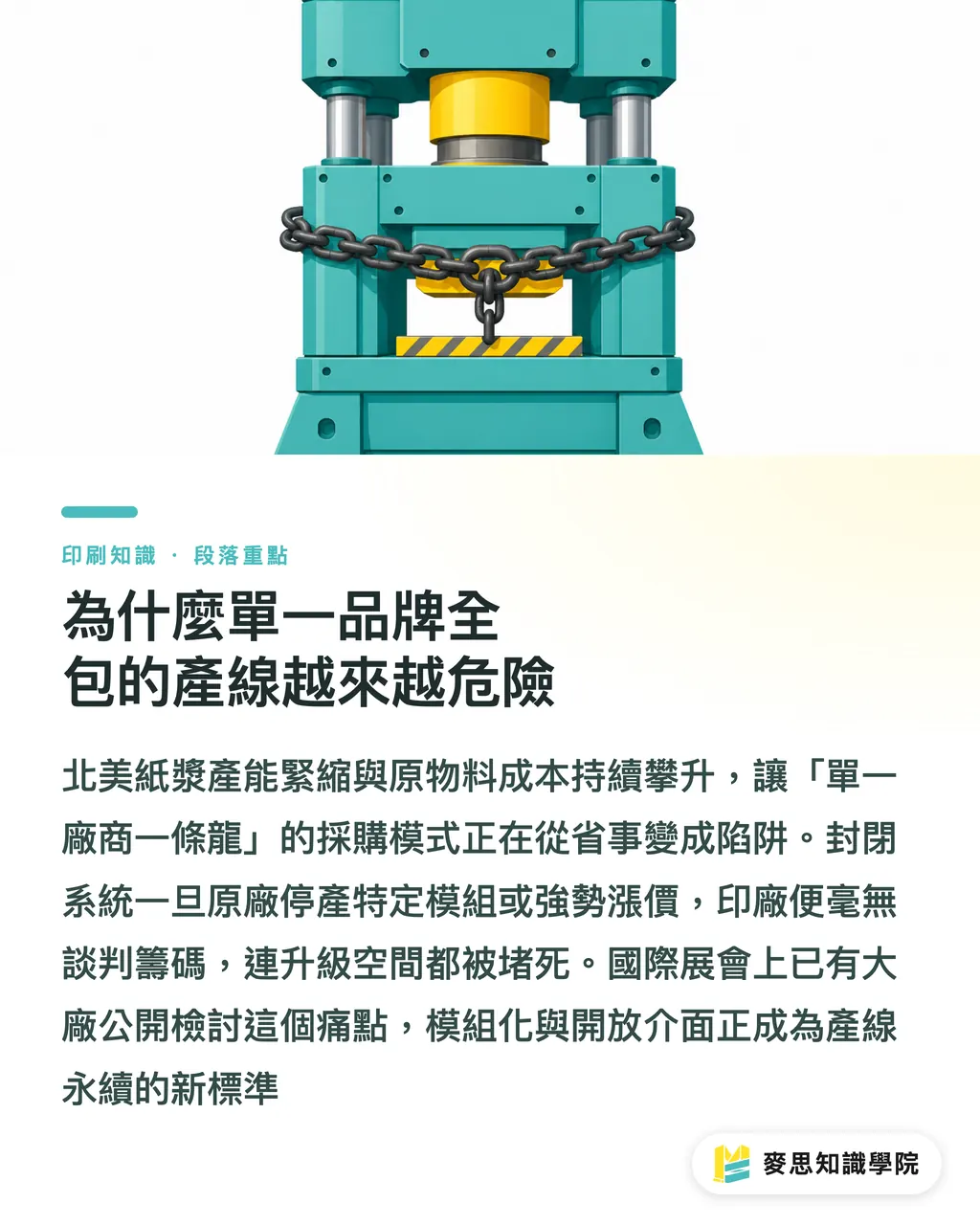
How Hardware/Software Decoupling and Open Connectivity Work
The only true way to mitigate risk is to shift toward modular production systems and open connectivity
This means treating prepress RIP software, mid-stream industrial inkjet engines, and post-press automated cutting/finishing as independent, swappable nodes
The ability for equipment from different manufacturers to communicate smoothly relies on underlying standardized communication protocols
・Equipment Level: Systems must support the JDF/JMF standard formats, the common language for cross-brand job ticketing and machine status reporting
・Software Level: Systems must feature REST API interfaces to facilitate easy integration with in-house ERP systems or external order platforms
Taking the 2026 FESPA exhibition in Germany as an example, the Durst P5 500 TEX iSUB displayed on-site could be directly paired with Hasler Magna equipment to form a dye-sublimation workflow, a concrete demonstration of breaking down single-brand hardware barriers
How Small and Medium-Sized Print Shops Can Smartly Evaluate Equipment Procurement
In recent months, I have frequently reminded clients preparing to upgrade their production lines not to focus solely on hardware specifications
Especially in light of the precise packaging requirements driven by the miniaturization of medical devices, there is an increase in extreme, small-batch orders with ultra-short turnaround times and high traceability requirements. What shops need is the flexibility to swap out localized modules at any time
When I previously tracked the case of the UK's Swanline Group integrating multi-vendor machines into a single IoT platform, it confirmed that system integration for mixed-line printing facilities is no longer a myth
During your next equipment procurement negotiations, ensure these questions are on your checklist:
・Ask whether the vendor provides open API access or if it requires expensive additional licensing fees
・Verify if new equipment can exchange data with existing legacy machines from different vendors via JDF
・Confirm whether software licensing is a separate contract to prevent being forced to repurchase software when hardware is eventually replaced
The Durst P5 350 CORE is a great entry point for SMB print shops to enjoy open architecture at a lower barrier to entry. Combined with their Kyveris software's sandbox testing environment, it allows operators to confirm software integration feasibility before committing to hardware investments
Key Takeaways
・Closed production lines face escalating risks under inflation and supply chain volatility; modular architecture is the foundation for maintaining hardware bargaining power
・JDF/JMF and REST API support should be considered a non-negotiable threshold for new equipment procurement, as it dictates the future expandability of your machinery
・Investments in front-end RIP, mid-stream printing, and post-press finishing should be phased to retain the flexibility of replacing a single node without impacting global production
Extended Reflections
Based on my first-hand coaching experience, the era of buying hardware outright is over. Future core competitiveness lies in the mastery of equipment data flow
For practitioners in the printing industry, whether they are brand clients evaluating the introduction of MINDS one-stop services or local shops actively transforming, the next step is not to blindly pursue the fastest or largest machines
Instead, it is to thoroughly audit existing in-house IT infrastructure, pilot open standards starting with small-batch, high-value production lines, and turn the facility into a plug-and-play platform for software and hardware integration
Further Reading
FAQ
- What is JDF/JMF, and why is it essential when buying equipment?
- These are international standard languages for cross-brand equipment communication in the printing industry. Supporting these standards means your Brand A printer and Brand B cutter can exchange job tickets and progress data, preventing them from becoming isolated information silos
- Can I still achieve modular integration if my legacy machines lack open API interfaces?
- In practice, you can capture operational data by installing external sensors or intermediary IoT gateways. While not as seamless as native support, it serves as a practical stop-gap solution during the transition period
- If I buy hardware from different brands, who is responsible if something goes wrong?
- This is the most common pain point during initial implementation. The best solution is to establish in-house standard operating procedures (SOPs) for integration testing or to commission a team with cross-system integration experience, such as MINDS, to perform total system acceptance
References
Related articles





The Print × AI weekly
The print and AI know-how designers, brands and enterprises can use before they commit — one email, every week
MINDS Free Tools
Spine width and imposition calculators — skip the manual math, free in your browser.
MINDS Group
Need actual printing or gifting services?
From premium printing to online ordering and festive gifts — the MINDS Group sister brands take it from here.