

What Does €600 Million Actually Buy?
Start with the numbers. On June 1st, Smurfit Westrock announced €600 million in investment across French operations over the next three to five years, with the focus on production line modernization and further carbon reduction, one of the largest single-market capital expenditures since the 2024 merger
Two specific plants have already been named: the Épernay facility in the Champagne region receives €40 million for expansion and upgrades, while the Rethel plant in Ardennes gets €20 million to strengthen its corrugated board operations. Add in the more than €500 million the group had already invested in France over the previous five years, and this is essentially a second layer built on top of an already substantial foundation
What's worth noting even more is the carbon reduction track record. The group currently operates four carbon-neutral plants in France, plus one near-zero-emission paper mill. French Country Manager Andrew Coffey has explicitly framed environmental performance as 'a natural extension of paper-based packaging' — a clear signal that decarbonization isn't PR; it's a competitive moat
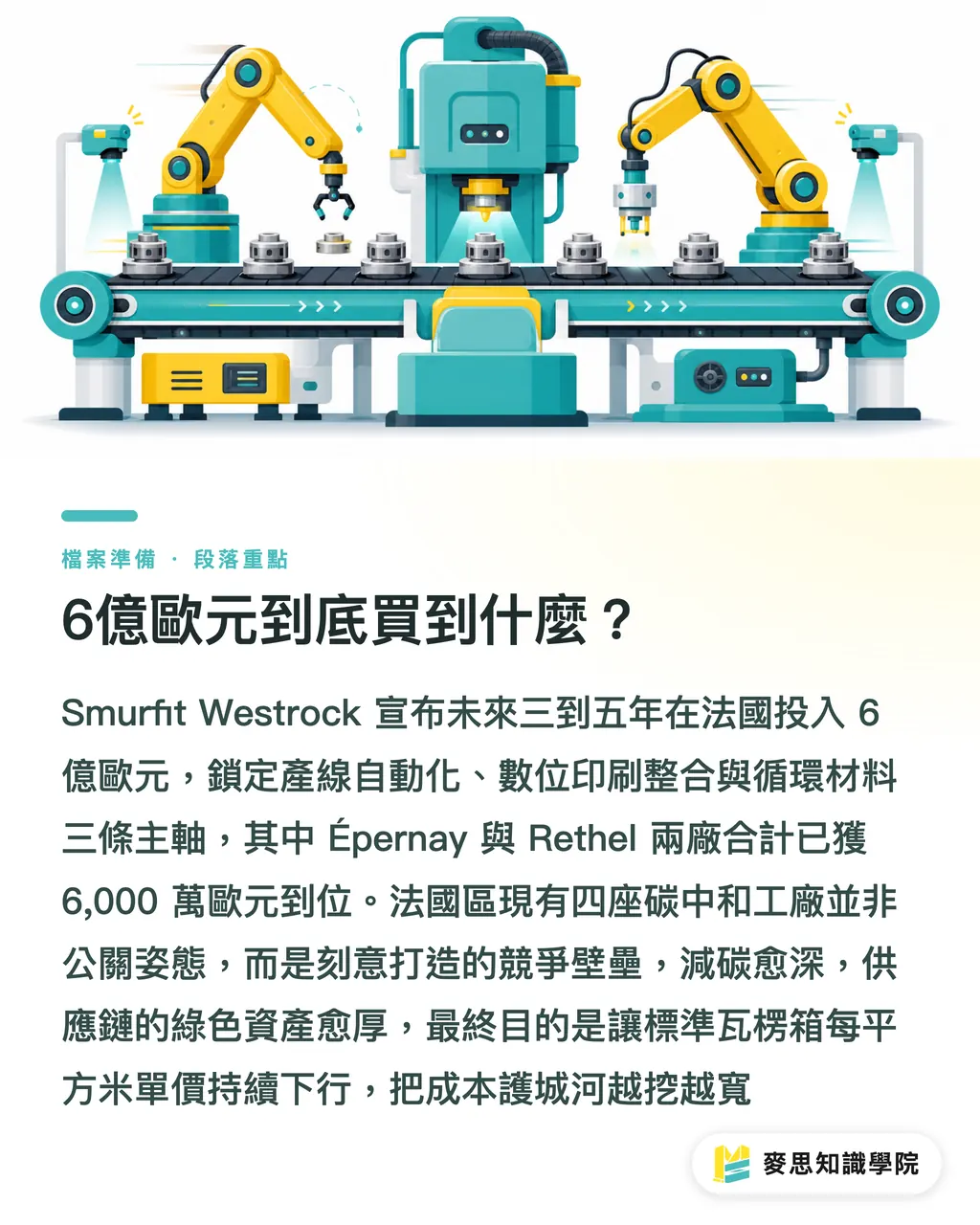
Break down the spending and the logic becomes clear: automated lines cut labor costs, integrated digital printing shortens changeover time for short runs, and circular materials build out the green credentials of their own supply chain. Together, these three moves keep pushing the cost per square meter of standard corrugated boxes lower and lower
Why Does a Big-Player Upgrade Hurt Small Shops the Most?
Capital investment at this scale is essentially a trade of fixed costs for variable costs. The more automated the line and the longer the amortization period, the lower the marginal cost per standard box
The problem is that corrugated boxes are a highly commoditized category. Once a major player drives standard-product costs below the floor that small and mid-sized shops can reach, any buyer with consistent specs and sufficient volume has almost no reason to choose the more expensive option
In the packaging procurement conversations I've had over the past month or two, the pattern is consistent: standard boxes get compared down to the decimal, cheapest wins. That segment of the market is simply no longer a battlefield where smaller shops should be fighting head-on
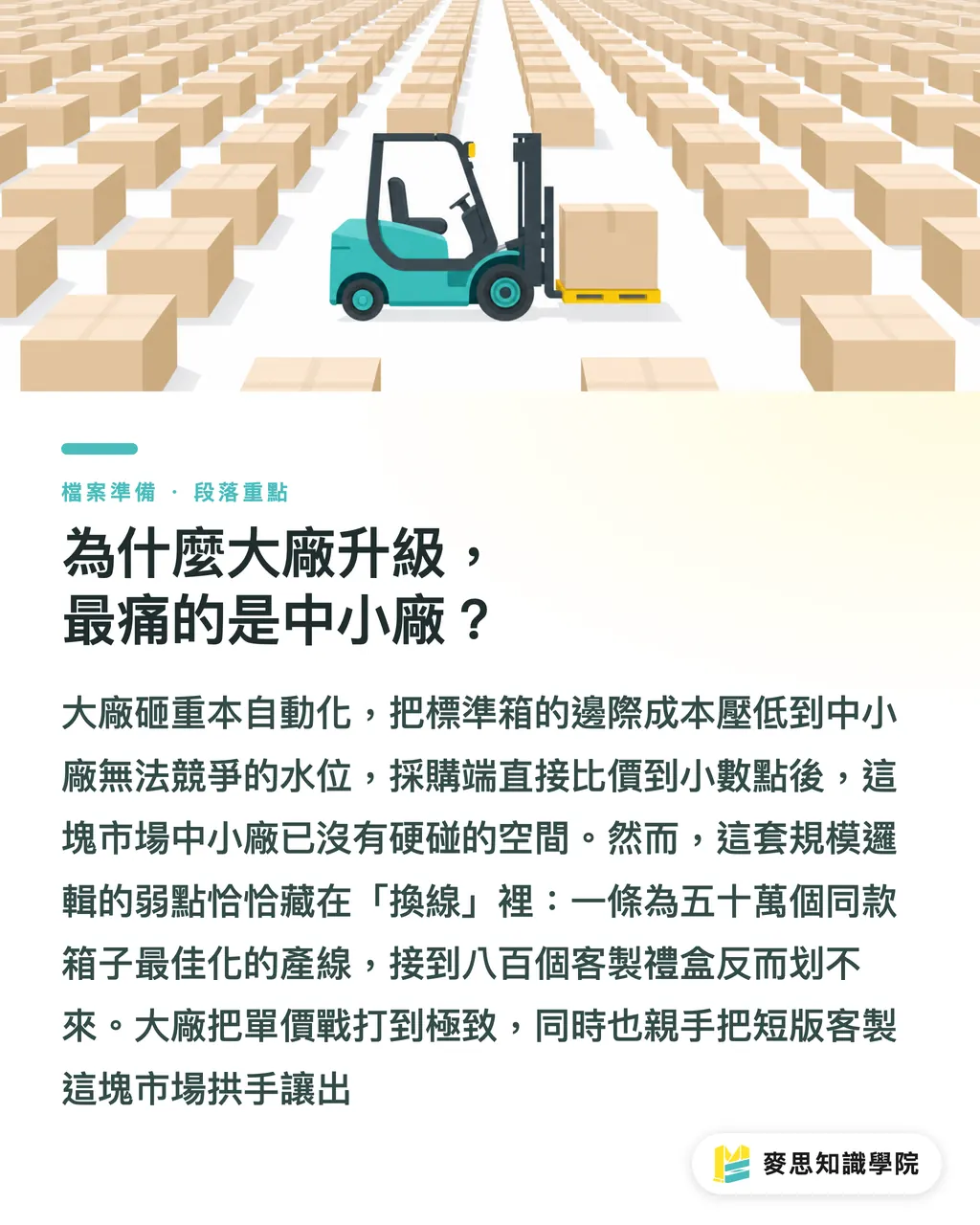
But there's a flip side that often gets overlooked. Automated lines hate changeovers. A line optimized to run 500,000 identical boxes can't economically stop to print 800 custom gift boxes, the time cost of swapping plates, calibrating color, and cleaning the machine simply doesn't pencil out. The cost advantage of big players is airtight on standard products; the moment you move into short-run custom work, that same logic of scale becomes a liability
In other words, as the majors drive unit-price competition to its extreme, they simultaneously hand off another segment of the market
What Can Small Corrugated Shops Actually Defend?
Not competing on who has the cheapest box, but on who can take the jobs that big players can't even start. Having spent time on both the production floor and the client side, I've found that what actually holds up comes down to three things
・Speed: A client confirms artwork today, needs a proof tomorrow, and wants a small quantity on shelf the day after to test the market. That pace doesn't fit into a major plant's scheduling system, but it's exactly where a smaller shop's flexibility becomes an advantage
・Customization: Die-cut shapes, specialty flute grades, foil stamping, embossing, spot UV coating, the work that makes a single order complex is precisely the work that high-volume lines don't want to touch
・Short-run premium quality: Brand clients launching new products, holiday limited editions, or crowdfunding fulfillment need small quantities with a strong sense of craft and design. Standard-box thinking can't serve this need at all
Connecting these three points, the direction small shops should pivot toward isn't 'make cheaper boxes' — it's 'make the boxes that big players can't and won't make.'
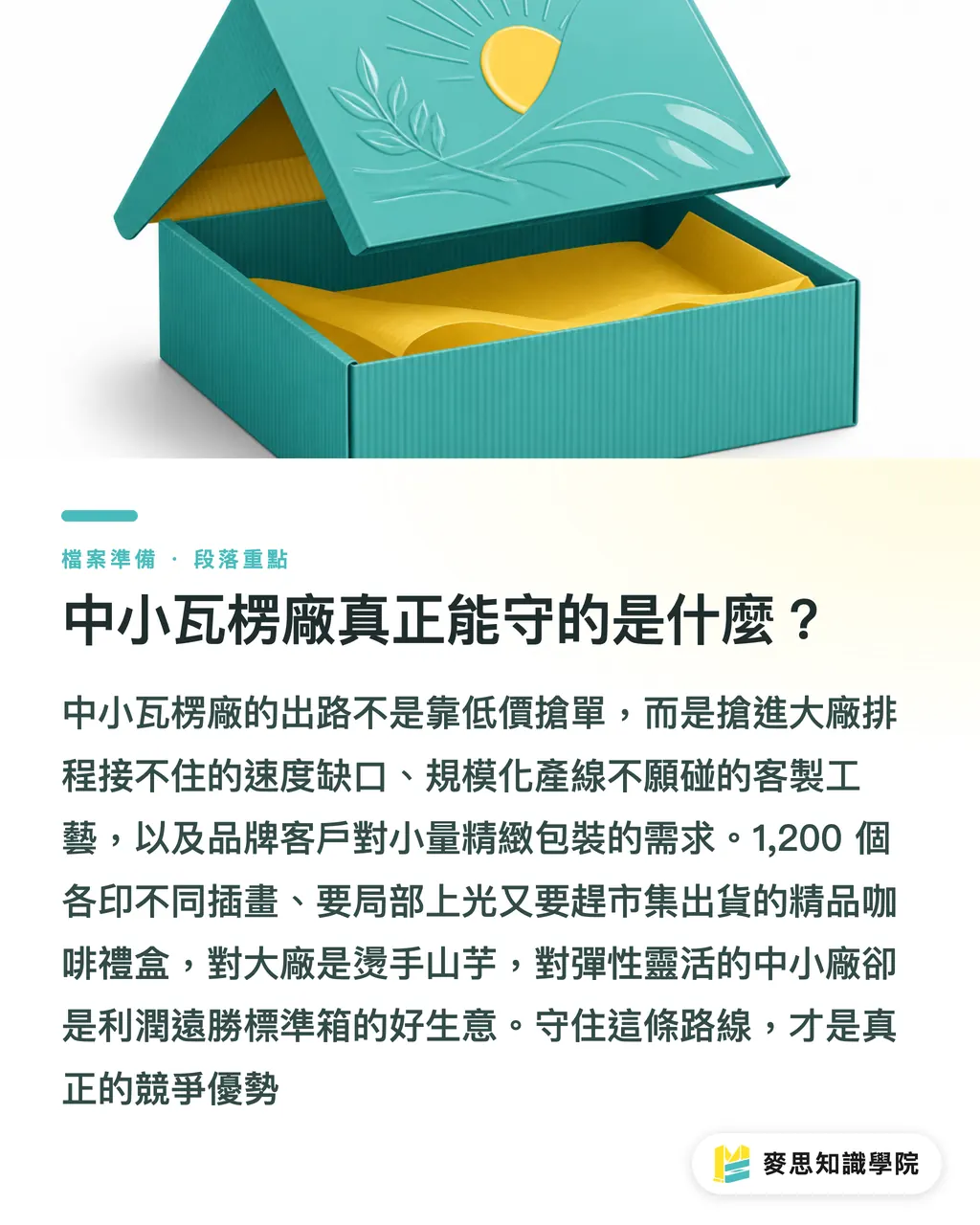
A real-world example: a specialty coffee brand needed 1,200 gift boxes, each printed with a different origin illustration, with spot UV coating, delivered before a weekend market. Quoted at a major plant, just the tooling and minimum order quantities would have scared the client off. For a shop with fast proofing, flexible die-cutting, and willingness to take small runs, that job is far more profitable than any standard box order
Will Design and Prepress Be the Next Dividing Line?
Yes, and I think it's the most underestimated asset small shops hold
No matter how sophisticated a major player's digital printing integration becomes, it solves for production efficiency. But the differentiation small shops need to build starts further upstream. Design and prepress are where real pricing power lives. Two corrugated boxes with identical specs can feel completely different depending on whether the layout, structure, die lines, and finishing processes were thought through together, and clients can feel that difference in what they're willing to pay
Over the past while, I've noticed a clear shift in how brand clients ask questions. It used to be 'how much per unit?' Now it's more often 'can this structure open more easily?' 'How accurate is the color registration?' 'Is there a more sustainable paper that doesn't compromise the feel?' These aren't questions that a pure price comparison can answer
For small shops, the implication is this: whoever can connect design, structural prototyping, prepress, and finishing into a smooth, integrated workflow, letting clients make fewer visits, revise fewer times, and run into fewer errors, is the shop that escapes the unit-price race. That's exactly what MINDS has been building: integrating the entire span from design through production so that short-run custom work is no longer expensive and slow, but a reason brand clients keep coming back

Key Takeaways
・The real purpose of the €600 million upgrade is to push standard corrugated box pricing to a level small shops can't compete with. Don't fight head-on in the standard-products market
・The more powerful an automated line, the more it fears changeovers. Short-run custom work is a segment the big players are actively ceding
・Small shops can only defend three things: speed, flexibility, and customization. Everything else gets rolled over by scale
・Die-cut shapes, foil stamping, embossing, and spot UV, the work that makes orders complex, is exactly the small shop's shield
・Design and prepress are where pricing power comes from. A seamless workflow from design through finishing is worth more than competing on price
Food for Thought
A next step for three different audiences: If you're in print manufacturing, audit your production capabilities and clearly identify what you can do, fast changeovers, small runs, unusual die cuts. That's what you should be leading with externally, not capacity numbers. If you're in design, don't just hand over print-ready files. Package structure, die lines, and finishing specifications into your proposals, clients are buying an overall result, not a flat layout. If you're looking to bring in AI or SaaS tools, don't rush into a large-scale automation platform. The highest-use digital transformation for a small shop is the 'proofing to quoting' stretch, cut the waiting time from client inquiry to sample review in half, and you'll feel the impact faster than anything else. And for brand clients: next time you're selecting a packaging partner, rather than comparing unit prices alone, ask whether the shop can deliver the quality you want within the timeline you need. The ones who can actually answer that question are the ones who can genuinely help
Further Reading
FAQ
- What is Smurfit Westrock's €600 million investment actually for?
- It funds the modernization of French production facilities over three to five years, with a focus on automated lines, integrated digital printing, and further carbon reduction. The Épernay plant has been allocated €40 million and the Rethel plant €20 million
- Why is a major player upgrading its lines bad news for small corrugated shops?
- Automation drives down the marginal cost of standard corrugated boxes, allowing big players to push pricing on commodity products to levels small shops can't match, effectively forcing them out of the pure price-comparison market for standard products
- How should small print shops respond to the big players' arms race?
- Move toward work that big players can't do and don't want to do: fast turnaround proofing, production flexibility, custom die cuts, and short-run premium customization, all of which are uneconomical on high-volume automated lines
- Why is short-run custom work an opportunity for small shops?
- Automated lines hate changeovers. A line optimized for large runs of identical products is too costly to pivot to a few hundred custom pieces. This small-volume, quality-focused market is one that big players effectively give away
- Beyond production, where else can small shops differentiate?
- In design and prepress. Integrating layout, structure, die lines, and finishing processes, then wrapping that into a seamless workflow from design through production, lets brand clients revise less, make fewer mistakes, and ultimately pay a premium well above standard-box pricing
References
- Smurfit Westrock 砸 6 億歐元升級法國廠 · printindustry.news
Related articles




The Print × AI weekly
The print and AI know-how designers, brands and enterprises can use before they commit — one email, every week
MINDS Free Tools
AI background removal, a LINE sticker maker, spine & imposition calculators — all free, right in your browser, no upload.
MINDS Group
Need actual printing or gifting services?
From premium printing to online ordering and festive gifts — the MINDS Group sister brands take it from here.