
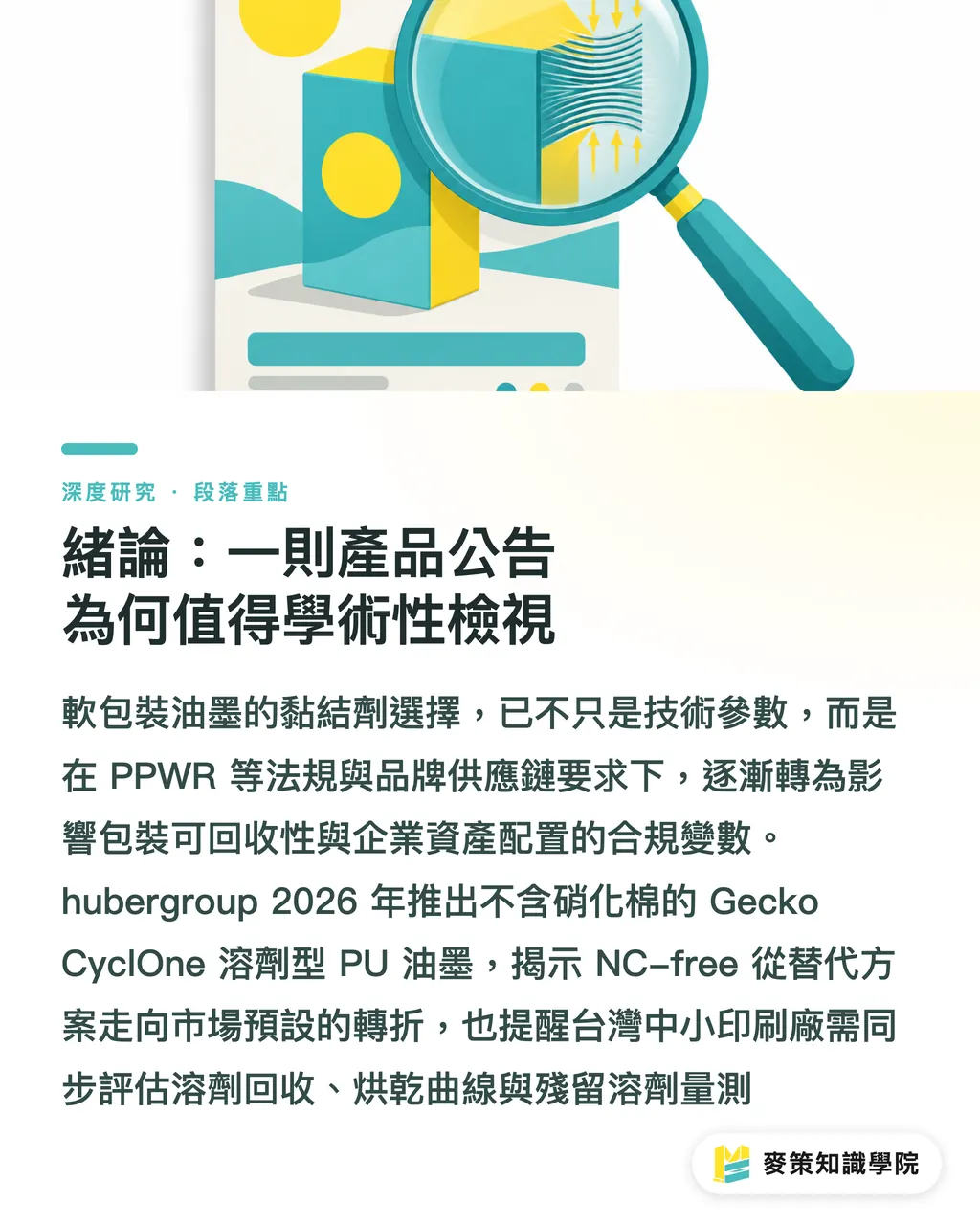
Introduction: Why a Single Product Announcement Deserves Academic Scrutiny
The choice of binder in flexible-packaging inks is shifting from a purely technical-parameter question to a matter of compliance and asset allocation. In September 2026, hubergroup Print Solutions announced the Gecko CyclOne series, a solvent-based liquid ink system free of nitrocellulose (hereafter NC), built on its proprietary polyurethane (hereafter PU) technology. It is intended for flexography and gravure, covering surface printing, reverse printing, and lamination printing [1]. At the product level alone, this is a routine new-product announcement. Set against a moment when the European Union's Packaging and Packaging Waste Regulation (hereafter PPWR) has formally become binding law [3], however, it offers a window for examination: under what combination of institutional pressure and technical maturity does a binder chemistry used for decades move from "an option" to "the default"?
The research questions are: What variables drive the commercialization timeline for NC-free inks? To what extent does the proposition that "traditional solvent formulations are on a countdown to phase-out" hold, and at which levels has it been oversimplified?
Existing discussions have three specific gaps:
・First, industry media generally focus on product specifications and vendor quotations, with little analysis that places a single product within the regulatory timeline and the cost structure of substitution
・Second, academic literature on sustainable packaging concentrates on material structures, recycling rates, and life cycle assessment (hereafter LCA) [5]. Methodologically, discussion is relatively thin on how an ink binder, which makes up a very small share of packaging weight yet may determine the recyclability classification of the package as a whole, should be incorporated into the assessment
・Third, Taiwan's small and midsize printers face an indirect pressure path in which "material specifications driven by European regulations" enter through supply-chain requirements imposed by brand customers, yet almost no public, structured analysis exists on how to judge the cost and timing of adoption
This article makes three contributions, each corresponding to a section of the main text:
・First, it redefines what NC-free technically replaces, distinguishing between binder substitution and solvent-system substitution, two levels that are often conflated. This corresponds to Section 3
・Second, it uses PPWR's design-side recyclability requirements as the institutional reference point to analyze how ink binders shift from "performance choices" to "compliance variables." This corresponds to Section 4
・Third, it breaks down the actionable decision points for Taiwan's small and midsize printers, the design side, and the brand side in this substitution process, including specific adjustment directions for solvent recovery systems, drying curves, and residual-solvent measurement. This corresponds to Section 5
The importance of this topic to Taiwan's industry lies in its structural position: Taiwan's flexible-packaging printers take on a large volume of export-oriented contract-manufacturing orders for food and consumer products. Material-compliance requirements in end markets flow back to the pressroom in the form of specification sheets. Printers are usually the last link in the supply chain to be informed, yet the one expected to shoulder the equipment and process-adjustment costs
Literature and Current Landscape Review: Three Discussion Axes That Developed Separately and Have Yet to Converge
Existing discussions can be grouped into three clusters. Their concerns and methodologies differ noticeably, and the point where they intersect is where this article begins
First group: Regulatory literature on packaging waste and design-side compliance. The EU has elevated packaging and packaging-waste rules to the directly applicable Regulation level, and the text includes recyclability requirements for packaging design [3]. The European Commission's Directorate-General for Environment also frames packaging-waste management as one of the core areas of circular-economy policy [4]. The defining feature of this body of literature is its top-down direction: it works backward from waste-management goals to packaging-design specifications. Its limitation is that the legal text handles recyclability determinations at the packaging level. How inks, adhesives, and coatings, as "non-structural components," affect the outcome is generally left to later implementing rules and industry standards. This article differs from that group by not restating the legal provisions. It asks how regulatory pressure concretely reaches the choice of ink formulation
Second group: Methodological literature on packaging life cycle assessment. The packaging field has accumulated a substantial body of LCA research and has developed meta-analytic approaches for integrating and comparing those studies [5]. This research provides a quantitative comparison framework across materials and scenarios. Its shared limitation is that LCA results are highly sensitive to the system boundary and functional unit, while ink accounts for a very small share of total packaging weight and is often truncated or aggregated in life-cycle inventory analysis. This article argues that this is the methodological reason ink-binder substitution has remained "invisible" in sustainability discussions for so long: it contributes very little to weight-based indicators, yet it may have a disproportionate effect on deinking performance in recycling processes and on the quality of recycled material. The connection with this body of work is that this article puts forward a dimension that LCA has difficulty capturing but that is materially important to recyclability determinations
Third group: Industry dynamics and organizational evolution among ink suppliers. In 2020, hubergroup split its German operations into Chemicals and Print Solutions (inks) [2]. This organizational adjustment allowed the ink business to focus independently on formulation technology pathways. The company says it has invested in developing PU-based inks since 2015, and that Gecko CyclOne extends its NC-free product line after Gecko Platinum and Gecko Xtreme White [1]. The value of this group of data is that it provides a time dimension for the substitution technology. Its limitation is equally clear: the sources are vendor releases and industry-media retellings, and the performance claims lack independent third-party verification. This article handles these data by strictly distinguishing between a "verifiable factual skeleton," including the product's existence, technical basis, and application range, and "vendor claims," including the degree of recyclability improvement and the ease of conversion. The latter are consistently identified as independently unverified
The shared gap across the three discussions is this: the regulatory side discusses packaging recyclability, the LCA side discusses quantitative comparison, and the supplier side discusses product performance, but no line of inquiry fully connects the timeline of generational change in binder chemistry. This article attempts to fill that connection point
Clarifying the Technical Levels: NC-free Replaces the Binder, Not the Solvent
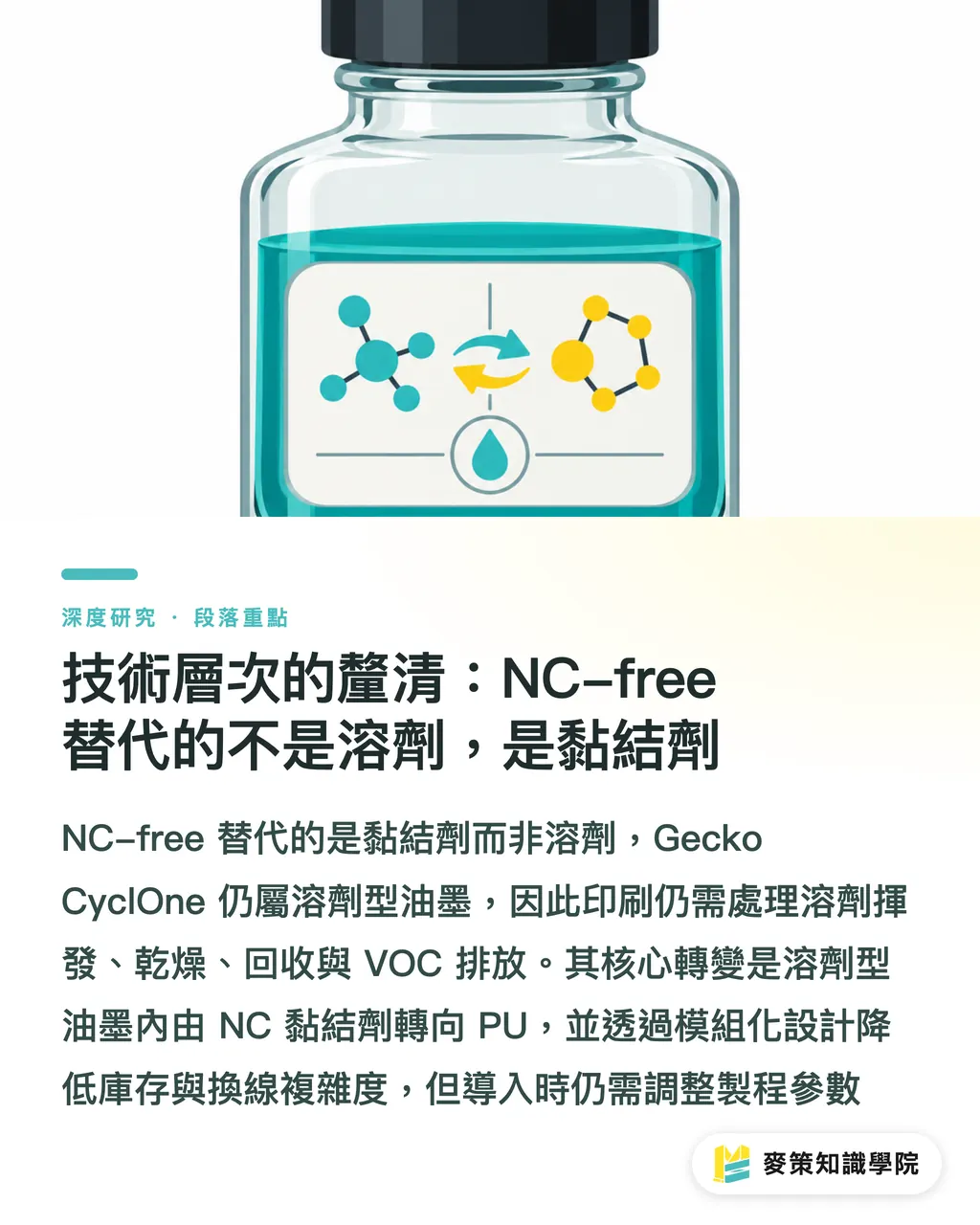
"NC-free ink" replaces the binder system, not the solvent system. This is the first distinction needed to understand the subject
Gecko CyclOne is explicitly described as a solvent-based (lösemittelbasiert) ink system [1]. At the process level, this means printing still requires solvent evaporation and drying, along with solvent recovery and volatile organic compound (hereafter VOC) emissions management. Therefore, if the headline proposition that "traditional solvent formulations are on a countdown to phase-out" is taken to mean that solvent-based printing will soon be replaced by water-based or solventless processes, it represents an inferential leap. A more accurate description is that the mainstream binder used within solvent-based printing is moving from NC to PU
NC has served as a solvent-based ink binder for many years, and its position is the result of historical accumulation. As packaging recyclability requirements rise, demand for alternatives grows accordingly [1]. This statement, confirmed jointly by the vendor and the media, deserves scrutiny. It points the motive for substitution clearly toward recyclability rather than print quality, cost, or safety. In other words, NC has not failed on the traditional evaluation dimensions. It loses points on a newly added dimension. This is the key to understanding the substitution timeline. When the motive comes from external institutional requirements rather than an internal performance shortfall, the speed of substitution depends on the institutional timetable and the efficiency of supply-chain transmission, not on the technology curve
The architecture of Gecko CyclOne is also worth taking apart. The system uses a modular design in which pigment concentrates (Pigmentkonzentrate) can be adjusted with specific additives for different printing methods, allowing surface printing, reverse printing, and lamination printing to share one system. The product line covers white ink, CMYK process colors, varnish, and primer. It can be used for flexography and gravure, and versions are available for mono-solvent (Mono-Lösungsmittel) applications [1]. This article reads the design goal of the modular, shared system as reducing the number of inventory items and the complexity of changeovers at the printer. That choice itself reveals where the real friction in the substitution process lies. The friction is not the print quality of a single batch. It is the factory-level cost of inventory, changeovers, and process-parameter management
The vendor states that moving from NC-based inks to a PU-based system does not require fundamental changes to existing production processes, but adjustments are still needed [1]. This is a notably restrained claim. It should be read literally rather than amplified: "adjustments are needed, but no fundamental changes" means that conversion costs exist and are not zero. The public information does not explain which parameters require adjustment. Section 5 therefore proposes items that printers should measure themselves, clearly identifying them as the author's analysis rather than source information
Analyzing Institutional Drivers: The Mechanism Path from Performance Option to Compliance Variable
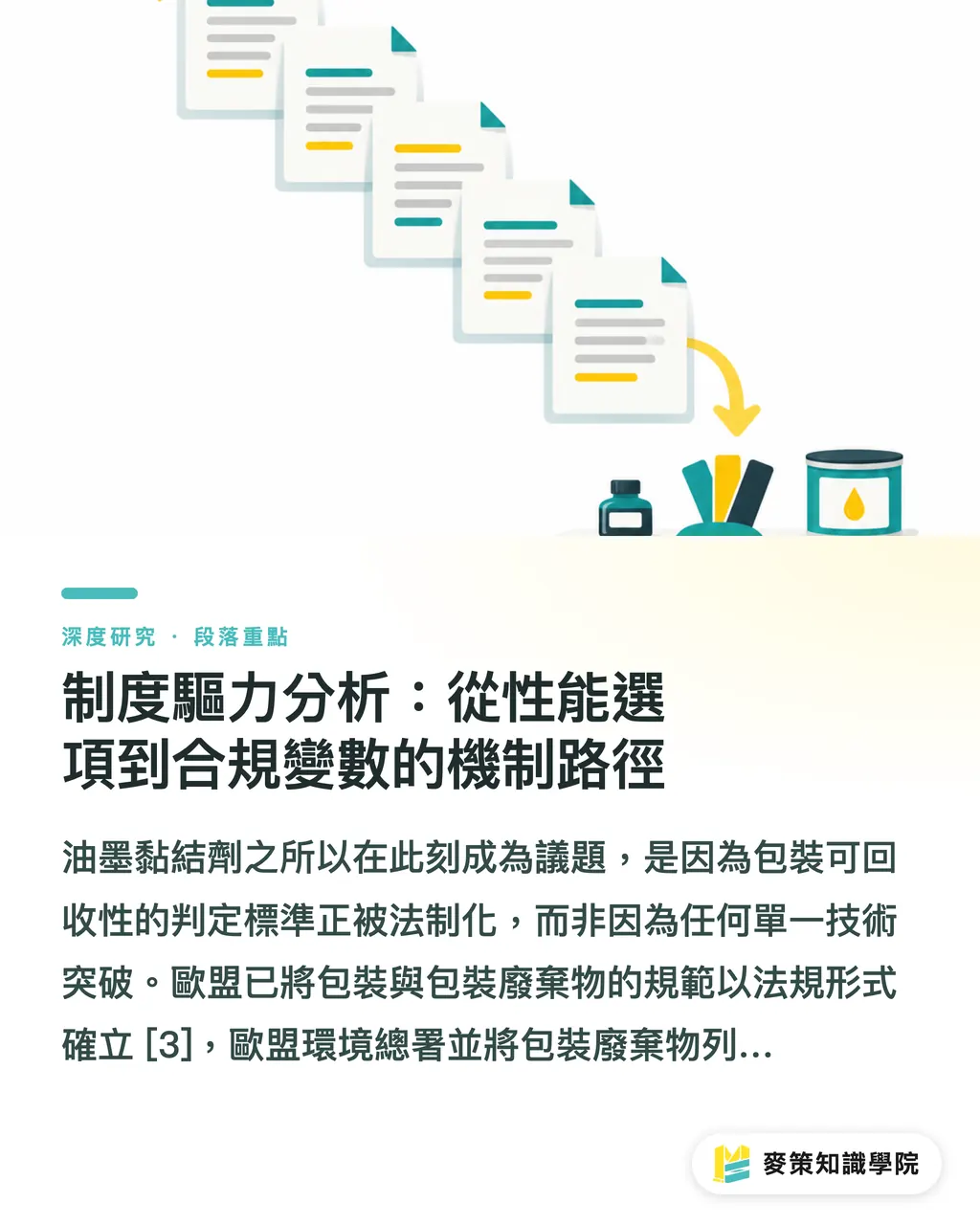
Ink binders have become an issue at this particular moment because packaging recyclability criteria are being codified in law, not because of any single technical breakthrough
The EU has established its packaging and packaging-waste rules in the form of a Regulation [3], while the European Commission's Directorate-General for Environment treats packaging waste as a dedicated area of waste and recycling policy [4]. This article argues that the institutional strengthening from the Directive level to the Regulation level effectively turns recyclability from "a differentiated requirement after transposition by each member state" into "a common threshold across markets." As a result, upstream specification decisions in the supply chain must align with one standard. For ink suppliers, this changes product-development priorities. For printers, it changes the content of customer specification sheets
The mechanism can be broken into four stages. This article calls it the "specification transmission chain": regulation sets a recyclability threshold → brands revise packaging specification sheets to maintain market access → flexible-packaging converters and printers select materials and inks according to those specifications → ink suppliers adjust their product lines accordingly. The key feature of this chain is the time lag. Between a regulation taking effect and the actual ink change on the press floor lies the brand's packaging redesign cycle, which usually runs in years. This analysis explains why hubergroup began developing PU-based inks in 2015 [1] yet did not expand the product line into this application range until 2026. Technical readiness came before market demand was ready, and the intervening wait was set by the institutional timetable
hubergroup claims that, compared with traditional NC- or PVC-based ink systems, Gecko CyclOne offers improved recyclability and supports the industry's pursuit of circular packaging solutions [1]. The boundary of this claim's verification must be stated clearly. Public sources provide no quantitative data on the degree of recyclability improvement, no test method, and no third-party certification information. Without those details, the reasonable treatment is to regard the statement as a directional claim rather than a comparable performance metric. Researchers and procurement decision-makers who want to use this claim should request a specific recyclability test protocol and its results from the supplier
One company executive went further, saying that NC-free has long been more than just an option and is the direction in which the industry is heading [1]. This article reads the statement in two ways. As a vendor position, it carries a commercial interest and should not be accepted directly as an industry consensus. As a signal, however, it still has informational value. When a sizable ink supplier anchors its product-line narrative in "not an option but an inevitability," that usually reflects its internal observation of how often customers ask about specifications. This article argues that such narrative anchoring is itself an indicator to watch when substitution moves from early adoption into mainstream use, although it is not evidence that the phase has already arrived
As for the interface with LCA methodology, the packaging field has built up a substantial body of LCA research that can be integrated and compared [5]. This article argues that rigorously evaluating the environmental benefits of ink-binder substitution requires addressing a methodological problem. The benefits appear less in production-stage emissions or weight than in the quality of end-of-life recycling processes, including whether the material can be effectively recovered and whether the recycled material is contaminated. This requires extending the LCA system boundary into recycling treatment and obtaining the relevant inventory data. That is precisely where data availability is currently weakest
Implications for Taiwan's Design and Printing Industry: Actionable Judgments at Three Levels
Taiwan's flexible-packaging supply chain faces indirect requirements transmitted through export customers' specification documents, rather than direct regulatory responsibility. The key decisions therefore concern timing and measurement readiness, not an immediate, industry-wide switch of inks
Small and midsize printers should measure first, not switch inks. Before customers issue clear specification requirements, a full switch to NC-free systems lacks commercial rationale. Useful preparatory work includes taking stock of the applications and customer mix for current NC-based inks, and identifying the share of orders exported to EU markets. Printers should request technical data sheets for NC-free alternatives from their current ink suppliers and compare differences in solvent composition. They should also record current drying-temperature curves, airflow settings, and residual-solvent readings to establish baseline data. This baseline is a core asset for later negotiations and adoption. The solvent-release behavior of PU-based systems differs from that of NC-based systems. Without a pre-conversion baseline, it becomes difficult to identify the cause of quality anomalies after conversion. Small and midsize printers should also assess the compatibility of their solvent recovery systems. Since Gecko CyclOne remains solvent-based [1], the recovery equipment itself does not need to be replaced, but if the solvent types change, the composition of the recovered liquid and its reuse pathway must be reconfirmed
Designers will face tighter specification constraints earlier, not looser ones. If the packaging design side is already addressing recyclability requirements, a change in ink system will also affect the range of available print effects. At the proposal stage, designers should confirm with the printer whether the target packaging structure calls for surface printing, reverse printing, or lamination printing. Although systems such as Gecko CyclOne promote a shared architecture [1], each application still requires separate proofing to confirm color performance and adhesion characteristics. Proofing schedules also need practical adjustment. The first adoption of a new binder system usually requires additional proofing rounds, and the design side should build them into the project schedule rather than discovering color differences during mass production. Designers should also avoid writing "NC-free" directly into environmental declaration copy on packaging without confirmation from the printing side. Publicly available data do not currently support a quantifiable environmental-benefit claim
Brand owners should include the ink system in supplier-audit questions and demand evidence. The brand side is the starting point of the specification transmission chain, and its decisions directly determine the adoption timeline downstream. Actionable steps include adding a declaration field for ink-binder type to packaging-supplier evaluation documents, requiring suppliers to provide the basis for recyclability testing rather than accepting product names or marketing claims alone, and rolling out the change by product line instead of making a one-time blanket switch. Priority should go to products exported to the EU whose redesign cycle is already due. This article argues that the biggest risk for brand owners is a mismatch between declared specifications and actual use. Without a third-party verification mechanism, declarations of ink type depend heavily on supply-chain integrity. Audit design should therefore include physical spot checks, not document review alone
The shared judgment across all three levels is this: the pace of substitution is set by customer specification sheets. The most valuable preparation is therefore not early procurement, but the early creation of comparable process data and a verifiable specification-declaration process
Conclusion and Limitations
This article asked which variables drive the commercialization timeline for NC-free inks and how far the proposition that "traditional solvent formulations are on a countdown to phase-out" actually holds
The study reaches three conclusions:
・First, NC-free ink replaces the binder rather than the solvent system. Gecko CyclOne itself is solvent-based [1]. Therefore, "the phase-out of solvent formulations" should be understood as a generational change in binders within solvent-based printing, not the end of the solvent-based process itself
・Second, the driver of this substitution is the codification of packaging recyclability requirements in law [3][4], not internal evolution in ink performance. Technical readiness, with the company developing PU-based inks since 2015, clearly preceded market demand readiness [1]. The lag was jointly determined by the institutional timetable and brand redesign cycles
・Third, for Taiwan's printing industry, substitution pressure travels through specification sheets from export customers. The most cost-effective preparation is to establish a pre-conversion process baseline rather than replace all inks ahead of demand
This article has two concrete limitations that must be disclosed clearly
The first is a limitation in source coverage. All technical and performance information about Gecko CyclOne comes from a single industry-media report on the vendor's announcement [1]. This article did not obtain independent laboratory test data, third-party recyclability certification documents, or real-world feedback from printers using the system. Accordingly, every statement about the product's performance and the extent of its recyclability improvement remains at the level of a "vendor claim" and does not constitute a verified performance comparison. No procurement decision should rely on this analysis alone
The second is the boundary of inferential extrapolation. The institutional analysis is anchored in the EU regulatory environment [3][4], while Taiwan has no corresponding mandatory law on packaging recyclability. The implications drawn for Taiwan's industry rest on the assumption that export-oriented orders transmit customer-side specification requirements. The timeline judgment does not apply to printers focused on the domestic market whose customers have not made such requests. In addition, the subject of this article is flexographic and gravure applications in flexible packaging [1]. It does not cover labels, paper-based packaging, or other printing segments, where the logic of binder substitution may differ significantly
There are three concrete directions for follow-up research:
・First, print samples of the same packaging structure with NC-based and PU-based inks, submit them to the same recyclability test protocol, and obtain comparable quantitative results. This is the clearest empirical gap in the public literature at present
・Second, track one complete ink-system conversion at a printing plant, recording changes in drying parameters, residual solvent, print speed, and defect rate to establish an empirical estimate of conversion costs
・Third, include inks, coatings, and other non-structural components within the system boundary of packaging LCA and extend it to recycling treatment, then test whether the methodological settings of current LCA synthesis studies [5] are sufficient to capture variables with a low share of total weight but a high impact on the process
Key Takeaways
・Gecko CyclOne is a solvent-based ink system. It replaces the binder, swapping NC for PU, rather than changing the solvent-based process as a whole [1]
・NC's disadvantage is not print quality or cost. It is that the material lacks the newly added recyclability criterion, so the pace of substitution is determined by regulation and supply-chain transmission, not by the technology curve
・hubergroup had been developing PU-based inks since 2015 but did not expand into this application range until 2026, showing that technical readiness clearly preceded market demand readiness [1]
・The vendor's claim of improved recyclability lacks public quantitative data and third-party verification. It should be treated as a directional claim rather than a comparable performance metric
・For Taiwan's small and midsize printers, the most cost-effective preparation is to establish baseline data for drying curves and residual solvent before conversion, rather than switch all inks in advance
Further Reflections
For print manufacturing, the main cost of this substitution is not the price of the ink itself but the expense of recalibrating the process and adjusting inventory. Factories with complete process-parameter records have both lower conversion risk and more bargaining power than factories that rely on veteran press operators' experience. That turns process digitalization from an "efficiency investment" into "compliance preparation." The lesson for the design side is that specifications must be confirmed earlier. The binder system affects the range of available print effects and the number of proofing rounds, so aligning with the printer at the proposal stage is far cheaper than fixing the issue before mass production. AI has a concrete and underestimated point of entry here. Drying curves, press speed, and residual solvent in solvent-based printing are coupled across multiple variables. After an ink change, parameters are still usually found through trial and error. If historical production data can be used to build a process model that helps recommend starting parameters, it could directly shorten the trial-run waste incurred during the conversion period. At the SaaS level, the issue points to supply-chain specification management. Declarations, audits, and version traceability between the brand's specification sheet and the ink actually used on press are still commonly handled through spreadsheets and PDFs. This is precisely the gap where a structured system can create verifiable records. Three questions remain unresolved: recyclability test protocols still lack a unified cross-market standard, there is no consensus on how inks should be handled in LCA, and Taiwan lacks the corresponding verification institutions and capability infrastructure
References
[2] Hubergroup Germany splits its business into Chemicals and Print Solutions (inks). Focus on Pigments. DOI: 10.1016/j.fop.2020.08.031
[3] EUR-Lex: Full Text of the EU PPWR Regulation. EUR-Lex
[4] European Commission Directorate-General for Environment: EU Packaging Waste Page. European Commission Directorate-General for Environment
[5] Mendeley (indexing Journal of Cleaner Production paper): Meta-analysis of Packaging Life Cycle Assessment. Mendeley (indexing Journal of Cleaner Production paper)
FAQ
- Does NC-free ink mean that solvents are no longer used?
- No. NC-free means the ink contains no nitrocellulose binder and uses another binder technology instead. hubergroup's Gecko CyclOne is itself a solvent-based ink system. Solvent evaporation and drying are still required during printing, and the need for solvent recovery and VOC management remains unchanged
- Why does the ink binder affect packaging recyclability?
- Ink makes up a very small share of total packaging weight, but binder chemistry can affect deinking performance in recycling processes and the degree of contamination in recycled material. This makes it nearly invisible in weight-based environmental indicators, yet capable of having a disproportionate effect on recyclability determinations
- Should Taiwan's printers switch entirely to NC-free ink now?
- Before customers issue clear specification requirements, a full switch lacks commercial rationale. A more practical approach is to assess the share of orders exported to the EU, request technical data sheets for NC-free products from suppliers, and record current drying-temperature curves and residual-solvent readings to establish a baseline. This makes it possible to identify the cause of quality anomalies when conversion eventually takes place
- Does switching from NC-based to PU-based ink require major changes to the production line?
- hubergroup says that the conversion requires adjustments but does not require fundamental changes to existing production processes. Public information does not specify which parameters need adjustment, so printers should validate drying parameters, press speed, and adhesion through proofing and small-batch trials. They should not schedule mass production directly on the basis of the vendor's statement
- Can the claim "NC-free is more environmentally friendly" be used directly in packaging copy?
- Publicly available information does not support a quantifiable environmental-benefit claim at present. The vendor claims improved recyclability compared with NC- or PVC-based systems, but provides no test method, quantitative data, or third-party certification. Using the claim directly in environmental declaration copy carries a risk of greenwashing
Related articles
The Print × AI weekly
The print and AI know-how designers, brands and enterprises can use before they commit — one email, every week
MINDS Free Tools
AI background removal, a LINE sticker maker, spine & imposition calculators — all free, right in your browser, no upload.
MINDS Group
Need actual printing or gifting services?
From premium printing to online ordering and festive gifts — the MINDS Group sister brands take it from here.