
1. Introduction: An Underestimated Entry-Level Industry Decision
Choosing entry-level wide-format printing equipment is one of the most common yet least systematically analyzed capital decisions facing small and medium print shops in Taiwan. Entry-level 1.6-meter roll-fed machines play a major role in the wide-format market. Many print shops start with this type of equipment to build an initial client base and validate their business model. Established offset and flexo printers treat them as a first step into wide format. Mature wide-format print service providers also use them to add capacity without committing heavy capital [1]. These three purchase motivations, startups, crossover expansion, and scaling, each carry different criteria for success, yet they are often lumped into the exact same spec-sheet comparisons
From an industry standpoint, this issue matters even more in Taiwan. Order profiles in Taiwan's wide-format printing sector are fragmented. Short-term outdoor posters, indoor displays, vehicle graphics, and low-volume proofing across unusual substrates often land in the order queue of the same small or medium shop. Once a printer is selected, its drying or curing mechanism immediately locks in the compatible substrate range, required finishing steps, and turnaround times, with consequences that last five to eight years. As this analysis shows, the real risk of choosing an entry-level machine goes far beyond what the equipment price tag suggests
Current industry discussions leave three major gaps:
・First, most comparisons focus on ink unit prices and hardware costs, rarely pulling drying or curing energy consumption, lamination labor and materials, and waiting times into a unified cost framework
・Second, while 'eco-friendly' labels are thrown around constantly for latex and UV, their actual technical meanings (zero volatile organic compounds, or VOCs, versus low-energy curing) and their real persuasive power with end clients are seldom treated separately
・Third, existing reviews implicitly assume application mixes from European and American markets, failing to account for Taiwan's hot, humid climate and its order profiles dominated by short-term outdoor graphics
To address these gaps, this article makes three contributions, each tied to a core section:
・Contribution 1 (Section 3): Uses drying and curing mechanisms as the core analytical axis to rebuild the differences across the three paths, showing that ink chemistry alone is not the primary point of divergence
・Contribution 2 (Section 4): Introduces an expanded cost perspective that factors in lamination, energy consumption, and turnaround time, explaining under what order profiles 'cheapest ink' diverges from 'lowest overall cost.'
・Contribution 3 (Section 5): Offers actionable selection and print-buying criteria tailored across three levels: small and medium print shops, designers, and brand owners
2. Literature and Market Review: Segmenting the Three Paths
This section organizes existing market discussions by technology path, then highlights how each group relates to and differs from our analysis
Group 1: The argument for eco-solvent as the cost-optimal solution. The core of this argument centers on return on investment (ROI). Eco-solvent hardware and ink are both the least expensive options among the three, creating a compelling case for ROI [1]. In terms of technical mechanics, the solvent binds pigments into the media surface coating before evaporating, requiring coated substrates, which are widely available on the market [1]. Color performance is typically rich and punchy [1]. The boundary of this argument lies in weather resistance. Eco-solvent ink is ill-suited for long-term outdoor exposure without lamination, as the ink layer will fade [1]. However, this limitation is not an issue for vehicle wraps, where lamination is standard practice and the ink layer tolerates heat stretching [1]. Some manufacturers offer optional heaters to speed up drying and boost print speeds [1]. The connection to our analysis: this logic holds only when lamination costs are factored into the quote. Section 4 will demonstrate how this cost advantage gets repriced when order profiles shift toward unlaminated short-term work
Group 2: The argument for latex/resin as a balanced compromise. This group positions latex ink (also called resin ink) as a step up from eco-solvent [1]. Supply options are already broad. Roland DG and Epson both offer entry-level resin models, while HP provides larger 3.2-meter roll-fed and hybrid latex systems [1]. Its defining feature is a water-based formulation that supports a cleaner, greener workflow, giving print shops a practical selling point for eco-conscious clients. The workspace stays odorless, with zero volatile organic compound (VOC) risks [1]. However, the ink requires an active drying process that consumes energy and drives up operational costs [1]. On the plus side, prints dry instantly and can ship right off the printer without extra curing or outgassing time [1]. Substrate compatibility spans paper, vinyl, and textiles. Still, higher drying temperatures on certain resin models can cause issues on heat-sensitive media like window cling film [1]. Our analysis highlights an unresolved tension here: skipping lamination saves money, but drying burns extra electricity. Most industry discussions treat these two opposite costs in isolation rather than netting them out, which is exactly what Section 4 addresses
Group 3: The argument for UV-curable as the media versatility solution. This group highlights how UV-curable ink paired with LED lamps cures instantly across diverse substrates while drawing very little power [1]. Commercial models already target this entry tier, such as Mimaki's 1.6-meter UJV200 series [1]. What separates this group from the first two is a shift in focus. Discussions around eco-solvent and latex revolve around print durability, whereas UV discussions center on substrate range. Because they sit on different evaluative axes, a simple linear ranking is impossible. That is precisely why Section 3 rebuilds our analytical framework
Cross-group synthesis and gap identification. All three discourse groups agree on one point: the entry-level printer market is fiercely competitive, hardware margins are paper-thin, and room for equipment price negotiation is tight. However, dealers are often willing to discount RIP software, service contracts, or even ink pricing, so buyers can usually find an attractive package by shopping around [1]. This consensus carries an important methodological implication: because list prices have converged, the deciding factors must lie in ongoing operating expenses and application fit. While existing coverage thoroughly outlines technical features, it leaves three questions unanswered: how total cost of ownership (TCO) stacks up under different order profiles, what commercial conversion rates look like for sustainability claims, and how unlaminated prints truly hold up outdoors in Taiwan's climate. This article tackles the first two questions, while Section 6 explains why the third remains an empirical gap
3. Core Analysis 1: The Divide Is Not the Ink, but the Drying and Curing Mechanisms
This section argues that the real distinction among the three paths stems from the physical physics of ink drying or curing, rather than pigment selection or color gamut. Rebuilding the comparison around this mechanical axis clarifies why prior discussions fail to reach a single clear-cut ranking
The three mechanisms function as follows:
・Eco-solvent: Evaporative solvent bonding. The carrier solvent bites into the media coating to deposit the pigment, then evaporates away [1]. The inevitable result of this mechanism is that the media must have an receptive coating. The pigment needs a chemically prepared surface to anchor into
・Latex/resin: Thermal-driven drying. Water-based ink requires active heat drying, which consumes energy [1]. Heat is necessary to form the polymer film, meaning heat-sensitive substrates hit an inherent operational ceiling. Higher-temperature curing on some machines can easily warp materials like window cling film [1]
・UV-curable: Instant photochemical curing. Paired with LED lamps, it cures instantly while drawing minimal power [1]. Because curing does not depend on media absorption or high heat to form a film, it handles an exceptionally diverse range of substrates [1]
Data anchor and interpretation. The clearest illustration of these mechanical differences is an apparent paradox in the latex path: drying consumes power and raises operating expenses, yet finished prints can ship immediately without waiting or outgassing [1]. This contrast reveals an overlooked logic: latex trades time cost for energy cost. The eco-solvent route leaves costs on the timeline (waiting for outgassing, waiting for lamination), whereas latex converts that delay into an electric bill. For small shops managing tight cash flow and aggressive deadlines, this trade-off is often worthwhile. Time delays damage customer relationships through missed deadlines, whereas power consumption is simply a predictable utility cost
A second mechanical takeaway involves substrate limits. Eco-solvent requires coated media, though options on the market are plentiful [1]. UV relies on its curing mechanism to print on a wide spectrum of media [1]. On the surface, both seem capable of handling many materials, but the underlying principle is fundamentally different. Eco-solvent depends on an established supply chain of pre-coated media, whereas UV can bond directly without any coating. This distinction proves decisive for short-run prototyping. When a client walks in with an off-spec, uncoated substrate, a broad commercial supply catalog will not help you
A third takeaway concerns the ambiguity around the term 'eco-friendly.' The green case for latex rests on its water-based formula, odor-free operation, and zero VOC risk [1]. The green case for UV rests on the low energy consumption of LED curing [1]. These address entirely different environmental facets. One targets the shop floor environment and air emissions, while the other addresses energy use. Collapsing both under a generic 'eco-friendly' banner prevents buyers from evaluating what their clients actually value. For indoor installations or odor-sensitive retail environments, latex and its zero-VOC profile offer a genuine selling point. For corporate brand accounts facing carbon disclosure mandates, UV and its minimal power draw provide the relevant talking point
4. Core Analysis 2: Bringing Lamination, Power Draw, and Waiting Time into One Cost Framework
This section argues that 'cheapest ink' and 'lowest total cost' split apart under specific order profiles, and the tipping point depends entirely on the share of jobs requiring lamination. The following points unpack this layer by layer
Layer 1: List price is no longer a differentiator. The entry-level printer market is fiercely contested. Equipment prices are razor-sharp with little room to negotiate, and dealer concessions usually show up in bundled RIP software, service contracts, or ink pricing [1]. Because hardware sticker prices have converged across comparable models, basing a purchase primarily on machine price means evaluating a static variable. The real cost gap develops through recurring production expenses across every job run
Layer 2: Lamination is a conditional cost. Eco-solvent prints are not built for extended outdoor exposure, and unlaminated graphics will fade [1]. In financial terms, this limitation turns lamination from an optional upsell into a non-negotiable process step for any outdoor application. The true unit cost of eco-solvent must be calculated as 'ink cost + (probability of lamination × lamination cost).' This probability depends entirely on the shop's job mix, not the printer. A shop where 80 percent of jobs are long-term outdoor billboards will experience drastically higher production costs on the exact same machine than a shop where 80 percent of jobs are short-term indoor signs
Layer 3: Latex trades energy consumption for fewer steps and faster turnaround. The outdoor durability of latex eliminates the need for lamination on many outdoor jobs. The trade-off is higher drying power draw and increased operating costs [1]. In return, prints ship straight off the bed without outgassing or drying delays [1]. This sets up a straightforward break-even calculation. Once the percentage of jobs requiring lamination crosses a specific threshold, the savings from skipping lamination (film, labor, machine wear, and extra turnaround time) outweigh the added power costs. While no universal threshold number exists because local electricity rates, finishing capacity, and staffing differ, every shop can calculate this from past job logs. In our view, this is the single most valuable calculation a small or medium print shop can run right now
Layer 4: The cost advantage of UV lies in media transitions, not per-print ink cost. UV pairs LED curing with low power draw across diverse substrates [1]. While low power consumption gives UV a structural edge in electricity bills, the real advantage of an entry-level UV printer (like the 1.6-meter Mimaki UJV200 series [1]) goes beyond unit costs. Its primary asset is the option value of never having to buy another machine just to handle an unconventional substrate. For newcomers whose customer base and order patterns are still evolving, this flexibility functions as an insurance policy against capital risk
Integrated evaluation framework. Based on this, we propose a three-step filter rooted in job mix, which we call the 'Application, Durability, Substrate' checkpoint. First, assess where and how long the print will be displayed (application). Second, ask whether outdoor durability requires lamination by default (durability). Third, determine whether client jobs will fall outside standard coated rolls (substrate). Answering these three questions usually narrows the field down to one or two printer models without getting bogged down in spec sheets
5. Implications for Taiwan's Design and Printing Industry
This section argues that choosing among these three paths creates different practical implications across the supply chain, requiring a tiered look at each role
For small and medium print shops: Calculate your job profile before opening an equipment catalog. Here are three practical steps:
・Review job tickets from the past 12 months and calculate the ratio of laminated jobs to total jobs. If this ratio runs high, the outdoor durability of latex without lamination [1] deserves a closer look. If it runs low and indoor short-term graphics dominate, the lower hardware and ink costs of eco-solvent [1] remain the clearest path to quick returns
・Count how often clients ask to print on unusual, customer-supplied materials. If these inquiries occur frequently and are turned away, the revenue potential unlocked by the media adaptability of UV [1] should be weighed directly against any hardware price premium
・Shift bargaining focus from machine list price to RIP software, service agreements, and bundled ink, as this is where equipment dealers hold genuine discounting flexibility [1]
For designers: Move substrate decisions to the start of the design phase. The most frequent design misstep is locking down media and display environments only after artwork is finished. Three practical habits to adopt: Confirm display settings (indoor vs. outdoor), planned display duration, and viewing distance right in the design brief. If a client insists on heat-sensitive materials like window cling film, check with the print shop before sending files to verify that their printer's curing heat will not distort the substrate, since elevated drying temperatures on some resin machines can cause warping [1]. If prints will face extended outdoor sun and use an eco-solvent setup, write lamination into the job specifications and budget from day one instead of treating it as an afterthought [1]
For brand owners: Specify exact targets when demanding sustainable printing. 'Eco-friendly' in wide format covers at least two distinct technical angles: the zero-VOC, odor-free water-based latex route [1], and the energy-efficient UV LED curing route [1]. When setting sustainability requirements, brands that specify whether they care about shop-floor air quality, solvent emissions, or power draw and carbon footprint will help suppliers deliver matching technical documentation. In practice, vague eco-friendly requests simply push print shops toward whatever solution is easiest to explain, which rarely aligns with the brand's actual reporting needs
Shared takeaway across all tiers. Picking a technology route for an entry-level machine sets the boundary of what jobs a shop can accept for years to come. Equipment selection is ultimately a business strategy decision. Sales teams need a seat at the table during evaluation, as leaving it purely to production managers creates blind spots
6. Conclusions and Limitations
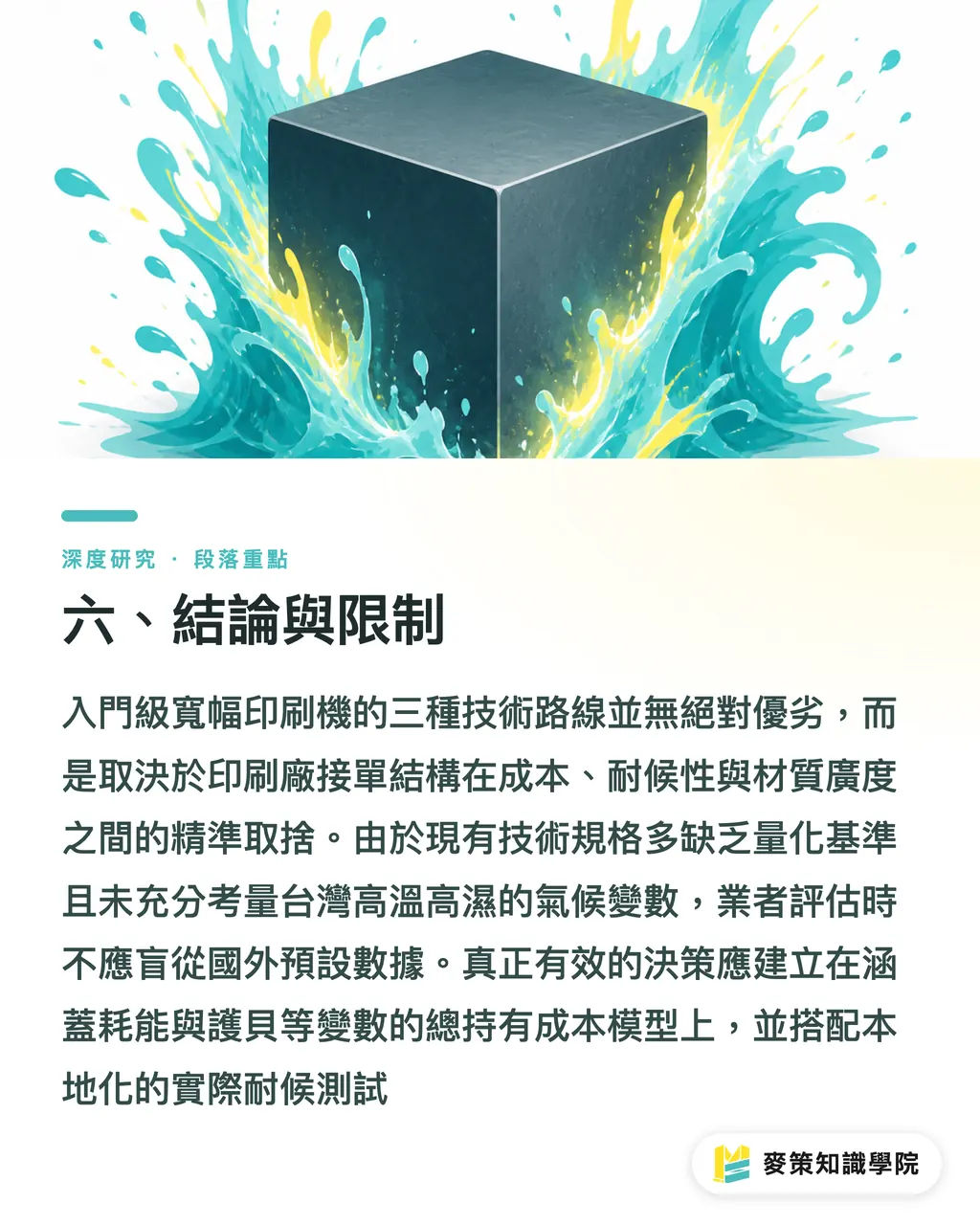
Conclusion. This study set out to answer how to choose between the three technology paths for entry-level 1.6-meter wide-format printers. Our findings show that these three do not represent a hierarchy of quality, but rather different coordinates within a single trade-off triangle of unit cost, weather resistance, and media versatility. Eco-solvent offers the lowest hardware and ink prices, making the strongest case for pure ROI, with the caveat that outdoor durability requires lamination [1]. Latex trades drying energy for unlaminated outdoor durability, a VOC-free workplace, and immediate turnarounds [1]. UV uses low-energy LED curing to achieve the widest media compatibility [1]. The deciding variable is not hardware specs, but the buyer's own order profile, especially since equipment prices have converged under competitive pressure and offer limited bargaining room [1]
Limitation 1: Concentrated data source and lack of quantitative benchmarks. The technical descriptions in this article rely primarily on a single industry technical review published in August 2026 [1]. That source focuses on qualitative comparisons and lacks hard quantitative figures such as ink cost per square meter, drying kilowatt-hours, or outdoor lifespan in months. Therefore, the break-even lamination framework proposed in Section 4 remains a structural argument rather than a universal formula. Every print shop must run its own numbers using its local utility rates, finishing capacity, and past job logs, and this article does not attempt to supply substitute figures. In addition, the specific models mentioned in that source (such as the Mimaki UJV200 series and Roland DG TrueVis VG4-640) serve only as representative examples of their technology classes [1], and we have not independently verified their performance
Limitation 2: Climate and regulatory boundaries for Taiwan remain unverified. Durability and environmental claims in existing literature implicitly assume European and North American climates and regulatory systems. Taiwan's combination of high heat, extreme humidity, intense UV exposure, and typhoon seasons may yield real-world outdoor performance for unlaminated prints that departs sharply from Western assumptions. At the same time, local VOC regulations place fewer practical constraints on small and medium print shops, meaning that the VOC-free advantage of latex may not translate into the same commercial value seen in Europe. The Taiwan-specific insights in Section 5 should therefore be viewed as analytical deductions rather than empirical conclusions
Directions for follow-up research (actionable items):
・First, build an accelerated weathering study under Taiwan's climate conditions. Print the same test file across all three technology paths on identical media, divide them into laminated and unlaminated groups, and track outdoor exposure across northern, central, and southern Taiwan over 12 months, logging color shift (ΔE) to establish localized durability benchmarks
・Second, gather operational data from small and medium print shops in Taiwan to build a total cost of ownership (TCO) model incorporating ink, energy, lamination materials and labor, and machine depreciation, using the lamination ratio as an independent variable to pinpoint cost crossover points across the three paths
・Third, conduct structured interviews with corporate brand buyers to quantify how they weight 'zero VOC' versus 'low energy consumption' when evaluating suppliers, testing the green messaging differentiation hypothesis proposed in Section 3
Key Takeaways
The three technology paths do not form a quality ranking, but represent distinct trade-offs across unit cost, weather resistance, and media versatility. The deciding factor is your order profile, not equipment specifications
Eco-solvent offers the lowest hardware and ink costs alongside vibrant color output, but unlaminated prints fade quickly outdoors, meaning its true operating cost must factor in the likelihood of lamination
Latex/resin uses a water-based, odorless formulation free of VOC concerns. While heating draws significant electricity and adds operating cost, prints ship immediately with zero outgassing delays
UV LED curing handles a vast range of media while drawing very little power. Its core value lies in the option value of printing on new substrates without purchasing extra equipment, rather than a per-print cost advantage
Entry-level printer sticker prices have flattened under stiff competition, leaving narrow margins for discount. Dealers have much more leeway to negotiate on RIP software, service contracts, and ink bundles
Further Considerations
For print manufacturers, the clearest takeaway here is shifting equipment purchasing from a back-office procurement chore to a joint decision between sales and production. Once a drying or curing system is chosen, it locks in the outer limits of what jobs a shop can take on for years to come. That makes it a business model question, not a spec-sheet debate. For designers, locking down substrates and installation conditions needs to happen during the design brief. That is especially true for heat-sensitive film and long-term outdoor exposure, where fixing mistakes after printing costs far more than checking upfront. In terms of AI adoption, a practical entry point is training quote-assistance models on historical job records, turning the likelihood of lamination from guesswork into a structured prediction. This addresses the missing TCO infrastructure highlighted in this analysis. For SaaS providers, the wide-format sector still lacks a dedicated multi-path cost comparison tool. A simple calculator that lets print shops input their electricity rates, finishing capacity, and job mix to surface break-even points across all three technologies presents low development barriers and obvious industry utility. Three open questions remain: localized durability benchmarks for unlaminated prints under Taiwan's climate, the true weight of green messaging in local purchasing choices, and residual equipment values and upgrade paths across a five-to-eight-year machine lifecycle. Reliable public empirical data is currently lacking for all three
References
FAQ
- Between eco-solvent, latex, and UV, which entry-level wide-format printer is best for beginners?
- Your choice of equipment should match your core job mix. If you mainly handle short-term indoor graphics on a tight budget, eco-solvent has the lowest hardware and ink costs and offers the fastest return on investment. If you focus on outdoor durability, latex eliminates the need for lamination. If you regularly handle non-standard substrates, UV LED curing provides the broadest media versatility
- Does eco-solvent printing always require lamination?
- It depends on how long the print needs to last. Because eco-solvent inks are not suited for long-term outdoor exposure and will fade without protection, lamination is a required step for weather-resistant work. For vehicle graphics, lamination is already standard practice and the ink film stretches well under heat, so this limitation does not get in the way
- Is latex (resin) ink truly more eco-friendly?
- Latex ink uses a water-based formulation that runs odor-free with zero VOC risks, which forms the technical foundation of its environmental pitch. However, the ink requires active drying that consumes considerable power and raises operating bills. In this context, 'eco-friendly' refers strictly to air emissions and workplace safety, not energy efficiency
- What is the biggest advantage of UV-curable printing?
- UV ink paired with LED lamps cures instantly, draws very little electricity, and bonds across a diverse range of substrates. Because curing does not rely on media coatings for absorption or high heat to form a film, it holds a distinct structural advantage when taking on customer-supplied, off-spec materials and short-run prototyping
- Where should you focus price negotiations when buying an entry-level wide-format printer?
- The entry-level market is fiercely competitive, hardware margins are already thin, and room to discount the machine itself is minimal. Dealers have much more flexibility on RIP software, service maintenance contracts, and bundled ink packages, so that is where you should direct your negotiation efforts
Related articles

The Print × AI weekly
The print and AI know-how designers, brands and enterprises can use before they commit — one email, every week
MINDS Free Tools
Imposition calculator and preflight file check — free prepress tools, right in your browser.
MINDS Group
Need actual printing or gifting services?
From premium printing to online ordering and festive gifts — the MINDS Group sister brands take it from here.