

Overview
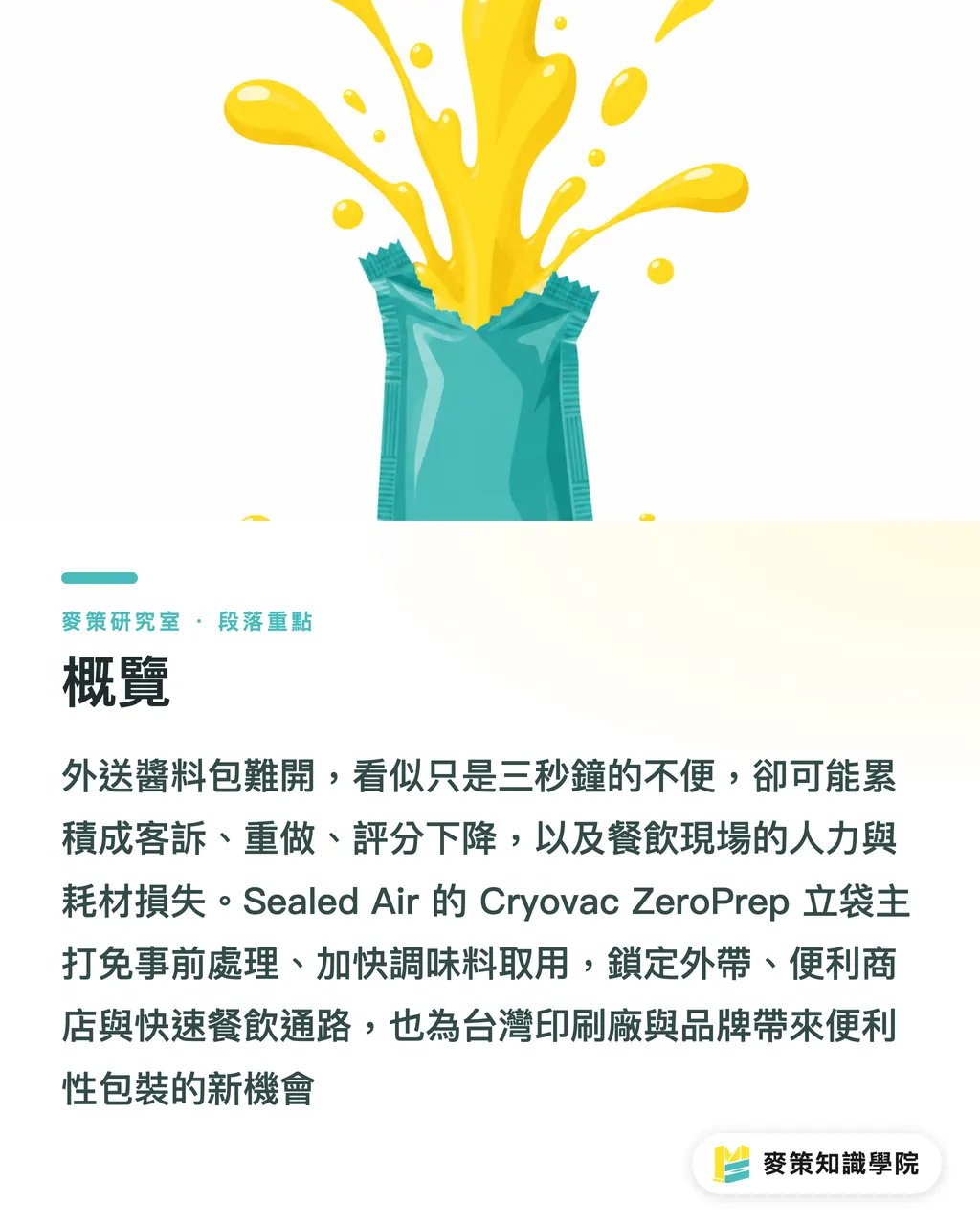
You have probably had this experience: a delivery arrives, and you bite the sauce pack, pick at it with your fingernail, and still end up spraying half of it across the table. For consumers, it is a 3-second frustration. For brands, it is a cost that is hard to quantify: complaints, remakes, and lower ratings on delivery platforms
The view from behind the counter makes it even clearer. At a convenience store's hot-food station or a fast-food pickup counter, staff may open hundreds of sauce packs a day. Add 2 seconds to each pack, or have one leak in every 20 packs, and the total becomes a real loss in labor and consumables
Sealed Air's Cryovac ZeroPrep stand-up pouch is aimed squarely at this pain point. It promises a faster condiment-dispensing experience for takeout, convenience stores, and quick-service food channels [1]. The name ZeroPrep practically puts the design intent on the label. Packaging should not require any preparation beforehand
The real question is what this convenience-led innovation means for Taiwan's printers and brand clients. Is it worth following, or is it simply another product-line expansion from a multinational supplier?
Why Has Opening Speed Become a Primary Packaging Selling Point?
Because in a takeout setting, the packaging user is no longer just the consumer. The operator is also a user, and an operator's time has a price
In flexible packaging, the first items on a spec sheet have traditionally been barrier properties, seal strength, and shelf life. None of that has gone away. ZeroPrep is an extension of the Cryovac product line, and Cryovac sealing technology itself has decades of published research behind it in food preservation. As early as the 1960s, a study had already tested sealed Cryovac with polyethylene liners to preserve hatching eggs [2]. In other words, preservation performance is this company's home turf, not a new proposition
The new question is where to find differentiation once preservation performance has broadly reached the industry baseline. The answer lies in the few seconds between opening and use. That is my judgment, not the manufacturer's wording. When a physical property becomes a baseline that everyone meets, competition shifts to user experience and operating efficiency. Packaging is no exception
Takeout and quick-service channels are especially responsive to this idea for three reasons:
・There is no room for a pause in the service rhythm: every action that takes two hands or a pair of scissors becomes a bottleneck in the line
・Consumers use the product while on the move: in a car, at a desk, or by the roadside, with no table to catch and clean up spills
・Brand touchpoints are diluted by delivery: when customers do not enter the store, packaging is almost the only physical brand experience
What Extra Complications Does a Stand-Up Pouch Create for Prepress Artwork?
Three kinds: distortion compensation, clearance around the seal area, and layout keep-out zones created by the opening structure
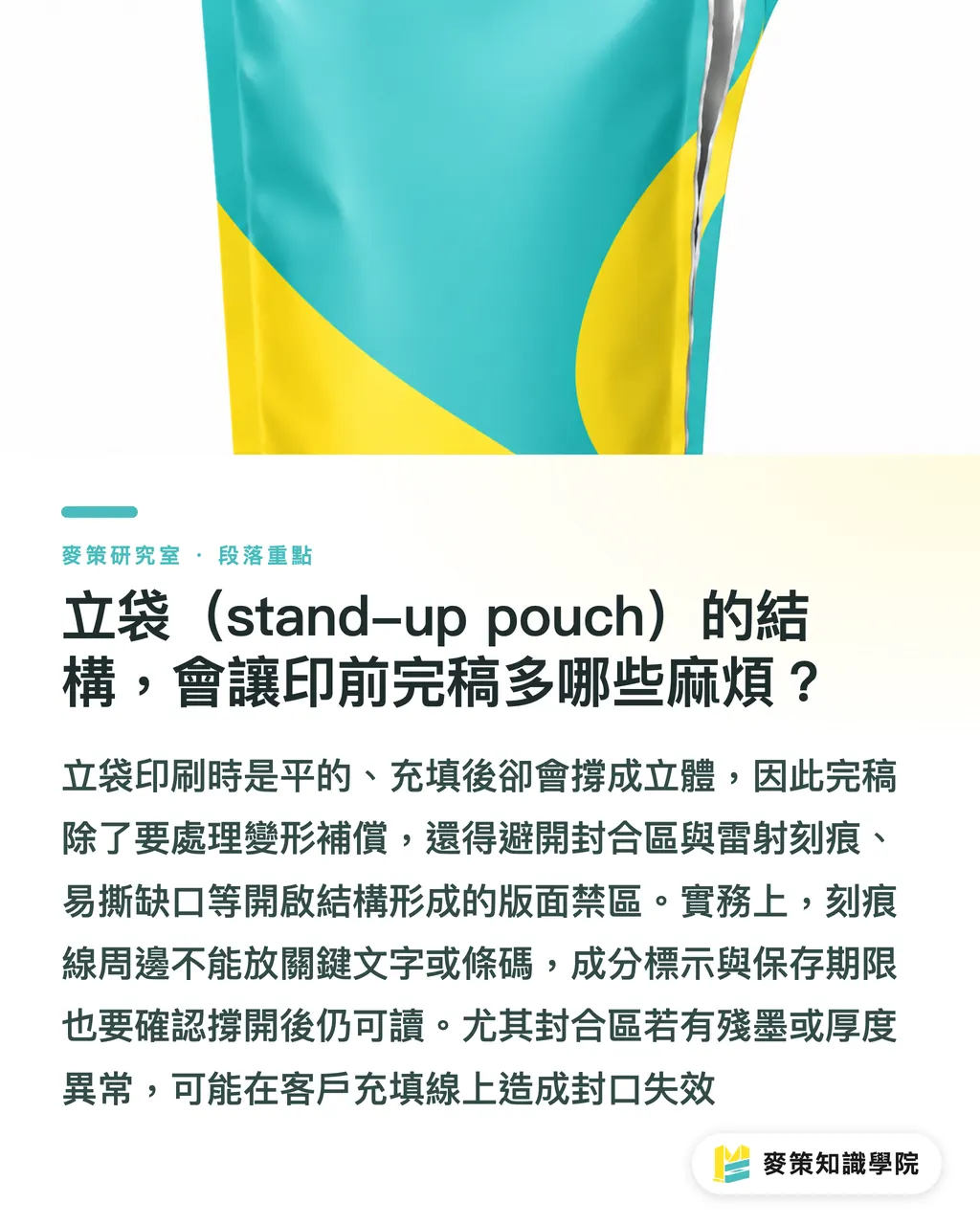
A stand-up pouch is three-dimensional by nature. The bottom-gusset structure folds inward and opens out after filling. It stays flat during printing but becomes three-dimensional in use, causing graphics and copy to shift and stretch. This is a long-standing flexible-packaging artwork problem. Once the package adds a quick-opening feature, whether a laser score, tear notch, or modified seal edge, even less of the layout remains usable
In practice, ask the client three questions in advance:
・Where exactly is the opening feature, and what is its tolerance? Do not place key copy or barcodes near the score line
・Will the width of the seal area change because of the new structure? Ink in the seal area can affect seal strength
・After the pouch is opened out, which face will still keep legally required information such as the ingredient declaration and expiration date readable?
One downstream step is easy to overlook: seal-quality inspection. There is dedicated testing equipment and technical research for checking the integrity of heat-sealed pouch closures. For example, a 2025 paper examined a device for inspecting heat-sealed pouch closures [3]. This shows that a seal is not simply a matter of sealing it shut. It is an engineering item with measurement methods and failure modes. The implication for printers is direct: if there is residual ink or an abnormal thickness in the seal area of the printed film you deliver, the problem will not surface in your plant. It will surface on the customer's filling line, and the job will come back to you
As a side note, the term sealing covers a much wider range in engineering literature than food packaging. It even includes sealed coupling devices for a car windshield-washer fluid spray pipe under the same heading [4]. When confirming specs with a client, spell out whether seal means heat sealing the pouch or sealing a joint. It can save a whole round of back-and-forth
How Can the Artwork Files Keep These Structural Requirements From Getting Lost?
Rely on a standardized checking process, not the memory of whichever senior artwork operator happens to be handling the job
The flexible-packaging artwork chain is long: the brand's design file, the agency's revision, the printer's imposition, and the plate maker's color separations. Every handoff is a chance for information to disappear. Structural constraints such as score positions and seal clearances are most likely to be deleted during a handoff as a reference layer
A more practical approach is to formalize the checks into three gates. I call them the three gates before press. This is an operating framework, not the formal name of any standard:
1. Structure gate: Are score lines, seal areas, and fold lines marked on separate layers, with no overlap with the artwork and text layers?
2. Technical gate: Do the color space, overprint settings, and transparency meet prepress requirements? For general PDF delivery specifications, see the technical specifications published by the Ghent Workgroup (GWG) [5][7]. GWG is an organization made up of different parts of the industry that focuses on standards for exchanging print files [6]
3. Readability gate: Simulate the visual appearance with the pouch opened out into its three-dimensional form, and confirm that regulatory information and brand recognition do not fall in the areas with the most severe distortion
The second gate is especially worth investing in because it can be automated. The value of GWG specifications is that they turn can this file be printed successfully? into a checklist of testable conditions [5]. That is exactly the part software and automation can take over. The first and third gates still depend heavily on a person's understanding of the structure. For small and midsize printers in Taiwan, that remains a professional competitive edge they can still hold in the near term
What Should Taiwan's Brands and Small and Midsize Printers Do Now?
Start with the products already in your client portfolio. Find the ones that are awkward to use and use them as the entry point for an upgrade
You do not need to wait to take on an international format like ZeroPrep. Start with three things:
・Collect failure evidence: Ask clients or channel partners to record the actual failure rate when opening packs and the rate of leakage. You have room to negotiate when you have numbers. Without them, convenience will always lose to a per-kilogram quote
・Map the limits of your own equipment: New structures often affect film gauge, ink adhesion, and converting. Confirm what your machines and partner converters can actually deliver before discussing a job, not the other way around
・Put structural constraints into the spec-confirmation form used before quoting: Make score position, seal area, and distortion warnings fixed fields, so they are forced to be restated at every handoff
One tension needs watching: convenience design can pull against the trend toward using less plastic. Easy-tear structures often require multilayer laminates or specific material combinations, while mono-material is the current mainstream direction for sustainable packaging. The two are not necessarily incompatible, but they need to be validated together. If you focus only on convenience and push the package out of recyclable streams, that will be a deal-breaker for EU customers
One final boundary on this conclusion: the analysis above assumes a setting involving takeout/ready-to-eat channels and single-use, small-portion condiment packs. If your client makes large foodservice ingredient packs, products for industrial use with long shelf lives, or operates a supply chain that is fully closed within the plant, dispensing speed carries much less weight. In those cases, it makes more sense to return to the traditional evaluation of barrier performance and cost
Key Takeaways
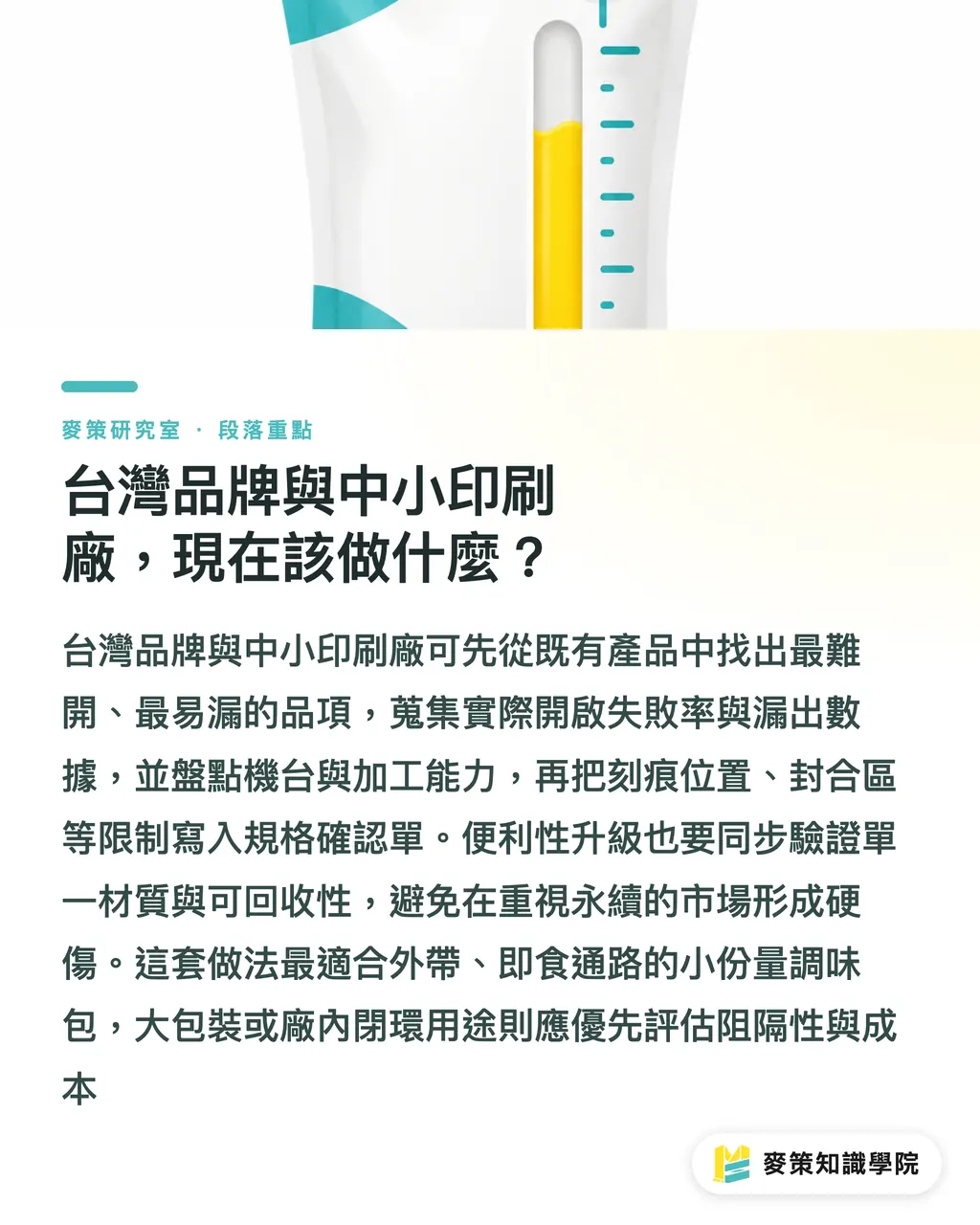
Cryovac ZeroPrep stand-up pouches focus on a faster condiment-dispensing experience, targeting takeout, convenience stores, and quick-service food channels [1]
The takeout setting expands packaging users from consumers to operators as well, making opening speed a performance metric with a price attached
The quick-opening structure of a stand-up pouch reduces usable layout area. Score positions, seal areas, and distortion zones must be locked down as separate layers during artwork preparation
Seal integrity is an engineering item with measurement methods and failure modes [3]. Residual ink in the seal area of printed film will create trouble on the customer's filling line
Technical checks can be automated with GWG technical specifications [5][7]. Decisions about structure and readability still depend on human expertise, which is a competitive threshold for small and midsize printers
Further Thoughts
For print manufacturers, convenience-led packaging shifts the center of value from printing beautifully to getting the structure right. A salesperson who asks the right questions about score tolerances and sealing conditions at the quoting stage will win better jobs than one who talks only about the price per kilogram. For designers, that means artwork cannot be finished only in 2D software. They need a habit of simulating the pouch in its opened-out three-dimensional state. Otherwise, regulatory information landing in a distortion band is only a matter of time. The entry point for AI and automation is clear: technical specifications that can be reduced to checklists, such as GWG [5], are best handed to automated checking tools, leaving people to focus on structural judgment and client communication. By contrast, decisions that require an understanding of the physical finished product, such as whether a score line runs through a barcode, should not yet be handed entirely to an automated workflow. The opportunity for SaaS is to connect specification confirmation, structural-layer checks, and client sign-off into a traceable chain, so information does not disappear across multiple handoffs. Two questions remain open. First, there is no public integrated validation data yet on whether convenience structures are compatible with mono-material recyclability requirements. Second, whether Taiwan's takeout sauce-pack market is large enough to support the tooling and pilot-production costs of a new structure needs to be backed by actual order volumes. Public statistics are currently lacking
References
[1] Sealed Air Cryovac ZeroPrep: How Ready-to-Use Condiment Packaging Is Changing the Takeout Market
[2] Proudfoot F. (1966). The Use of Sealed Cryovac and Polyethylene Case Liners With and Without Nitrogen Gas for the Preservation of Hatching Eggs. Poultry Science. DOI: 10.3382/ps.0450105
[3] Czajka P., Mizak W., Mężyk J. (2025). Device for inspection of thermally sealed pouches. Technologia i Automatyzacja Montażu. DOI: 10.7862/tiam.2025.2.5
[4] Device for the sealed coupling of a window washer fluid-dispensing pipe. Sealing Technology. DOI: 10.1016/s1350-4789(12)70205-2
[5] Ghent Workgroup: GWG Technical Specifications Homepage. Ghent Workgroup
[6] Ghent Workgroup: GWG Official Homepage. Ghent Workgroup
[7] Ghent Workgroup: GWG Specifications Overview. Ghent Workgroup
FAQ
- What kind of packaging is Cryovac ZeroPrep?
- Cryovac ZeroPrep is stand-up pouch packaging launched by Sealed Air. It focuses on a faster condiment-dispensing experience for takeout, convenience stores, and quick-service food channels [1]. Its core design idea is to reduce the preparation steps users need to take before opening it
- Why Does the Takeout Market Care So Much About Opening Speed?
- Because in takeout and quick-service settings, packaging users include both consumers and store operators. The extra seconds spent on each pack add up to labor costs, while consumers often use the packs on the move, without a table to contain sauce spills
- What Should Prepress Artwork for Stand-Up Pouches Pay Special Attention To?
- Three things. Score lines and tear features must be marked on separate layers and kept off key copy and barcodes. The seal area should not contain ink that affects seal strength. The artwork must be checked with the pouch opened out to confirm that regulatory information remains readable
- Are There Any Ready-Made Standards for Checking Flexible-Packaging Print Files?
- For general PDF delivery requirements, see the technical specifications published by the Ghent Workgroup (GWG) [5][7]. GWG is an organization made up of different parts of the printing industry that focuses on file-exchange specifications [6]. Its specifications are well suited to implementation through automated checking tools
- Could Convenience-Led Packaging Design Conflict With Sustainability and Plastic Reduction?
- It can. Easy-tear and quick-opening structures often require multilayer laminates or specific material combinations, while mono-material is the current mainstream direction for sustainable packaging. The two are not necessarily incompatible, but recyclability must be validated at the same time. Otherwise, they can become a compliance risk in strict markets such as the EU
Related articles

The Print × AI weekly
The print and AI know-how designers, brands and enterprises can use before they commit — one email, every week
MINDS Free Tools
Imposition calculator and preflight file check — free prepress tools, right in your browser.
MINDS Group
Need actual printing or gifting services?
From premium printing to online ordering and festive gifts — the MINDS Group sister brands take it from here.