
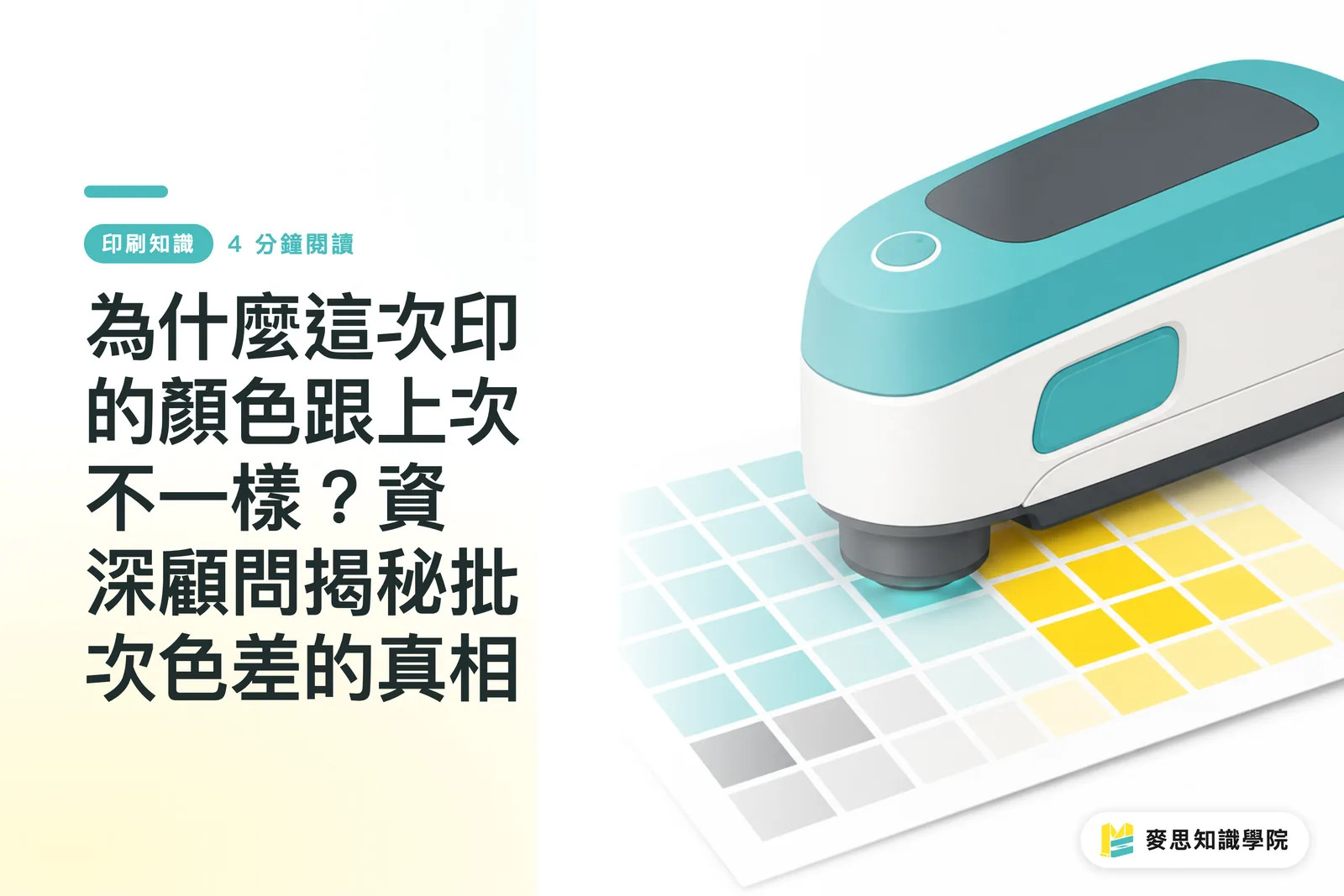
Why do the colors differ between two print runs if the files haven't changed?
Many clients have asked me why there is a visually noticeable difference in depth between two batches of finished products despite identical files. In actual printing, the variables are often hidden in the details you don't see:
・Paper Batch Variation: Even with the same brand and specifications, there are subtle differences in whiteness and surface smoothness between production batches, which directly affect the reflected spectrum after ink adhesion
・Environmental Temperature and Humidity Fluctuations: Printing presses are highly sensitive precision equipment. A variation in factory humidity of more than about 10% can change ink viscosity and flow. I have observed many cases over the years where the same order yielded significantly different results during the rainy season versus the dry winter
・Ink and Machine Status: The 'ink-water balance' after each startup relies on the operator's experience and tactile sense. Additionally, the oxidation level of the ink remaining in the fountain and the current temperature of the machine all lead to slight deviations in dot gain

Offset printing vs. digital printing: Which offers better color consistency?
In my professional experience, the color logic of these two processes is completely different, and the challenges they face vary:
・Offset Printing: Suitable for mass production but heavily reliant on the technician's control over ink film thickness. From the initial waste paper during startup to reaching stable production, there is a 'warm-up shift' in color, though consistency is generally better in large quantities
・Digital Printing: Although it eliminates the need for plate-making and theoretically has fewer variables, it is affected by internal electrical charge stability and drum wear. If daily 'Device Characterization' calibration is not performed, color shifts can still occur between the first and hundredth print of the day
How to use scientific methods to 'match colors' without miscommunication?
Stop arguing over whether a color is correct based on 'feeling.' You need a universal communication language to manage expectations:
・Introduce the ΔE Color Difference Concept: This is the international standard for quantifying color discrepancies. Usually, when ΔE is Less than 2.0: It is imperceptible to the human eye. If commercial printing can consistently keep it within Less than 3.0: It is considered an excellent performance
・The Binding Power of Physical Swatches (Pantone): CMYK values in files look different in various software, but matching a physical Pantone color code does not. When establishing a brand system, you must specify exclusive color codes rather than letting designers choose colors at will
・On-site Color OK and Retention: Sign and confirm on-site before full-scale production begins, and keep that sample as a 'retained sample.' For the next reorder, this sample is the print shop's only reference standard, which is more accurate than looking at any screen
Why can the colors on a screen never be used as a basis for printing?
This is the most common misconception I correct in teaching. Screens and printed materials are essentially two parallel optical worlds:
・Inherent Gamut Limitations: Screens use the RGB primary colors and emit light, offering a very wide gamut; printing uses CMYK inks that rely on paper-reflected light, resulting in a narrower gamut. Bright, fluorescent-like colors on a screen are destined to become dull and murky on paper
・Lack of Equipment Calibration: Most clients' screens have not been adjusted by hardware color calibrators, so the displayed blue might have a purple tint. If a designer adjusts colors under a flawed baseline, the printer will never match what you see on that screen, no matter how precisely they print
What are the real benefits of partnering with a fixed print shop long-term?
Color management is a marathon; frequent vendor switching is the beginning of color chaos. The value of a fixed partner is primarily reflected in stability:
・Establish Exclusive Color Profiles: In long-term stable partnerships, the print shop will create dedicated ICC Profiles for your commonly used paper materials and brand colors, allowing the equipment and your brand needs to achieve a technical consensus
・Reduce Communication and Trial-and-Error Costs: Every printing press has its own 'temperament.' A fixed vendor can adjust machine parameters in advance for your brand colors, avoiding the risk of having to re-match colors with every reorder

Key Takeaways
・Color deviation is an inevitable result of the physical environment, while consistency is the goal of process management
・Discard screen-based visual standards and adopt physical color swatches as the sole cornerstone for color communication
・Use ΔE quantitative data to transform color quality from subjective perception into objective data
・On-site color approval and retaining physical samples are the most practical insurance policies for solving batch color variation
Extended Reflection
For brand owners, color management should not just focus on the printing stage; it must start from the source, design specifications. I suggest incorporating the 'Brand Color System' and 'ICC Profiles' into standard specifications when adopting digital workflows. Future industrial competitiveness lies not in how advanced the machines are, but in who can best define that 'color translation standard' from digital design to physical imaging
Further Reading
・Color Management and ICC Profiles: The systematic root causes of discrepancies between screen colors and print colors
・Building a Brand Color System: From LOGO to printed materials, mastering color management in one go
・The Color Magic of Advertising Printing: From theory to practice
・Achieving Perfect Color from AI Design to Print: Practical approaches to building a brand color system
FAQ
- Why is there still a subtle difference between the print and the swatch, even after I chose a Pantone color code?
- Paper type is a key variable. The same color code will look completely different when printed on coated versus uncoated paper. Please be sure to confirm that your swatch version matches the actual paper type
- If I cannot be there for on-site color approval, what other methods can be used to control color?
- You can request the print shop to provide a digital proof or inkjet proof, stamped with the shop's calibration seal. While there are still subtle physical differences between digital proofs and the final production run, it is sufficient as a concrete reference for color direction
- Can screen calibration really solve printing color cast problems?
- It can make the screen closer to true colors, but it cannot make printing produce colors that are physically impossible. Calibration is intended to let designers 'foresee' gamut reduction, avoiding designs that cannot be physically reproduced
- Why does the color change when I switch to a new bucket of the same brand of ink?
- Ink is a mixture of pigments and binders. Subtle variations in chemical stability and pigment fineness between different production batches occur, which is why high-end printing places heavy emphasis on ink batch number management and density testing
Related articles




The Print × AI weekly
The print and AI know-how designers, brands and enterprises can use before they commit — one email, every week
Tool Library
RGB↔CMYK conversion, ΔE color difference and brand color print analysis — free color management tools, computed right in your browser.
MINDS Group
Need actual printing or gifting services?
From premium printing to online ordering and festive gifts — the MINDS Group sister brands take it from here.