
What Are the Main Box Folding Styles? The 3 Basic Structures Explained
There are countless ways to fold a paper box, but brand owners encounter and production lines know three styles best: Tuck Bottom Boxes (Telescope Top/Bottom Box), Crash Lock Boxes, and Shoulder Boxes (Lid and Base). These three structures dictate how the box is folded, glued, and packed, directly affecting your unit cost and turnaround speed
Here is the basic classification logic:
・Tuck Bottom Box: Interlocking flaps hold the box together, most common for lightweight products or inner cartons
・Crash Lock Box: Folded from a single sheet of paperboard with pre-creased interlocking bottom flaps that lock tight, offering high load-bearing capacity
・Shoulder Box (Lid and Base): Lid and base are produced separately, delivering the best texture and unboxing experience
Each of these three structures has its own quirks in die-line design, printing imposition, post-press finishing, and assembly labor. Let's break them down below
How to Fold a Tuck Bottom Box: The Quickest Structure to Assemble
A tuck bottom box is made from a single sheet of cardstock. The sides and bottom lock into place with tuck flaps, standing up on their own without extra gluing. This structure is also commonly called a tuck-end or snap-bottom box in Taiwan, making it the go-to choice for cosmetics, pharmaceutical packaging, and creative goods
・Structural feature: The base locks together with two tuck flaps and forms without glue
・Assembly speed: About 5-8 seconds per box by hand, with semi-automatic box folding machines speeding up volume runs
・Load capacity: Best suited for lightweight products within 100-300 grams
The biggest advantage of a tuck bottom box is saving labor. Since it requires no gluing or separate lid assembly, the packaging line simply folds the printed cardstock along the crease lines and presses the bottom flaps into place. In fully customized commercial printing services like MINDS, tuck bottom boxes are often listed as a standard box style, offering the shortest lead times for proofing and mass production
Note that tuck bottom boxes require good paperboard stiffness. If your product is on the heavier side or the paper stock is too thin (such as folding boxboard under 250g), the bottom flaps can give way, causing a sagging bottom. When that happens, you need to upgrade the paperboard to 300g or higher, or add an extra cardboard insert at the base
Crash Lock Boxes: Interlocking Flap Structure and Weight-Bearing Strengths
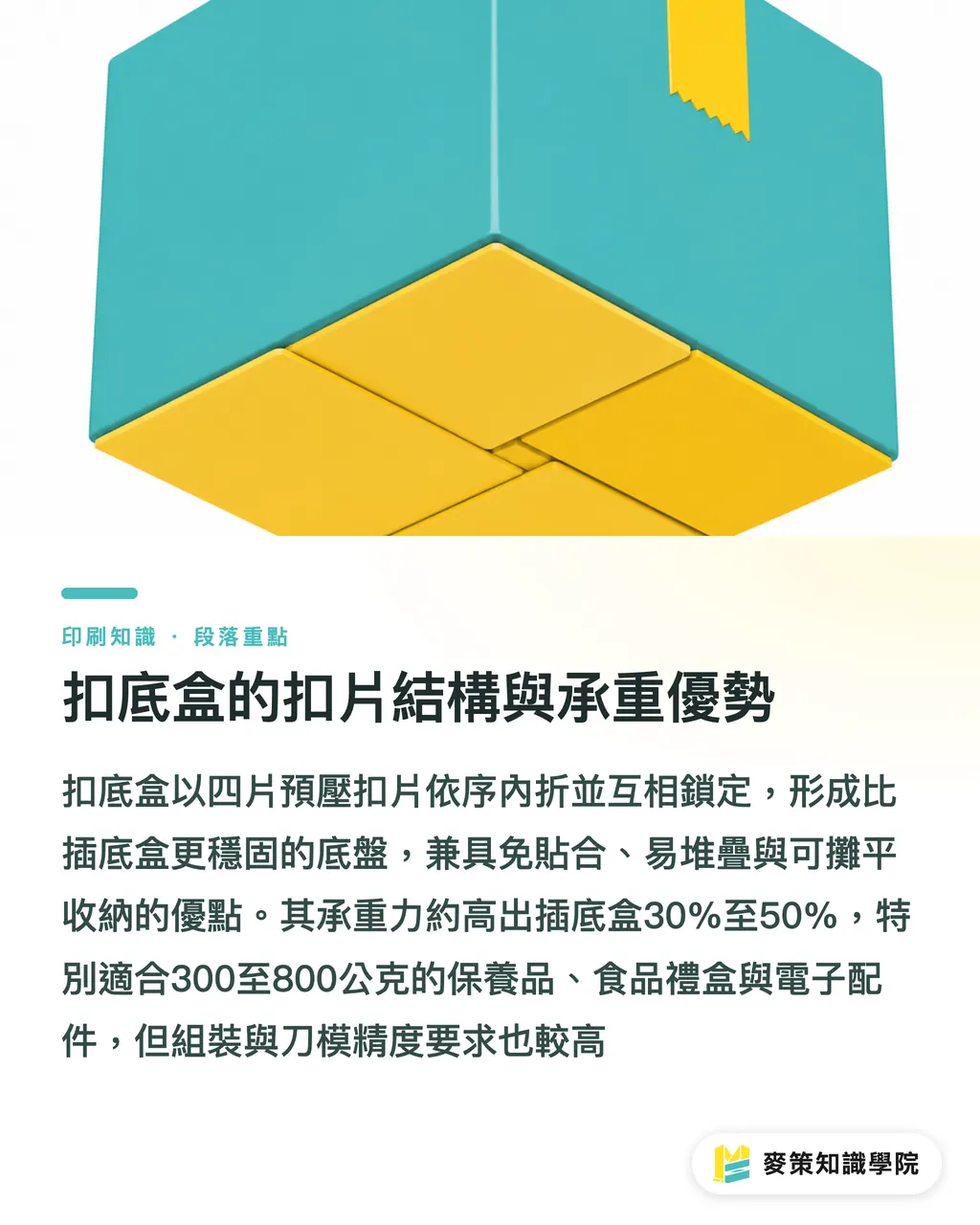
A crash lock bottom box is also built from a single piece of paperboard, but its base features 4 pre-creased locking flaps. During assembly, the flaps fold inward in sequence and lock together, forming a sturdy base. This structure is commonly called a Crash Lock or 1-2-3 Bottom in Western packaging markets because it takes exactly three steps to assemble
Pros:
・The base is locked together by multiple flaps, offering about 30-50% more load capacity than a tuck bottom box
・Lies flat and even after assembly, making it ideal for stacking and shipping
・Folds completely flat before use, keeping storage footprint small
Cons:
・Requires 2-3 more motions than a tuck bottom box, taking about 10-15 seconds per unit to assemble
・Die-line design is more complex, resulting in slightly higher die-cutting plate tooling costs
・Requires high die-cutting precision. Slight errors in paper caliper or crease depth can prevent the flaps from locking securely
Crash lock boxes are a favorite for skincare products, food gift sets, and small-to-medium electronics accessories because they deliver two big benefits at once: no extra gluing needed and solid load-bearing strength. If your product weighs between 300-800 grams and you want clean, one-piece box construction, a crash lock box is practically the top choice
In practice, I often see clients confuse crash lock bottoms with tuck bottoms, assuming they are basically the same. The difference is actually significant: tuck bottoms use two interlocking flaps, while crash lock bottoms use four (or more) sequentially locked flaps, putting them in a completely different tier of stability. If you have a tight budget but a heavier product, forcing a tuck bottom box is often where disasters start
Shoulder Boxes: Two-Piece Structure and Premium Brand Texture
A shoulder box (lid and base) splits the packaging into two separate components: a top lid and a bottom base. A common variation makes the base slightly shorter than the lid so that when the lid slides down, a distinct "shoulder" is exposed, which gives the style its English name. This structure is practically standard for luxury items, high-end skincare, and premium gift boxes
There are two main production methods for shoulder boxes:
・Full wrapped: Both lid and base are fully wrapped in matching paper stock, delivering the most seamless texture at the highest cost
・Nested set: Lid and base are built separately with an inner neck or tray inserted to form the structure, taking less labor while creating rich visual layering
Pros:
・Best unboxing experience with a strong sense of ceremony
・Lid and base can be printed and finished separately, offering maximum design flexibility
・Easy to pair with inserts (velvet trays, EVA foam, molded pulp) for luxury packaging
Cons:
・Requires manufacturing two separate pieces, doubling the mounting or nesting labor compared to tuck bottom boxes
・Uses significantly more material, with paper costs running about 40-60% higher per unit than tuck bottom boxes
・Lids and bases are stored or shipped separately, increasing both warehouse space and packing labor
If you are producing high-end gift boxes with a unit retail price over NT$200 and run sizes in the thousands, the extra labor and material costs of a shoulder box are well worth absorbing because the added brand equity far outweighs the packaging expense. On the flip side, if your product carries a low price point and high volumes (like promotional packs running in tens of thousands), the cost structure of a shoulder box will eat away most of your gross margins
How to Choose: Decide Using Run Volume, Product Weight, and Brand Positioning
The key to picking a box structure is not finding what looks best, but finding what matches your product specs and shipping rhythm. When assisting clients with packaging evaluations at the Mai Strategy Knowledge Academy consulting team, I usually break the decision down into three variables:
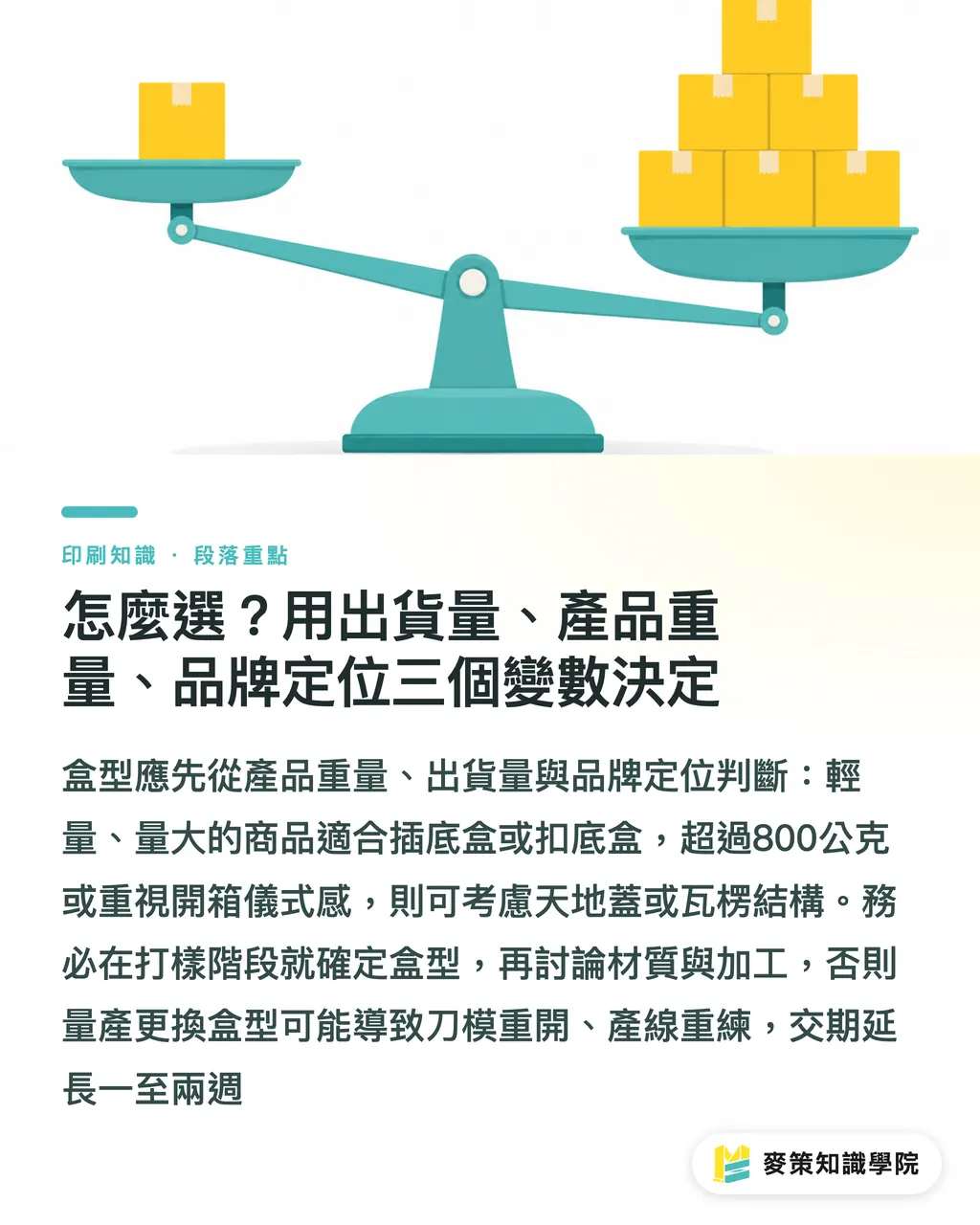
1. Product weight and volume: Tuck bottom boxes work fine for lightweight items between 100-300 grams. Upgrade to crash lock boxes for 300-800 grams. For items over 800 grams or those needing heavy insert support, move straight to shoulder boxes or corrugated packaging
2. Run volume and price point: High-volume, low-margin promotional items call for tuck bottom or crash lock boxes. Premium, low-volume gift sets justify shoulder boxes
3. Brand positioning and unboxing experience: Choose shoulder boxes if you need a memorable unboxing ritual. Choose tuck bottom or crash lock boxes if speed, simplicity, and efficiency come first
My practical advice to clients is always: lock in the box structure first, then discuss materials and finishes. Many new brands get caught up right away debating matte versus gloss foil stamping or how many coating passes to run on 4-color process printing, completely overlooking the cost structure of the box itself. Pick the wrong box style, and every finish you add later is wasted money
Another common blind spot is prototyping with one box style and switching to another for mass production. A tuck bottom box might pass proofing, and switching to a crash lock box for mass production sounds like an upgrade, but you will have to re-cut the die, retrain packaging line SOPs, and push back delivery by at least one to two weeks. Lock your box structure down during the sampling phase and do not change it right before mass production
Key Takeaways
・Labor hours vary widely among the three basic box styles: tuck bottom is the fastest, crash lock sits in the middle, and shoulder boxes are the most expensive
・Box structure sets your cost baseline. Pick the structure before talking paper stock and finishes to keep budgets in check
・Tuck bottom boxes have limited load capacity. Do not push them with heavy products, as crash lock or shoulder boxes are the right answer
・Extra costs for shoulder boxes must be offset by brand equity. They are not suited for high-volume promotional runs
・Finalize the box structure during proofing. Switching box styles right before mass production means starting over from scratch
Further Considerations
Looking back at the projects I have worked on with clients over the years, the biggest trap in box selection is not picking the wrong style, but picking it too late. Many brands finalize their design files first, only to turn around and ask the printer, "Is this structure going to be too expensive?" The correct sequence is: lock in the box style based on product specs and fulfillment needs, select paper stock and caliper based on that structure, and only then start graphic design and post-press finishing. For small and medium brands, getting this order backward can easily waste NT$30,000 to NT$50,000 in reproofing and reprinting costs. If you are unsure how the numbers add up, get a packaging structure review with a printing consultant before proofing. It is far more effective than slashing your budget after the fact
Further Reading
FAQ
- What is the difference between a tuck bottom box and a crash lock box?
- A tuck bottom box locks together with two flaps and takes the least assembly time. A crash lock box locks with four flaps in sequence, offering greater load capacity but requiring more assembly steps. If your product exceeds 300 grams, go with a crash lock box directly
- Why are shoulder boxes more expensive than tuck bottom boxes?
- A shoulder box consists of two separate parts (lid and base), requiring double the mounting or nesting labor. Material usage also jumps by 40-60%, making the unit cost roughly 1.5 to 2 times that of a tuck bottom box
- How can you cut labor costs when folding boxes for mass production?
- Tuck bottom and crash lock boxes can be sped up with semi-automatic box folding machines. Shoulder boxes involve separate lid and base assembly, so most of the work remains semi-manual. If your run exceeds 5,000 boxes, check with your printer beforehand to confirm whether their automated folding equipment supports your style
- Can you change box styles during proofing?
- Not recommended. Changing the box style requires new die-cutting tooling and updated assembly SOPs, which usually extends turnaround time by one to two weeks. Locking down the box structure during the sampling phase is the most cost-effective approach
- Which box style should skincare packaging use?
- Choose shoulder boxes for products with retail prices over NT$200 that emphasize an unboxing ritual. For lower price points and high-volume promotional sets, crash lock boxes work best. Tuck bottom boxes are only suited for lightweight sample packs or inner cartons
Related articles
The Print × AI weekly
The print and AI know-how designers, brands and enterprises can use before they commit — one email, every week
MINDS Free Tools
Spine width and imposition calculators — skip the manual math, free in your browser.
MINDS Group
Need actual printing or gifting services?
From premium printing to online ordering and festive gifts — the MINDS Group sister brands take it from here.