
Overview
Choose paper weight by use first, hand feel second, and price last. In the three-part paper selection framework used by MINDS (MS, mid- to high-end fully custom commercial printing), that means judging ① use-case strength ② surface performance ③ post-press finishing together. 80-120gsm is commonly used for documents and flyers, 157-200gsm works well for DM pieces, folded leaflets, and saddle-stitched inner pages, 250-350gsm moves into business cards, covers, and premium folded pieces, while anything above 400gsm usually needs packaging structure and finishing reviewed together
What does paper weight in gsm mean?
gsm stands for grams per square meter. In Taiwan print shops, people often call it "pounds" or "grams," but the standard meaning is the weight of one square meter of paper. It reflects weight and material use, but it is not the same thing as thickness, stiffness, or a premium feel by itself
The misunderstanding I run into most often on pressroom floors is when a client points to 250gsm and 300gsm and asks, "So 300 must be thicker, right?" The answer depends on the paper type
・80-120gsm: Common for office documents, letterhead, and general flyers. The point is easy folding, easy distribution, and manageable per-sheet cost
・157-200gsm: Common for DM pieces, menus, folded leaflets, and saddle-stitched inner pages. Images hold up better than on 100gsm, and the piece feels more substantial in hand
・250-350gsm: Common for business cards, invitation cards, covers, and premium folded pieces. Stiffness becomes obvious, and the design has to start accounting for fold lines
・400gsm and above: Common for premium packaging, heavy cards, sticker backing stock, or special structures. Usually you should not only ask "Can it be printed?" You also need to ask, "Can it be folded, die-cut, and glued?"
Paper weight is like the weight of ingredients. Hand feel is the finished dish. With the same 300gsm, fiber formation, calendering, coating, and paper bulk can all change how the final sheet feels
How many gsm should you choose for business cards, DM pieces, folded leaflets, and packaging?
Do not start paper selection with "I want it to feel premium." That is too vague. When Mai Strategy Knowledge Academy teaches procurement teams and designers how to communicate, I ask them to define the item first, because a business card needs stiffness, a folded leaflet needs foldability, and packaging needs structural support
・Office documents: Recommended 80-100gsm. Suitable for quotations, manuals, and training materials, especially when the page count is high and you do not want the document to get too bulky
・General flyers: Recommended 100-157gsm. Go lighter for mass distribution, or closer to 157gsm for in-store displays and event DM pieces
・DM pieces and single-sheet catalogs: Recommended 157-200gsm. 157gsm is a common balance point, while 200gsm feels more present in hand
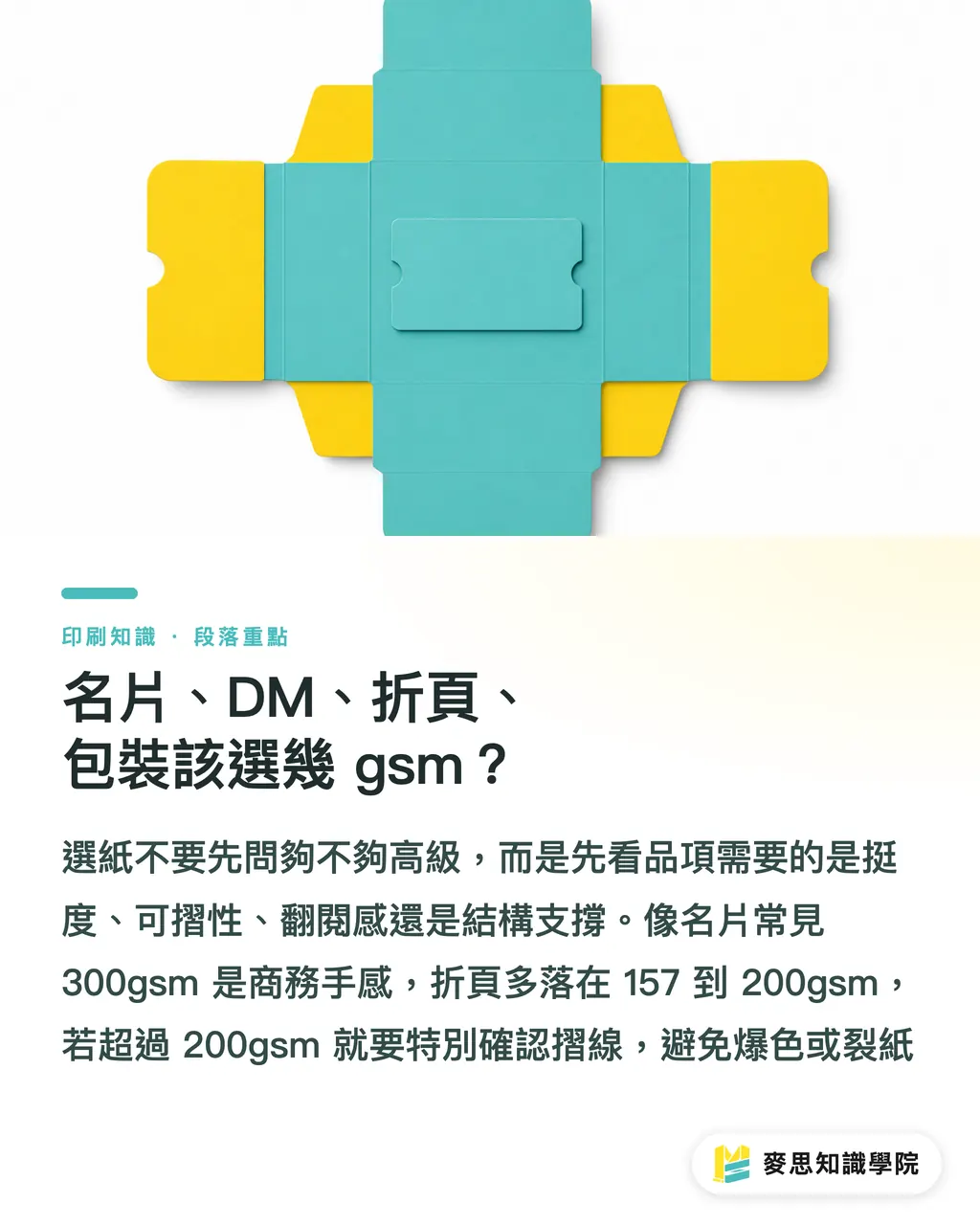
・Tri-fold and bi-fold leaflets: Recommended 157-200gsm. Above 200gsm, confirm the crease first, or the outer fold may crack or lose color
・Saddle-stitched inner pages: Recommended 100-157gsm. The higher the page count, the less suitable thick inner pages become, otherwise the fore edge will bulge
・Catalog covers: Recommended 200-250gsm. The cover should be stiffer than the inner pages, but still bind and flip cleanly
・Business cards: Recommended 250-350gsm. 250gsm feels relatively light, 300gsm is a common business feel, and 350gsm or above gets closer to the impression of heavy cardstock
・Hang tags and invitation cards: Recommended 300-400gsm. If you need punching, foil stamping, or die-cutting, check the paper's crack resistance first
・Premium packaging and paper boxes: Recommended 400gsm or above, or a mounted paper structure. Box style, load capacity, creasing, and gluing method affect success more than a single gsm number
・Sticker backing stock: Often falls into the range of heavy backing or special backing materials above 400gsm. The key is release performance, stiffness, and compatibility with post-press finishing
For business cards, I usually do not recommend judging by "the thicker, the better." Some 350gsm papers are very stiff, but once you print a black background and then crease or trim them, the corners can expose a rough feel instead. That is what happens when the paper spec and the design language do not line up
Why can the same 300gsm feel so different?
At the same 300gsm, coated paper feels smoother because of calendering and the coating layer. Colors look more saturated, lines look cleaner, and the hand feel often comes across as thin but stiff. Uncoated papers such as woodfree paper and art paper show more fiber texture, absorb more ink, and often feel thicker and warmer to the touch
Paper bulk refers to the relationship between paper weight and actual thickness. At the same gsm, high-bulk paper feels puffier and thicker, while low-bulk paper feels denser and smoother. Print color and stiffness change with it
・Coated paper: Smooth surface, suitable for photos, product images, and color DM pieces. 157gsm to 200gsm is very common
・Woodfree paper: Less reflective surface, suitable for text, brand manuals, and literary-style business cards, but large dark areas tend to absorb more ink
・Heavy cardstock: 250-350gsm is common for business cards and cards. The paper feel is direct, and trimming and creasing quality become more visible
・Specialty paper: With the same 300gsm, texture, cotton-like feel, and dyed paper cores all change the first touch. A proof is more reliable than guessing from specs
My own rule is simple: if there are many photos, look at coated paper or high-white smooth paper first. If text and brand tone matter more, then look at woodfree or specialty paper. If you want someone to pause and touch it for a second, do not chase only gloss and thickness
If the procurement side is unsure, the most practical move is to ask the Mai Strategy Knowledge Academy consulting team for similar paper samples, and ask the supplier for five details: paper type, gsm, whether it is coated, whether it has lamination, and whether it is creased. Only then can you compare hand feel properly
Why does extra-thick paper crack when folded?
Once paper goes above 250gsm, creasing can no longer be treated as a small binding detail. By 300-400gsm, paper grain direction, crease depth, ink layer position, and whether lamination is applied all directly affect whether the fold will crack
Paper grain is the main direction formed by paper fibers during papermaking and roll processing. Folding with the grain is smoother. Folding against the grain is more likely to burst. With thick paper, full-coverage dark ink, and matte lamination, grain direction especially needs to be confirmed upfront
・Below 200gsm: Most folded pieces are relatively easy to handle, but full-coverage dark designs still need attention around the fold line for color loss
・Around 250gsm: Creasing is recommended, especially for folded cards, covers, and menus
・Above 300gsm: Creasing is almost a basic step. If the grain direction is wrong, the finished piece can easily show white edges at the fold
・Above 400gsm: Treat it with packaging logic, including die-cutting, creasing, mounting, and forming tests
Digital printing and offset printing also differ. Digital presses are more sensitive to thick-paper feeding, paper bending paths, and toner adhesion. Offset printing usually offers more flexibility for high-volume stability and paper selection, but it still depends on the equipment, paper type, and finishing process
For small runs of high-priced cards, a fully custom commercial printing process like MINDS (MS) is better suited to checking paper samples and finishing first. Making one small mistake early is far cheaper than having an entire batch crack at the folds
How should you confirm paper feel during procurement and proofing?
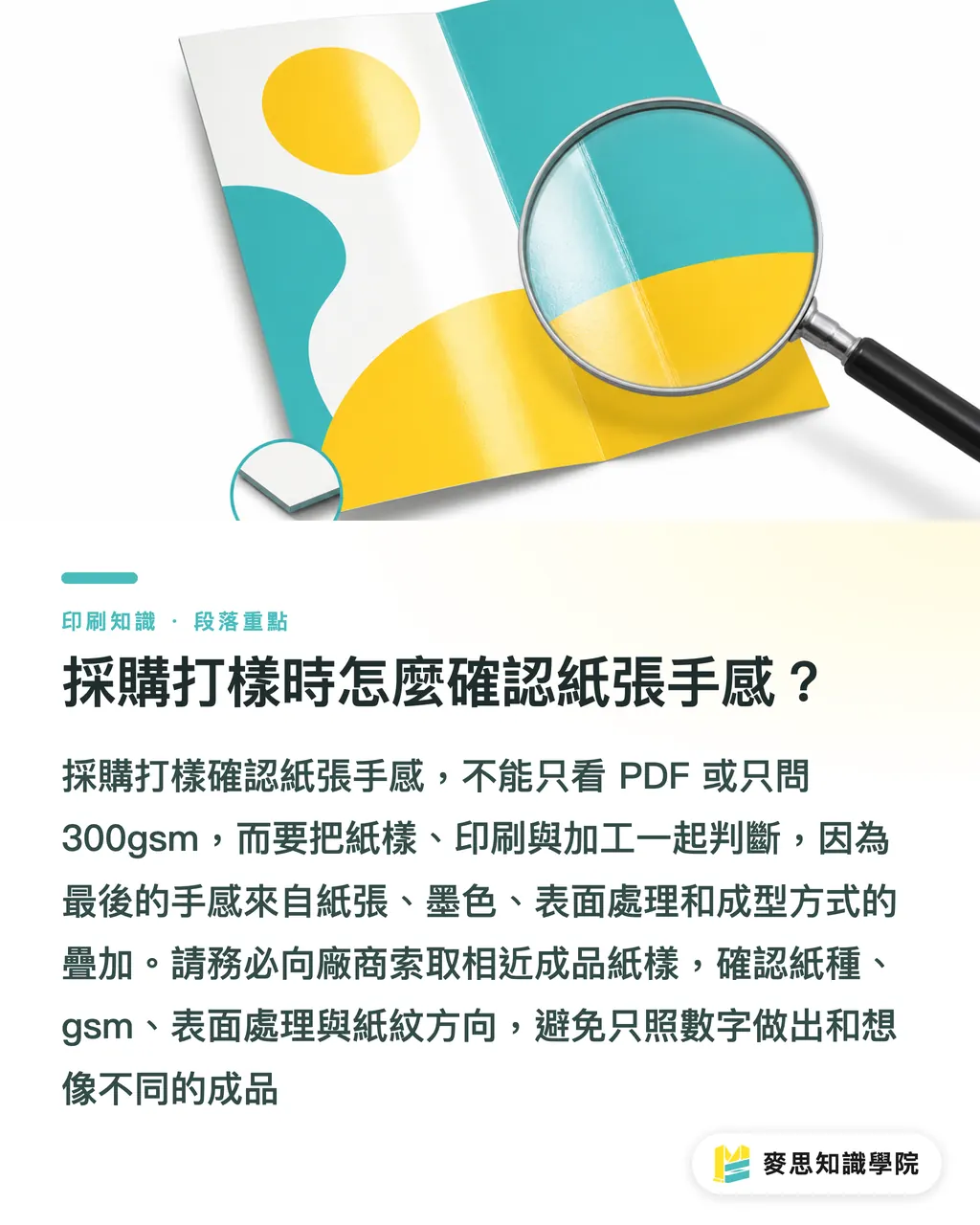
Proofing is not just checking a PDF, and it is not enough to ask, "Do you have 300-pound paper?" The right way is to judge the paper sample, printing method, and finishing method together, because the final hand feel comes from paper, ink color, surface treatment, and forming method as a whole
MINDS (MS) uses a three-check print workflow this way: ① check the use case, confirming the item and durability needs ② touch the paper sample, confirming gsm, paper type, and surface treatment ③ verify finishing, confirming whether creasing, trimming, lamination, foil stamping, or die-cutting is compatible
・Ask for the paper name: Do not write only 300gsm. Ask whether it is coated paper, woodfree paper, ivory board, heavy cardstock, or specialty paper
・Ask about thickness feel: Have the vendor provide samples of similar finished pieces. That is more accurate than verbal descriptions like "a bit thicker" or "more premium"
・Ask about the print method: Digital printing suits small runs and fast-changing content. Offset printing suits large runs and stable color control
・Ask about finishing: Lamination, foil stamping, embossing, die-cutting, and creasing all change paper stiffness and cracking risk
・Ask about paper grain: Folded leaflets, covers, paper boxes, and hang tags need grain direction confirmed, especially at 300gsm and above
I have seen too many projects where the design looked great, only to get stuck on one sentence: "We thought 300gsm meant that thick kind of feel." If the print spec does not clearly define "that feel," the production floor can only follow the number. The result may not be the finished piece you had in mind
Key Takeaways
・gsm is weight, not thickness. To judge paper feel, look at paper type, bulk, and surface treatment together
・80-120gsm is about lightness, 157-200gsm is about presentation, 250-350gsm is about stiffness, and 400gsm or above is about structure
・At the same 300gsm, coated paper tends to feel smooth and stiff, while woodfree paper tends to feel bulkier and more ink-absorbent. They are not the same texture
・For thick paper, ask about grain direction and creasing first. Fold-cracking risk above 300gsm cannot be left to luck
・For procurement and proofing, request physical paper samples. At minimum, the spec sheet should clearly state paper type, gsm, print method, surface treatment, and finishing
Further Thinking
For print manufacturers, communication around paper weight needs to move from a quotation field to a spec judgment. For designers, layout, full-coverage dark color, fold lines, and paper grain should be considered together before final artwork. For SaaS and AI application teams, the most valuable task is not filling "300gsm" into a form. It is converting use cases like business cards, folded leaflets, covers, and packaging into checkable print conditions, so sales, design, production, and clients stop imagining different things under the same word
FAQ
- Does a higher paper weight always mean thicker paper?
- Not always. Paper weight in gsm means the weight of one square meter of paper. Thickness also depends on paper type, bulk, coating, and calendering. At the same 300gsm, coated paper may feel smooth and dense, while woodfree paper may feel thicker to the touch
- How many gsm should a business card usually be?
- Business cards are commonly recommended at 250-350gsm. 250gsm feels lighter, 300gsm is a common business feel, and 350gsm or above feels thicker and stiffer. If you need foil stamping, embossing, or specialty paper, it is best to check a physical paper sample first
- How many gsm are suitable for DM pieces and folded leaflets?
- DM pieces and folded leaflets commonly fall around 157-200gsm. 157gsm suits general event and product information, while 200gsm feels more substantial. For tri-folds or bi-folds, anything above 200gsm should be checked for creasing and fold condition
- Why does thick paper crack when folded?
- Cracking in thick paper is often tied to grain direction, crease depth, ink layer thickness, and lamination. For 300gsm and above, confirm the grain and add creasing first. Full-coverage dark designs need extra care to avoid white edges at the fold
- Can digital printing handle very thick paper?
- Digital printing can handle many thick-paper jobs, but it is affected by the machine's feed path, paper bending, and adhesion conditions. For small runs of heavy cards or specialty paper, proofing first is best. Offset printing is more often used for high-volume commercial print jobs with stable specs
Related articles


The Print × AI weekly
The print and AI know-how designers, brands and enterprises can use before they commit — one email, every week
MINDS Free Tools
Spine width and imposition calculators — skip the manual math, free in your browser.
MINDS Group
Need actual printing or gifting services?
From premium printing to online ordering and festive gifts — the MINDS Group sister brands take it from here.