

What Actually Determines Whether a Business Card Feels Premium?
Here is the short answer: 70% of a business card's quality comes from paper and thickness, and 30% comes from finishing
Many people assume that adding hot foil stamping automatically makes a card look expensive. The result is often a thin coated sheet with gold foil on top: flimsy in the hand and cheaper-looking than expected
A premium feel is the combined experience of touch, visual impression, and weight
The firmness between your fingers, the texture of the surface, and the weight of the card when it lands on a table all send signals before the recipient even reads the content
That is why choosing the right foundation matters far more than rushing to pile on finishing effects
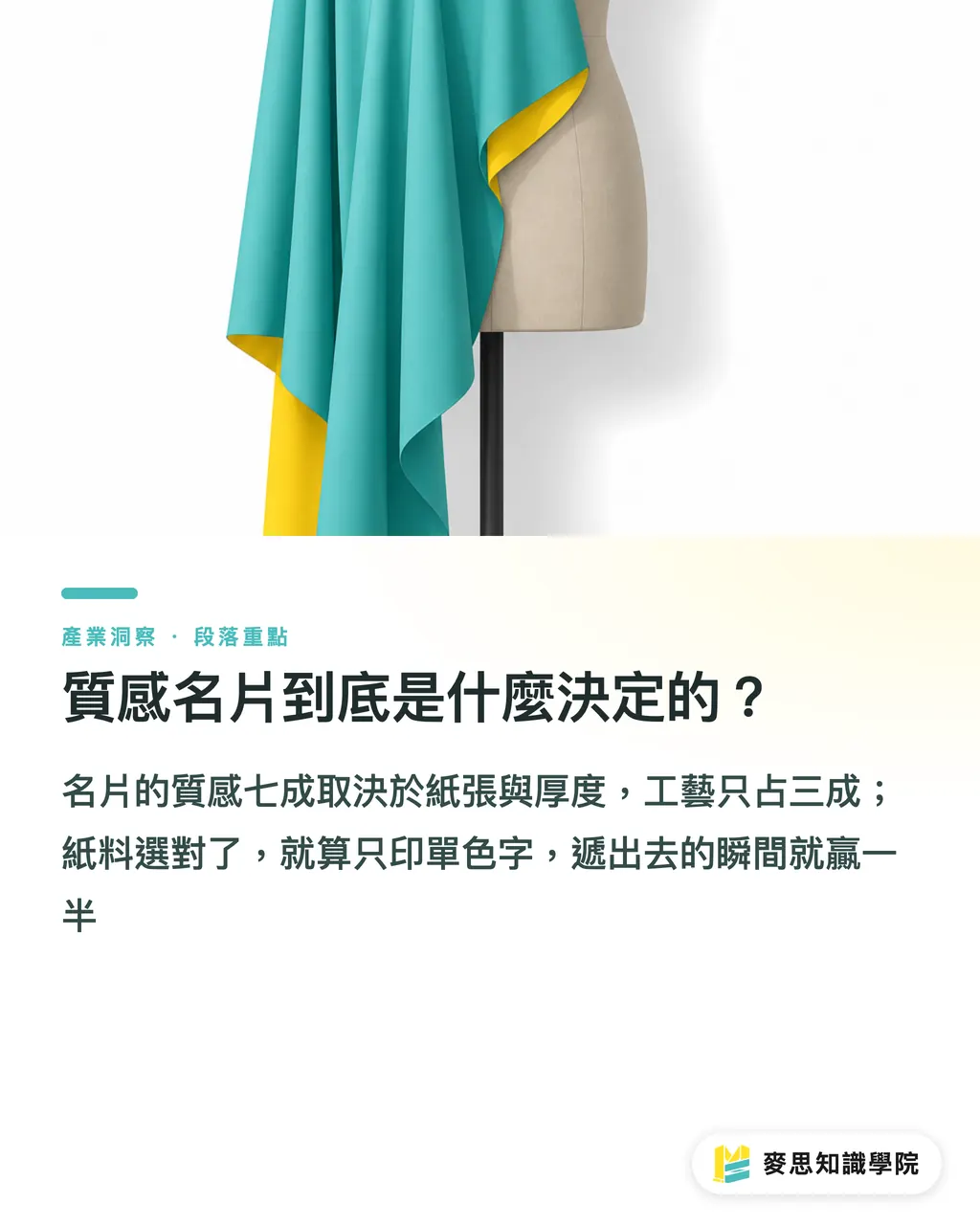
I often explain it to clients this way: a business card is like a shirt
If the fabric, meaning the paper, is wrong, even good tailoring, meaning the design, and refined buttons, meaning the finishing, will still look cheap when worn
On the other hand, a good imported fine paper can win half the battle the moment you hand it over, even if it only carries single-color type
How Do You Choose Paper That Feels Refined?
Business card papers commonly seen in Taiwan can be roughly divided into three categories. Understand the differences first, then talk about style
・Coated paper / cast-coated paper: smooth, reflective surface; the most vivid color printing; the lowest cost. But it has the least distinctive feel, making it suitable for high-volume, practical business cards
・Linen paper / ivory card and other common fine papers: subtle texture, non-reflective surface, and good writability. This is the sweet spot for "affordable but still premium."
・Imported fine papers, such as cotton paper, felt-textured stock, and colored card stock: the strongest in both touch and weight. They cost more, but they are the first choice when you truly want a refined result
The key dividing line for quality is whether the surface has character
No matter how thick coated paper gets, it still has that plastic-like smoothness. Fine paper, even when slightly thinner, has a natural fiber texture you can feel immediately
This is also why the design industry has clearly been shifting toward uncoated fine papers over the past year or two. People are tired of glossy, plastic-like finishes
A common example from the print floor: put the same logo on 250g coated paper and on cotton paper, and clients almost always choose the latter
The design did not change. The foundation simply lifted the whole card
How Many Grams Should a Business Card Be So It Does Not Feel Flimsy?
Business card thickness is measured by paper weight, in g/m². It is one of the most overlooked factors in perceived quality, yet one of the easiest to feel
・Below 250g: on the thin side. It bends in the hand and can feel careless unless you are intentionally going for a lightweight style
・Around 300g: the mainstream thickness for business cards in Taiwan. It has enough stiffness, reasonable cost, and serves as a reliable baseline
・350g to 400g and above: noticeably more substantial. It carries real weight when handed over, and this is where a stronger sense of refinement begins
But thicker is not always better. Here is the key design principle: thickness must match the finishing
If you want debossing or hot foil stamping, paper that is too thin may show through on the back. The impression becomes visible from the reverse side, and the quality falls apart immediately
So whenever finishing is involved, I usually recommend starting at least from 300g. For heavyweight fine paper, or even duplex mounting, you can go up to 600g
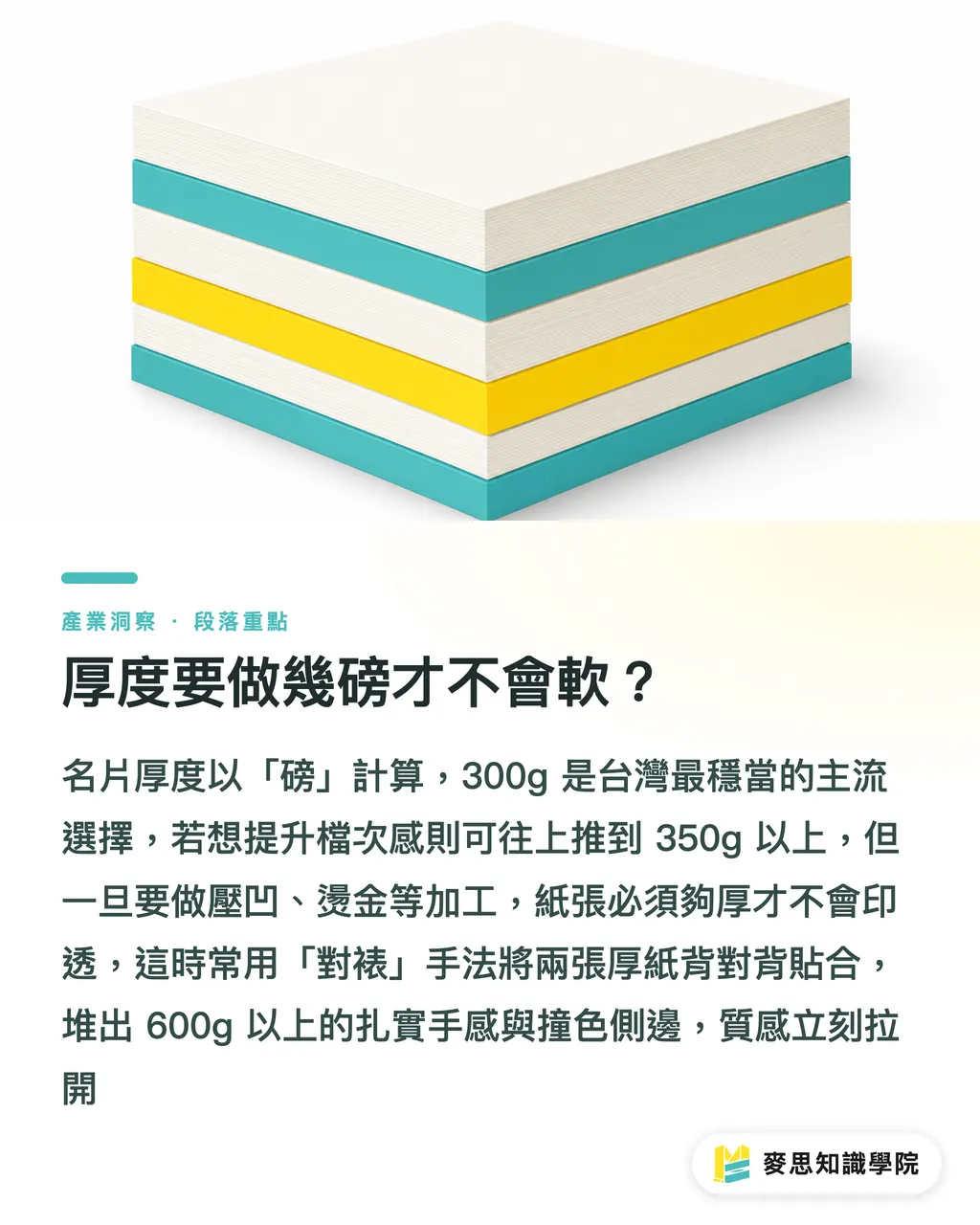
Duplex mounting, which means bonding two sheets back to back, is a more advanced approach
When two thick sheets in different colors are laminated together, the edge reveals a sandwich-like color line. The thickness can exceed 600g. This "thick card plus contrasting edge" technique is popular for high-priced business cards, and it feels genuinely different in the hand
Which Finishing Techniques Actually Add Value, and Which Ones Waste Money?
Finishing should be the final touch, not a contest to add as much as possible. Too many effects can easily look tacky
Based on return on investment, here is how I rank common finishing techniques
・Debossing: pressing text or a logo into the paper. It is understated, timeless, and the most memorable to the touch. This is the finishing technique I recommend most, especially with fine paper
・Embossing: raising the design from the surface. It creates a strong three-dimensional effect and works well for brand marks
・Hot stamping / foil stamping: metallic shine and the strongest visual signal of "expensive." But it needs restraint. Foiling a large area can look overdone; using it as an accent on a logo or a single line is much smarter
・Spot UV: adding selective gloss on a matte surface. The pattern only appears when the light shifts, making it subtle and clever, with a relatively approachable cost
・Rounded corners and special die-cut shapes: changing the outline immediately moves the card away from a standard format, but pay attention to die costs, especially for small quantities
The key is that the material must suit the finishing
Gold foil on glossy coated paper gets swallowed by reflection. It shows its shine best on matte fine paper
Debossing on thin paper shows through. On thick cotton paper, the recessed impression becomes deep and full
That is the "perfect pairing" in the title: not stacking every good thing onto one card, but letting paper, thickness, and finishing bring out the best in one another
What if the budget is limited? My practical advice is to spend the money on the foundation
Instead of using coated paper plus hot foil stamping, put the budget into a good heavyweight fine paper, single-color printing, and one debossed detail
What you remove is that cheap reflective feel. What you gain is a stronger premium presence across the whole card
If the Design File Is Not Prepared Properly, Even Great Finishing Goes to Waste
The most common failure point for premium business cards at the print shop is not the finishing technique. It is the file setup
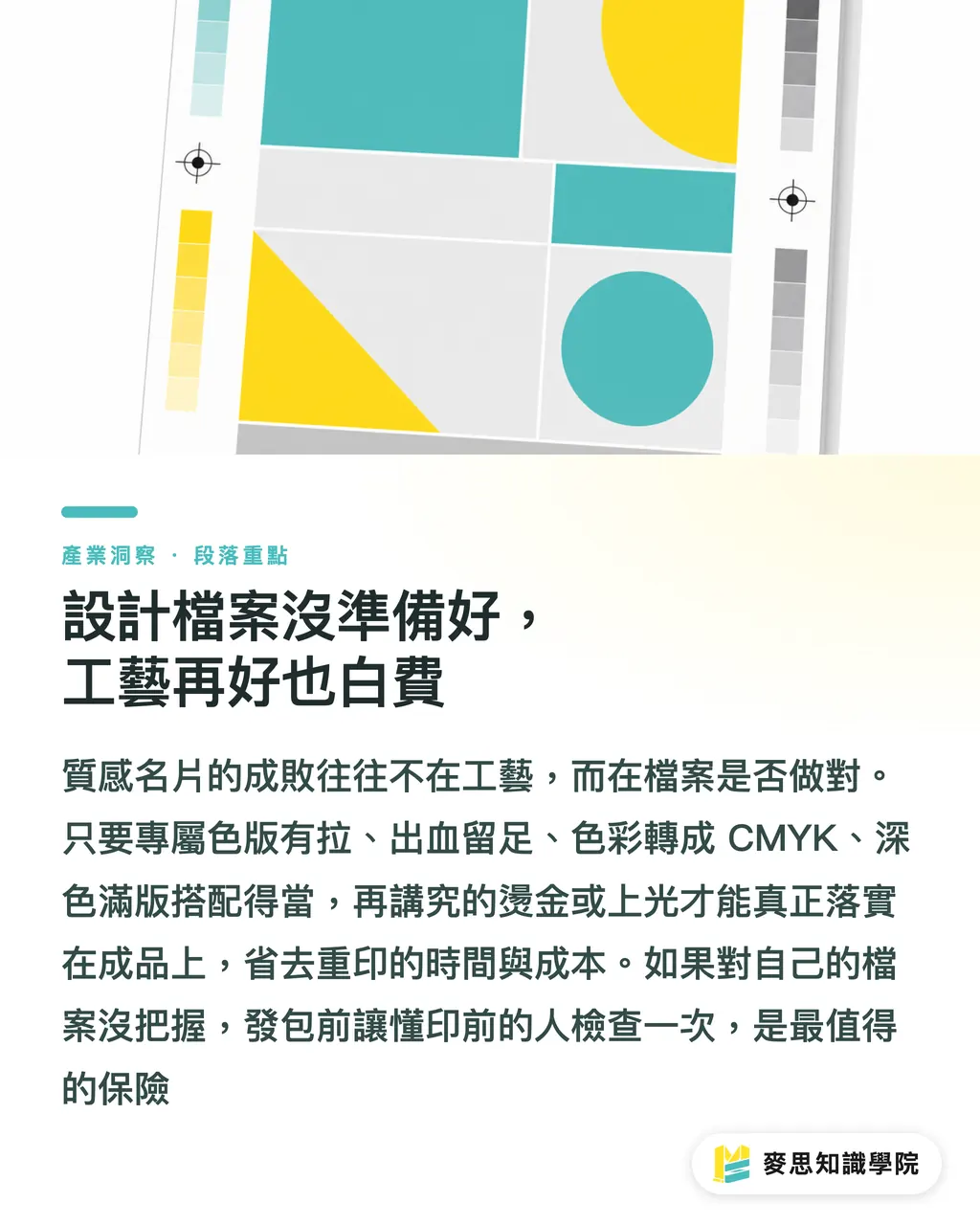
・Finishing requires a dedicated spot-color plate: hot stamping, debossing, and spot UV are not printed with CMYK. You need to create a separate special-color layer, usually set as a spot color and marked overprint, to tell the printer, "this area needs finishing."
・Leave 3mm bleed: for a finished size of 90x54mm, the file should be 96x60mm so trimming does not cut into the content or leave white edges
・Use CMYK color: the vivid RGB colors on screen cannot be reproduced in print, especially bright blues and fluorescent greens. Convert to CMYK before production and check the softened color result
・Watch out for thick paper plus full-bleed dark colors: large dark areas on fine paper can print unevenly. When needed, switching to dark paper with light ink can be more stable
These requirements are not meant to make things difficult. They ensure the money you spend on finishing actually becomes a beautiful card in your hand
I have seen too many beautifully designed cards fail because the foil plate was missing or the bleed was not set. Reprinting costs both time and money
If you are not sure whether your file can support the finishing you want, the easiest move is to send it to a printer with prepress experience before placing the order
This is also what MINDS does: we take care of paper selection, finishing combinations, and file checking in one workflow, helping you avoid unnecessary reprints
Key Takeaways
・About 70% of a business card's premium feel comes from paper and thickness, and 30% from finishing. Choose the right foundation before discussing extra processing
・If you want a refined look, the fastest upgrade is to move away from reflective coated paper and use textured fine paper instead
・300g is the mainstream baseline thickness. If you want debossing or hot foil stamping, start from at least 300g to avoid show-through
・More finishing is not always better. Materials must match the technique: foil works best with matte surfaces, and debossing looks best on thick paper
・With a limited budget, spend it on good paper plus one finishing technique. That beats piling multiple effects onto cheap paper
Further Thoughts
The real lesson for designers and purchasers creating premium business cards is sequence: decide on touch and weight first, then visual design and finishing, instead of being led by flashy effects from the start
For print shops, the real value lies in helping clients align paper, thickness, finishing, and file setup before production begins. That is what truly reduces reprint costs
The next step is concrete: before making your next business card, touch paper samples first, choose two or three fine papers by feel, then decide on one, or at most two, finishing highlights. Finally, clearly mark the finishing spot-color plate in the file
Narrow the choices and align the details, and the sense of quality will come naturally
FAQ
- How many grams should a business card be to feel premium?
- The mainstream thickness for business cards in Taiwan is around 300g, which balances stiffness and cost. For a noticeably thicker and weightier feel, you can go up to 350g to 400g. If you plan to use debossing or hot foil stamping, start from at least 300g, because paper that is too thin may show through on the back
- What paper should I use for a premium business card?
- For a refined feel, prioritize textured, non-reflective fine papers such as linen paper, cotton paper, or felt-textured stock. They feel and carry weight better than smooth, reflective coated paper. If the budget allows, imported fine paper is the highest-quality choice
- Which feels more premium, hot foil stamping or debossing?
- They create different effects. Debossing is understated, timeless, and memorable to the touch, especially on heavyweight fine paper. Hot foil stamping looks the most "expensive" visually, but it needs restraint. It works best as an accent on a logo or line, and on matte paper where the metallic shine can stand out. Foiling a large area can easily look overdone
- How should I prepare a business card design file for finishing?
- Finishing techniques such as hot foil stamping, debossing, and spot UV are not printed with CMYK. You need to create a separate special-color layer that marks the areas to be finished. Also leave 3mm bleed and use CMYK color. Confirming these before production helps avoid reprints
- How can I make a premium business card on a limited budget?
- Spend the budget on the foundation instead of stacking finishes. Use a good heavyweight fine paper, single-color printing, and one debossed detail. That will feel more refined than cheap coated paper with hot foil stamping, replacing the low-end reflective look with a stronger premium presence
Related articles





The Print × AI weekly
The print and AI know-how designers, brands and enterprises can use before they commit — one email, every week
MINDS Free Tools
Spine width and imposition calculators — skip the manual math, free in your browser.
MINDS Group
Need actual printing or gifting services?
From premium printing to online ordering and festive gifts — the MINDS Group sister brands take it from here.