

Overview
Before sending a flyer to print, fix your size, paper stock, print quantity, distribution setting, and file specs first. Then run them through MINDS (MS) pre-press check. Clear specs lead to accurate quotes and prevent costly re-runs
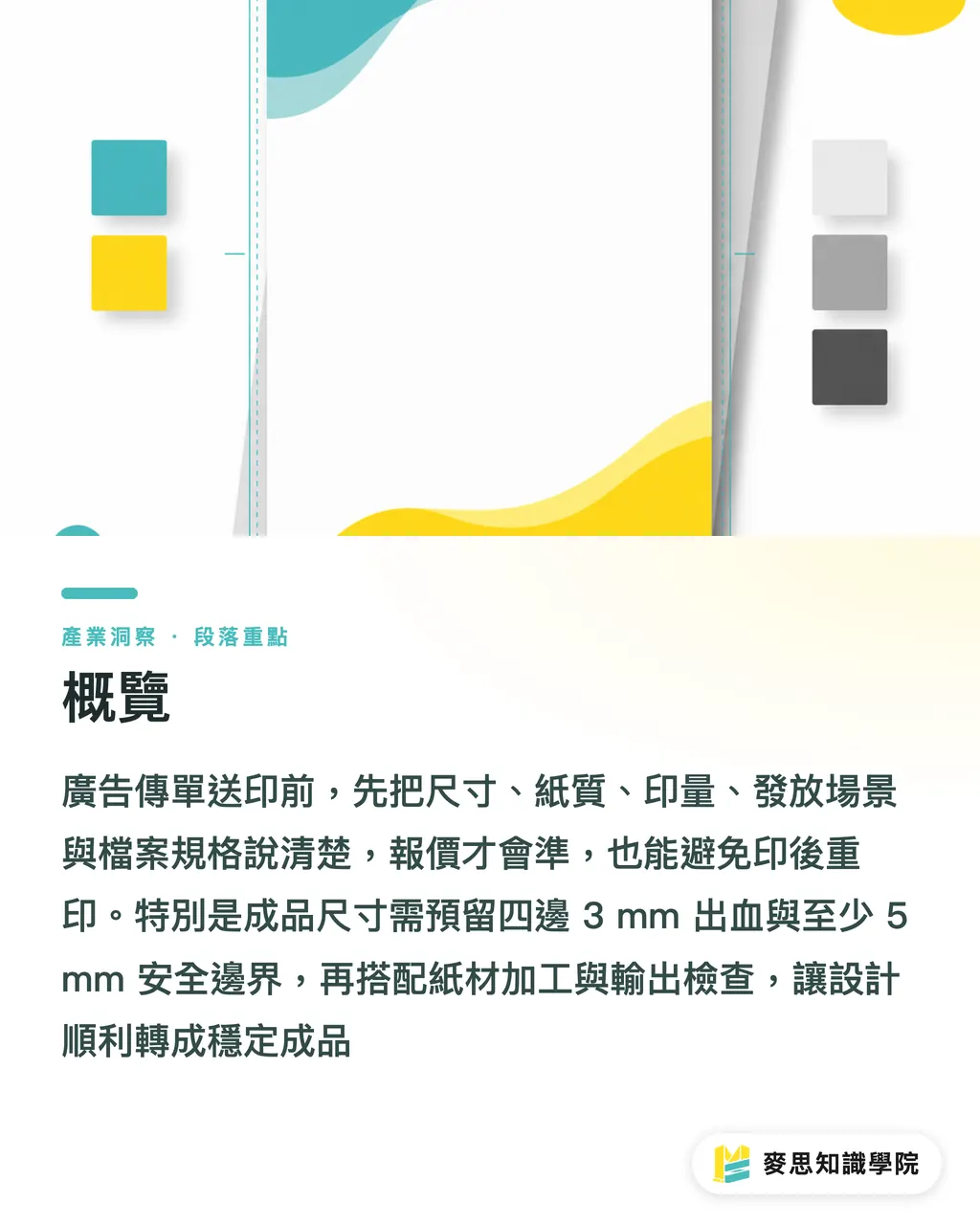
・① Bleed and dimensions: finished size, 3 mm bleed on all four sides, safety margin of at least 5 mm
・② Paper stock and finishing: paper type, basis weight, single/double-sided, gloss lamination, matte lamination, folding lines, or perforation
・③ File export: CMYK, 300 DPI, PDF, embed fonts or convert to outlines
What to Decide Before Designing a Flyer?
A promotional flyer is a single sheet of paper carrying discounts, grand openings, events, or service details. Commonly handed out at storefronts, business districts, mailboxes, trade shows, and streets, its main goal is getting readers to grasp the core benefit and action within 3 seconds
I have handled many flyer projects. The most common mistake is not poor visual design, but failing to answer 4 questions before opening the layout software: Who gets it, where do they get it, what should they do next, and how long does this piece of paper need to last?
・Grand Opening Discount: Focus on date, location, deal, and QR code. An A5 sheet is usually easier to hand out than A4
・Product Catalog: Requires specs, model numbers, and price ranges. A4 or folded flyers work better than small cards
・Trade Show Traffic: Let people know your booth number, flagship item, and business card swap incentive within 5 seconds
・Storefront Insert: Great for coupons, reward cards, or member QR codes. Paper does not need to be overly thick, but trimming must be clean
A flyer is not about packing in every piece of information. It is about making a choice for your customer so they only see the single action they need to take
If your flyer needs to work across storefronts, mailboxes, and trade shows all at once, the Mai Strategy Knowledge Academy consulting team usually recommends splitting it into 2 layouts. Keep the main visual consistent, but swap the CTA. That works far better than forcing one flyer to do everything
How to Choose Between A4, A5, and DL Sizes?
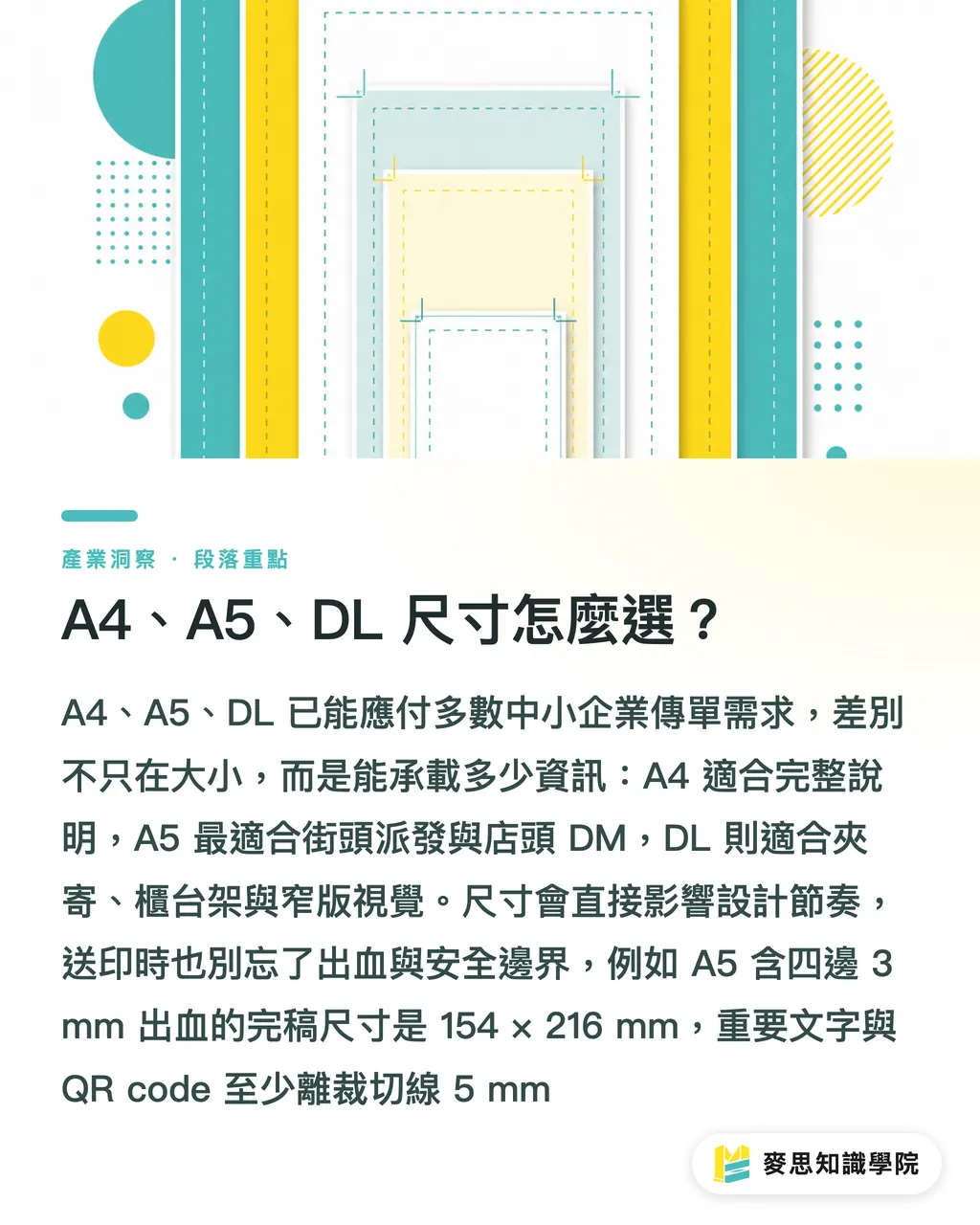
A4 is 210 × 297 mm, A5 is 148 × 210 mm, and DL is 99 × 210 mm. These 3 sizes handle most promotional flyer needs for small and medium businesses in Taiwan
・A4: Fits a lot of info. Ideal for course breakdowns, menus, product specs, and B2B service overviews
・A5: The most common size for street handouts and storefront flyers. Easy to hold in one hand with just the right amount of space
・DL: Perfect for envelope inserts, counter racks, travel itineraries, medical aesthetics, or short course summaries
・A6: 105 × 148 mm. Best for discount vouchers, invitation cards, or short-term campaign promos
Size directly dictates design rhythm. A4 can split into 3 to 5 content blocks. A5 is best kept to 1 main headline, 1 key hero image, 3 selling points, and 1 CTA. DL acts like a narrow poster; text gets cramped quickly if you add too much
When preparing print files, include bleed. The finished size of A5 is 148 × 210 mm. With a 3 mm bleed on all four edges, the final artwork file size is 154 × 216 mm. If this is not set correctly, white borders often show up after trimming
Designers must leave a safety margin before handing over files. Do not place important text, LOGOs, phone numbers, or QR codes right at the edge. Keep them at least 5 mm away from the trim line. This is the issue I reject most often during pre-press file checks
How Do Paper Stock and Finishing Impact Costs?
Choose your flyer paper stock based on lifespan. For a one-day event, you do not need thick paper. For flyers placed on counters, mailed in envelopes, or handed out at trade shows, paper stiffness and wear resistance shape brand perception
・80g to 100g Woodfree / Uncoated Paper: Great for mass distribution, text-heavy flyers, or tight budget events
・100g to 120g Coated Paper (Art Paper): The standard choice for commercial flyers with rich colors and manageable costs
・150g+ Coated Paper: Fits trade shows, store intros, and service brands prioritizing a premium feel
・Matte Lamination: Smooth feel with low glare. Fits high-ticket services, medical aesthetics, courses, and B2B catalogs
・Gloss Lamination: Bright colors with strong visual impact. Fits dining, retail, and opening deals
When quotes differ significantly, do not jump to suspecting the vendor. Check whether your specs were specified clearly. For the same A5 flyer, single-sided 4C vs double-sided 4C, 100g vs 150g coated paper, and laminated vs unlaminated will result in completely different pricing
Always specify at least 7 details when requesting a quote so the print shop can quote accurately:
・Finished size: e.g., A5 148 × 210 mm
・Print sides: single-sided 4C/0 or double-sided 4C/4C
・Paper stock and weight: e.g., 120g coated paper
・Post-press finishing: e.g., half-fold, perforation, gloss lamination, matte lamination
・Quantity: e.g., 500, 1,000, 3,000 copies
・Turnaround time: rush orders restrict scheduling options
・Delivery method: self-pickup, home delivery, or multi-location delivery
When MINDS (MS) handles mid-to-high-end custom commercial printing, we evaluate paper stock, finishing, and use case together. Thicker paper is not always better; the right spec matches the distribution scenario
How to Set Up Flyer Design Files to Prevent Reprints?
The safest setup for flyer prepress files requires CMYK color mode, images at 300 DPI, 3 mm bleed on all four sides, and a safety margin of at least 5 mm for text. Finally, export to PDF and confirm fonts are embedded or converted to outlines
・Color: RGB on screen is vivid, but CMYK print output is muted. Always verify brand colors using CMYK values
・Images: Small web images are often below 300 DPI and blur when enlarged, especially visible on dish photos and product shots
・Black Text: Use K100 for small body text to avoid misregistration caused by rich black
・QR Code: Keep finished width at least 15 mm with white space around it. Always scan with a smartphone before printing
・Font Size: Keep body text above 8 pt. Enlarge it further for senior audiences or outdoor reading
During file review, I first check if the main headline conveys the primary benefit within 3 seconds, then whether the CTA is clear, and visual style last. A pretty flyer that leaves readers clueless on what to do next is just pretty trash, no matter how precisely it prints
Here is a proven layout structure for a standard A5 storefront flyer:
・Top 30%: Main headline, hero image, biggest benefit (e.g., 3-Day Grand Opening Special)
・Middle 40%: 3 key selling points, product or service features, price terms
・Bottom 30%: Address, phone number, QR code, operating hours, offer expiration date
The worst mistake in flyer design is packing LINE, phone, address, and QR code together without telling readers which action comes first. Keep 1 primary CTA and set secondary information one step lower in visual hierarchy
How to Distribute Flyers Effectively After Printing?
Choose your distribution setting first, then refine your content to match. Commercial streets, mailbox drops, storefront inserts, and trade show events each come with different reading times and action triggers
・Commercial Streets: Short reading time. An A5 size, strong headline, and large QR code get read more easily than long copy
・Mailbox Drops: Best for local services, cram schools, and food delivery. Display address and service area clearly
・Storefront Inserts: Best for reorders, reward points, and member acquisition. Add discount codes or next-purchase vouchers
・Trade Show Events: Show your booth number, main package, and contact info clearly so prospective clients can find you after heading home
Align distribution timing with customer buying context. Food lunch specials work best distributed 60 to 90 minutes before noon. Weekend events benefit from extra push 1 to 2 days prior. For trade shows, treat opening crowds and closing crowds separately
To evaluate if your flyer works, do not just count how many copies were handed out. Give every batch traceable leads:
・QR Code: Route to a landing page or form with UTM tags added to track traffic sources
・Discount Codes: Assign distinct codes for each channel, like STORE, MAIL, or EXPO
・Phone Extensions: Provide specific extension numbers or sales scripts for high-ticket services
・Redemption Vouchers: Track physical coupon returns as your baseline conversion metric
Community residential areas, shopping malls, trade shows, and department stores usually require venue approval in advance. Street distribution must also avoid blocking traffic or creating litter. Careless distribution damages brand first impressions
Key Takeaways
・Cost variances often stem not from the print shop, but from unclarified size, paper stock, single vs double sides, finishing, and turnaround times
・A5 is the reliable choice for most storefront and street flyers, while A4 is best for information-dense product charts and service overviews
・A 3 mm bleed, 5 mm safety margin, CMYK color mode, and 300 DPI images form the essential baseline for print-ready files
・Flyer design starts with picking 1 primary CTA. The more information you cram in, the harder it is for readers to decide their next step
・Distribution strategies need tracking. QR codes, discount codes, and redemption vouchers offer far more value than just handing out copies
Further Considerations
Print manufacturers should treat flyers as a specification management task, designers as a 3-second decision problem, and marketers as a traceable offline channel entrance. AI can assist upstream with copywriting brainstorming, layout variations, and CTA testing. However, production must still return to the MINDS (MS) 3-stage pre-press check for bleed dimensions, paper finishing, and file exports. When SaaS teams connect QR codes, UTM tags, forms, and redemption codes together, flyers cease to be simple printouts and become physical traffic entrances that can be tracked, measured, and optimized
FAQ
- What is the most commonly used size for promotional flyers?
- The most practical flyer size in Taiwan is A5 (148 × 210 mm), perfect for street distribution, storefront inserts, and short-term promotions. Use A4 (210 × 297 mm) for larger amounts of information, or consider DL (99 × 210 mm) for envelope inserts and counter display racks
- What paper weight should I use for flyers?
- For mass handouts, 80g to 100g woodfree or uncoated paper works best. Standard commercial flyers commonly use 100g to 120g coated paper, while trade show or store introductions can go up to 150g or heavier. Choose paper based on use case; thicker is not always cost-effective
- What should I keep in mind when preparing flyer files for print?
- Completed artwork requires CMYK color mode, images at 300 DPI, 3 mm bleed on all four sides, and important text placed at least 5 mm away from trim lines. Before exporting to PDF, confirm that fonts are embedded or converted to outlines, and test-scan all QR codes on an actual phone
- Is it better to print flyers single-sided or double-sided?
- Single-sided printing is usually sufficient for promotions, grand openings, and discount vouchers so readers can skim quickly. Product specs, course outlines, menus, or trade show flyers are better suited for double-sided 4C/4C printing, using the front side to grab attention and the back side for details
- How can I measure whether a flyer campaign is effective?
- Add traceable QR codes, promo codes, redemption vouchers, or dedicated phone extensions to every batch of flyers. This lets you identify which channel (street, mailbox, store, or expo) drove redemptions, providing hard data for your next print run and layout design
Related articles




The Print × AI weekly
The print and AI know-how designers, brands and enterprises can use before they commit — one email, every week
MINDS Free Tools
Spine width and imposition calculators — skip the manual math, free in your browser.
MINDS Group
Need actual printing or gifting services?
From premium printing to online ordering and festive gifts — the MINDS Group sister brands take it from here.