

Overview
Does packaging reduction mean sacrificing protection? The answer is no, provided you don't cut down blindly based on gut feeling
True lightweight design treats protection specifications as a non-negotiable "pre-constraint," establishing a safety baseline before trying to trim away unnecessary materials
In my years of consulting for mid-to-high-end custom commercial printing and packaging projects, I usually advise clients to apply the "MINDS Lightweight Packaging Three-Gate" framework: first, lock in the drop test standard; second, optimize paperboard grammage and corrugated structure; and finally, simplify or replace cushioning materials. This approach ensures precise cost and carbon reduction while keeping your product perfectly safe
Why Packaging Reduction Frequently Becomes a Customer Complaint Landmine
Recently, while visiting clients, I've noticed that everyone is rushing to make their packaging thinner and lighter to meet ESG reporting requirements or new EU environmental regulations
The most common disaster scenario: procurement directly requests the OEM to downgrade the outer shipper's corrugated board from 5-ply to 3-ply, or abruptly slashes the white paperboard from 350pt to 250pt
As a result, while the packaging weight did decrease, products were damaged in e-commerce fulfillment centers. The return rate shot up, and the cost of damaged products and round-trip shipping far exceeded the savings on paper
The reality of engineering is far harsher than just looking at numbers
Before any lightweight project begins, a Drop Test baseline must be established
Drop Test: A testing standard that simulates the impact of a package falling during transit. The industry often follows ISTA or ASTM standards, setting a sequential drop order at specific heights, corners, edges, and faces. This is the only physical baseline to verify whether the protective capability of lightweight packaging passes the test
Weight reduction without testing and verification is just cutting corners, and you will eventually pay the price on the production line or in logistics
How to Reduce Weight Without Losing Protective Capabilities
To achieve data-backed lightweighting, we usually approach it from three dimensions in production practice, using structural mechanics to compensate for the loss of strength caused by lower grammage
・The Golden Intersection of Grammage and Corrugated Structure: Lower the basis weight of the linerboard or medium (e.g., from 150g to 120g) while switching to a denser flute profile (e.g., replacing B-flute with E-flute or F-flute) to maintain or even increase compressive strength
・Size Minimization and Snug-Fit Design: Re-evaluate the gap between the product and its packaging to squeeze out excess air. This saves a significant amount of paper, improves pallet use, and directly reduces transportation carbon emissions per unit
・Boldly Cutting Unnecessary Inserts: Some cosmetics or consumer electronics include excessively complex paper inserts or plastic trays just for the unboxing experience. Redesigning a one-piece folding box structure can often save over 20% of packaging material weight
If your project is stuck and you are looking for a production solution that balances structure and aesthetics within budget, the production and structural design team at MINDS Printing (MS) can step in to evaluate and sample for you, helping you avoid those design blind spots that look great on screen but fail on the production line
Are Honeycomb Paperboard and Molded Pulp Really Better?
When we move on to replacing cushioning materials (the stuff stuffed into boxes for shock absorption), the most common question is: what can we use to replace highly non-eco-friendly EPE foam?
Currently, the mainstream eco-friendly alternatives in the industry each have their own strengths, and choosing the wrong material will only send your budget through the roof
・Molded Pulp: Formed by hot-pressing recycled pulp, it offers excellent protection and is fully recyclable. The downside is that tooling costs can easily range from tens of thousands to over a hundred thousand NTD, making it suitable for high-volume, single-model consumer electronics or high-ticket cosmetics with complex shapes
・Honeycomb Paperboard: Features extremely high compression resistance and stiffness. It is ideal for corner protection of large home appliances, furniture, or flat heavy goods, but is difficult to apply when wrapping small, irregular products
・Corrugated Layering and Custom Die-Cut Boxes: Uses standard corrugated board stacked in layers or designed with interlocking tabs. It requires no expensive tooling costs, just a die-cut mold. This is the fastest eco-friendly alternative for budget-constrained small and medium enterprises, though it highly tests the skills of the structural designer
How to Turn Weight Reduction into a Highlight in Your ESG Report
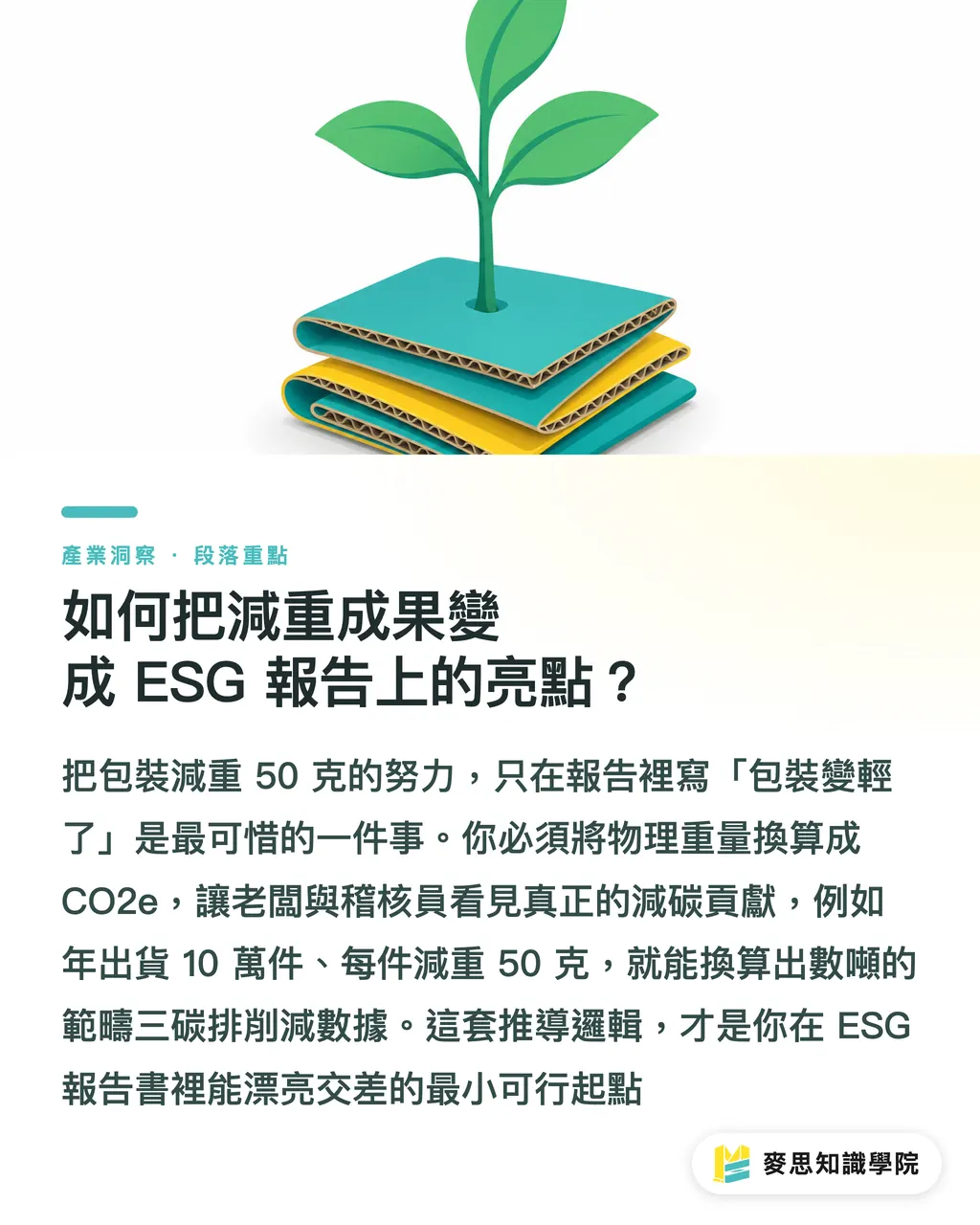
Many designers and procurement specialists go to great lengths to reduce packaging weight by 50 grams, only to write a single line in the final report: "The packaging has become lighter."
With ESG data disclosure requirements becoming increasingly stringent, this is a real missed opportunity
You must translate the physical weight reduced into a language that bosses and auditors understand: Greenhouse Gas Reduction Equivalent (CO2e)
Based on the public coefficients from the Product Carbon Footprint Information Network of Taiwan's Ministry of Environment, consuming one kilogram of corrugated boxes generates approximately 1 to 1.5 kilograms of carbon emissions (the exact coefficient depends on the declaration of different paper mills)
If your company ships 100,000 products a year and each package is successfully reduced by 50 grams,
this means you save the purchasing cost of 5 tons of paper, while also tangibly reducing several tons of Scope 3 carbon emissions
This derivation logic serves as your Minimum Viable Product (MVP) data inventory starting point to deliver an impressive annual ESG report
Key Takeaways
Do not cut down weight blindly based on gut feeling; please treat the ISTA Drop Test as your non-negotiable protective baseline
When reducing linerboard grammage, always pair it with flute profile optimization or a one-piece structure to compensate for compression resistance
Molded pulp is suitable for single-model blockbuster products, while corrugated die-cuts with interlocking tabs are a high-CP value choice for SMEs to test the waters
Multiply every gram of paper saved by the corresponding carbon footprint coefficient, and you get the most solid ESG carbon reduction performance
Further Thinking
For the printing manufacturing and design sectors, packaging lightweighting is a close-combat battle of precisely calculating material mechanics and carbon emission costs
When brands face severe regulatory pressure, manufacturers who are the first to propose a trinity solution of "weight reduction, protection guarantee, and easy auditing" will capture the discourse power in the supply chain
If you are a SaaS product developer, this is also a huge pain point gap: using systems to quickly simulate the effects of different paper grammages and structural folding methods on compressive strength, or even generating packaging carbon emission projection reports that comply with GRI standards, is definitely a software market with massive commercial monetization potential in the next two years
FAQ
- Does making packaging thinner always save money?
- Not necessarily. If you make it thinner without adjusting the internal structure, leading to higher damage rates during transit, the extra return logistics fees and product scrap costs will usually far exceed the price difference saved on paper
- Molded pulp tooling costs are very high; can small and medium enterprises still adopt it?
- If your print volume for a single SKU does not exceed 10,000 units, I generally do not recommend rushing into tooling. You can start by using corrugated board with die-cut patterns to design interlocking tabs and cushioning layers. This not only eliminates tooling fees but also offers much higher agility for sample modifications
- My client is asking for packaging carbon reduction data. Where can I find this information?
- You can start by looking up the generic carbon footprint coefficients for local corrugated paper and white paperboard on the Ministry of Environment's "Product Carbon Footprint Information Network." Once you calculate the total weight of the packaging material saved, simply multiply it by the coefficient to get a preliminary carbon reduction equivalent for your report
Related articles



The Print × AI weekly
The print and AI know-how designers, brands and enterprises can use before they commit — one email, every week
MINDS Free Tools
AI background removal, a LINE sticker maker, spine & imposition calculators — all free, right in your browser, no upload.
MINDS Group
Need actual printing or gifting services?
From premium printing to online ordering and festive gifts — the MINDS Group sister brands take it from here.