
Why You Can No Longer Slap '100% Eco-Friendly' on Packaging
Here is the bottom line: if your packaging copy uses words like 'eco-friendly,' 'sustainable,' or 'earth-friendly,' you must explain the exact claims, the conditions, and who certified them on the same panel or via a clear QR code. Otherwise, it is greenwashing
Over the past year or two, more and more clients have been asking how to write safe packaging copy. There is real regulatory pressure behind this. In 2023, the EU proposed the Green Claims Directive, requiring third-party verification before any environmental claim can appear on products in the EU market. Around the same time, the UK Competition and Markets Authority (CMA) updated its guidance on environmental claims, stating plainly that terms like 'carbon neutral' and 'climate friendly' are misleading without a sound methodology. While local enforcement in Taiwan has been less aggressive, export brands shipping to Europe and the UK are already receiving strict buyer compliance forms
This is not about whether the copy sounds catchy. It is about genuine legal risk
---
Layer 1: Verifiable Claims. Stick Only to What You Can Prove
When helping clients revise proofs, this is where most people trip up. It is not that brands set out to lie. They simply fall back on pretty adjectives instead of stating specific facts
A side-by-side comparison of vague claims and clear alternatives makes this obvious:
・'Made with eco-friendly materials' → Change to 'Paperboard contains over 80% FSC certified recycled fiber,' and print your FSC license number on the layout
・'Recyclable packaging' → Change to 'Outer paperboard is recyclable with paper waste. Dispose of inner PE film at designated plastic film drop-off points.' Separate each material instead of lumping them together
・'Low-carbon process' → If you hold an official carbon footprint label, print the badge along with the exact emissions value. If you do not have one, drop the claim entirely
・'100% sustainable' → Nobody can back this up across the entire lifecycle. Regulators will almost certainly challenge it. Remove it completely
The core rule is simple: only claim what you can prove. FSC, PEFC, Seedling compostable certifications, and official green design marks are tangible proof. They hold up on packaging. If you lack a formal certificate for a material, describe it plainly: 'This product uses recycled polyester fiber sourced from post-consumer PET bottles.' It is specific, traceable, and a hundred times safer than calling it 'eco material.'
---
How to Write User Instructions Consumers Actually Understand
Many brands print a laundry list of green claims on their boxes without telling consumers what to do with the packaging. That is layer two, and it is the step people skip most often
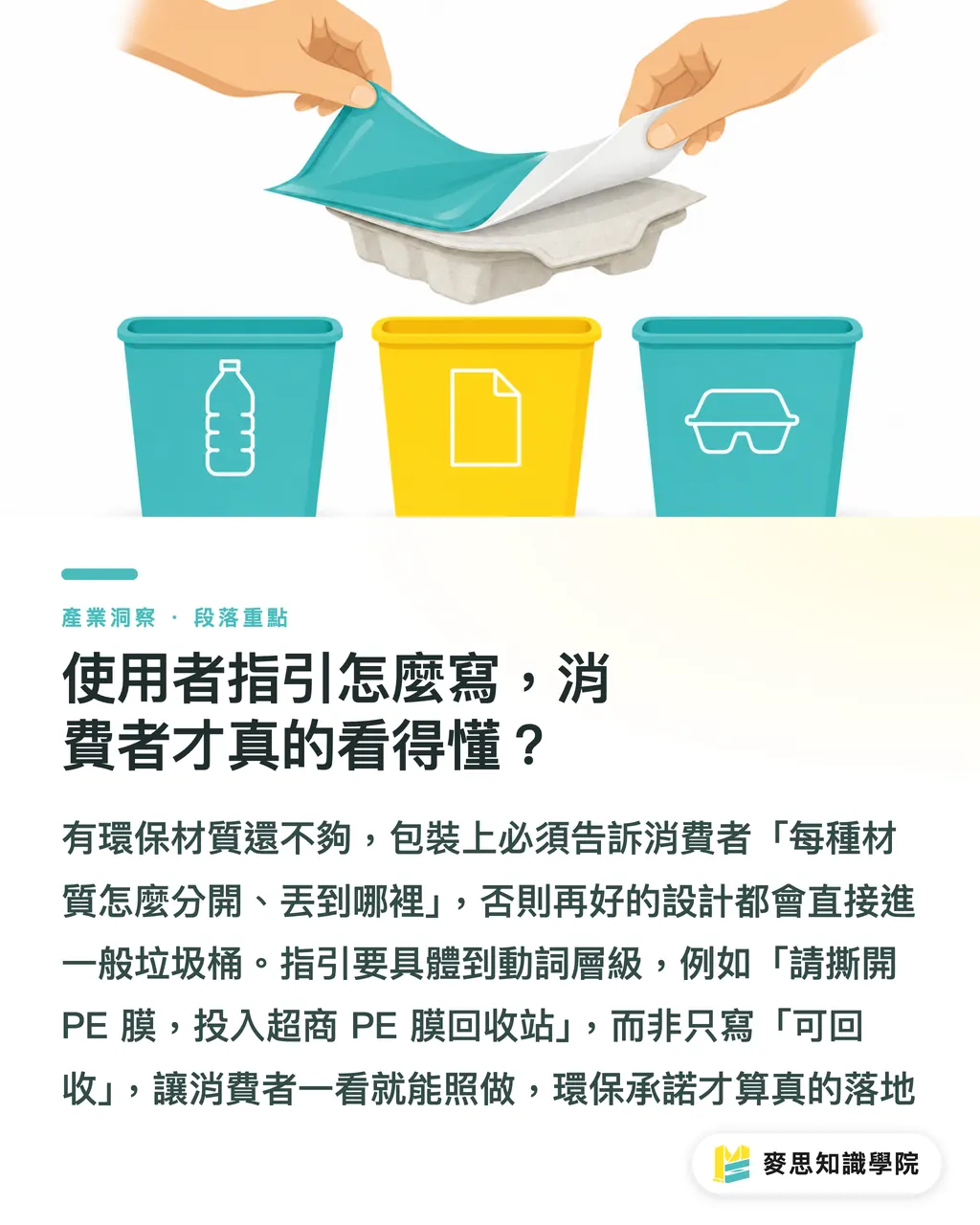
Take a real example. A food client created a gift box with an FSC paperboard outer box, a molded bagasse pulp tray, and a PE film divider. All three materials were labeled, but there were no sorting instructions. Consumers opened the box, found it too annoying to figure out, and tossed the whole thing into the trash. The packaging claimed to be recyclable, but the actual recycling rate was zero
Clear user instructions must do three things:
・Match each material to its disposal path: 'Outer box → Paper recycling, Inner tray → Paper or compost bin (check local guidelines), PE film → Plastic film drop-off point.' Give each material its own line
・State any disposal conditions: Some compostable certifications, such as the Seedling logo, require industrial composting facilities. They will not break down in a home compost bin. Spell this out clearly, or confused consumers will still see it as greenwashing
・Add a short URL or QR code: If you run out of layout space for full instructions, linking to a detailed web page via QR code works well. Just make sure the page is maintained and never returns a 404
Lead with action verbs: 'Peel off the PE film and place in...' is much clearer than 'PE film is recyclable,' and far less likely to be called out for exaggeration
---
What Layout Spaces Must Designers Reserve on the Packaging?
No matter how accurate your claims are, if the design does not leave room for them, they will get cut off or shrunk down until they are illegible. I have run into this issue multiple times during client proof reviews
Designers need to plan for three specific zones early on:
・Certification mark zone: Marks like FSC, carbon footprint, and green design badges have strict minimum size rules. FSC officially requires a minimum height of 10mm for the standard single-color mark. Shrinking it below this threshold can lead to audit failures and costly reprints. Lock in the specs for certification marks during the initial draft rather than squeezing them in wherever space is left
・Material and recycling instructions zone: This section takes more text than typical marketing copy. Use a clean 7-8pt font against a high-contrast background (white text on a dark background is often sharper for tiny print than dark text on white). Place it on an easily readable panel once folded, never hidden along a glue flap
・QR code clear zone: If you link to an external page for extra details, keep a quiet zone around the QR code of at least four modules wide. Keep adjacent graphics away so scanners pick it up reliably
When presenting proposals to brand clients, designers can turn these three zones into a layout checklist to get sign-off upfront, saving hours of revisions later
---
Striking the Right Brand Tone: Warm Without Exaggeration
The final layer is tone, which is also the hardest to quantify. Brands want to sound sincere without coming across as dry, but pushing too hard easily slips into greenwashing territory
My rule of thumb: keep emotional language in your calls to action, and keep factual language in your material descriptions. Do not mix the two
・Acceptable: 'Every choice matters. Thank you for taking thirty seconds to separate the box from the liner.' This is emotional and makes no unverified claims
・Unacceptable: 'This packaging makes the planet a better place.' This is a claim without specific supporting conditions, and regulators will flag it
A few words are especially risky in brand messaging because they sound like factual claims while being impossible to verify:
・'Green': Without certification, this word is too vague to defend
・'Sustainable': The same applies. You must specify which dimension of sustainability you mean and what standard you are measuring against
・'Non-toxic' or 'Harmless': Toxicity requires specific testing standards such as RoHS or food contact material regulations. Calling something non-toxic outright is irresponsible
If your materials or production processes lack full certification, the safest brand voice is honest transparency about where you stand and what you are working toward. Saying 'We have transitioned our packaging paperboard to 80% recycled fiber and are evaluating alternatives for the remaining materials' builds far more trust than claiming 'We are a sustainable brand,' and it stands up to scrutiny
At Mai Strategy Knowledge Academy, our standard during copy reviews is simple: for every environmental claim, ask 'What evidence backs this up?' If you cannot answer, take it off the layout and add it back once you have the proof
If your packaging design is headed to press, you can also reach out to the production team at MINDS to double-check certification mark specs and material labeling before proofing, avoiding costly plate revisions once the job is on press
Key Takeaways
・The only safe rule for eco-copy is to claim only what you can prove. Without certifications, avoid words like 'eco-friendly' or 'sustainable.'
・Certification marks like FSC, carbon footprint badges, and the Seedling logo have strict minimum size requirements. Lock in layout dimensions early rather than leaving them until the end
・User instructions must specify the exact disposal route for every material. A vague 'recyclable' label counts as greenwashing
・Keep emotional language in calls to action and factual statements in material breakdowns. Never blur the two
・The EU Green Claims Directive demands third-party verification before products hit store shelves. Export brands need to prepare documentation now
Looking Ahead
Looking upstream from the print production floor, the real answer is not just about writing safer copy. It is about getting materials and processes sorted first so your copy has solid ground to stand on. I have seen too many brands try to print green-looking packaging first and chase certifications later, only to find the materials fail the audit and the entire run must be reprinted. Getting the sequence backward is expensive
Designers can help by bringing a documentation checklist into the initial proposal. If a client wants to claim FSC, ask for the FSC certificate. If they want to mention carbon footprint, confirm that they hold an official carbon label from the ministry. Moving this step upstream is far easier than scrambling for documents after printing. The consulting team at Mai Strategy Knowledge Academy also helps clients set up this documentation process, so feel free to reach out if you need assistance
FAQ
- Does printing 'made with eco-friendly materials' on packaging count as greenwashing?
- In most cases, yes. 'Eco-friendly material' has no legal definition, making it impossible for regulators or consumers to verify. The safe approach is to name the material clearly, such as 'paperboard contains 80% FSC certified recycled fiber,' accompanied by the certification badge and license number
- Can I simply print 'recyclable' on the packaging?
- It is not recommended on its own. 'Recyclable' must clarify which material is recyclable, where to dispose of it, and whether any prep work is needed, like rinsing or peeling off labels. If packaging contains multiple materials, list the sorting route for each one separately
- What can we state on packaging if we do not hold any eco-certifications?
- You can describe what materials you use and where they come from. For instance: 'This box uses a non-woven bag made from recycled polyester fiber sourced from post-consumer PET bottles.' It is concrete, verifiable, and stands up without a formal badge. What you cannot do is use unverifiable claims like 'eco material' or 'better for the planet.'
- Does the FSC label have a minimum size limit?
- Yes. FSC official guidelines specify a minimum print height of 10mm for the standard single-color label. Shrinking it below this size can cause audit rejections and force costly reprints. Lock in the certification area during early layout planning to avoid re-plating once the job reaches the press
- Does the EU Green Claims Directive affect Taiwanese brands?
- Brands exporting to the EU are directly affected, as buyers will require third-party verification reports for any green claim in product packaging dossiers. While domestic regulations in Taiwan are not yet as strict, consumer expectations and retail procurement standards, like policies at major supermarket chains, are already heading in that direction
Related articles


The Print × AI weekly
The print and AI know-how designers, brands and enterprises can use before they commit — one email, every week
MINDS Free Tools
AI background removal, a LINE sticker maker, spine & imposition calculators — all free, right in your browser, no upload.
MINDS Group
Need actual printing or gifting services?
From premium printing to online ordering and festive gifts — the MINDS Group sister brands take it from here.