
Why You Can't Freely Write Things Like "Planet-Friendly" Anymore
Over the past year or two, I've clearly felt that more clients are bringing up environmental claims in meetings, but eight out of ten still can't tell whether the wording they wrote carries legal risk
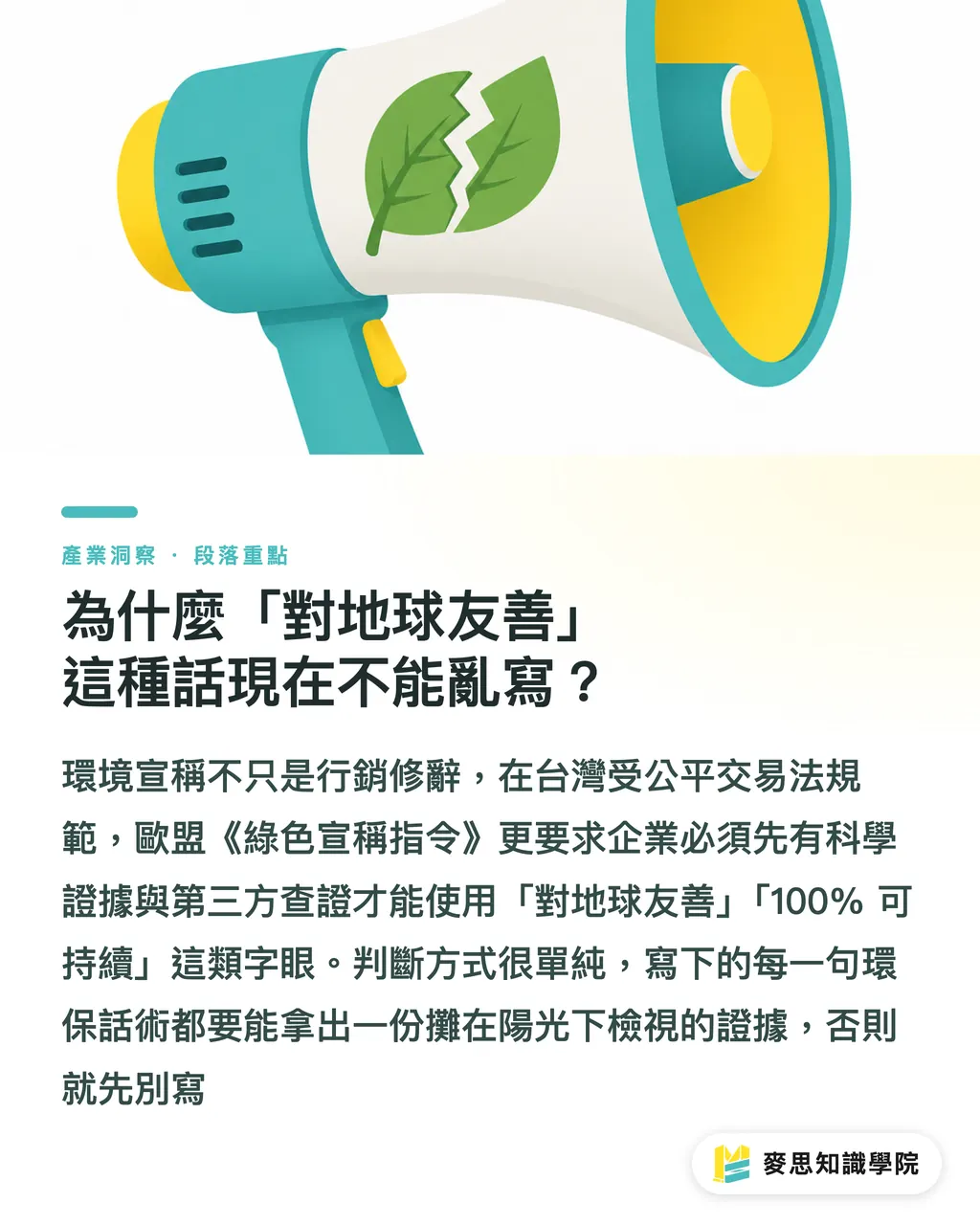
The most common misunderstanding is thinking environmental claims are just marketing language, and that sounding good is enough
They are not. In Taiwan, environmental claims fall under the Fair Trade Act. If a statement is false or misleading, regulators can impose penalties
The EU is even more explicit. The draft Green Claims Directive directly targets vague, unsupported wording like "planet-friendly," "eco-friendly," and "green," requiring companies to have scientific evidence and third-party verification before making those claims
That direction will spill over into supply chains. Taiwanese exporters will sooner or later be asked by clients to provide proof
A few phrases that may look harmless but are actually risky:
・"Planet-friendly" or "environmentally friendly": no defined scope, no proof. Classic vague claims
・"100% sustainable" or "fully eco-friendly": absolute wording that is almost impossible to prove. The more definitive it sounds, the easier it is to challenge
・"Non-toxic" or "zero carbon": unless you have complete data and certification, you are putting the burden of proof directly on yourself
The test is simple: for every positive environmental statement you write, can you produce evidence that can be laid out on the table?
If not, don't write it yet
Are There Compliant Alternatives to Greenwashing Language?
Yes. The core idea is simple: replace adjectives with facts that are quantifiable and verifiable
Greenwashing is often not about outright lying. It happens because the claim says more than the company can prove
Compliant wording means saying only the part you can prove, while making the scope clear
Here are a few direct comparisons. The left side is the risk. The right side is a safer rewrite:
・Change "eco-friendly packaging" to "this paper box uses FSC-certified paper": move from an abstract environmental label to a specific material and certification
・Change "recyclable" to "this box body is made of single-material PET and can enter general recycling streams": state which component, what material, and which recycling route
・Change "reduces carbon emissions" to "uses about 20% less paper than the previous packaging version": give the comparison baseline and the specific reduction
・Change "plastic-free" to "the inner tray has been changed to molded pulp, replacing the original plastic cushioning": describe the change you made instead of declaring an end state
There is one key design rule here: every environmental claim must identify its object and scope
Is the whole package environmentally better, or only the outer paper box? Does the plastic bag inside count?
I've seen too many cases where a brand used recycled paper for the outer box and printed "eco-friendly packaging" on the front, while the inside was full of blister packs and plastic film. Under the EU's new rules, that kind of overgeneralization is clear greenwashing
One more detail: avoid absolute wording
Words like "most eco-friendly," "100 percent," and "fully" have an extremely high burden of proof. The fewer you use, the better
Can You Use the FSC Label Just by Printing It?
No. This is one of the traps I see most often
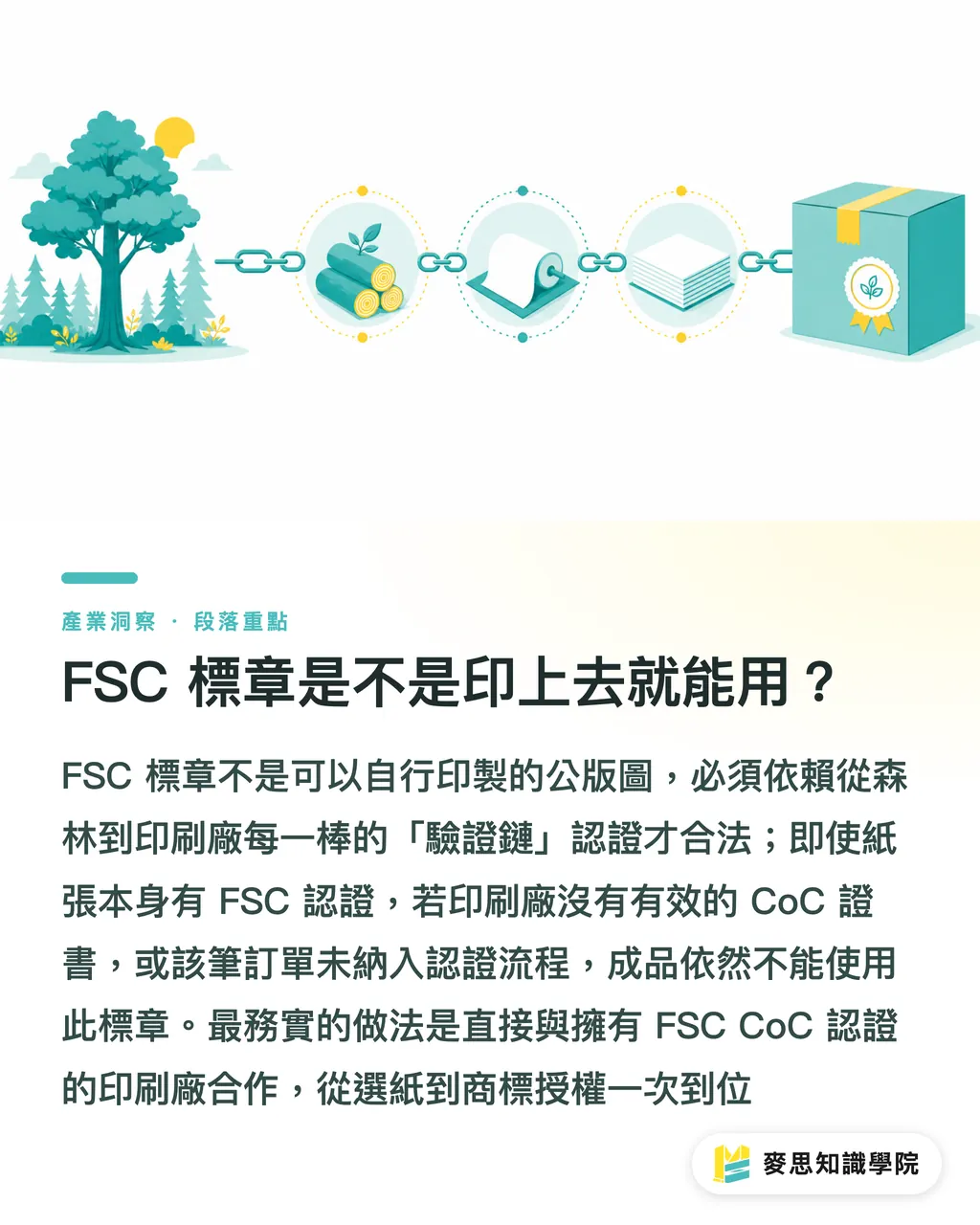
The FSC (Forest Stewardship Council) label is not public artwork. You cannot print it just because you want to
Its core mechanism is Chain of Custody, or CoC. From forest to paper mill to printer to your finished product, every link must hold a valid CoC certificate for the label to be lawful
A few practical points you must remember:
・Your printing company must hold a valid FSC CoC certificate, and this specific order must run through the certified process for the label to be valid
・The label must receive an authorization code through FSC's official trademark approval process. You cannot just grab an image file and place it on the artwork
・Certificates have scopes and expiry dates. Printing FSC on a product after expiry or outside the certified scope amounts to unauthorized trademark use
In other words, the FSC label proves that the source of the paper can be traced back to responsible forestry. It does not mean "this package is eco-friendly"
I often remind clients: buying FSC paper does not mean your printed piece can carry the FSC label. The key is whether the printer in the middle is certified and whether this order has entered the certified process
If you want to use the label but your printer does not have CoC, the most practical move is to work with a certified vendor. This is where integrated print services can help, aligning paper selection and certification from end to end so you do not have to figure out the label rules on your own
Where Do Recycling Symbols and Third-Party Verification Most Often Go Wrong?
Recycling symbols are another high-risk area, because they look too much like generic eco icons, so people use them casually
First, separate the two things that get mixed up most often:
・The Mobius loop, the three chasing arrows: originally used to indicate "recyclable" or "contains recycled content," but it does not have a mandatory legal definition by itself. Misusing it can easily become misleading
・Resin identification codes, the numbers 1 to 7 on plastic, also inside a triangle of arrows: these are material classification codes. They do not mean "recyclable." Many people wrongly assume that printing the number means the item can be recycled
The key rule: whether you can label something "recyclable" depends on whether the actual recycling system accepts it
A material may be technically recyclable, but if there is no local recycling route for it, labeling it that way is a problem
The direction of the EU's new rules is to crack down on labels that say something is technically recyclable while, in reality, it ends up being incinerated
Which claims require third-party verification? My rule of thumb is: the more it sounds like a promised result, the more evidence it needs
・Carbon-neutral, carbon footprint, net zero, and other carbon-related claims: these require inventory work and verification reports. You cannot declare them yourself
・"Biodegradable" and "compostable": these must meet specific standards and state the conditions, such as industrial composting or home composting, and how long it takes. Writing the claim without conditions is the riskiest version
・Recycled content percentages, such as "uses 30% recycled plastic": you need proof of material source, and the number must hold up
By contrast, credible third-party certifications such as FSC and carbon labels are relatively safer, because the verification responsibility sits with the certifying body
If you make the claim yourself, the burden of proof sits with you. That line has to be clear
Is There a Self-Check List Before Sending Artwork to Print?
Yes. This is the process I suggest every brand and designer run through. Spend ten minutes before launch and avoid the cost of taking products down and reprinting later
Treat it as part of prepress checking, alongside bleed, resolution, and CMYK:
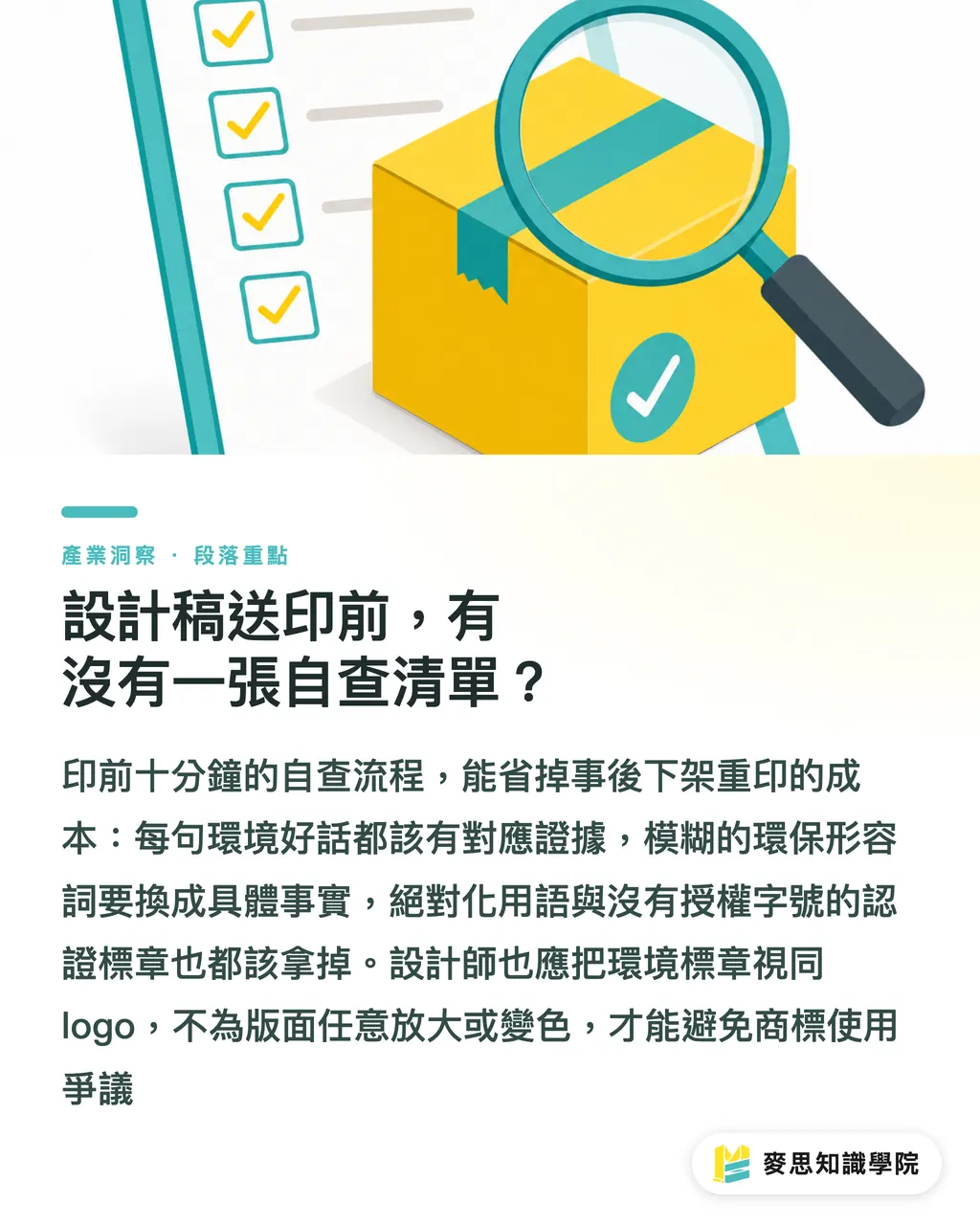
・Does every positive environmental statement have a matching evidence document? If you cannot produce one, delete the statement
・Are you using vague adjectives like "friendly," "eco-friendly," or "sustainable" without defining the scope? If yes, rewrite them as specific facts
・Are there absolute terms such as 100%, fully, or most? Remove them wherever possible
・For certification marks such as FSC and carbon labels, do you have a valid certificate, an authorization code, and is this order running through the certified process?
・Are the recycling symbols used correctly? Is it the Mobius loop or a material code? Does it refer to the whole package or a specific component?
・Do claims like "recyclable" or "degradable" state the conditions and the applicable recycling or composting system?
・Is the scope of the claim clear? Whole product or partial component? Any overgeneralization?
I add one more test for myself: imagine this copy is reported by a consumer or competitor. How would you explain it to the regulator?
If the explanation holds, it passes. If you need to talk in circles before it makes sense, that sentence has a problem
Designers also need to build the habit: environmental labels are not decorative elements. You cannot enlarge them or change their colors just to make the layout look better
Labels such as FSC all have usage rules. Changing the color, proportions, or clear space can violate trademark use conditions. Treat them like any other logo and follow the guidelines
Key Takeaways
・Environmental claims are not marketing flourishes. They are regulated statements under the Fair Trade Act. If you cannot provide proof, do not write them
・Compliance means replacing adjectives with quantifiable, verifiable facts, while clearly defining the object and scope
・The FSC label proves that the paper source is traceable. It does not prove the package is eco-friendly, and the printer must hold a valid CoC certificate
・The Mobius loop is not the same as a resin identification code. "Recyclable" depends on whether the actual recycling system accepts it
・Result-based claims such as carbon-neutral, degradable, and recycled-content percentages all require third-party verification before use
Further Thoughts
The next step for brands is specific: include environmental claims in the prepress SOP and check them on the same list as bleed and color management
Design teams can create a claim comparison sheet. Put the desired claim in the left column and the matching certificate or data link in the right column. If there is no right column, the copy cannot enter the artwork
Exporters need to start even earlier. Once the EU's new rules take effect, overseas clients will turn around and ask for supply chain evidence. Organizing FSC and carbon data documents now will be far calmer than scrambling at the last minute
When choosing a print partner, include "valid FSC CoC" and "ability to assist with label authorization" in the evaluation. Aligning paper selection, certification, and submission together is much easier than patching documents after the fact
FAQ
- Is it illegal to write "planet-friendly" on packaging?
- It carries risk. Vague environmental claims like this, with no defined scope or supporting proof, may be considered misleading under Taiwan's Fair Trade Act. The EU's draft Green Claims Directive also directly targets them. A safer approach is to rewrite the claim as a specific, verifiable fact
- If the paper I bought is FSC-certified, can my packaging print the FSC label?
- No. The FSC label requires your printer to hold a valid Chain of Custody certificate, the order to run through the certified process, and an official FSC trademark authorization code. Using FSC paper alone is not enough to place the label on the package
- Do the triangle numbers on plastic mean it is recyclable?
- No. Those are resin identification codes. They only classify the material. Whether you can label something "recyclable" depends on whether the local recycling system actually accepts it. Treating material codes as recycling symbols can be misleading
- Which sustainability claims require third-party verification?
- Carbon-related claims such as carbon-neutral, carbon footprint, and net zero, as well as result-based promises like "biodegradable," "compostable," and recycled-content percentages, all need to meet relevant standards and have verification reports. You cannot simply declare them yourself
- How can I quickly check artwork for greenwashing risk before print?
- Check every environmental claim line by line: whether evidence exists, whether vague adjectives or absolute wording are used, whether certification marks are valid and authorized, whether recycling symbols are correct, and whether the claim scope is clear. If you cannot produce evidence, delete the claim
Related articles



The Print × AI weekly
The print and AI know-how designers, brands and enterprises can use before they commit — one email, every week
MINDS Free Tools
AI background removal, a LINE sticker maker, spine & imposition calculators — all free, right in your browser, no upload.
MINDS Group
Need actual printing or gifting services?
From premium printing to online ordering and festive gifts — the MINDS Group sister brands take it from here.