

What Scopes Are Included in a Print Product's Carbon Footprint?
Visiting several OEM facilities and print shops lately, I noticed everyone is scrambling over carbon emission data requested by clients
Brands face strict ESG reporting disclosure rules, so the pressure naturally trickles down to the supply chain
Yet auditing a print product's carbon footprint isn't rocket science. Focus on three core areas: materials, operations, and transport, and you can produce data procurement teams trust
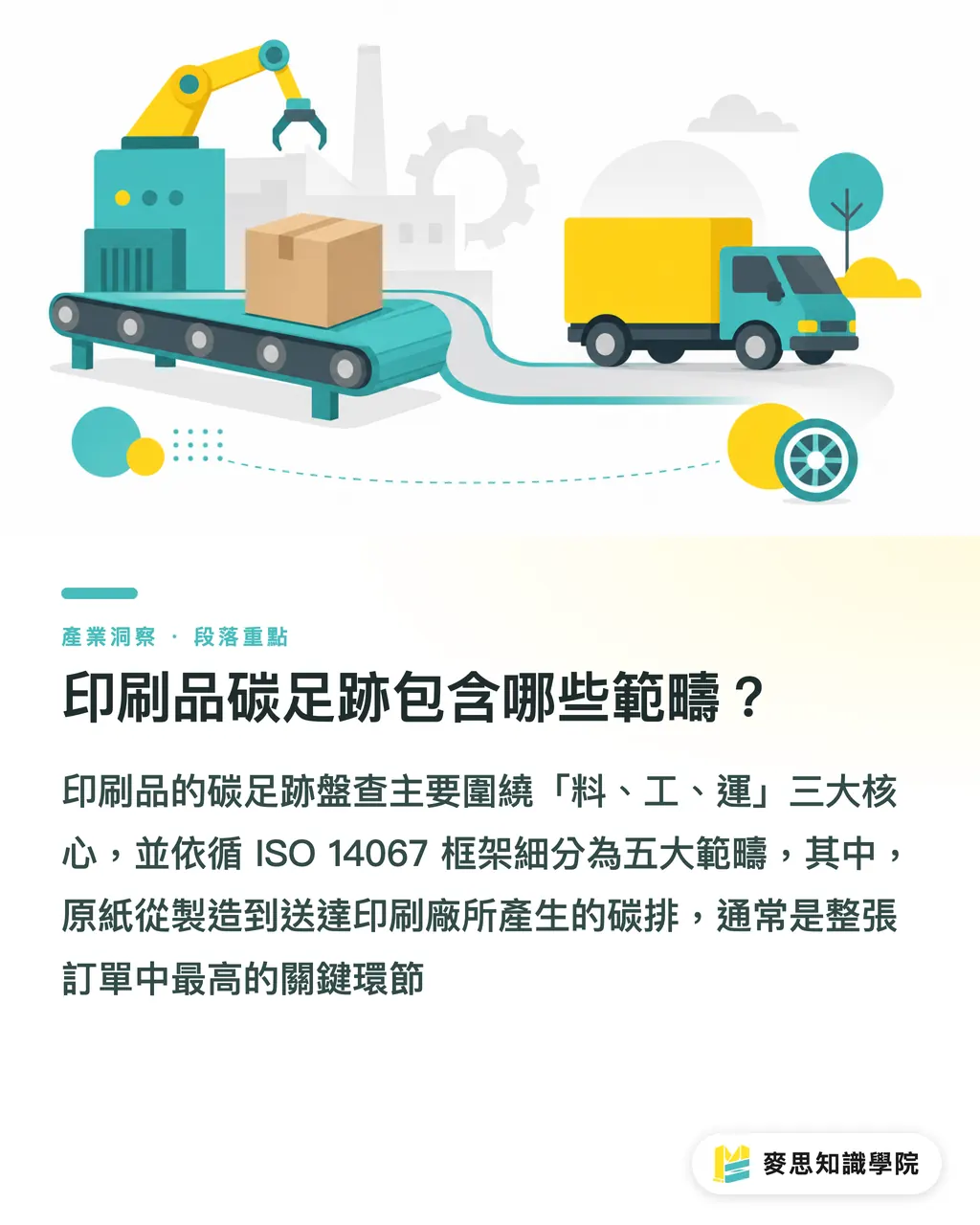
In practice, we usually align with the ISO 14067 product carbon footprint framework, breaking a print product's lifecycle into five main scopes
・Raw paper: Emissions from pulp manufacturing to delivery at the printing plant. This is usually the largest carbon contributor in the entire order
・Inks and consumables: Covers the production and use of soy inks, water-based printing pastes, or standard UV inks
・Printing energy consumption: Electricity used during press runs and facility operations, closely tied to sub-metering setups and equipment energy efficiency
・Post-press processing: Equipment energy consumption across post-press steps, including coating, die-cutting, foil stamping, and binding
・Logistics and transport: The final mile from the printing plant to the client's designated location. This is one of the most frequently overlooked pitfalls in calculations
Why Does Raw Paper Always Account for the Highest Share of Emissions?
Many designers think switching to soy ink will cut carbon dramatically, but paper is the real heavy emitter
Papermaking requires massive amounts of water and thermal energy. On top of that, if imported paper is selected, international sea and air freight emissions cannot be ignored
Taking typical commercial catalogs and folding cartons I have worked on as an example, raw paper often accounts for over 60% or even 70% of total emissions
That is why I often advise clients that if they want to cut emissions fast, the first step is reviewing paper specs and packaging structures
・Prioritize paper stock with FSC or PEFC forest certification to ensure legal, sustainable timber sourcing
・Evaluate switching to paper with a high recycled content, but mind its ink absorption and color behavior. This calls for practical experience in precise color management
・Re-examine packaging weight and paper basis weight. Reducing 350 gsm C1S paper to 300 gsm can often save significant carbon and procurement costs
Where Can You Find Carbon Emission Factor Data?
The hardest part of an audit is rarely the math; it is finding credible data
You multiply in-house activity data (how much material and power was used) by emission factors (carbon output per unit) to get the final numbers
Activity data comes from daily purchase orders, production reports, and utility bills. Emission factors, however, need solid grounding
・Request product-specific carbon footprint inventories or declaration documents directly from paper mills or ink suppliers first. This is the most accurate primary data
・If suppliers cannot provide them, fall back on default values from public databases such as the Ministry of Environment's Product Carbon Footprint Information Platform
・For electricity usage, you must use the latest grid emission factor published by the Energy Administration, Ministry of Economic Affairs (for example, the 2023 factor was 0.495 kg CO2e/kWh)
・A common calculation disaster is mixing electricity factors from different years or countries, which invalidates the entire audit report
How Should You Format Data for Brand Clients?
Once you calculate the totals, the key lies in how you present them to your client
Brand procurement teams do not want obscure astronomical numbers. They need concrete metrics that fit directly into the GRI framework for their ESG reports
That is why you must define a Functional Unit early in the audit
・For bulk orders of a single item, set the metric as carbon emissions per 1,000 or per 10,000 printed units
・For complex packaging boxes or multi-component items, I recommend converting to emissions per kilogram of printed product for easier calculations on the brand side
・The report must clearly state system boundaries, including final-mile logistics transport, to guarantee data integrity and avoid greenwashing
・For large listed corporate clients, I advise setting up a minimum viable data collection workflow for packaging materials, retaining original receipts, and coordinating with third parties such as SGS or BSI for verification when needed
Key Takeaways
・Print carbon auditing is not hard. Mastering the five core areas of raw paper, inks, energy use, post-press, and logistics lets you align smoothly with the ISO 14067 framework
・Paper is the biggest emission culprit. Reducing basis weight and switching to FSC-certified or recycled paper are the fastest solutions to cut carbon
・Always use the latest grid emission factors and reliable databases consistently. Mixing data across different years or countries is a common landmine
・Confirm with your client whether the functional unit is per 1,000 units or per kilogram before presenting data, so procurement can seamlessly plug it into their ESG reports
Further Considerations
For Taiwan's print OEMs and packaging plants, providing carbon audit data has shifted from a bonus feature to a mandatory requirement in procurement evaluations
Instead of manually digging through reports whenever clients chase you for data, take this opportunity to audit your plant's level of digitization. MINDS' one-stop integration services can also step in early during design and material selection to assist with evaluation
Standardize paper carbon emissions, certification histories, and production data. When you proactively deliver precise reports that meet ESG requirements, you solve a brand's biggest pain point. That is where the true value of modern print services lies
FAQ
- We are a small print shop. Do we really need to pay a third party to verify our carbon footprint?
- If you are simply responding to basic client requests, clear calculations following ISO 14067 logic will suffice. However, if your client is a strict multinational brand or a publicly listed company, they will usually require a third-party verification report to ensure data credibility
- Does using recycled paper really reduce a print product's carbon footprint?
- Usually, yes, because it eliminates energy-intensive logging and pulping stages. However, color management for recycled paper is trickier, so we recommend involving a print consultant during the design stage to evaluate ink performance and color rendering
- How can we calculate carbon emissions from logistics and transport more accurately?
- You need to know delivery vehicle payloads, fuel efficiency, and actual mileage driven. For outsourced logistics, request carbon footprint estimates per trip directly from the fleet, or use transport emission factors published by the Ministry of Transportation and Communications
Related articles




The Print × AI weekly
The print and AI know-how designers, brands and enterprises can use before they commit — one email, every week
MINDS Free Tools
AI background removal, a LINE sticker maker, spine & imposition calculators — all free, right in your browser, no upload.
MINDS Group
Need actual printing or gifting services?
From premium printing to online ordering and festive gifts — the MINDS Group sister brands take it from here.