
FSC vs. PEFC: What's the Real Difference in Forest Certification?
Sustainability in printing has gained significant traction in recent years, with FSC (Forest Stewardship Council) being the term clients bring up most often
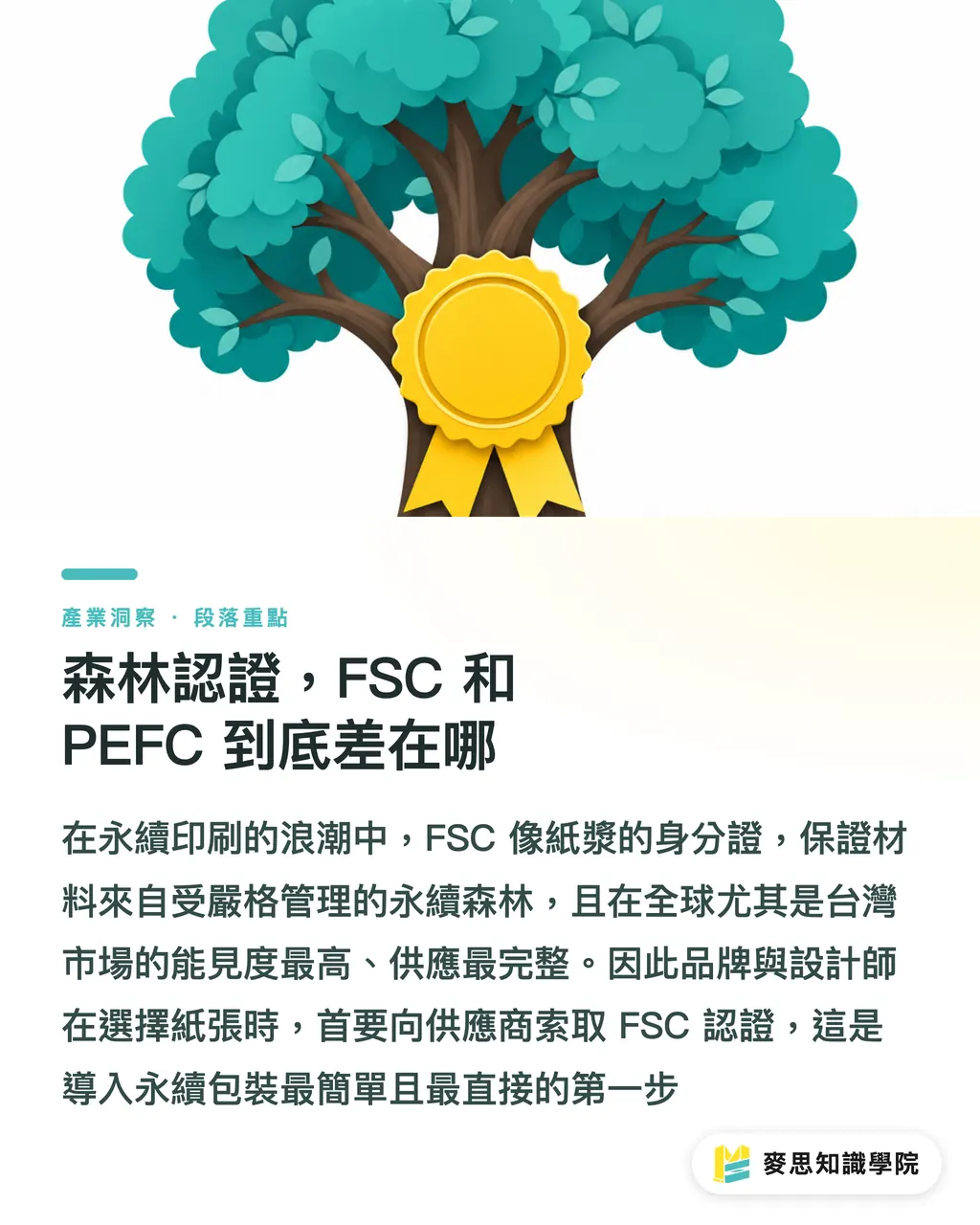
Think of it as an 'ID card' for your paper pulp, ensuring the wood used for your paper doesn't come from controversial, illegally logged areas, but from strictly managed, sustainable forests
FSC is currently the most widely accepted standard globally; from the West to Asia, it's what everyone looks for, and it boasts the most complete supply chain
PEFC (Programme for the Endorsement of Forest Certification) is another similar system, common in Europe. Both share the same goal: promoting sustainable forest management
However, for brands or designers in the Taiwan market, FSC should absolutely be your top priority
It has the highest visibility, the most direct communication with consumers, and printers have the most readily available inventory
Requiring suppliers to provide FSC-certified paper is the most fundamental and easiest first step for brands to adopt sustainable packaging
From Carbon Emissions to Recycling: Understanding Carbon Labels and Recycled Paper Marks
Beyond wood sources, another angle clients frequently ask about is the environmental impact across the 'product lifecycle', which involves two other major types of labels
・Carbon Footprint Labels / Carbon Neutral Marks: This isn't about the source, but rather calculating the greenhouse gases generated throughout the product's entire process, from raw materials, manufacturing, and transport to usage and disposal. It's like a 'carbon health check report'. Having a carbon label means honest disclosure, while 'carbon neutral' goes a step further by offsetting total emissions to zero through measures like carbon credits
・Recycled Paper Environmental Mark: This mark focuses on 'circular use,' indicating the percentage of recycled pulp used in the product. In Taiwan, environmental marks explicitly specify the mixing ratio for recycled pulp, making it a concrete way to practice circular economy
It's important to note that these certifications evaluate 'sustainability' from different dimensions, and none are inherently 'better' or 'worse' than the others
FSC paper might have a high carbon footprint due to long-distance transportation; 100% recycled paper might consume significant energy during the de-inking process
As a procurement professional or a brand, you need to think about what the core message of your ESG strategy is: supporting sustainable forestry, disclosing carbon responsibility, or promoting recycling
How Brands Can Use Certifications and Avoid Greenwashing
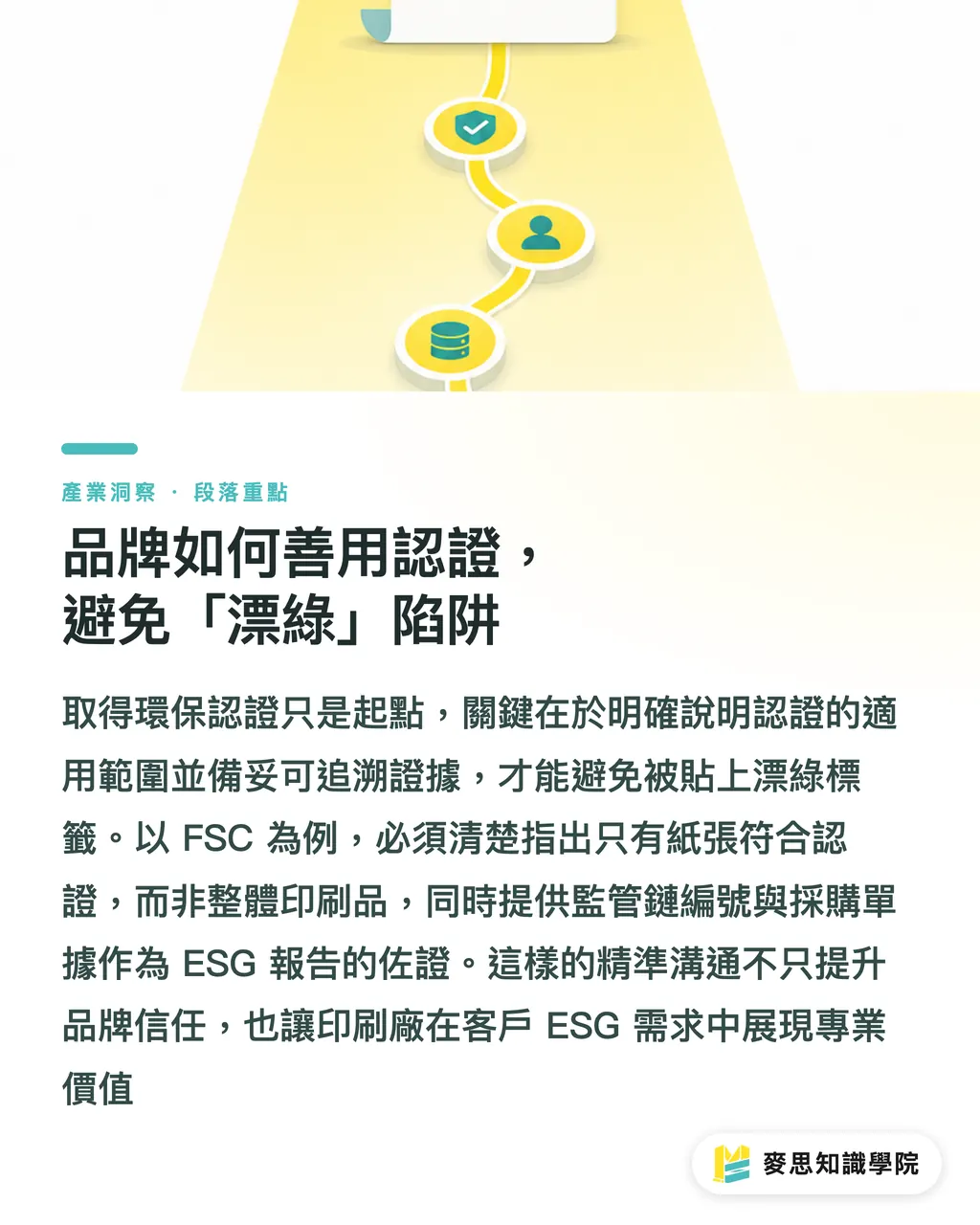
Obtaining a certification is just the first step. Communicating it correctly to avoid being labeled as 'greenwashing' is the real test
Based on my long-term observations on production lines and with clients, there are two most common risks
・Unclear scope and exaggerated claims: This is the biggest pitfall. Using FSC-certified paper does not mean your 'entire printed product' is an FSC-certified product, because the ink, glue, and the printing facility itself may not have passed the complete Chain of Custody (CoC) certification. When promoting, be precise: state that 'the paper used is FSC-certified,' rather than vaguely saying 'this product is FSC-certified'
・Lack of traceable evidence: When you claim to use eco-friendly materials, you must be able to provide proof. A printing house should be able to provide a complete FSC Chain of Custody number, paper procurement invoices, and so on. These are the most powerful supporting documents for your future ESG reports
For printers, this is also an opportunity for transformation and upgrading
When your clients are struggling with their ESG reports, you shouldn't just hand them a certificate. You should be able to clearly explain the scope and limitations of each certification, helping them make choices that best fit their brand strategy, that is where your professional value lies
Key Takeaways
・FSC is currently the most universal certification for paper sources; treat it as your brand's entry ticket to sustainable printing
・Carbon labels calculate the lifecycle carbon footprint, while recycled paper marks indicate the proportion of recycled pulp, they measure different dimensions
・The key to avoiding greenwashing is 'precise communication'; clearly state whether the certification applies to the paper, the ink, or the entire process
・Printers should have FSC Chain of Custody (CoC) documentation prepared for clients to use as evidence for their ESG reports at any time
・Choosing which certification to use depends on what sustainability focus your brand wants to communicate
Extended Reflections
For printers and designers, this wave of sustainability is not a pressure, but an opportunity
In the past, we competed on price and speed; in the future, we will compete on who can provide a more complete 'sustainable solution'
Rather than passively waiting for clients to ask, proactively understand the properties, costs, and certification processes of various eco-friendly materials, and build your own knowledge base
Just like Huhtamaki started with fiber lids and Sinclair with compostable labels, sustainability transformation doesn't have to be achieved all at once or through a full replacement
We can start with 'paper,' which is the easiest and most perceptible to clients, by helping them adopt FSC certification. This is the fastest, highest ROI entry point
When you can translate these complex certifications into a language clients understand and actionable plans, you are no longer just an executor, but a trusted consultant
FAQ
- What is the difference between FSC certification and recycled paper?
- FSC certification ensures the wood 'source' comes from well-managed forests, focusing on origin sustainability; recycled paper uses recovered waste paper, focusing on 'circular' usage. Both are sustainable practices, but from different angles
- Is a product printed on FSC-certified paper automatically an FSC product?
- Not necessarily. In addition to the paper, the printer itself must also pass FSC Chain of Custody (CoC) certification to ensure the entire process from raw material to finished product complies with regulations before the FSC logo can be displayed on the product
- Does a carbon footprint label mean a product is more eco-friendly?
- A carbon footprint label only indicates that the manufacturer has 'honestly disclosed' the carbon emissions of the product's lifecycle, it's a sign of transparency. It provides a basis for consumer comparison, but it doesn't directly mean the product's emissions are lower or more eco-friendly
- As a brand, what documents should I require from the printer to prove environmental claims?
- If it's FSC certified, you can ask the printer to present an invoice or shipping note with their FSC Chain of Custody (CoC) number, this is the most direct evidence. For other environmental labels, you can request copies of relevant certificates and numbers for your records
Related articles
The Print × AI weekly
The print and AI know-how designers, brands and enterprises can use before they commit — one email, every week
MINDS Free Tools
AI background removal, a LINE sticker maker, spine & imposition calculators — all free, right in your browser, no upload.
MINDS Group
Need actual printing or gifting services?
From premium printing to online ordering and festive gifts — the MINDS Group sister brands take it from here.