

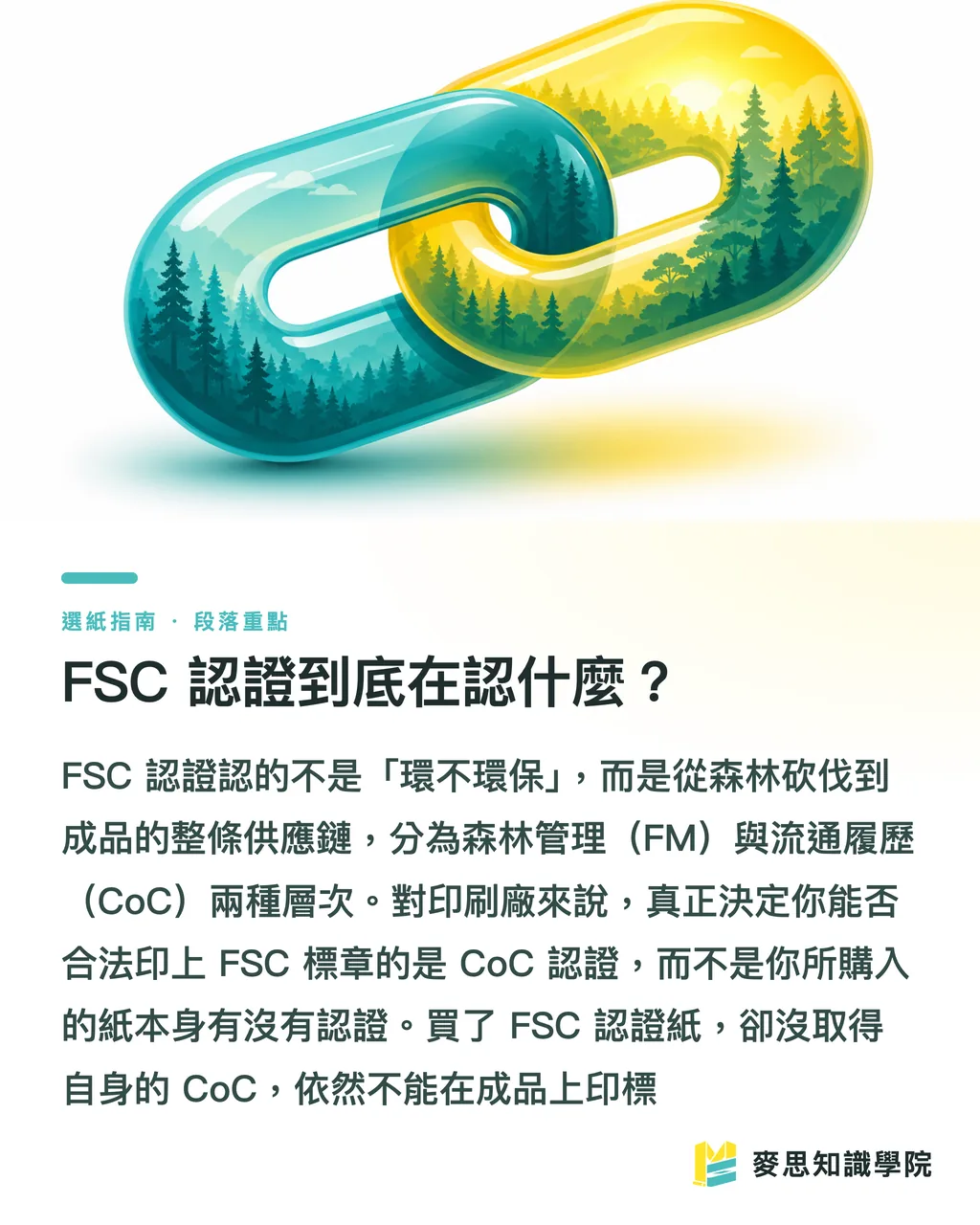
What Does FSC Certification Actually Certify?
FSC stands for Forest Stewardship Council, an independent international non-profit organization
What it certifies isn't something as vague as 'is this paper eco-friendly.' It covers an entire supply chain: from how forests are harvested and replanted, whether local ecosystems and workers' rights are protected, all the way through paper mills and traders to your print shop
There's one key distinction that trips a lot of people up
FSC certification comes in two levels:
・FM (Forest Management) — certifies the management practices of the forest itself
・CoC (Chain of Custody) — certifies the 'flow of custody,' ensuring that wood fiber from origin to finished product has not been mixed with materials of unknown or unverified origin
For print shops, the level that determines whether you can display the label is CoC
I've seen too many clients assume that 'if I buy FSC-certified paper, I can print the FSC logo on the finished product.' That's wrong
Paper being certified does not mean your shop is legally authorized to print the label
What's the Difference Between FSC 100%, Mix, and Recycled?
These three are what readers ask about most, and get wrong most often
Here's a one-sentence way to remember each:
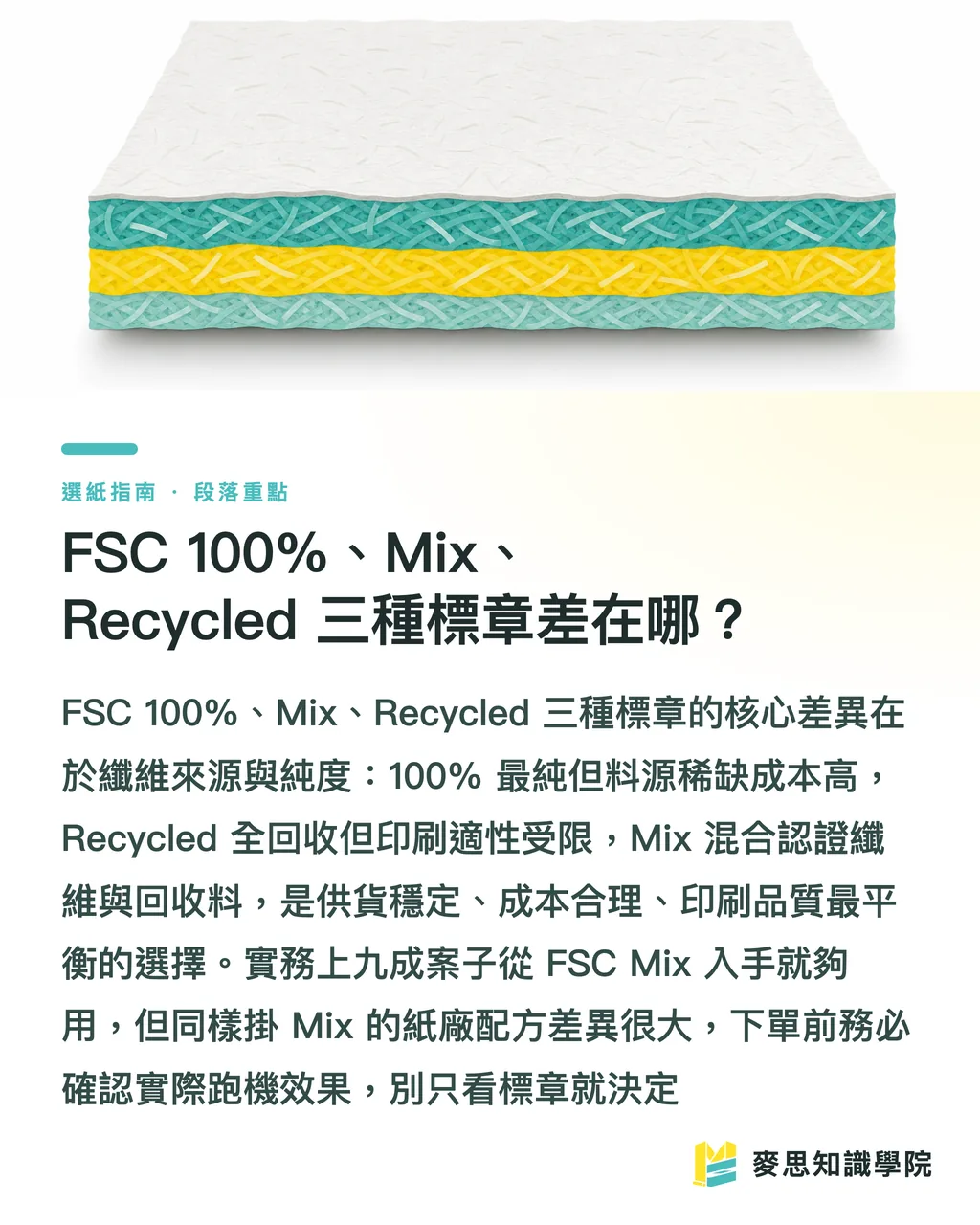
・FSC 100%: All fiber comes from FSC-certified forests. The 'purest' option, but sourcing is scarce and costs are highest, typically reserved for premium packaging with the most demanding sustainability claims
・FSC Mix: A blend of FSC-certified fiber, recycled material, and controlled wood. The most widely available and practical option on the market, for most brand printing, this is all you need
・FSC Recycled: Fiber is 100% post-consumer recycled material, with no newly harvested certified timber at all. The strongest environmental claim, but brightness and surface smoothness usually require a compromise
In practice, I recommend starting with FSC Mix for nine out of ten jobs
The reason is simple: 100% stock is frequently out of supply with unstable lead times, while Recycled can be unforgiving for fine halftone dots and solid flood coverage
Mix offers the best balance of cost, availability, and print quality
One detail to watch when selecting paper: even under the same FSC Mix label, recycled content ratios and fiber formulations vary significantly between mills. Always run press proofs on the actual stock, don't place an order based on the certification label alone
Recycled Paper, Eco-Friendly Paper, Soy Ink, Can You Trust These Terms?
These terms are badly overused. Let me break them down
'Recycled paper' has a relatively clear definition: made from recovered paper fibers. More rigorous suppliers will specify the PCW (Post-Consumer Waste) percentage
But 'eco-friendly paper' has no unified standard, anyone can say it
So when a client tells me 'I want eco-friendly paper,' my first question is always: do you mean FSC-certified? A specific recycled content percentage? Or chlorine-free bleaching? These are three completely different things
Ink needs the same breakdown
Soy ink's claim is that it replaces part of the petroleum-based solvent with soybean oil, resulting in lower VOC (volatile organic compound) emissions and easier paper de-inking
Water-based ink is mainly used in certain flexible packaging and corrugated box printing, the solvent is water, reducing VOC emissions
But let's be clear: soy ink does not mean zero pollution. Its environmental value lies in reducing dependence on petrochemicals and easing de-inking burden, not in being 'completely harmless.'
Overstating it as 'zero carbon' or 'non-toxic' is greenwashing and a genuine legal liability for the brand
My advice: only put ink-related eco claims on packaging when you have supplier spec sheets to back them up. If you can't, it's better to say nothing
Why EU Regulations Are Forcing You to Choose Sustainable Materials Earlier Than You Think
Over the past few years, the pressure I see from export clients being pushed by overseas brands to use sustainable materials has grown noticeably
The biggest driver is two EU regulatory frameworks:
・PPWR (Packaging and Packaging Waste Regulation): Sets mandatory thresholds for packaging recyclability and recycled content, with requirements tightening progressively
・EPR (Extended Producer Responsibility): Holds brands financially responsible for the end-of-life handling of their packaging, the less sustainable the packaging, the more they pay
The key with both isn't 'what the EU itself is doing' — it's the ripple effect
As long as your clients have goods entering the European market, these requirements cascade upstream through every layer of the supply chain, ultimately reaching the material choices at your print shop
What I've been feeling strongly over the past month or two is that this kind of requirement is no longer limited to large European and American brands
Major Southeast Asian conglomerates have also started switching all their packaging to FSC-certified stock. The procurement wind is shifting entirely
For Taiwanese SME clients, this means one thing: what today feels like 'FSC is a bonus' could easily become 'no FSC, no contract' as a baseline requirement within two years
Getting familiar early with FSC Mix sources, suppliers, and lead times is itself a competitive advantage when quoting for business
Should Brands Choose FSC? And How Do You Use the Label Compliantly?
First, let's talk about whether you should
My evaluation criteria are practical:
・Does your end client have ESG reporting pressure? Are they exporting to Europe? If yes, choose FSC
・Is your brand positioning centered on eco-friendliness, natural ingredients, or sustainability? Then your materials and labeling need to match your story, otherwise you're saying one thing and doing another
・Purely domestic sales, competing on low price and volume, clients who don't care at all? Then FSC is pure cost for you, don't force it
Once you've chosen FSC, how to display the label correctly is where it really matters
This is where most people trip up: to print the FSC label on a finished product, your print shop must hold a valid CoC certification, and the authorization code, trademark version, and usage must all comply with FSC's guidelines, you can't just grab the logo off the internet and paste it on
The practical process roughly goes like this:
・Confirm the paper stock itself is FSC-certified material, with corresponding sales documentation
・Confirm the print shop holds CoC certification and can carry forward the chain of custody for this batch of material
・The label version, authorization code, and claim type (100% / Mix / Recycled) must match the actual materials used
・Label use on finished products typically requires review, it's not something you can print at will
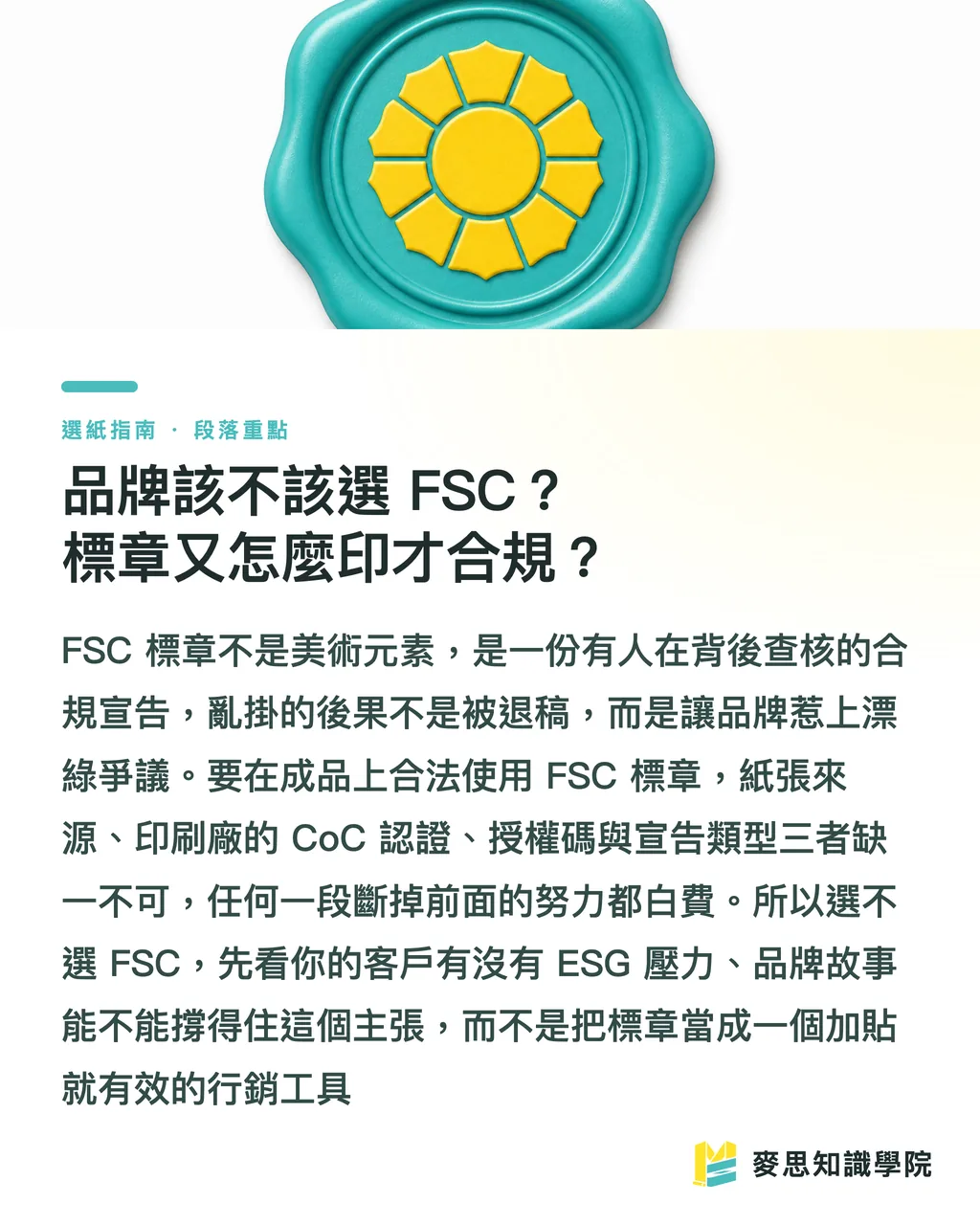
In other words, the FSC label isn't a design element, it's a compliance declaration with someone checking behind the scenes
The consequences of misusing it aren't just a rejected file, they're greenwashing disputes that can seriously damage a brand
This is why I've always told clients: paper selection, ink selection, and label compliance are three things best handled within one integrated workflow
Paper certification, shop CoC, label compliance, if any link in the chain breaks, all the work before it is wasted
That's exactly the value of integrating material sourcing, press proofing, and print production under one roof, not upselling you on services, but closing the compliance gaps before they become problems
Key Takeaways
・Having FSC-certified paper does not mean you can print the FSC label. Whether you can display the label depends on whether the print shop holds a valid CoC certification
・Among the three label types, FSC Mix offers the best balance of cost, availability, and print quality, start here for nine out of ten jobs
・'Eco-friendly paper' has no unified standard. Before placing an order, clarify whether you mean FSC-certified, a specific recycled content percentage, or chlorine-free bleaching
・The value of soy ink lies in reducing petrochemical dependence and easing de-inking burden, don't overstate it as zero pollution. That's a greenwashing legal risk
・Pressure from EU PPWR and EPR cascades upstream through supply chains. FSC is shifting from a bonus feature to a baseline requirement for winning export orders
Further Thinking
If you're on the brand or design side, the next step is concrete: audit your current projects to see if any involve European export or clients with ESG requirements. If so, start listing FSC Mix as the default now, and confirm that your print partner holds a valid CoC certification
For print manufacturers, the real opportunity is in making material chain-of-custody traceability a trackable, deliverable service, not just selling paper
Where AI and SaaS can help in this space is digitizing and auto-matching scattered documents, CoC transaction certificates, paper specifications, label authorization codes, to prevent human verification errors that lead to greenwashing disputes
Rather than waiting for clients to ask 'do you have eco certification,' build out the full sustainable supply chain in advance, so that from material selection to compliant labeling becomes a ready answer at the moment you're quoting for business
FAQ
- If I buy FSC-certified paper, can I print the FSC logo on the finished product?
- No. Having certified paper only means the material source qualifies. To print the FSC label on a finished product, the print shop must hold a valid CoC (Chain of Custody) certification and use the authorization code and trademark version in strict compliance with FSC guidelines
- How do I choose between FSC 100%, Mix, and Recycled?
- FSC Mix is the most practical choice for most brand printing, it blends certified fiber, recycled material, and controlled wood sources, offering stable supply with a strong balance of cost and print quality. Reserve 100% for premium applications with the most demanding eco claims; choose Recycled when environmental impact is the top priority and you can accept compromises in brightness and surface smoothness
- Is soy ink completely non-toxic and zero-pollution?
- No. Soy ink's value lies in replacing part of the petroleum-based solvent with soybean oil, reducing VOC emissions and de-inking burden, but it is not completely harmless. Marketing it as zero-carbon or non-toxic constitutes greenwashing and carries real legal risk for the brand
- Do SMEs doing purely domestic sales need to use FSC paper?
- If your clients have no ESG reporting pressure, no European export requirements, and compete purely on low price and volume, FSC is mainly a cost consideration and isn't necessary. But if there is any European export involvement or clients who care about sustainability, early adoption is recommended
- What do EU PPWR and EPR have to do with Taiwan's print shops?
- The connection is the ripple effect. As long as your clients have goods entering the European market, PPWR's recycled content and recyclability requirements, along with EPR's producer responsibility fees, cascade upstream through the supply chain, ultimately affecting the material sourcing conditions for Taiwan's print shops
Related articles



The Print × AI weekly
The print and AI know-how designers, brands and enterprises can use before they commit — one email, every week
MINDS Free Tools
AI background removal, a LINE sticker maker, spine & imposition calculators — all free, right in your browser, no upload.
MINDS Group
Need actual printing or gifting services?
From premium printing to online ordering and festive gifts — the MINDS Group sister brands take it from here.