
Why Does "I Want Eco-Friendly Materials" Leave Printers Unable to Quote?
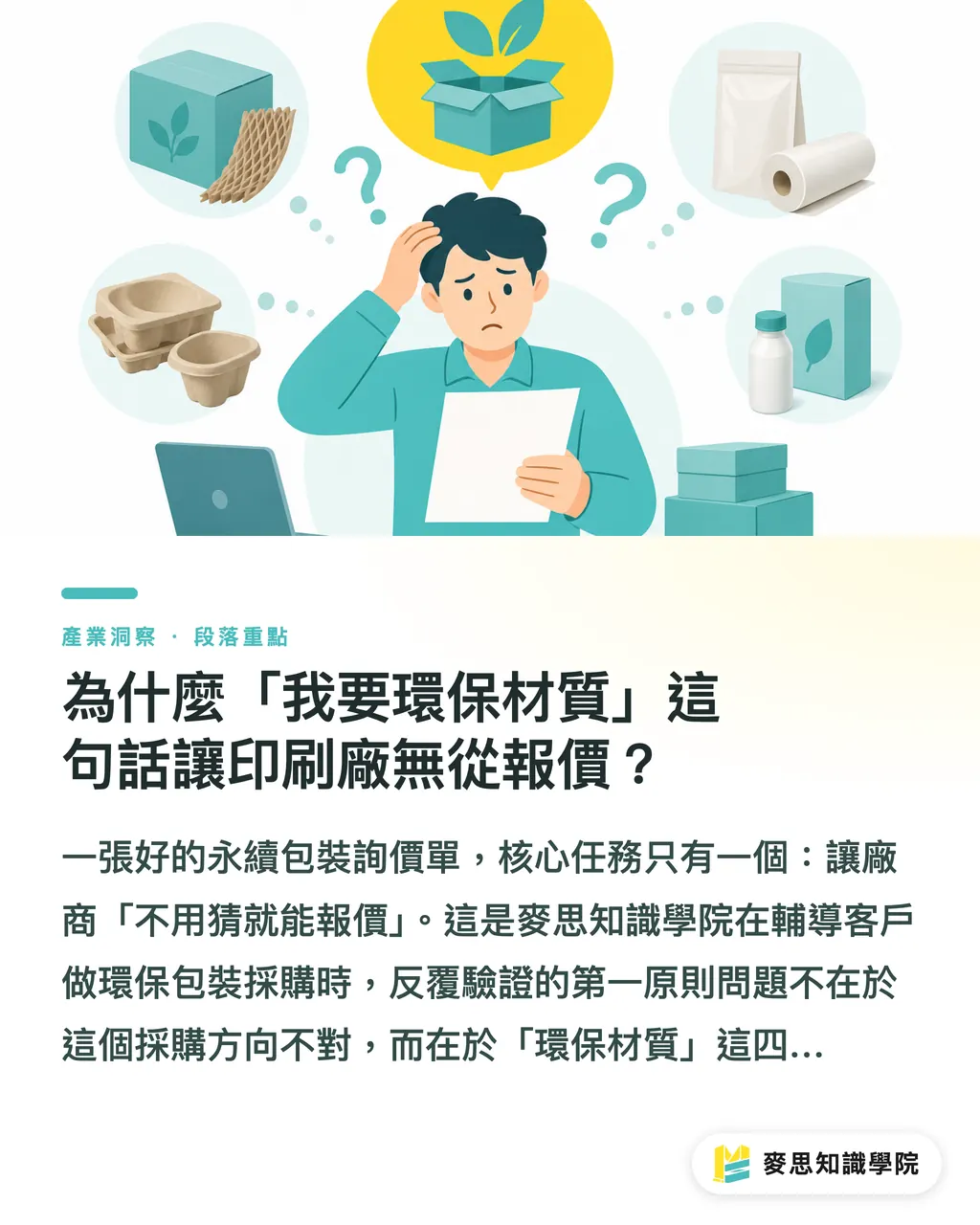
A good sustainable packaging RFQ has one core job: let the vendor quote without guessing. This is the first principle Max Knowledge Academy has verified again and again when advising clients on eco-friendly packaging procurement
The problem is not that the procurement direction is wrong. It is that the phrase "eco-friendly materials" gives a printer far too many undefined options: FSC-certified virgin pulp, PCW recycled paperboard, bagasse paper, kraft paper, recycled PP... Paperboard alone can include more than a dozen choices, each with different thickness ranges, cost structures, and compatible finishing processes
When vendors receive this kind of RFQ, they usually can only "guess at a middle-ground solution" and quote based on that. The quote you receive may be 30% off from the solution you ultimately need, two weeks away from the required timeline, and several rounds of design revisions removed from reality
The more specific the description, the more accurate the quote and the lower the communication cost later. The logic is straightforward, but in my estimate, fewer than 20% of RFQs actually achieve it
---
Four Things to Clarify Before Requesting a Quote
Whether or not the project involves sustainable packaging, these four dimensions are the foundation of any packaging RFQ. In sustainable projects, however, they are more easily left out because everyone focuses on whether the material is "green enough" and forgets to explain what the box needs to hold and what conditions it must withstand
・Product use and load-bearing needs: What will be inside the package, what is the net weight of each unit, and how many layers will be stacked? Recycled paperboard usually has one grade lower compression strength than virgin paperboard. If your product is heavy or requires high stacking strength, your material choices will be narrowed
・Moisture resistance and storage conditions: Will the product go through e-commerce logistics or retail display? Is the warehouse air-conditioned? Recycled paperboard is more sensitive to high-humidity environments. If this is not made clear, the vendor may recommend a solution that deforms easily under your storage conditions
・Display and unboxing requirements: Will consumers see the outside of the package? Do you need UV ink or foil stamping? Many sustainable packaging materials have surface treatment limits, and some eco-certified materials cannot be coated with varnish. This detail needs to be stated upfront
・Quantity milestones: What is the first-batch quantity, and will future orders be seasonal replenishments or stable long-term volume? Sustainable materials often have higher MOQs than conventional materials. The cost structure for small trial runs is completely different from mass production, so these should be written separately in the RFQ
---
How Should You Ask About Sustainable Materials?
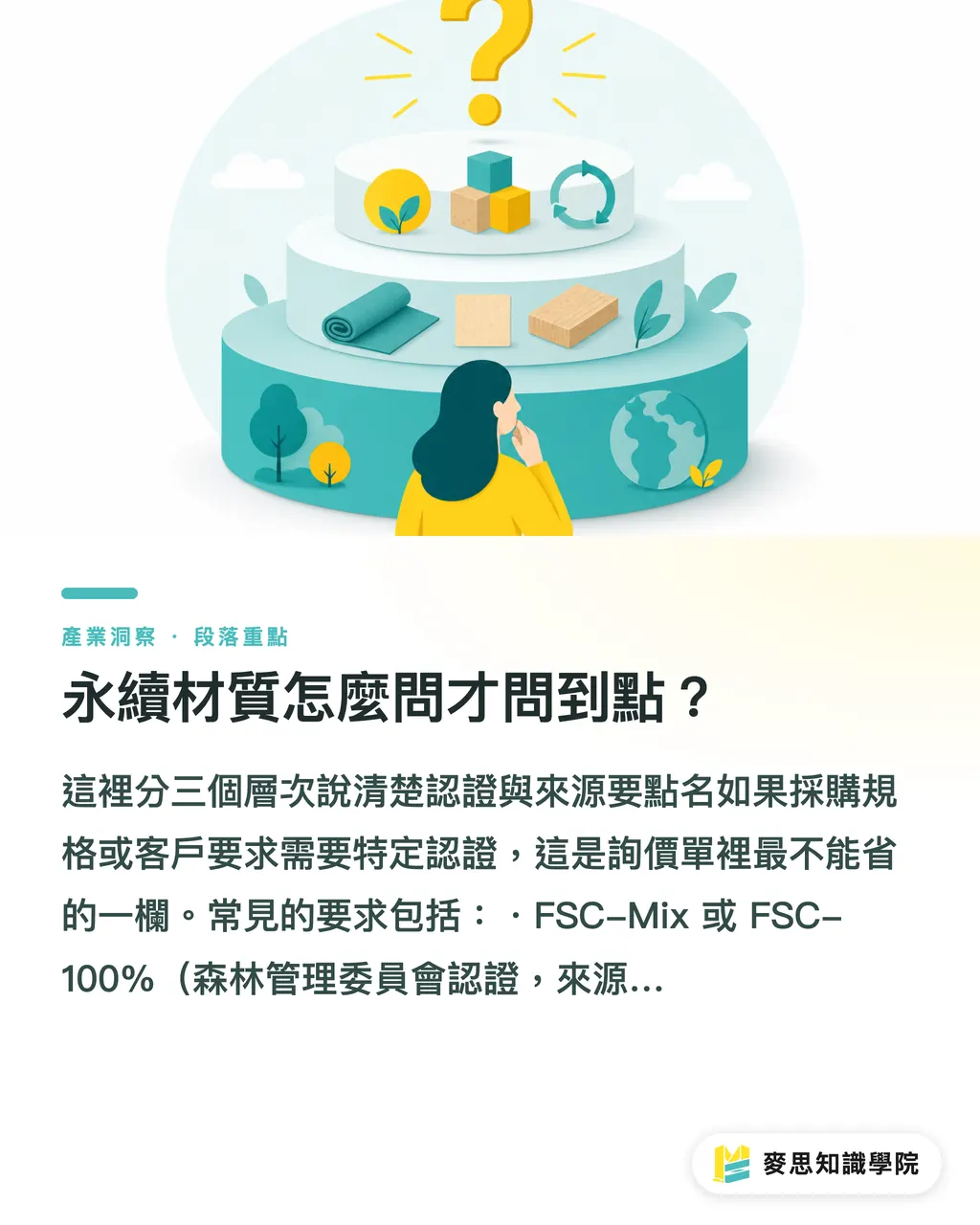
This can be clarified at three levels
Name the certifications and sources
If your procurement specifications or customer requirements call for a specific certification, this is the one field in the RFQ you cannot omit. Common requirements include:
・FSC-Mix or FSC-100% (Forest Stewardship Council certification, with traceable sourcing)
・PCW content percentage (Post-Consumer Waste recycled content; 30%, 50%, and 100% each have different costs)
・Whether the vendor must provide original certification documents, or raw material traceability data required for ESG reporting
Many small and medium-sized companies only write "eco-friendly materials" in their RFQs, but what the customer actually needs is FSC documentation for audit purposes. If you only discover after the printer quotes that they do not have the certification, you are essentially starting over
Give a number for recycled content
Beyond certification, clarify whether your recycled-content requirement is "nice to have" or has a minimum threshold. Some procurement specifications require paperboard PCW content of ≥ 30%, and that number directly affects the vendor's screening range
Give a direction for thickness as well. The same material comes in different grammages. Writing "E-flute recycled paperboard, around 400-450 g" is far more useful than "a thicker eco-friendly paperboard."
State green limits on finishing at the same time
This is the part most often omitted from RFQs, and also the part most likely to cause costs to surge later. If your solution has sustainability requirements, clarify these questions upfront:
・Whether lamination is acceptable (OPP, matte PE film): Some sustainable procurement specifications do not allow paper to be laminated with plastic film because the materials cannot be separated for recycling
・Whether UV gloss varnish or water-based varnish is acceptable: Water-based varnish is more recyclable, but the effect is different, so the vendor needs to confirm whether you can accept it
・Ink requirements: Soy-based ink or plant-based ink are common eco-friendly options, but some spot colors still require confirmation on whether alternatives are available
・Foil stamping or silver stamping: Metallized transfer foil can become a contaminant during recycling. If your certification requires the package to be fully paper-recyclable, this finishing process must either be abandoned or replaced with eco-friendly foil
If these issues are not made clear in the RFQ, the version quoted by the vendor may not align with your sustainability goals at all. Finding out after final artwork is complete that changes are required is when the cost becomes truly high
---
Quantity, Budget, and Lead Time: Get These Three Fields Wrong and the Quote Will Be Off
The cost structure of sustainable packaging is very different from conventional packaging. Recycled paperboard, FSC-certified materials, and water-based inks already cost slightly more; add a small trial run, and the unit cost may be two to three times that of mass production
The RFQ should list three separate stages:
・Sample or pilot-run quantity (usually 50-200 sets)
・First mass-production quantity
・Estimated annual total usage or replenishment frequency
These three numbers affect the vendor's material preparation cost and scheduling flexibility in different ways. If you only write "samples needed, additional orders later," the vendor cannot assess whether it is worth opening a dedicated mold for you or reserving long-term material supply
It is also advisable to include a budget range. Many buyers do not want to disclose budget upfront because they worry vendors will price upward. But for sustainable packaging, the budget range determines which material grade is viable. FSC-100% and FSC-Mix sit in different price bands. Stating this clearly lets the vendor jump directly to the right solution instead of giving you a quote that obviously exceeds your budget
For lead time, specify the deadline milestone rather than saying "needed sometime around a certain month." Sustainable materials sometimes take longer to prepare than standard materials. If you have a hard deadline, such as a trade show or seasonal launch, state it directly in the RFQ so the vendor can judge whether they can take the job
The Max Printing advisory team recommends dividing the RFQ into two parts: "fixed basic information" (product size, use, quantity) and "discussable sustainability conditions" (certification level, recycled-content ratio, finishing limits). This way, even if you have not finalized every sustainability detail, the vendor can still give you a cost range based on the basic structure, giving both sides a starting point for discussion
---
How Much Time Can a Good RFQ Actually Save?
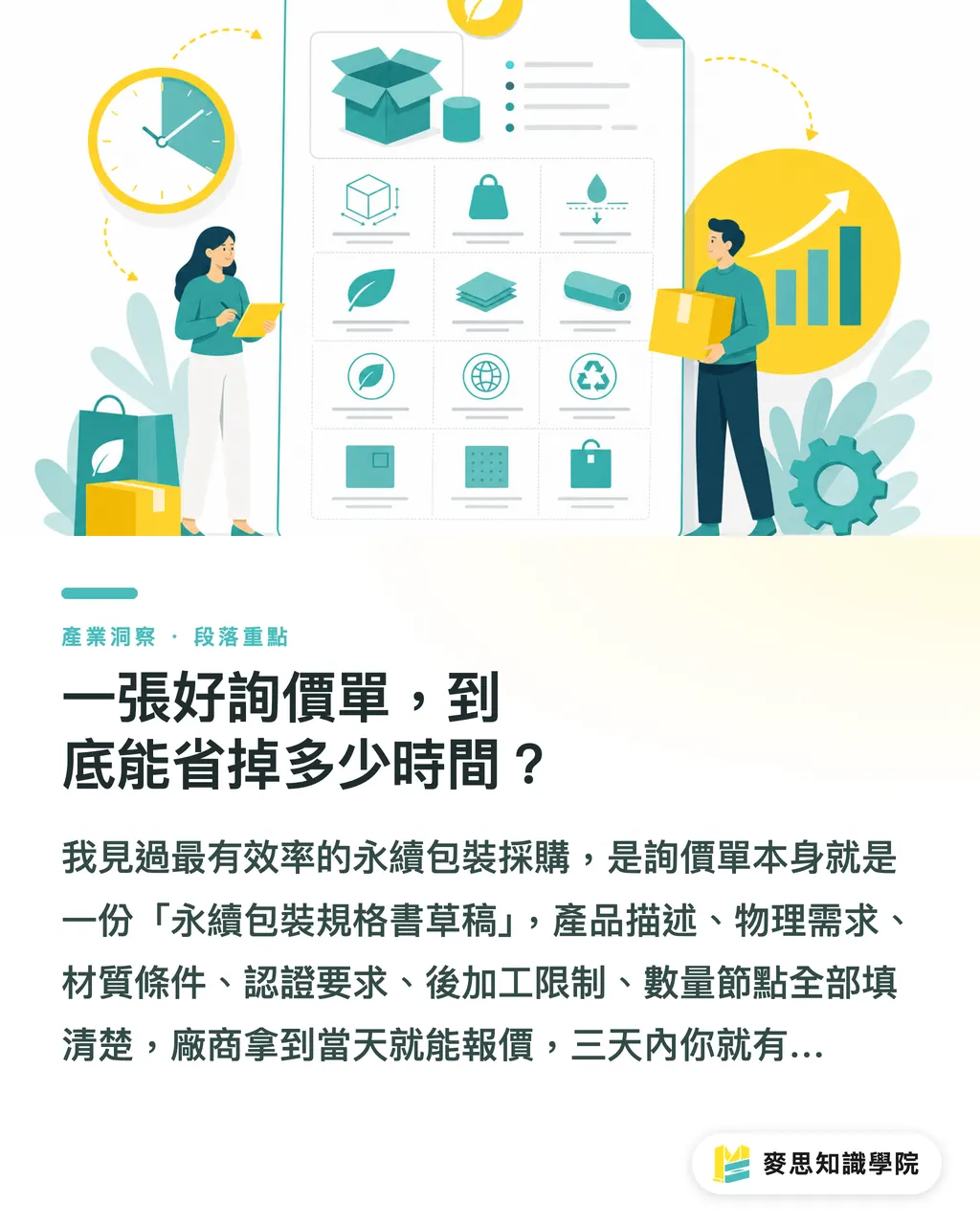
The most efficient sustainable packaging procurement cases I have seen used the RFQ itself as a draft sustainable packaging specification sheet. Product description, physical requirements, material conditions, certification requirements, finishing limits, and quantity milestones were all clearly filled in. The vendor could quote on the same day and provide a decision-ready quotation within three days
The most time-consuming cases go the other way: "I want an eco-friendly packaging box, about 100 pieces, please quote." This kind of inquiry usually needs seven or eight rounds of confirmation before it can even enter a real quotation stage, and a single conflicting condition along the way can easily force the entire previous discussion to restart
An RFQ is not just about asking for information. At its core, it confirms how clearly you have thought through the solution yourself. The process of writing it clearly is often more valuable than receiving the quote. That is something I have observed from both the production-line side and the client side
Key Takeaways
・"I want eco-friendly materials" is basically a blank RFQ to a printer. There are too many material options, and without enough conditions, the vendor can only guess, so the quote will inevitably be distorted
・Sustainable packaging RFQs must state load-bearing, moisture-resistance, and display requirements because the physical limits of materials are especially sensitive to these conditions
・Certification level (FSC-100% vs FSC-Mix) and PCW recycled-content ratio must be written clearly. This number determines the vendor's screening range
・Sustainability limits on finishing processes such as lamination, foil stamping, and UV ink should be confirmed at the RFQ stage. Discovering conflicts after final artwork is completed is costly
・Quantities should be divided into three stages: pilot run, first batch, and annual estimate. These three numbers affect material preparation costs and the vendor's willingness to schedule the job
Further Thoughts
For designers, the lesson is fairly direct: design decisions for sustainable packaging become constrained by material conditions earlier than they do in conventional packaging. Whether lamination is possible, whether foil stamping can be done, and whether large areas of dark color can be printed on the surface are things that might be decided after design in ordinary packaging. In a sustainable solution, it is better to reach preliminary agreement before the RFQ; otherwise, once the design is finished and only then discussed with the printer, revisions are very likely
For procurement and brand teams, it is worth building an internal "sustainable packaging procurement specification sheet." Clearly list the minimum certification level, unacceptable finishing methods, and document formats required for ESG reporting, then attach it to every RFQ. Vendors will not need to ask the same questions every time, and the efficiency difference is substantial
A more advanced approach is to conduct an "annual sustainable material review" with key suppliers: understand what certified materials they currently stock, what inventory availability looks like, and where there is flexibility in MOQs. Having this information in advance prevents urgent projects from getting stuck on material lead times
FAQ
- Does every sustainable packaging RFQ need to specify FSC certification?
- Not every project needs FSC certification, but the RFQ should clearly state whether you need certification documents to support ESG reporting or customer audits. If you only want to use recycled paperboard and do not need formal certification, simply state the required recycled-content ratio. The vendor can then give you options based on that without being tied to a certification level
- Should I tell the vendor my budget before asking for a sustainable packaging quote?
- It is best to provide a range instead of making the vendor guess. Sustainable material costs vary widely, and FSC-100% and FSC-Mix sit in different price bands. Clarifying the budget lets the vendor directly recommend a solution at the right grade and saves a round of requoting
- If I am not sure whether to use lamination yet, how should I write the RFQ?
- Write "surface treatment to be confirmed; please quote the price difference between options with and without lamination" in the RFQ, and explain your recycling goal, such as wanting the entire package to enter paper recycling together. This lets the vendor recommend the most suitable treatment based on your sustainability target
- If the pilot-run quantity is very small, will printers still make sustainable material samples?
- Yes, but the cost structure is different. Many sustainable materials have higher MOQs than standard materials, and the unit cost during sampling may be two to three times that of mass production. Write the "pilot-run quantity" and "estimated mass-production quantity" separately in the RFQ so the vendor can assess whether to prepare special materials or use in-stock materials with similar specifications for sampling first
- If I am not sure about the quantity yet, can I first ask for a cost range for sustainable materials?
- Yes, but you should provide a quantity range, such as "first batch of 500-1000 sets, with quarterly replenishment in the future." If you only write "quantity to be decided later," the vendor cannot estimate material preparation costs, and the price they provide will only be a rough estimate. The error may exceed 20%, making it of limited value for budget planning
Related articles
The Print × AI weekly
The print and AI know-how designers, brands and enterprises can use before they commit — one email, every week
MINDS Free Tools
AI background removal, a LINE sticker maker, spine & imposition calculators — all free, right in your browser, no upload.
MINDS Group
Need actual printing or gifting services?
From premium printing to online ordering and festive gifts — the MINDS Group sister brands take it from here.