
Overview
A low-carbon packaging brief should start with the use case, then define limits around materials and production. The three checkpoints often used by MINDS (MS, high-end fully custom commercial printing) can turn "we want eco-friendly materials" into specification language a printer can quote, proof, and deliver
Why Is "Eco-Friendly Materials" Not Enough?
A low-carbon packaging brief is a procurement document that turns carbon-reduction goals into something that can be priced, proofed, and delivered. At minimum, it needs to answer 7 types of conditions
The most common sticking point I have seen between procurement teams and printers is this: the brand writes "we hope to use eco-friendly materials," and the printer can only respond with a long list of questions. The sentence is not wrong, but it is nowhere near enough for quoting
When a printer sees "eco-friendly materials," at least 3 judgments are still missing
・How much load-bearing, cushioning, and friction protection the product itself needs
・Whether the packaging will go through home delivery, pallets, cold chain, or retail shelf placement
・What visual adjustments the brand can accept, such as removing one coating layer, switching to water-based ink, or dropping large-area foil stamping
For example, a 300 g skincare carton and a 3 kg outer box for electronic components can both aim for low carbon, but their compression strength, transport risks, and surface protection needs are completely different. If the brief is reduced to one adjective, each supplier can only make its own guess, and the quotes will not be comparable
What Usage Conditions Should a Low-Carbon Packaging Brief Include First?
The first page of a low-carbon packaging RFQ should describe the product and its use scenario. Materials matter, but materials should serve the product, not force the product to work around them
Procurement teams should first fill in 7 fields. In mid-to-high-end fully custom carton projects, MINDS also reviews this information before discussing paper substitutions
・Product weight and dimensions: list the net weight per item, packed weight, and length, width, and height. Lightweight and heavy products call for different paperboard strategies
・Shipping method: list home delivery, convenience-store pickup, pallet shipping, or cold chain. The logistics path affects compression strength, moisture resistance, and outer carton design
・Shelf or storage environment: list retail display, warehouse stacking, e-commerce shipping, or event giveaways. The same carton faces different requirements in a humid warehouse and a short-term display
・Food contact: if the package directly or indirectly contacts food, clarify the packaging layers first, so ink, liners, or barrier materials do not have to be changed later
・Estimated print quantity: list the first-run quantity and annual estimate. A 500-piece trial run and a 50,000-piece production run differ in plate setup, die-cutting mold decisions, and material preparation
・Budget band: list the target unit price or total budget range, so low-carbon options can be compared within a purchasable range
・Brand visual limits: list colors, logo size, spot colors, foil stamping, or matte lamination requirements that cannot change, so the team does not discover after proofing that the brand side cannot accept the result
Changing materials first and filling in context later is the easiest way to create disputes over weak compression strength or color deviation. Once these 7 fields are clear, the printer can confidently suggest alternative paper stocks and structural options
How Should Paper Stock, Ink, and Finishing Limits Be Written?
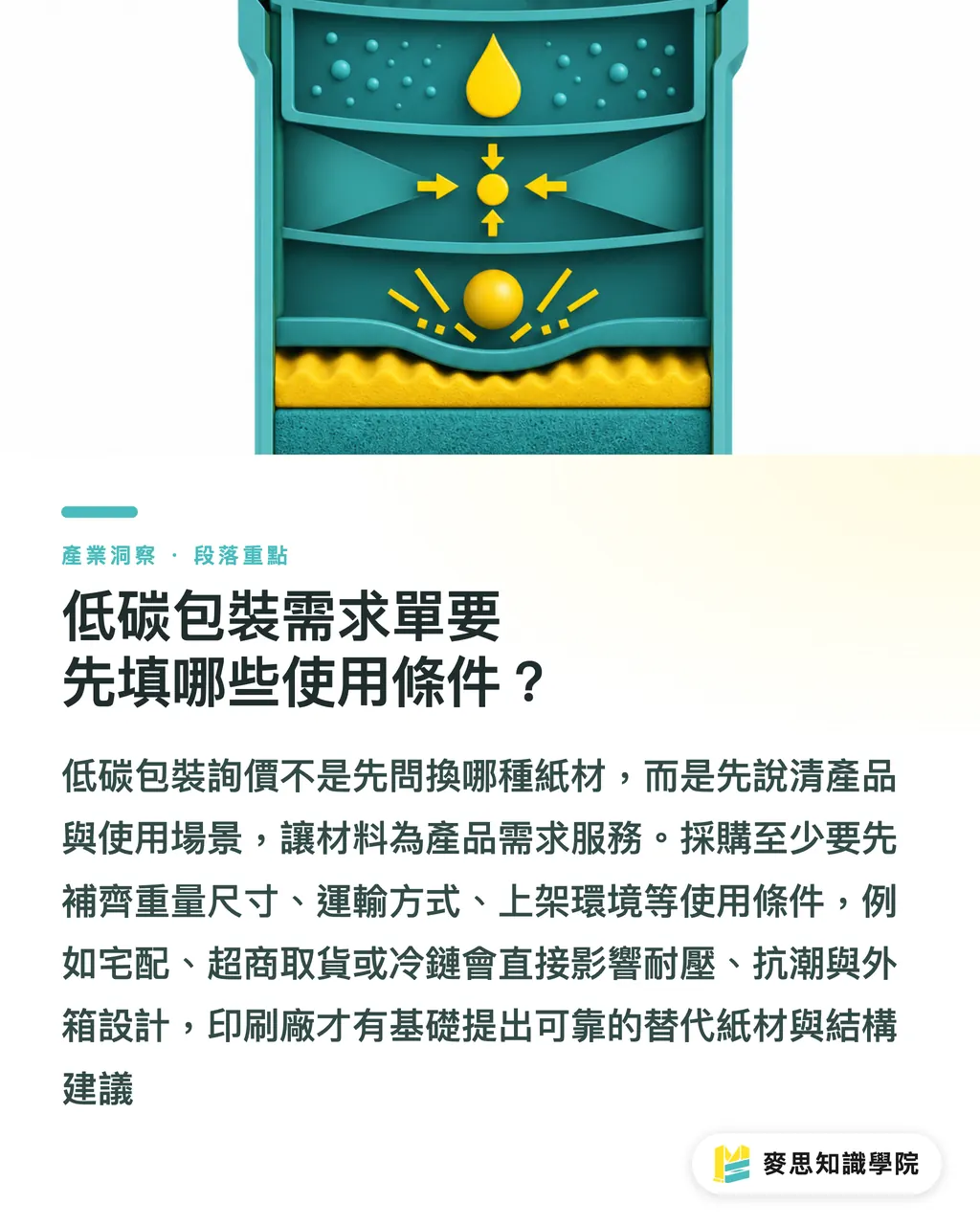
I usually break low-carbon packaging requirements into the five-part map used by MINDS. These 5 fields are easy for procurement, design, and printing teams to discuss
・Materials: state the paper source clearly, such as FSC certification, recycled paper ratio, virgin paper, or alternatives to grayback duplex board. If no certification is required, write "priority for suppliers that can provide traceable sources."
・Process: for ink, state preferences such as water-based, soy-based, or low-VOC, but ask suppliers to reply with feasibility, lead time, and color risks
・Logistics: size and carton quantity affect shipping volume. The brief should ask whether outer-carton void space can be reduced or pallet efficiency improved
・Loss: if a low-carbon design lowers yield, both carbon emissions and cost return through the back door. The brief should ask suppliers to identify possible waste points
・Disposal: recycling labels, material simplification, and ease of disassembly should be written in from the start. Composite films, foil stamping, and large-area coating all affect recycling communication
A common example is switching a color box to uncoated paper. The paper feel is natural, but full-coverage dark colors tend to absorb more ink, and corners get dirty more easily. The brief can say: "Test 1 uncoated paper and 1 lightly coated paper first. Supplier to explain ΔE risk for the brand's primary color."
How Do You Get Comparable Quotes from Printers?
The way to get comparable quotes is basic, but it works: make every supplier reply in the same format. Without fixed response fields for low-carbon packaging, Supplier A quotes materials, Supplier B quotes unit price, and Supplier C talks concepts. Procurement still cannot compare them in the end
The supplier response format should include at least 6 fields
・Option name: for example, Option A keeps the current structure, Option B changes the paper stock, and Option C changes both structure and post-press finishing
・Unit price and setup fees: separate first run, reprint, proofing fee, die-cutting mold fee, and other costs, so a low unit price is not hiding one-time fees
・Material notes: list paper brand or grade, basis weight, certification, substitute materials, and replacement rules if materials are unavailable
・Production limits: list number of print colors, ink options, coating or lamination limits, foil stamping area, and possible color variation
・Structural verification: list suggested tests for load-bearing, stacking, opening and closing, hanging, or home delivery. At minimum, state whether a white sample and final color proof are needed
・Lead time and risks: list proofing days, mass-production days, minimum order quantity, peak-season scheduling, and possible delay points
Low-carbon projects should have at least 2 proofing stages: first use a white sample to verify structure, then use the final material to verify color and surface treatment. Approving the white sample before discussing ink saves a lot of back-and-forth
If a company already has ESG or brand guidelines, the consulting team at Mai Strategy Knowledge Academy can first turn those written goals into this response format, then hand it to procurement for RFQs
How Can Procurement, Design, and Suppliers Reduce Greenwashing Together?
The risk in low-carbon packaging is not only in the material. It is also in the sentence printed on the package. If the environmental claim overreaches, the design may look good, but it can become pressure on the brand after launch
A mature low-carbon packaging brief separates the responsibilities of 3 roles
・Procurement owns the boundaries: clearly state use, print quantity, lead time, budget, and verification documents instead of throwing every risk into the phrase low carbon
・Design owns the trade-offs: mark 2 types of visual items early, those that can change and those that cannot. For example, the brand's primary color cannot change, but full matte lamination can be changed to spot coating
・Suppliers own the proof: reply with material sources, production limits, recycling notes, and proofing results. Environmental claims should only state what can be backed by evidence
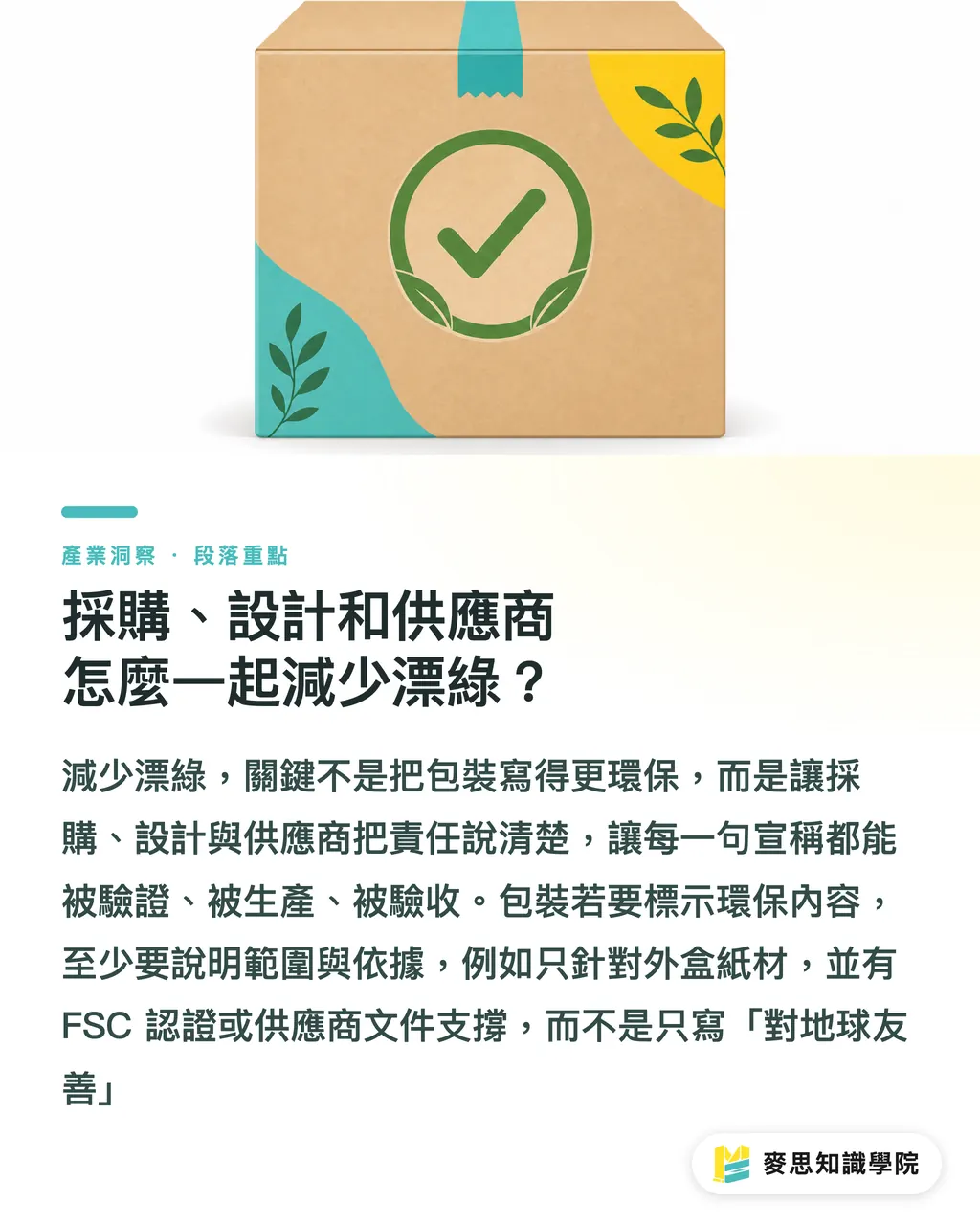
If an environmental claim will appear on the package, I would require at least 3 things
・State the scope clearly, for example, only the outer carton paper stock. Do not let people mistake it for the entire packaging set
・State the conditions clearly, such as removing labels, separating liners, or emptying the contents before recycling
・State the basis clearly, such as FSC-certified paper or a recycled-paper ratio supported by supplier documents. Avoid writing only "planet-friendly."
The final output of a low-carbon brief should be engineering language: ready for material selection, plate setup, proofing, and acceptance. The clearer procurement writes it, the more confident printers will be in proposing alternatives, and the less likely the brand is to discover at the last moment that texture, color, or recycling labels have gone off track
Key Takeaways
・For low-carbon packaging, write the context first and the materials second. Without product weight and logistics path, eco-friendly materials is only an adjective
・The RFQ should turn paper source, ink, finishing, structure, recycling, and proofing into fields, so suppliers answer in the same language
・Carbon reduction cannot depend on stripping material until the structure barely holds. Returns and reprints caused by structural failure often hurt more than the paper saved
・Environmental claims need evidence. A sentence on the package should ideally map back to proof inside the brief
・Comparable quotes require every option to include unit price, setup fees, materials, limits, verification, and lead time
Further Thinking
For print manufacturers, a low-carbon packaging brief can become a specification checklist before quoting. For design teams, it pulls aesthetic choices back into paper stock, ink, and finishing limits earlier. For AI or SaaS teams, the most worthwhile first step is to turn the 7 usage-condition fields, 5 production-limit fields, and 6 supplier-response fields into a repeatable workflow, so procurement misses one fewer required field every time it sends an RFQ
FAQ
- Does a low-carbon packaging brief have to specify FSC paper?
- Not necessarily. FSC is a common traceable paper option, but the brief can say "priority for suppliers that can provide proof of paper source," then ask suppliers to reply with available paper types, pricing, and lead time
- If the budget is limited, what should be changed first in low-carbon packaging?
- Look at structure and post-press finishing first. Many projects do not need expensive material swaps. Reducing unnecessary lamination, full-coverage coating, excessive mounting, or oversized outer cartons can already lower the burden from materials and processing
- How much proofing is enough?
- At minimum, split it into 2 stages: a white sample and a final-material color proof. Use the white sample to check load-bearing, opening and closing, and dimensions. Use the final-material color proof to check color, ink, surface treatment, and recycling-label placement
- How do you compare supplier quotes when the prices vary a lot?
- Require every supplier to reply in the same format, including unit price, setup fees, paper stock, finishing limits, proofing fee, lead time, and risks. Otherwise, a low unit price may simply push die-cutting molds, waste, or substitute materials into later costs
- Can packaging directly say eco-friendly, low-carbon, or sustainable?
- Yes, but the scope and basis must be clear. For example, state whether the claim only refers to the outer carton paper stock, ink, or recycling method, so consumers do not mistake it to mean the entire packaging set has been verified as low carbon
Related articles

The Print × AI weekly
The print and AI know-how designers, brands and enterprises can use before they commit — one email, every week
MINDS Free Tools
AI background removal, a LINE sticker maker, spine & imposition calculators — all free, right in your browser, no upload.
MINDS Group
Need actual printing or gifting services?
From premium printing to online ordering and festive gifts — the MINDS Group sister brands take it from here.