
Overview
The most practical way to approach low-carbon printing is the five-part check MINDS (MS) often talks about: materials, production, transport, waste, and disposal. Waste less material, lose less in production, avoid unnecessary transport, recycle offcuts, and keep finished products from being scrapped
Low-carbon printing: reducing lifecycle emissions from printed materials through materials, production processes, energy, logistics, and waste management. The point is to cut waste first, then choose lower-carbon alternatives
Where Should Low-Carbon Printing Start?
Much of a printed piece's carbon footprint is already locked in before the press starts running. Paper weight, sheet layout, print volume, coating method, and delivery batches. Once these 5 things are written into the specs, the production line can only follow them
The most painful waste I have seen in print shops is not because the press operator cannot print well. It is when the design reaches the final stage and someone realizes the size does not impose well, so one full sheet fits one fewer piece, and the paper offcuts go straight up. The MINDS (MS) low-carbon five-part check starts with a very plain but very effective question: is this sheet being fully used?
・Materials: Start by reviewing FSC-certified paper, recycled paper, suitable paper weights, and single-material structures
・Production: For short runs, multiple versions, or early testing, digital printing can reduce waste from plates and proofing
・Transport: Print nearby and consolidate deliveries. One less vehicle run means one less round of packaging and handling
・Waste: Imposition, make-ready allowance, and color proof approval should happen early to avoid reprints
・Disposal: Paper offcuts, printing plates, and developer should have recycling or treatment records
What 6 Things Can Print Shops Change First?
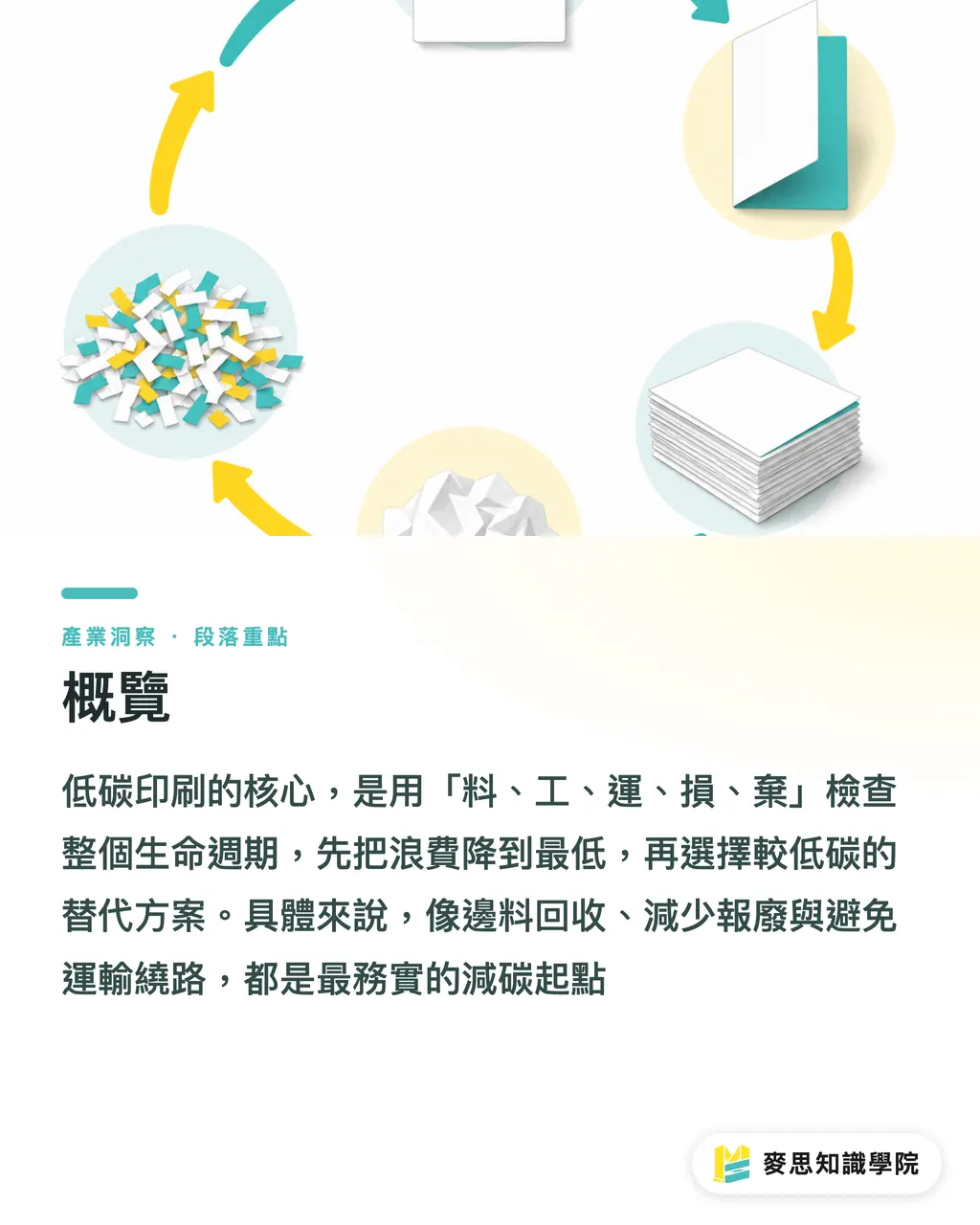
Print shops do not need to start low-carbon work with major investments. First, make 6 on-site practices consistent. Then when clients ask about ESG, there are records to show, and it is less likely to become a verbal promise from the sales side
・Classify paper options first: FSC-certified paper suits brands that care about source management. Recycled paper suits products that can accept differences in surface texture. Both still need printability testing
・Ask about ink by use case first: Plant-based inks can be part of the options, but they are not carbon-free inks. Food packaging, abrasion resistance, and drying conditions still need case-by-case checks
・Avoid unnecessary lamination first: Water-based coating works for many commercial printing and packaging surfaces. If the finished product does not need high water resistance or a special hand feel, one less film layer usually makes recycling easier
・Bring CTP into prepress: CTP removes the need for film and cuts out the traditional film workflow. Plate output is also more stable. Developer recycling and plate recycling should be written into the shop's SOP
・Use digital printing for short runs: Digital printing suits small quantities, multiple versions, variable data, and pre-launch testing, with fewer plates, fewer proofs, and less inventory
・Keep energy records: If the plant has introduced green power, solar energy, or energy-saving equipment, keep electricity bills, contracts, equipment records, and maintenance records. These are more useful than saying, "We are very eco-friendly."
When MINDS (MS) works on mid- to high-end fully custom commercial printing, it often helps clients break paper, coating, binding, and lead time into comparable specification tables. Once specs can be compared, carbon reduction can be discussed properly
How Can Brands Put Carbon Reduction into Print Procurement Specs?
For brands, the biggest waste is often not spending a few more dollars on paper. It is printing too much, changing too late, and letting stock expire in the warehouse. If a catalog will actually be handed out in 800 copies, but procurement prints 1,500, the remaining 700 are just inventory pressure, no matter how beautiful they are
Brand-side procurement can start by changing 5 specification items. These lines can later be organized into ESG reports or supplier management documents
・Split print volume into batches first: For product launches, event booklets, and DM, print the first batch first, then reprint based on actual consumption. Avoid printing the full quantity at once and scrapping it after revisions
・Specify certified paper: FSC, recycled paper, or a brand-approved paper list should be written into the RFQ. Do not wait until prepress to make a last-minute switch
・Choose lower-carbon suppliers: Ask whether the print shop has records for paper offcut recycling, plate recycling, developer treatment, green power, or solar energy
・Consolidate transport first: For the same brand, store materials, event materials, and packaging should be delivered together whenever possible instead of split across multiple trips
・Set a deadline for revisions: One complete proofread before printing is cheaper than three corrections after plates are made, and it also reduces the risk of remaking plates and reprinting
If a brand does not yet have its own low-carbon printing specs, the consulting team at Mai Strategy Knowledge Academy can help turn "materials, production, transport, waste, and disposal" into a procurement questionnaire, so design, procurement, and suppliers can communicate from the same checklist
How Can the Design Stage Use Less Paper and Reduce Scrap?
Designers can reduce carbon much earlier than many people imagine. A 5 mm size difference, one fold line changed, or one fewer material layer can all affect imposition, finishing, and recycling
On the design side, treat low carbon as a layout condition from the start. Do not wait until after final artwork and ask the print shop to "help me save a little." The print shop can help, but in the end it often gets stuck on die lines, paper grain, bleed, and finishing limits
・Ask about imposition before setting the size: For catalogs, cards, hang tags, stickers, ask the print shop to estimate full-sheet usage first. Avoid a beautiful size that eats up too much edge waste
・Reduce pages before layout locks: If 12 pages can tell the story clearly, do not force it to 16 pages. Page count directly affects paper, binding, and weight
・Keep materials simple first: If a paper box can be made with a single paper material, use less paper-plastic composite, partial film, and hard-to-separate decoration
・Stabilize color first: Brand colors, skin tones in photos, and large dark backgrounds should be proofed early. When color mismatch causes a reprint, every saving gets wiped out
・Check final artwork first: Bleed, resolution, black text settings, die lines, fold lines, and spot color names. One mistake in these 6 items can drag the job into re-output
I would suggest designers add a "10-minute low-carbon final artwork check" before sending files to print: size, page count, material, coating, print volume, delivery. Those 10 minutes are usually much cheaper than fixing things afterward
How Do You Put a Carbon-Reduction Checklist into an ESG Report?
Printing-related carbon reduction does not need to turn every DM into a thick report. Start by keeping auditable items, such as paper documentation, print volume records, delivery batches, recycling records, and supplier replies. These 5 types of data can already support many internal brand explanations
ESG reports are weak when they are full of empty claims. Print procurement is best written as "action + scope + proof." For example, in a given year, a brand switched part of its catalogs to FSC-certified paper, moved short-run event materials to digital printing, and changed store materials to consolidated delivery. That kind of wording is clear, and it stands up better to follow-up questions
・Action: Use FSC-certified paper, recycled paper, water-based coating, digital printing, film-free CTP, or consolidated delivery
・Scope: Explain which items it applies to, such as catalogs, paper boxes, stickers, tote bags, and store materials
・Proof: Keep paper certificates, supplier statements, recycling receipts, delivery records, and print volume records
・Result: You can describe reduced reprints, lower inventory scrap, and easier recycling. If there are no quantified figures, do not force in percentages
Low-carbon printing is not about replacing every material with the most expensive option. For small and medium-sized businesses in Taiwan, first print fewer mistakes, avoid overprinting, reduce unnecessary transport, and use fewer composite materials. Get these 4 things steady, and they usually work better than slogans
Key Takeaways
・Low-carbon printing starts with "materials, production, transport, waste, and disposal." Do not look only at ink or paper in isolation
・The first step a print shop can take is to organize FSC, recycled paper, CTP, recycling, and energy records into an auditable checklist
・For brands, the first thing to reduce is inventory scrap. Accurate print volume often works faster than changing materials
・The design stage determines paper usage. Size, page count, and material structure directly affect carbon emissions and cost
・ESG copy should state the action, scope, and proof. Do not force in numbers without a source
Further Thinking
For print manufacturing, low carbon will push factories to keep more detailed production records. For designers, low carbon extends final artwork beyond aesthetics into imposition, materials, and recycling. For AI application and SaaS teams, the direction that can truly be put to work is turning paper quantity estimation, imposition usage, print volume forecasting, inventory risk, and supplier records into decision tools before files go to print. The next step is simple: choose 3 frequently printed items and run their specs again through the MINDS (MS) low-carbon five-part check. Usually, you will quickly see where paper, vehicle trips, and warehouse space are being wasted
FAQ
- Is low-carbon printing always more expensive?
- Not necessarily. If you start with accurate print volume, imposition optimization, consolidated delivery, and fewer reprints, low-carbon printing can often reduce waste and inventory costs at the same time
- Which is lower carbon, FSC paper or recycled paper?
- FSC focuses on forest source management, while recycled paper focuses on material reuse. They serve different purposes. Print buyers should look at paper source, printability, transport distance, finished texture, and recycling needs together
- Can water-based coating fully replace lamination?
- Water-based coating can replace lamination for many commercial printing jobs and general packaging needs, but finished products that require high water resistance, high abrasion resistance, or a special tactile effect still need testing. Low-carbon printing should fit the use case first, then talk about substitution
- Is digital printing always lower carbon than traditional printing?
- Short runs, multiple versions, variable data, and test prints are well suited to digital printing because they require fewer plates, fewer proofs, and less inventory. For large quantities with fixed content, digital printing and offset printing still need to be compared by total consumables, speed, and waste
- What is the minimum data a brand should keep when writing print carbon reduction into ESG?
- At minimum, a brand should keep paper documentation, print volume records, supplier replies, delivery batch records, and paper offcut or plate recycling records. ESG content needs to be auditable. Do not write percentages that have no basis
Related articles



The Print × AI weekly
The print and AI know-how designers, brands and enterprises can use before they commit — one email, every week
MINDS Free Tools
AI background removal, a LINE sticker maker, spine & imposition calculators — all free, right in your browser, no upload.
MINDS Group
Need actual printing or gifting services?
From premium printing to online ordering and festive gifts — the MINDS Group sister brands take it from here.