
Overview
An eco-friendly packaging RFQ needs to cover 9 key items: application, direct contact contents, dimensions and structure, paper stock or recycled content requirements, printing method, post-press restrictions, certification requirements, quantity and lead time, and proofing/acceptance conditions. MINDS uses a three-checkpoint framework (① Where is it used? ② How is it produced? ③ How is it accepted?) to translate procurement language into actionable specs printers can quote before discussing which approach is greener
Eco-friendly packaging RFQ: A specification document submitted to printers by corporate buyers for quoting and evaluating manufacturing processes. It must clearly outline the intended use, materials, printing, finishing, certifications, quantity, lead time, and proofing requirements, rather than leaving suppliers guessing with a vague request for "eco-friendly."
Why Just Requesting Eco-Friendly Materials Leads to Inaccurate Quotes
To a printer, asking for "eco-friendly materials" usually means the inquiry hasn't even started
"Eco-friendly packaging" can mean FSC-certified paper, recycled stock, eliminating lamination, switching to aqueous coating, downsizing the structure, reducing ink coverage, or simply making the package easier to recycle. These six directions carry vastly different paper costs, printing limitations, and finishing risks, so quotes will naturally vary
The inquiries I dread most on the shop floor contain a single line, "Please provide an eco-friendly option," attached to a slick 3D mockup. The printer has no choice but to follow up asking for dimensions, contents, color count, hanging display needs, and exposure to oil, water, refrigeration, or shipping pressure. Just clarifying these questions adds two to three rounds of back-and-forth
An RFQ that yields an accurate quote starts with these basic details in the first section:
・ Application: Outer box, inner tray, header card, paper bag, e-commerce mailer box, or food-contact packaging
・ Contents: Weight, shape, and whether it contains oil, water, alcohol, powder, or fragrances
・ Dimensions & structure: Flat unfolded size, finished size, dielines, tuck flaps, hanging holes, handles, or inserts
・ Usage context: Retail shelf display, courier delivery, refrigeration, freezing, exhibition display, or short-term promotional events
・ Goals: Plastic reduction, recyclability, certified paper stock, lower finishing complexity, or reduced material consumption
If you need mid-to-high-end fully custom commercial printing, gather your existing dielines, sample photos, and estimated quantities, then send them to MINDS to help break down the specs. The first step in a packaging inquiry isn't finding the greenest buzzword, it's letting the factory know what the packaging needs to endure
What Fields Should You Include in an Eco-Friendly Packaging RFQ?
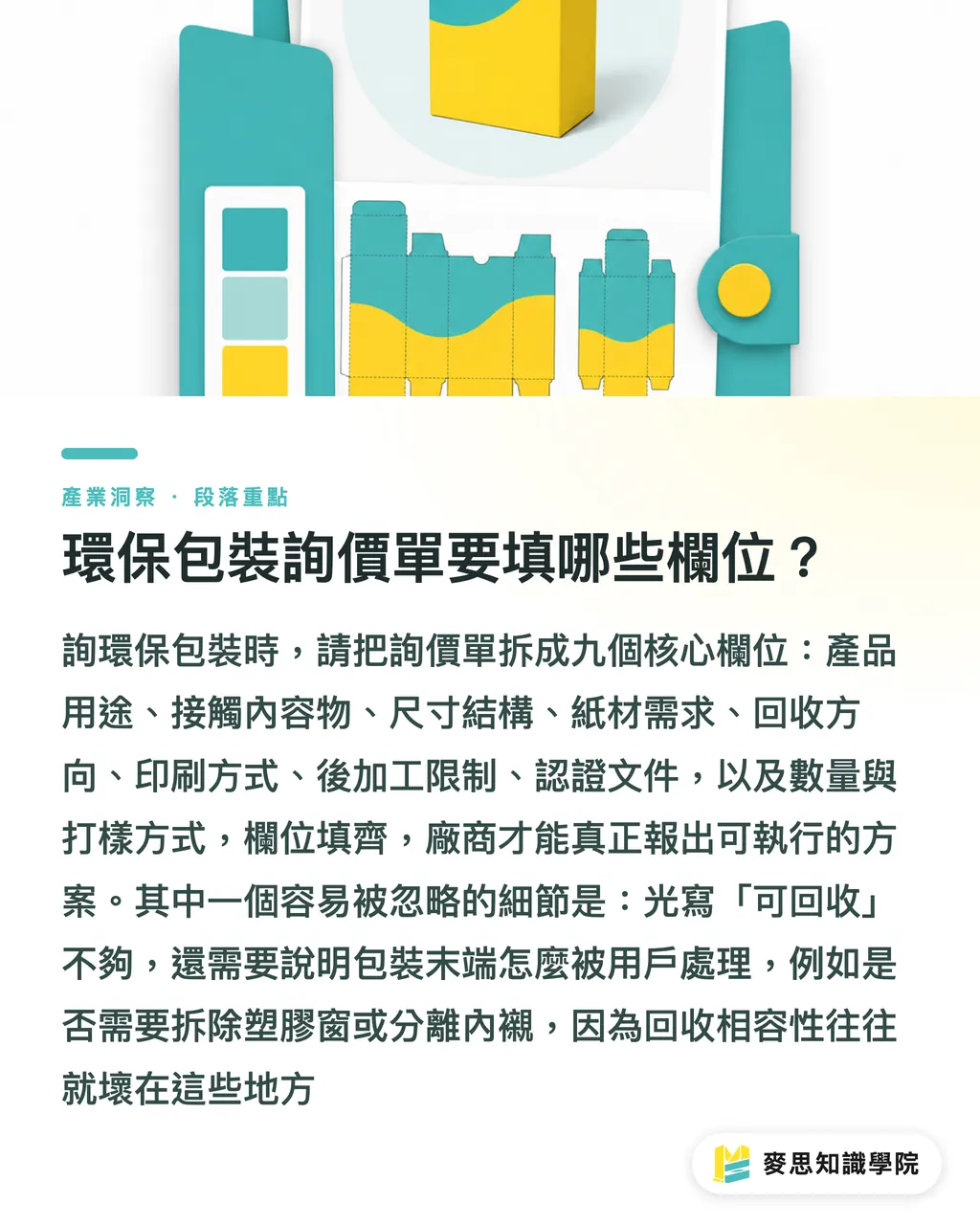
I recommend buyers break an inquiry down into 9 fields. Once these 9 fields are filled out, printers can evaluate paper stock, production processes, finishing, and proofing methods without relying on guesswork
・ Product & application: Specify what goes inside, such as skincare boxes, drip coffee boxes, e-commerce mailers, or trade show gift bags
・ Direct contact contents: State whether the packaging directly touches food, cosmetics, liquids, oils, or powders, as this impacts paper stock, coatings, and safety standards
・ Dimensions & structure: Provide length, width, height, flat layouts, dielines, windows, handles, hanging holes, tuck flaps, and load-bearing requirements
・ Paper stock requirements: Specify FSC-certified paper, recycled paper, uncoated paper, kraft paper, folding boxboard, duplex board, or other preferences. If unsure, state "Open to 2-3 recommendations from the printer."
・ Recycled content or eco-direction: If your brand specifies post-consumer recycled content percentages, plastic reduction, recyclability, or fewer composite materials, include these directly in the specs
・ Printing method: Indicate monochrome, 2-color, 4-color CMYK, Pantone spot colors, full-bleed printing, or low ink coverage requirements
・ Post-press finishing restrictions: Note whether to avoid matte lamination, gloss lamination, spot UV, foil stamping, plastic window film, magnets, foam inserts, or multi-material bonding
・ Certifications & documentation: State if you require FSC labeling, paper origin certificates, ink compliance statements, supplier declarations, or internal ESG reporting documents
・ Quantity, lead time & proofing: Outline estimated quantities, split deliveries, target lead times, unprinted structural proofs, digital proofs, press proofs, and acceptance standards
A quick heads-up: don't just write "recyclable" as a catchphrase and call it a day. Clearly specify how the end user will handle the packaging, such as removing a plastic window, separating an inner tray, or dealing with heavy lamination. Recyclability often breaks down over these small details
How to Specify Paper, Printing, and Finishing Without Running Into Pitfalls
The most common mistakes in eco-friendly packaging don't come from paper names, but from paper stock, printing, and finishing clashing with one another
Uncoated paper looks natural and feels great, but large areas of dark ink get absorbed quickly, so colors won't look as sharp as on coated stock. Recycled paper communicates sustainability well, but you need to check physical samples for paper shade, fiber texture, and batch consistency. Kraft paper fits eco-focused brands, but white, light colors, and fine text require special handling or the design will look dull
Structuring your RFQ like this makes it much easier for printers to respond effectively:
・ Paper stock: Prefer FSC-certified stock. Please suggest two options suitable for printing and die-cutting
・ Color: Brand colors must match specific Pantone codes. Please flag any color shift risks across different paper stocks upfront
・ Ink: Prefer low-odor or packaging-grade inks. If food contact is involved, please define the compliant options upfront
・ Coating: Aiming to avoid plastic films. Open to evaluating aqueous coating or no coating, but need to confirm scuff and smudge risks
・ Structure: Aiming to reduce multi-material bonding. Please suggest interlocking tabs, tucks, or foldable designs as glue-free alternatives
・ Post-press finishing: Please itemize quotes for foil stamping, spot UV, matte lamination, or clear windows if they impact recyclability or cost
Designers should also keep two practical issues in mind: heavy dark solids increase ink load and drying time, while small inverted text tends to bleed on rough fiber papers. If your brand wants a minimal, natural vibe, let the material's texture speak for itself instead of covering every inch of paper in ink
Why You Must Compare Structure and Durability for Identical Quotes
Two quotes might both list FSC paper, 4-color printing, and identical quantities, but represent completely different products
Evaluating packaging takes more than comparing unit prices. Look at three key factors: structural integrity, durability during shipping and retail handling, and ease of separation during recycling. If these three points aren't explicitly stated in the RFQ, suppliers will quote based on different assumptions, leaving you with numbers that look identical only on the surface
I advise buyers to ask printers to itemize the following details in their quotes:
・ Structure: Box style used, inner tray requirements, structural reinforcements, and flat-pack shipping options
・ Durability: Ability to withstand content weight, stacking, retail handling, courier impact, and repeated opening/closing
・ Recyclability: Whether paper is mixed with plastic, metal, magnets, foam, or non-separable adhesives
・ Finishing risks: Susceptibility to cracking along score lines, flaking, scuffing, warping, weak glue bonds, or color variations
・ Alternatives: Can the printer offer two price points and one low-finishing alternative for the same inquiry?
If you already have your brand visuals and general packaging direction, but haven't compiled them into actionable RFQ specs, turn to the Mai Strategy Knowledge Academy Consulting Team to translate your requirements into factory-ready language. Clear specs make vendor price comparisons meaningful
How to Include Proofing and Acceptance Terms in Your RFQ
Proofing is non-negotiable for eco-friendly packaging, especially when switching paper stock, dropping lamination, altering structures, or removing plastic components
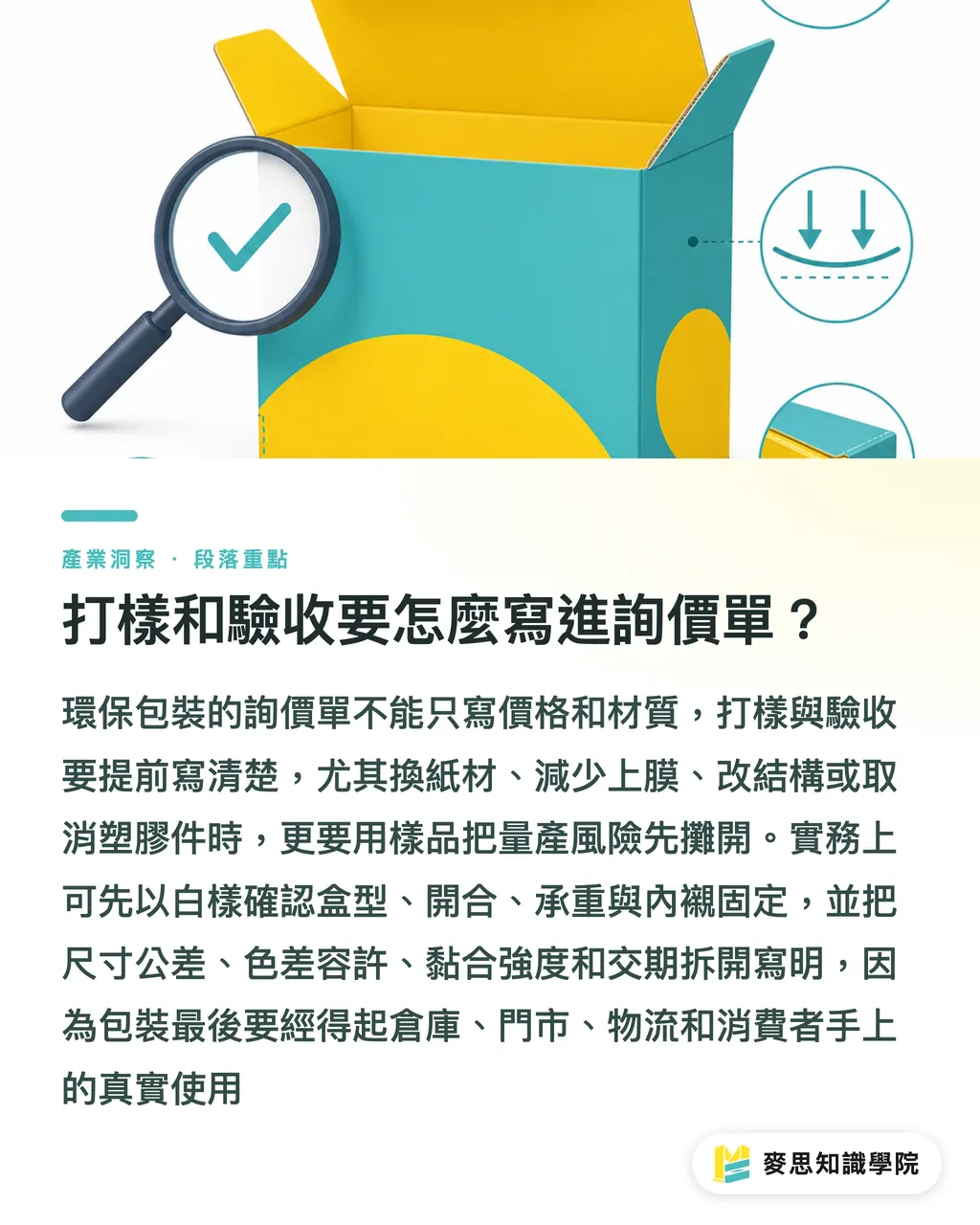
I divide proofing into three tiers in an RFQ: unprinted structural samples for form factor, digital proofs for visual layout, and press proofs for mass production risks. Not every project needs a full press proof, but if your packaging goes into retail channels, carries heavy weight, or requires strict color accuracy, skipping it often leads to costly mistakes during mass production
You can write these directly into your RFQ:
・ Unprinted structural proof: Verify box shape, closure, weight support, inner tray fit, and product placement
・ Digital proof: Check layout, text size, barcode placement, color direction, and alignment with dielines
・ Press proof: Evaluate press proofing if working with high-risk paper stock or complex finishing techniques
・ Acceptance criteria: Define dimensional tolerances, color variance limits, crease quality, bond strength, and scuffing standards
・ Delivery timeline: Separate structural proofing time, approval turnaround, mass production schedule, and batch delivery dates
Acceptance testing for eco-friendly packaging goes beyond checking if it matches the design file. Test if it can be loaded, handled, shipped, unboxed, and recycled. In the end, packaging doesn't live in pitch decks. It lives in warehouses, retail stores, shipping boxes, and consumers' hands
Key Takeaways
・ Start your eco-friendly packaging RFQ with the usage context before specifying materials so printers know which manufacturing methods to apply
・ "Eco-friendly materials" is not a specification. Itemize FSC certification, recycled paper, plastic reduction, recyclability, and minimal finishing separately
・ When comparing quotes for identical specs, don't focus solely on unit price. Structural integrity, durability, and recycling compatibility determine the real cost
・ The more finishing steps you add, the more cautious you must be with eco-claims. Inquire upfront about films, clear windows, foil stamping, and composite materials
・ Separate proofing into structural, digital, and press proofs. Which step you skip depends on project risk, not guesswork
Further Considerations
For print manufacturers, a solid eco-friendly packaging RFQ reduces back-and-forth clarification and aligns estimating, proofing, and purchasing on the same blueprint. For designers, sustainability isn't about making visuals look like recycled paper. It's about considering dielines, ink coverage, post-press finishing, and disassembly together. For AI applications and SaaS teams, the real value lies not in generating pretty adjectives, but in breaking down "I want something eco-friendly" into 9 actionable fields, 3 proofing tiers, and vendor response formats built for comparison
FAQ
- What are the minimum details needed in an eco-friendly packaging RFQ?
- At minimum, include application, contents, dimensions and structure, paper stock direction, printing method, post-press restrictions, certifications, quantity, lead time, and proofing conditions. These 9 items give printers enough detail to quote, manufacture, and establish acceptance standards
- Is asking for FSC paper enough when requesting a quote?
- No. FSC only covers paper sourcing. You must also specify printing color count, lamination, foil stamping, plastic windows, weight capacity, and proofing requirements
- Must eco-friendly packaging completely avoid lamination or foil stamping?
- Not necessarily. However, lamination, foil stamping, spot UV, windows, and multi-material bonding can impact recycling compatibility and cost. Request itemized quotes and ask printers for green alternatives in your RFQ
- Why is an unprinted structural proof necessary for eco-friendly packaging?
- An unprinted structural proof lets you verify box shape, fit, inner trays, weight support, and product placement early on. It's essential for new structural designs, plastic-reduction layouts, or paper stock switches
- How do you compare quotes for eco-friendly packaging with identical specs?
- Beyond unit price, evaluate structural stability, retail and shipping durability, ease of material separation for recycling, and clearly documented finishing risks. Without these details, two quotes may look identical on paper but represent completely different products
Related articles

The Print × AI weekly
The print and AI know-how designers, brands and enterprises can use before they commit — one email, every week
MINDS Free Tools
AI background removal, a LINE sticker maker, spine & imposition calculators — all free, right in your browser, no upload.
MINDS Group
Need actual printing or gifting services?
From premium printing to online ordering and festive gifts — the MINDS Group sister brands take it from here.