
Why Does Eco-Friendly Packaging Need Proofing Even More?
Eco-friendly packaging needs proofing more, because the moment you change materials, ink laydown, scuff resistance, crease lines, gluing, barcodes, and shelf presentation all shift at once. When I handle this kind of job at MINDS Printing, I run the "MINDS Printing (MS, mid-to-high-end fully custom commercial printing) Eco-Packaging Proofing Six-Check" before anyone says the word production
Eco-friendly packaging proofing means running white mock-ups, digital proofs, or actual material proofs before production, to check whether the stock, structure, printing, finishing, and on-shelf behavior can deliver reliably
The sentence I dread hearing most is "just swap the paper." On the production line, that sentence is usually the most expensive one in the room
Take the same CMYK file and move it to recycled stock, uncoated paper, or a heavier-fiber sheet, and the ink can go gray, fine type can fill in, and dark solids will scuff more easily. Take the same box and re-engineer it with less plastic, and the crease angles, tab tightness, and packing speed can all shift too
How Do Eco Materials Change the Way Print Behaves?
Recycled stock usually throws three variables at you: surface fiber, paper dust, and ink absorption. The MS Eco-Packaging Proofing Six-Check treats "color" and "paper surface condition" as two separate things, because a warmer-looking paper tone is not, on its own, a problem. Paper dust landing on the print area, or cracking at the crease, is what kills delivery
Uncoated paper feels great in the hand, but it does not hold ink on the surface the way a gloss-laminated or coated sheet does. Drop in shadow detail, thin lines, or light gray type and you may lose a full step of contrast on the proof. Designers have to accept that material language first, and procurement has to understand that this is not a bad print job, it is the stock behaving the way it behaves
For vegetable-based inks, pay close attention to drying, scuff resistance, and compatibility with downstream finishing. Three spots matter most: dark grounds, large solid areas, and the side panels that rub during packing. Do not judge the proof flat on the desk. At minimum, rub it finger-to-paper and simulate packing to see if the surface scuffs up
The thing most people under-estimate on reduced-plastic structures is glue bond and standing behavior. Drop a plastic window, switch to a paper card holder or a paper-lock tab, and the product weight, the center of gravity, and the shelf angle all change. Put the actual product inside during proofing. A pretty empty box proves nothing
What Are the 6 Things to Check at the Proofing Bench?
The MS Eco-Packaging Proofing Six-Check drops straight into a QC checklist. Every item points to a complaint that shows up after production:
・1. Color and ink laydown: Check brand colors, skin tones, grays, and dark solids on the eco stock against what you can live with. Screen color is not the only standard
・2. Paper dust and hickies: Touch the sheet, rake it under raking light, and confirm whether paper dust is fouling the print, foil-stamp, coating, or label areas
・3. Scuffs and abrasion: Test the top panel, the side panels, and the stack-contact surfaces separately. Dark grounds and matte finishes need extra care
・4. Crease lines and cracking: Fold and unfold along the score line three times. Check the outside for white burst and the inside for fiber lift. Test it on thick stock and on uncoated stock
・5. Glue bond and lamination strength: Check glue areas, lamination edges, and fiber tear. Load the actual product in, then check whether the panels pop open
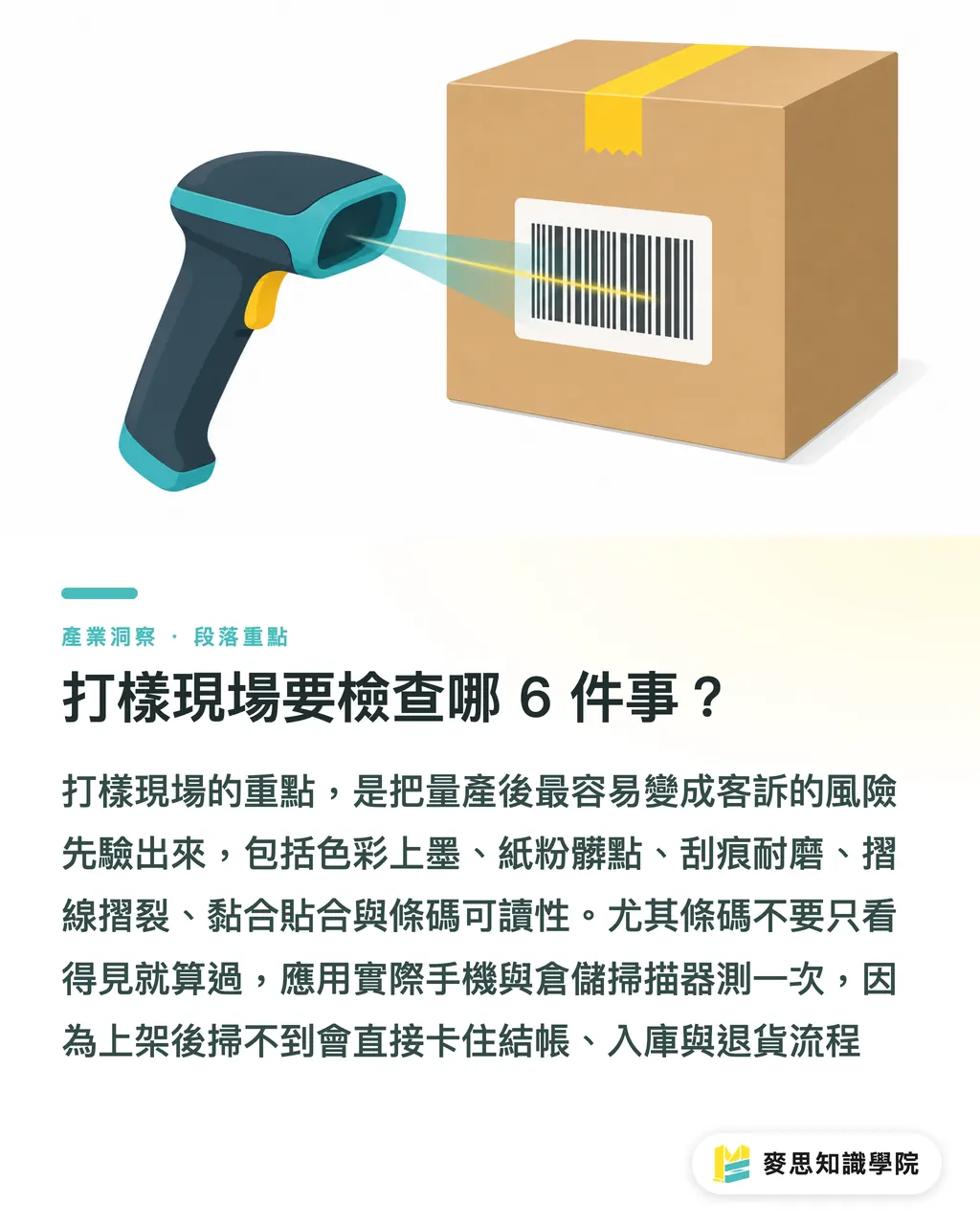
・6. Barcode readability: Scan EAN, QR codes, and shipping codes with the real scanning equipment. Light-colored eco stock and low-contrast ink can slow the scan
Barcode is the one most people skip. I insist on scanning with both a real phone and a warehouse scanner. Once the package is on the shelf, a barcode that won't scan is not an aesthetic issue, it jams up checkout, inbound, and returns
From White Mock-Up to Full Material Proof: The Acceptance Order
White mock-ups come first, and at this step the MS Eco-Packaging Proofing Six-Check only asks three questions: does the box stand, does the product fit, and will the packer's hands get stuck
Digital proofs come next, to confirm layout and information. Eco-friendly packaging often carries material labels, recycling notes, composition ratios, or reduced-plastic copy. Drop those down to 5pt, park them next to a crease line, or sit them on a low-contrast ground, and they turn into a complaint the day the boxes land
The full material proof is where production risk lives. Paper, ink, finishing, and lamination all need to be tested together. If the first run is planned at 1,000 boxes, the proof stage has to include loading the actual product, simulating stacking, and trying the box on the shelf, before the die-cut and the stock spec get locked
Do not rush this
The fastest way to wreck an eco-friendly packaging job is to skip the full material proof. A white mock-up can prove the structure direction. A digital proof can lock the visual direction. Only the full material proof exposes paper dust, crease cracking, abrasion, and glue failures on the line
How Should an SMB Spend Proofing Money Where It Counts?
Budgets are tight at small and mid-sized companies, and the MS Eco-Packaging Proofing Six-Check does not call for a full-spec proof on every job. Hit any one of these four triggers and I recommend a full material proof: a new stock, a new ink, a new box structure, or a new finishing method
If it's the same stock with a text change, a small-batch digital proof is usually enough. If you're moving a gloss-laminated pack onto uncoated recycled stock and adding vegetable ink and a reduced-plastic locking tab, a PDF is not enough. Problems will hit color, crease lines, glue bond, and shelf display at the same time
Designers can write the risks into the print-file notes before sending the job. Procurement can put the acceptance items into the quote and the schedule discussion. The print shop needs to translate sample test results into plain language. When material, structure, and production method all need to be weighed together, bring in the Mai Strategy Knowledge Academy advisory team for a pre-press check first
That's enough
The Short List
・Reusing the old proof after a stock change parks every unknown risk on the ship date
・On eco stock, check paper dust, scuffs, and crease cracking before you chase a pretty photo
・Unscannable barcodes, boxes that won't stay glued, and white-bursting creases are all production problems the proof stage should have caught
・Reduced-plastic structures need a real-product load test. A clean empty box does not mean a stable shelf
・Proofing cost is not extra spend. It buys down reprints, delays, and complaints in advance
Where This Goes Next
On the manufacturing side, treat eco-friendly packaging as a new process to manage. On the design side, fold the paper's character into layout decisions. On the AI and SaaS side, turn the proofing checklist into checkable fields that can take photos back and record versions. AI can flag missing bleeds or barcodes drifting too close to the crease, but whether paper dust fouls the plate or glue pulls the fiber still has to be checked by hand on the sample
FAQ
- Does eco-friendly packaging always need proofing?
- Once you switch to recycled stock, uncoated paper, vegetable-based ink, or a reduced-plastic structure, re-proofing is the safe call. Print, crease, glue, and barcode behavior can all shift
- Should I look at color first on an eco-friendly proof?
- Color gets checked, but it does not get checked alone. Eco-proofing also covers paper dust, scuffs, crease cracking, lamination bond, barcode readability, and how the pack actually performs on the shelf
- What is the difference between a white mock-up, a digital proof, and a full material proof?
- White mock-up checks the structure. Digital proof checks layout and information. Full material proof checks whether the stock, ink, finishing, and lamination will misbehave before production starts
- What should I watch for when using vegetable-based ink on packaging?
- Watch drying, scuff resistance, and compatibility with downstream finishing. Dark solids, side-panel rub zones, and stack-contact surfaces all need to go through the proof
- Why does reduced-plastic packaging need a real-product load test?
- Reduced-plastic structures usually change the support method, the center of gravity, and tab tightness. An empty box can look fine and still fail at standing, glue bond, and shelf display once the product goes in
Related articles
The Print × AI weekly
The print and AI know-how designers, brands and enterprises can use before they commit — one email, every week
MINDS Free Tools
AI background removal, a LINE sticker maker, spine & imposition calculators — all free, right in your browser, no upload.
MINDS Group
Need actual printing or gifting services?
From premium printing to online ordering and festive gifts — the MINDS Group sister brands take it from here.