
What Should You Actually Check in Sustainable Packaging Sampling?
Sustainable packaging sampling is a shared approval process before mass production that uses white mockups, digital proofs, or production-material samples to verify structure, printing, labeling, and packing efficiency
I have seen too many projects where everyone stares only at the colors when the samples are spread out on the meeting table. Only after warehousing, packing, and shelf placement do they discover cracked white fold lines, lifted glue flaps, or barcodes that cannot be scanned. At that point, going back to revise the die line or change the paper usually costs far more than producing one proper round of production-material samples
At MINDS, we often review sustainable packaging samples through three checkpoints before printing:
・① Structure checkpoint: paper thickness, fold-line tolerance, load-bearing strength, and bonding strength must pass first
・② Printing checkpoint: color, ink drying, surface abrasion resistance, and post-processing appearance must be reviewed together
・③ On-site checkpoint: barcode readability, label placement, packing efficiency, and logistics stacking must be tested in practice
The most common misunderstanding about sustainable packaging is treating "using less material" as the only goal. In practice, removing one structural layer, switching one paper stock, or eliminating one film layer can all affect compression resistance, abrasion resistance, and ink performance. Sampling is how you put those consequences on the table early
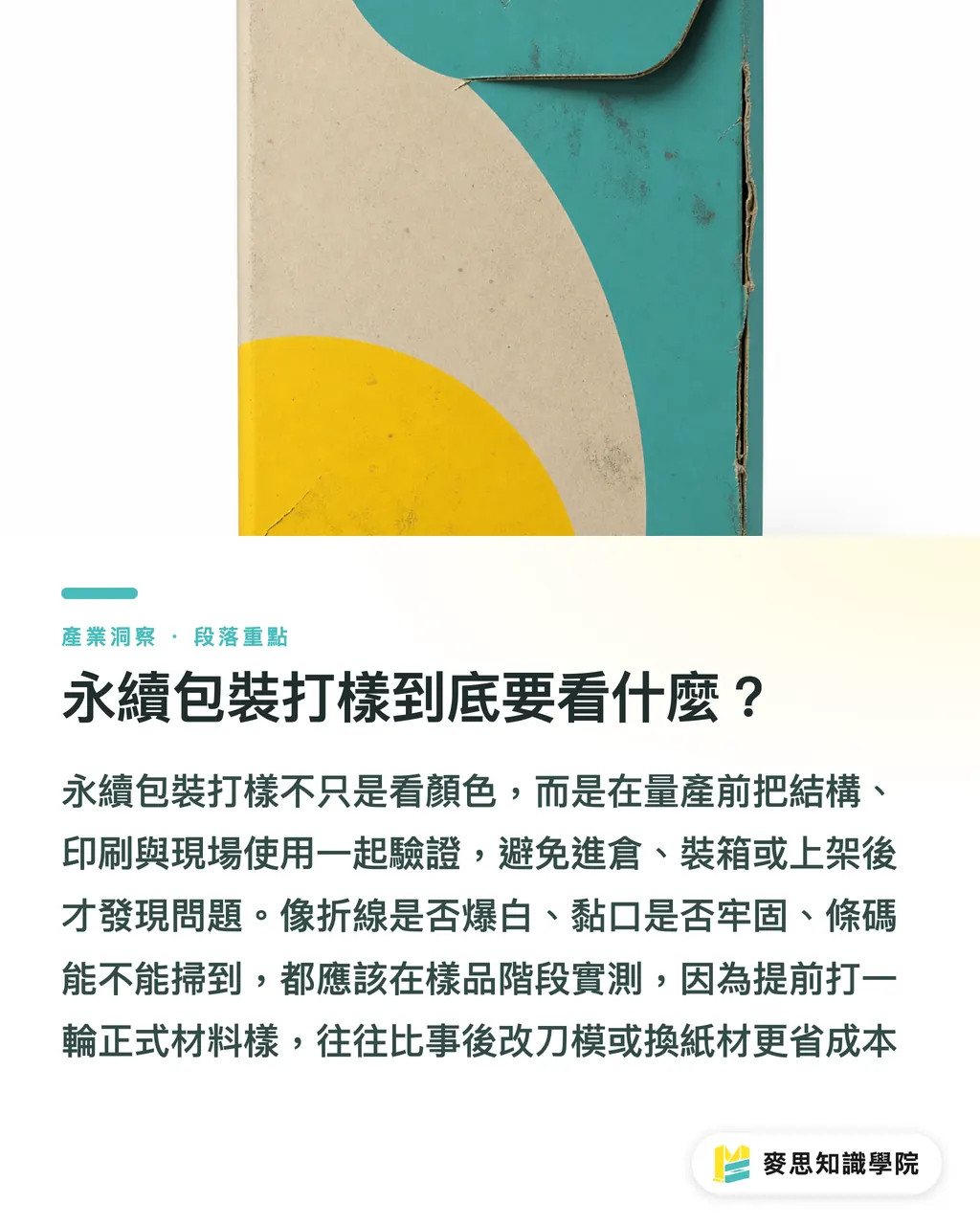
Why Is It Not Enough to Check Only Color and Appearance?
Checking color is basic in packaging sampling, but the risks in sustainable packaging often hide in three places: fold lines, glue flaps, and contact surfaces
For fold lines, check whether the crease cracks after scoring and whether the fold turns white after being bent 3 to 5 times. This is especially important because recycled paper, uncoated paper, and thick card stock all react differently during box folding. The same die line can perform completely differently after a paper change
For glue flaps, check whether the adhesive can hold on the paper surface. If the surface is too rough, glue coverage may be uneven; if it is too smooth, initial tack may be slow. Checking the box again after 24 hours is closer to a real production scenario than judging it immediately after gluing
For contact surfaces, check ink drying and abrasion resistance. Packaging rubs against other packaging during conveying, stacking, and packing. If a large dark printed area smudges as soon as it is rubbed, what the customer receives is not an "eco-friendly feel" but a poor quality-control impression
For mid- to high-end custom commercial printing projects, MINDS Printing usually recommends placing the sample into the actual carton or display rack for one test. One package looking good on a table does not mean it will still look good after one carton, one pallet, or one delivery
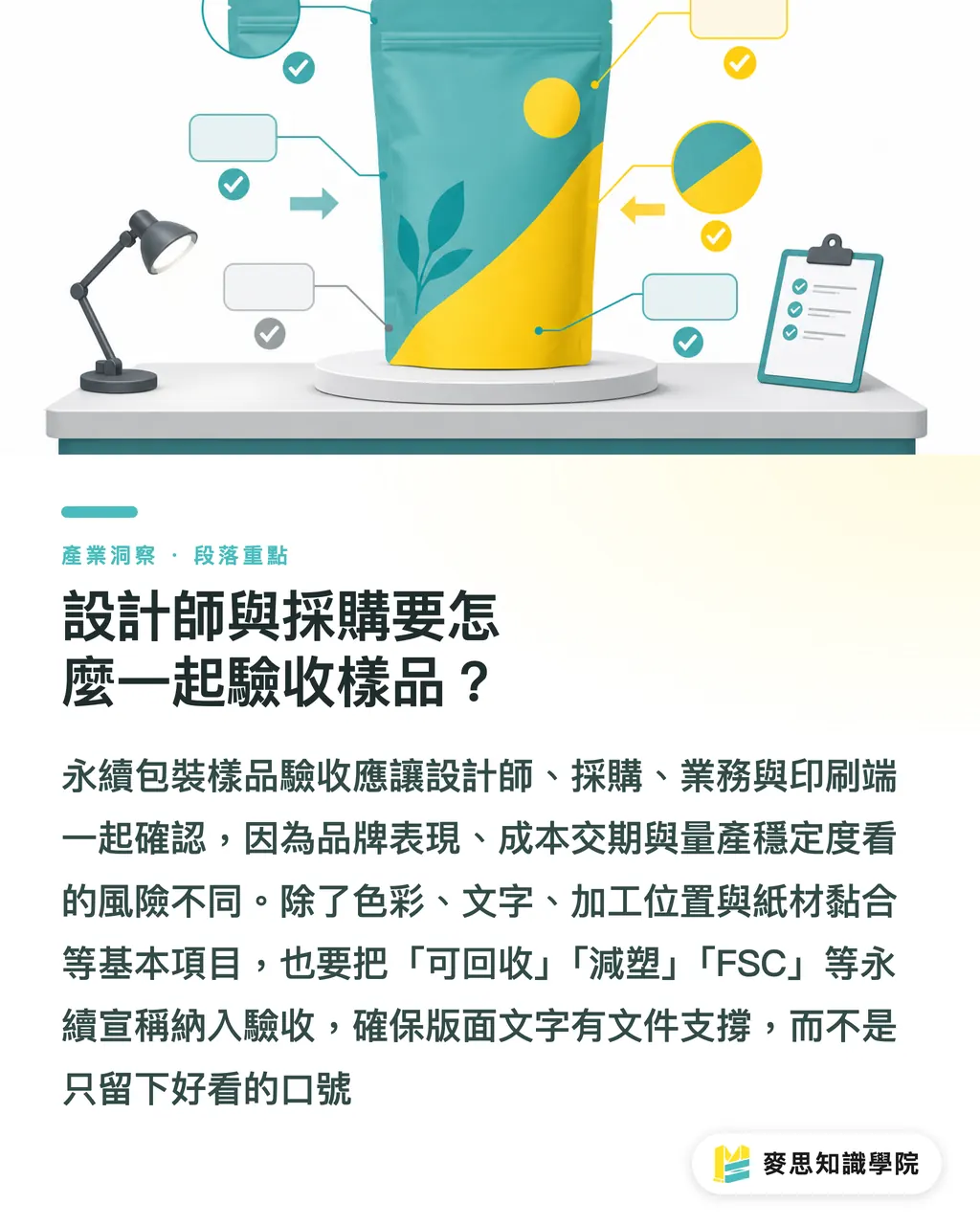
How Should Designers and Procurement Teams Approve Samples Together?
Sustainable packaging samples are best reviewed together by the designer, procurement team, sales team, and print partner, because each person sees a different risk. Designers look at brand expression, procurement looks at cost and lead time, and the printer looks at production stability
Items designers should approve:
・Whether the color is close to the approved artwork, especially brand colors, skin tones, food colors, and large background areas
・Whether text size is readable, and whether nutrition facts, ingredients, warnings, and recycling instructions are not cut through by fold lines
・Whether barcodes and QR Code areas have enough quiet space. Being scannable on a phone does not mean they will scan reliably with a warehouse scanner
・Whether finishing positions are accurate, and whether foil stamping, spot gloss, embossing, windows, and fold lines interfere with one another
Items procurement teams should approve:
・Whether the paper stock fits the budget, lead time, and supply stability. Formal mass production cannot be judged only by the feel of a sample room prototype
・Whether bonding strength is sufficient, and whether the package stays closed after the product is inserted, lifted, squeezed, and stacked
・Whether packing efficiency is reasonable. Having one person fold 20 boxes in a row quickly reveals whether the structure is easy to handle
・Whether label positions meet channel requirements. Outer cartons, individual boxes, hang cards, and display-facing surfaces should be checked separately
When reviewing artwork, the consulting team at Mai Strategy Knowledge Academy reminds clients that sustainability claims also need to be part of the approval checklist. Claims such as "recyclable," "plastic reduction," and "FSC" need supporting documentation behind them, and the layout must state the conditions clearly instead of leaving only a polished slogan
When Do You Need a White Mockup, Digital Proof, Production-Material Sample, or Pilot Run?
A white mockup is best for reviewing structure. The focus is the die line, fold lines, openings, locking tabs, hand feel, and packing path. A white mockup usually is not used to judge color, but it can identify 80% of structural issues the fastest
A digital proof is best for reviewing visuals. The focus is layout proportion, text hierarchy, information placement, barcode size, and the direction of brand color. The color of a digital proof can be used as a reference, but it cannot be treated as identical to the final printed color
A production-material sample is best for reviewing materials and finishing. Only after switching to the paper stock used in mass production will ink absorption, drying speed, crease response, and surface abrasion resistance be close to real conditions. For sustainable packaging, whenever the paper type changes, I usually require at least one production-material sample
A pilot run is best for reviewing workflow. This is especially important when a new die line, new paper stock, new adhesive, new finishing process, or new packaging line appears at the same time. A small batch can check machine stability, packing speed, barcode scanning, and the workload of manual operations
The decision can be very direct:
・Appearance change only, with no structural change: start with a digital proof and add a production-material sample if needed
・New box style or new die line: start with a white mockup, then produce a printed sample after confirmation
・Switching to recycled paper, uncoated paper, or specialty paper: review a production-material sample and do not rely only on screen artwork
・Entering retail channels, e-commerce, or logistics delivery: a pilot run is recommended, with at least one full packing and scanning process tested
If the packaging will enter mid- to high-end channels or a brand launch milestone, MINDS Printing usually separates the white mockup, production-material sample, and pilot run into 2 to 3 stages. This makes it easier to isolate problems instead of mixing design, material, finishing, and logistics issues into one round of discussion
How Can Sampling Results Become Risk Control Before Mass Production?
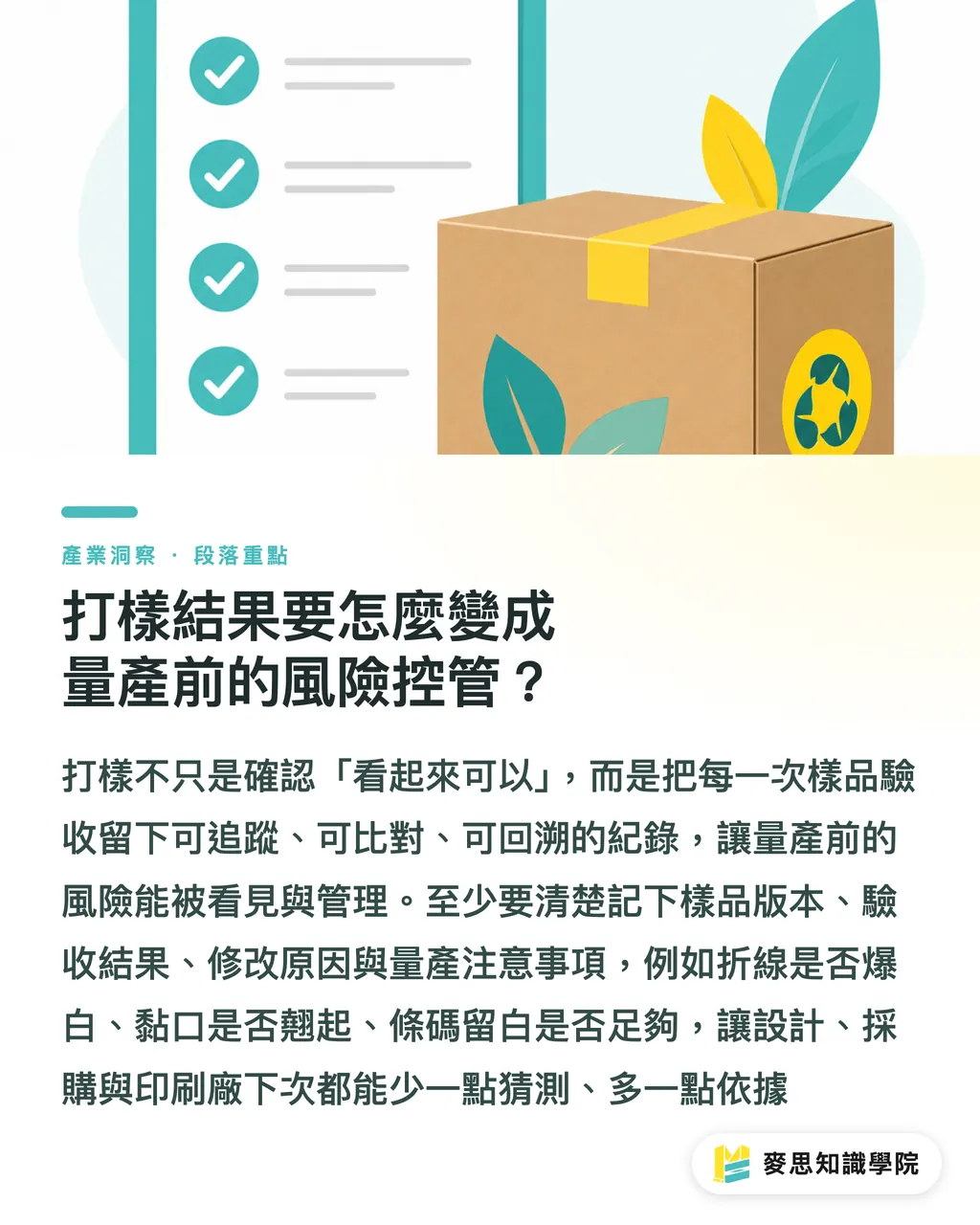
A good sample review should leave behind traceable decisions, not just a meeting-room conclusion that "it looks fine."
I recommend keeping at least 4 types of records for every sample approval:
・Sample version: die-line version number, design file version, paper stock name, and finishing method
・Approval result: passed, needs revision, or requires resampling. Do not record only verbal confirmation
・Reason for revision: for example, cracked white fold lines, lifted glue flap, insufficient barcode quiet zone, or ink not fully dry
・Production notes: on-press density, crease pressure, glue position, and packing direction
These records are also valuable for SaaS and AI application teams, because what printing workflows most need to digitize is not removing people, but turning "the judgment inside a veteran technician's head" into approval data that can be searched, compared, and traced
For designers, sampling records prevent the same issue from recurring in the next artwork revision. For procurement teams, they make quotes, lead times, and supplier communication more stable. For print factories, they reduce last-minute guesswork during mass production
My own standard is simple: with the sample in hand, you should be able to answer at least 8 questions. Will the structure hold up? Will the fold lines crack? Will the glue flap open? Will the ink drag? Will the surface scuff? Will the barcode scan? Will the label be blocked? Will packing get stuck?
Key Takeaways
・Sustainable packaging sampling should focus on mass-production risks; color is only one item
・Using less material does not automatically make packaging safer. Paper stock, structure, bonding, and logistics must be verified together
・White mockups review structure, digital proofs review layout, production-material samples review materials, and pilot runs review workflow
・Barcodes, labeling, and packing efficiency must be included in the approval checklist, because these issues are most easily underestimated before launch
・Good sampling records become a shared language for the next quotation, artwork revision, mass production run, and customer complaint review
Further Thinking
The next step for sustainable packaging is not making every project more complicated, but making approval clearer. Print manufacturers can manage white mockups, paper-stock samples, and pilot runs in separate stages. Designers can reserve space for barcodes, labels, and recycling claims in their files. Procurement teams can include packing efficiency, paper-stock stability, and bonding strength in RFQ conditions. AI and SaaS teams can start from "sample approval records" and organize versions, issues, corrections, and production notes into traceable data. Before entering mass production, work with MINDS Printing to review the sample together. The point is not to make one more sample, but to avoid one more problem that only blows up after launch
FAQ
- Do sustainable packaging projects always need a production-material sample?
- Whenever the paper type, recycled paper, uncoated paper, specialty paper, or finishing method changes, a production-material sample is recommended. Screen artwork and digital proofs cannot show the real state of ink absorption, fold-line tolerance, bonding strength, or surface abrasion resistance
- What is the difference between a white mockup and a digital proof?
- A white mockup mainly reviews structure, die lines, fold lines, openings, and packing hand feel. A digital proof mainly reviews layout, text, color direction, barcode placement, and information hierarchy. They serve different purposes and cannot replace each other
- What should designers check when reviewing sustainable packaging samples?
- Designers should check brand colors, text readability, barcode quiet zones, label placement, finishing registration, and whether fold lines cut through important information. Sustainability claims must also be specific, and terms such as recyclable, plastic reduction, and FSC need supporting documentation
- What do procurement teams most often miss when reviewing packaging samples?
- Procurement teams often miss packing efficiency, bonding strength, paper-stock lead time, and surface wear after logistics stacking. A sample looking good on its own is not enough. It is best to fold the box, insert the product, scan the barcode, and place it into the outer carton for one test
- When is a pilot run necessary?
- When a new die line, new paper stock, new adhesive, new finishing process, or new packaging line appears at the same time, a pilot run is recommended. A pilot run can reveal machine stability, packing speed, barcode scanning, and manual-operation issues early
Related articles

The Print × AI weekly
The print and AI know-how designers, brands and enterprises can use before they commit — one email, every week
MINDS Free Tools
AI background removal, a LINE sticker maker, spine & imposition calculators — all free, right in your browser, no upload.
MINDS Group
Need actual printing or gifting services?
From premium printing to online ordering and festive gifts — the MINDS Group sister brands take it from here.