
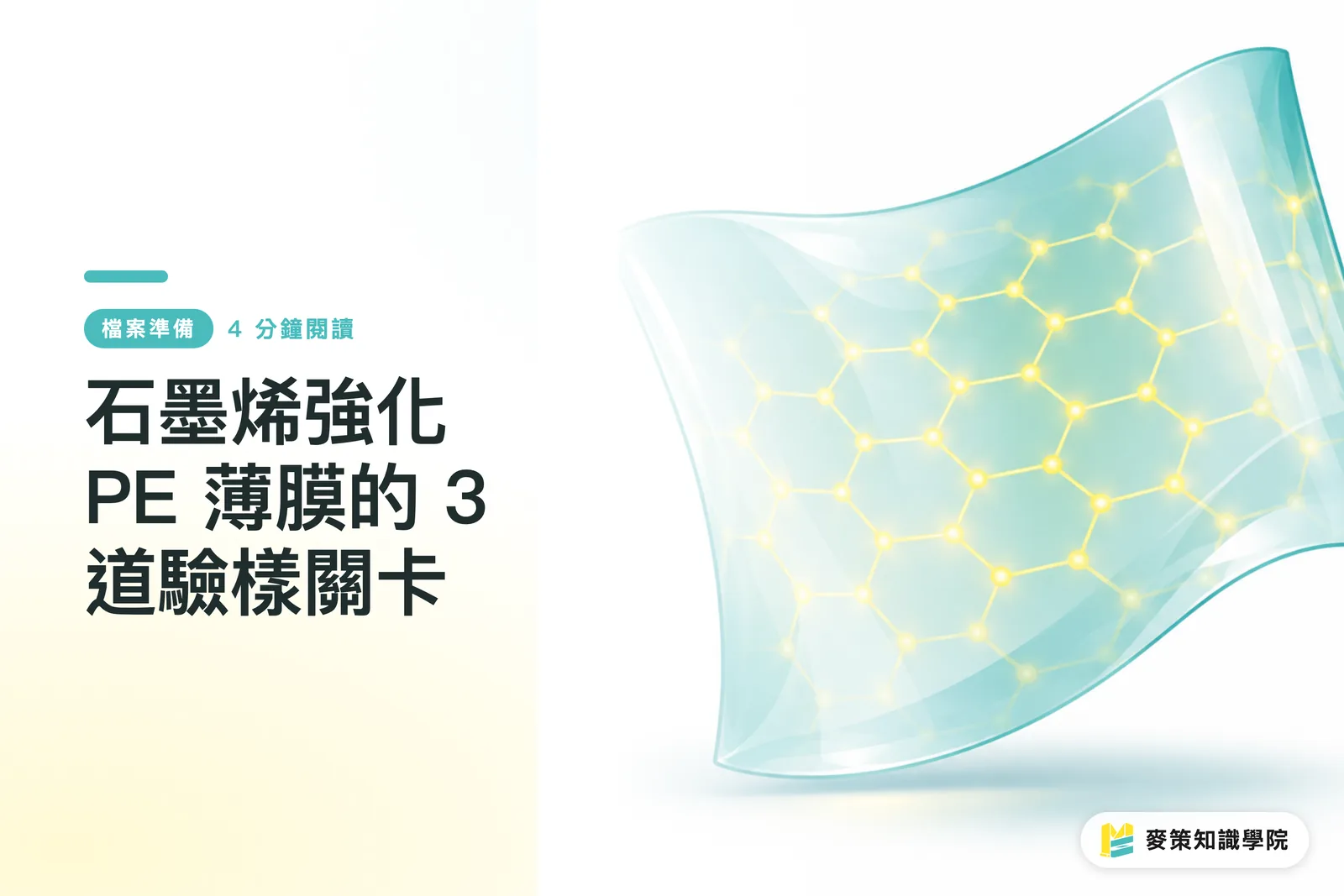
What has changed with this graphene PE film?
Duo Packaging announced its graphene-reinforced PE film on October 6, 2026, claiming it can improve mechanical strength and recycled content. See the original report. PE (polyethylene) is a thermoplastic made by polymerizing ethylene. As a film, it can serve as a flexible packaging substrate, and its formulation and processing conditions affect print and heat-seal performance
Graphene is a single-layer sheet made of carbon atoms. The report confirms that it has been added to PE film, but gives no loading level or details on how it is dispersed. Mechanical strength describes a film's ability to withstand forces such as stretching, puncture, and tearing. Comparisons need to be made under defined conditions. In MINDS (MS)'s three-gate sample review for mid- to high-end, fully custom commercial printing, "reinforced" goes on the list of claims to test. It does not go straight into the customer's specifications
Why test strength and recycled content separately?
The two claims need separate checks. Mechanical strength describes how a film performs under external forces, while recycled content describes what it is made from. One cannot stand in for the other. Post-consumer recycled polyethylene (PCR PE) is PE recovered after use and processed into film feedstock. Each batch still depends on sorting, reprocessing, and supply-chain specifications
MINDS (MS)'s three-gate sample review checks for contaminants, gels, heat-seal consistency, and batch records. These are all things to verify when buying film with recycled content. Adding graphene to a new formulation does not mean those issues have already been solved. Duo Packaging's announcement claims improvements in both areas, but provides no measurement values
How should a small or midsize plant run its first trial?
Start with a small trial using the same artwork, production line, and conditions, then compare the results with the film currently in use. MINDS (MS)'s three-gate sample review first gathers supplier documentation, then checks print adhesion, heat sealing, and recycled-material batches. Avoid changing the film and the process at the same time. Otherwise, it will be hard to trace the cause of any variation
・Material information: Confirm the film structure, recycled content, batch identification, and supply method
・Print adhesion: Use the current ink and inspection method, and record the surface treatment and sample batch
・Heat-seal performance: Check seal integrity under current production-line conditions, and record the temperature, pressure, speed, and results
Keep samples of the film, printed pieces, and seals from every batch. That makes it possible to trace later differences to the material, process, or artwork version
Which specifications should designers lock down before handoff?
Confirm the artwork together with the film version. A PDF approved for the old film cannot automatically serve as the sign-off file for the new one. MINDS (MS)'s three-gate sample review requires the print side, film structure, heat-seal area, and production dieline before proofing. Designers can then check the layout and bleed against the new information
If the customer changes a large color block, adjusts the bleed, or revises text or graphics near the seal, the job ticket should clearly state the artwork version, film batch, color-sample status, and tests being run. That way, prepress does not receive a new file while the production line carries on with the old sample
Keep a sample first
Don't rush to final approval
What needs to be in place before adoption makes sense?
Consider adoption only after the technical documentation and production-line trials both pass. What we can confirm so far is that Duo Packaging announced the new film on October 6, 2026, and made two performance claims. The report gives no strength increase, recycled content percentage, suitable film structure, or validation conditions. Do not write the claims into a purchase order as verified specifications
MINDS (MS)'s three-gate sample review checks the technical documentation, same-line print and seal results, recycled-material batch, and supply availability in sequence. The brand, print, and packaging teams then approve the specifications together. For custom commercial printing as part of a packaging project, contact MINDS. To organize supplier documentation, design handoff, and sample-acceptance workflows, contact the Mai Strategy Knowledge Academy consulting team
Key takeaways
・Graphene reinforcement and recycled content are separate claims. Test each one separately to see what the film actually does
・Trial the new film with the same artwork, line, and conditions, then compare it with the film currently in use
・Record the print side, heat-seal area, film batch, and artwork version together
・Do not turn product claims without test figures into production specifications
Further thoughts
Print shops can put supplier specifications, film batches, print conditions, and seal results in one sample record. Designers can link each PDF version to its approved sample. AI or SaaS tools can help compare fields and flag missing information. Material acceptance still needs to be signed off by technical staff based on actual samples. MINDS (MS) recommends starting with a small trial of one packaging product, recording the results, and then deciding whether to expand adoption
Further reading
FAQ
- Has graphene PE film been proven to be stronger?
- Duo Packaging claims the new film can improve mechanical strength, but the available report gives no test values or conditions. Print shops still need to verify the claim with a small trial run
- Can graphene-reinforced PE film directly replace the film currently in use?
- Do not switch materials based only on the product claims. First check the film structure, print adhesion, heat-seal performance, and recycled-material batch, then decide whether it is suitable
- What information should designers request from the supplier?
- At minimum, confirm the print side, film structure, heat-seal area, production dieline, recycled content, and batch identification. Link that information to the version of the file being submitted for print
- What should be kept from the first sample run?
- Keep film, printed pieces, and seal samples from the same batch, along with the production-line conditions. That makes it possible to trace differences to the material, processing conditions, or artwork version
Related articles
The Print × AI weekly
The print and AI know-how designers, brands and enterprises can use before they commit — one email, every week
MINDS Free Tools
Imposition calculator and preflight file check — free prepress tools, right in your browser.
MINDS Group
Need actual printing or gifting services?
From premium printing to online ordering and festive gifts — the MINDS Group sister brands take it from here.