
Overview
Lamination is the process of heat-bonding a thin BOPP or PET film onto the surface of a printed piece. It waterproofs, scratch-proofs, and stiffens the substrate, a key step for both protecting the artwork and upgrading the tactile experience
Faced with a wall of film options, the senior pressmen at MINDS usually start with the bluntest selection criteria: budget first, downstream finishing requirements second, visual tone last
From my years on the production floor and the client side, the complaints almost never come from the film itself. They come from choosing the wrong film, or from overlooking the chemical handshake between film, paper, and ink
What Actually Separates Gloss, Matte, and Soft-Touch?
You can't pick well until you understand the physical personality of each film
The mainstream films behave fundamentally differently in surface gloss and coefficient of friction
・Gloss film: slick and reflective. Pushes color saturation up another notch. Stain-resistant, fingerprints wipe right off. Usually the pick for vivid posters or budget packaging
・Matte film: microscopic diffusing particles on the surface. Visually pulls colors inward, nudging saturation down for a more restrained look. Its Achilles' heel: scratches and fingerprints show easily, especially on large dark areas where even a trace of skin oil becomes a glaring smudge
・Soft-touch film (velvet): specially treated surface that feels like peach skin or high-end suede. The matte effect is finer than standard matte film. Ideal for premium cosmetic boxes or hardcover book covers. The trade-off: usually two to three times the cost of a standard matte
・Holographic film: built-in micro-prismatic structure that flashes rainbow shifts at different angles. Designers often want to lock-register the holographic pattern to the printed artwork, I usually talk them out of it. Paper expands and contracts with heat, and the film stretches under pressure; registration drift is unavoidable. Treat it as a full-bleed background and you'll save yourself a world of pain
Can You Still Foil-Stamp or Spot-UV After Lamination?
Yes, and it's the most common one-two punch for elevating packaging
But the processing sequence and material compatibility are strict
The standard order is always: print → laminate → foil / spot UV
The lamination doesn't just protect the ink underneath; it gives the foil or UV a flat, uniform base to land on
The combo of "matte film + spot UV" is a favorite, the contrast between the muted background and the glossy highlight is visually arresting
The biggest pitfall at this stage is soft-touch film
The fuzzy micro-structure on the surface changes surface tension, which hurts foil adhesion. Pick at it lightly and the foil lifts right off
When the consulting team at Mai Strategy Knowledge Academy handles this kind of high-end work, our standard move is the MINDS three-step pre-press gate (MINDS = mid-to-high-end fully custom commercial printing): ① confirm ink dryness, ② run a small-batch sample lamination, ③ test the bite between foil and film
Skip any of those three and no production manager on the floor will green-light a full run
Why Does Lamination Bubble or Peel? Water-Based vs. Solvent-Based
Stand by a machine long enough and you'll see the failures roll through: bubbling, edge-lift. Nine times out of ten it's one of two things, the paper's too thin, or the ink wasn't dry
During lamination, the film pulls taut as it shrinks
Go below 150 gsm on a single-side laminate and the sheet will curl up like a dried squid, guaranteed
Bubbling tends to show up on heavily textured art papers, air gets trapped in the grooves and no amount of pressure pushes it out
Another silent killer: large solid dark areas
Thick ink stacks need serious drying time. Rush the job and laminate while solvents are still flashing off, and within a few days the whole film floats off the sheet
On the adhesive side, solvent-based films used to be the old favorite, nasty fumes, but the bite was ferocious
These days, with environmental regulations tightening and clients more sensitive to packaging odor, water-based film is the clear default
Water-based film isn't just low-odor, the end-of-life recycling footprint is friendlier too
The Procurement Cheat Sheet: Where Each Film Actually Fits
So you stop dithering at the spec stage, here's a field-tested pick list. Find your row, ship it
・Gloss film: toughest against smudges, brightest color. Good for restaurant menus, children's picture books, and budget packaging that needs splash protection
・Matte film: understated feel, strong contrast. Good for corporate brochures, arts-and-culture posters. Watch out for fingerprint show-through on dark designs
・Soft-touch film: killer hand-feel, highest cost. Good for cosmetic cartons, limited-edition hardcover covers. Verify foil adhesion first
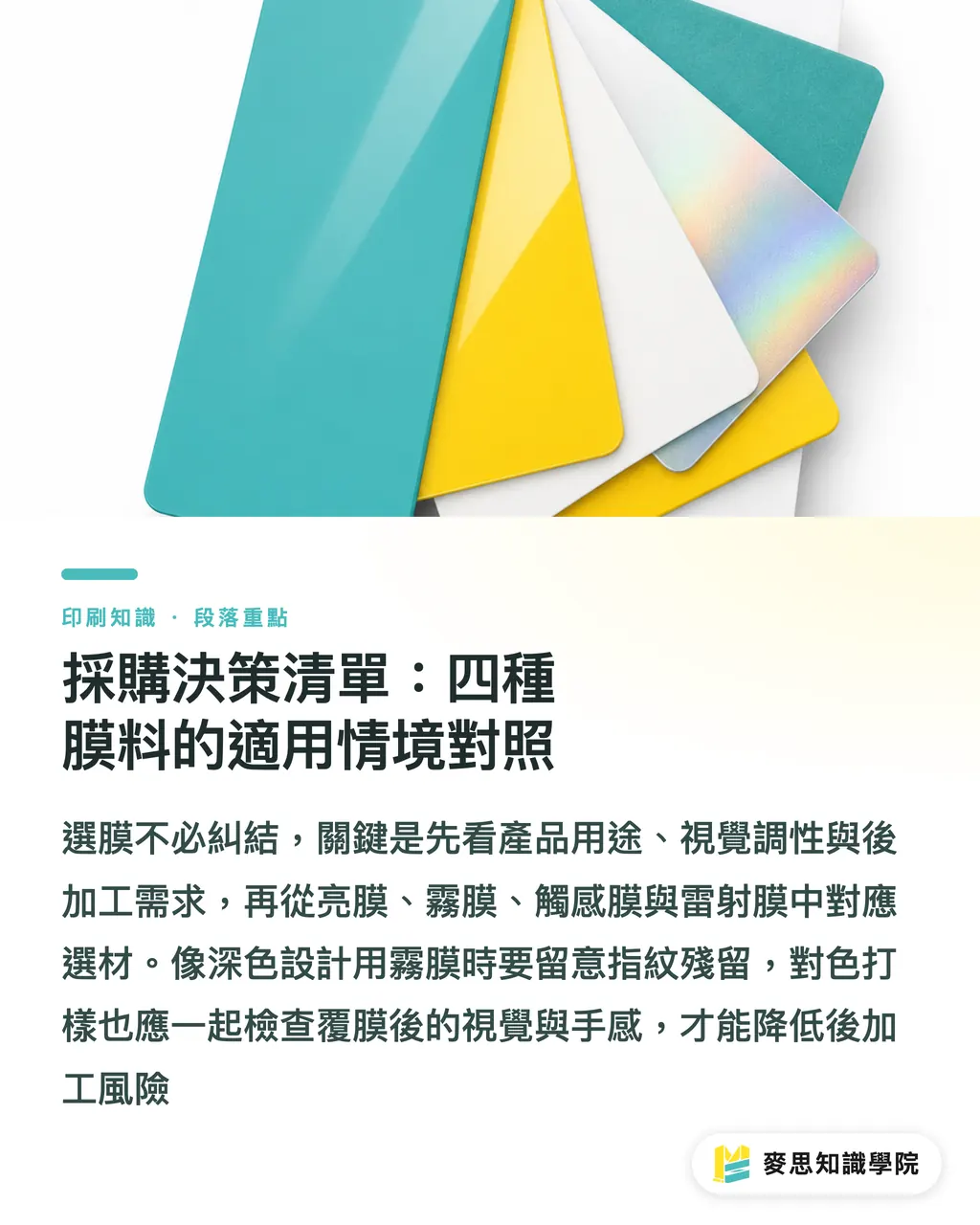
・Holographic film: built-in shimmer, loud visual. Good for streetwear stickers and trading card games. Avoid trying to register it against printed artwork
Pick the right film and your downstream finishing tolerance jumps by half
Next time you sign off a color proof, run the laminated sample under your fingers too
Key Takeaways
・Don't pick a film from a photo. Gloss pushes saturation up; matte and soft-touch eat a bit of chroma and add a grounded, quieter tone
・Large dark areas are matte film's kryptonite, oil from fingerprints sticks fast. If budget allows, jump straight to soft-touch or an anti-scratch film to head off the complaints
・Before layering foil or any specialty binding, confirm the film's surface tension can actually hold the foil. The proof test is the only honest answer
Wider Perspective
From a consultant's seat, lamination has quietly evolved from a pure protective measure into a layer of brand-experience design
Designers tweaking hex codes on a screen routinely forget the friction coefficient and light refraction of real, physical materials
For print shops rolling out automated estimating or SaaS workflows, baking "paper gsm × film compatibility" into a failsafe rule is the cheapest way to catch at least 40% of re-run waste at the order-entry gate
FAQ
- Does lamination change the color of the print?
- Yes. Gloss film makes colors look more vivid and pushes saturation higher; matte film pulls them slightly darker. That's why color proofs must always be checked on the laminated sample, not the bare print
- Can textured art papers be laminated?
- Papers with strong surface texture (watercolor paper, linen paper, etc.) are a bad match. The heat press can't drive the film into the fine grooves, leaving a constellation of tiny bubbles that wreck the look and feel
- Why is the film lifting at the edges of a freshly finished piece?
- Most often because a large dark ink area wasn't fully dry when it went through the laminator, gases escaping from the ink film break down the adhesive and the film peels. On thick stocks that also get folded, the crease line is another common spot for the film to crack open
Related articles

The Print × AI weekly
The print and AI know-how designers, brands and enterprises can use before they commit — one email, every week
MINDS Free Tools
Spine width and imposition calculators — skip the manual math, free in your browser.
MINDS Group
Need actual printing or gifting services?
From premium printing to online ordering and festive gifts — the MINDS Group sister brands take it from here.