
Overview
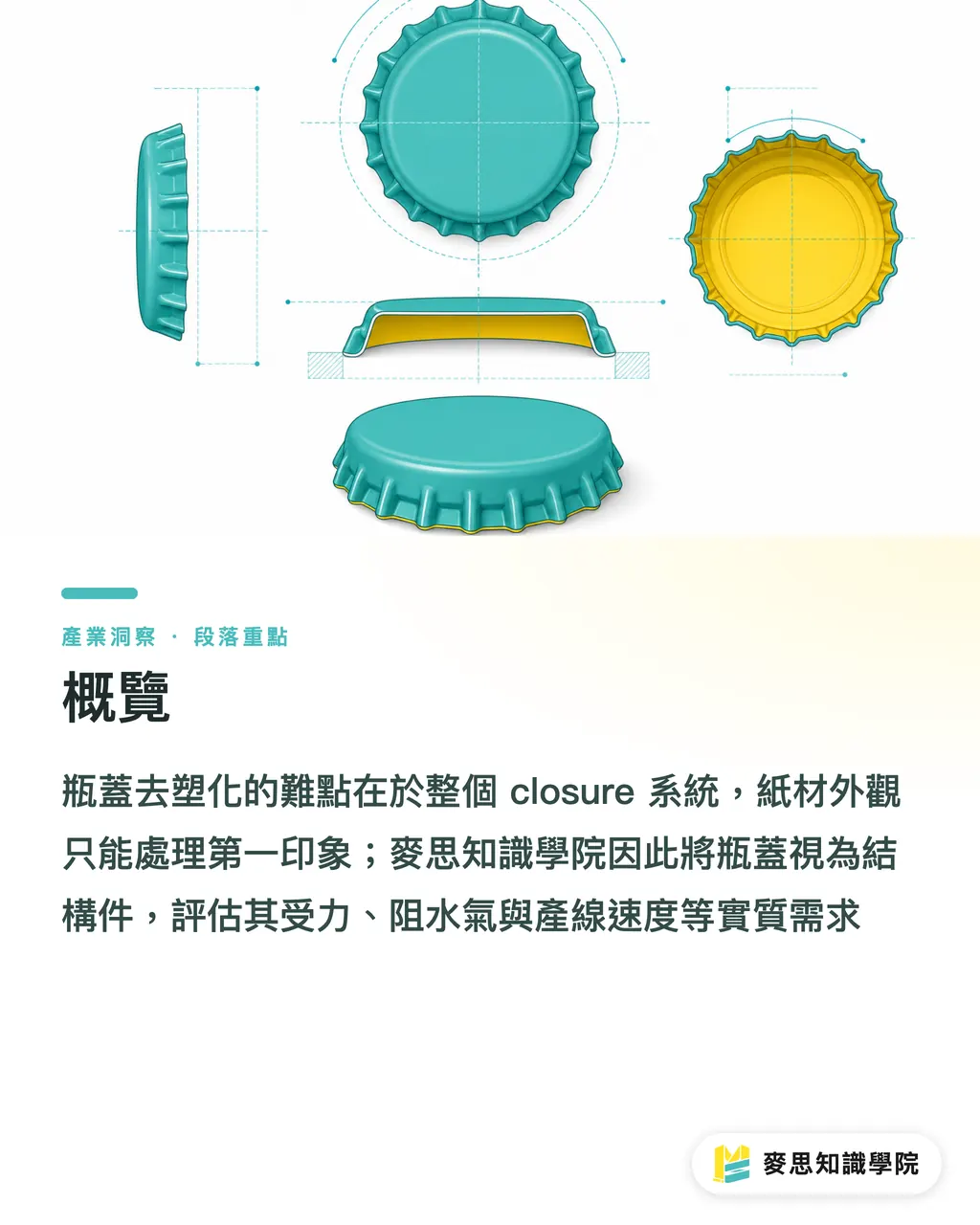
The main hurdle in de-plasticizing bottle caps lies in the closure system. Looking like paper only solves first impressions. At Mai Strategy Knowledge Academy, we treat caps as structural components that bear physical stress, resist moisture, and directly impact production line speeds
Why Have Bottle Caps Become the Weakest Link in Plastic Reduction?
Packaging Insights reported that Sensoplast expanded its fiber-based closure portfolio by acquiring Forewood. This move brings plastic reduction focus directly to caps & closures: bottle caps, plugs, seals, and opening mechanisms
In packaging projects over the past couple of months, I've noticed a clear shift. Brands used to ask about bottle bodies, paper boxes, and outer packaging first. Now, they are questioning the final plastic piece: can the cap be de-plasticized too?
Bottle caps get pushed aside until the end, yet they often drag sustainability promises back to the realities of engineering. If a closure fails qualification, the sustainability narrative for the entire bottle collapses
What Is a Fiber-Based Closure, and How Does It Work?
A fiber-based closure refers to caps, plugs, and sealing structures made from paper fiber or fiber composite materials, using paper fiber to meet opening, closing, sealing, and plastic reduction needs
When I evaluate fiber-based closures, I don't look at aesthetic paper texture first. I check five engineering criteria:
・Sealing: Looking like paper isn't enough once capped. Liquid, powder, or scented products immediately test the sealing surface
・Moisture resistance: Paper fiber changes behavior when exposed to water vapor. Surface treatments must be tested alongside the actual product contents
・Torque: Consumers need to twist it open easily, but it cannot loosen during transit. This mechanical and tactile balance is where closures get stuck most often
・Filling line compatibility: If a cap repeatedly stalls existing capping machines, the brand will reject the design and send it back to the supplier
・Recycling stream: Fiber-based closures must clearly define which recycling stream they enter. You cannot leave material claims for front-of-pack marketing text to figure out on its own
Which Three Capabilities Should Small and Medium Print Shops Build?
If small and medium print shops in Taiwan want to capture opportunities in fiber-based closures, I recommend using the 'MINDS 3-Step Pre-Press Verification' framework to break down tasks. Don't rush into mass production; lay out risks on the table first
・1. Material check: Treat paper fiber parts as 3D structural pieces, not just thick cardboard. Ask about material moisture content, barrier treatments, and deformation at the bottle mouth interface
・2. Forming check: Establish dimensional tolerances before die-cutting, creasing, curling, or laminating. Closures are far more sensitive to sub-millimeter errors than hangtags
・3. Claim check: Review 'plastic-reduced', 'recyclable', and 'paper-based' separately. MINDS can help brands organize material claims and artwork constraints prior to proofing, preventing designs that look great on screen from failing on the production line
How Can Brands and Designers Avoid Greenwashing Trap Claims?
The most common mistake brands make is treating closures like a minor graphic on a layout. A green arrow or a 'paper-based' slogan won't automatically address sealing, moisture resistance, torque, or recycling questions
I advise brands to prepare three documents before proofing, so designers, procurement teams, and print shops work from the exact same dataset:
・Material specifications: Clearly detail the primary material, coatings, or composite structure of the fiber-based closure as provided by the supplier
・Production line testing: Record results for capping, shipping, and re-capping after opening. Don't let samples stop at photo shoot mockups
・Claim boundaries: Evaluate 'plastic reduction' and 'recyclable' separately. Every claim must align with local recycling conditions
If a brand already has documentation from overseas suppliers, the consultant team at Mai Strategy Knowledge Academy can help translate English specifications into a clear checklist for procurement and design teams. This is far cheaper than revising front-of-pack artwork after the fact
What Does This Have to Do with AI and SaaS?
The biggest risk in closure projects is having information scattered across PDFs, quotes, proofing photos, and verbal notes on the shop floor. AI and SaaS should focus on record-keeping, search, and reminders first, rather than rushing into flashy recommendations
A practical packaging SaaS platform must standardize at least three categories of fields:
・Material fields: Primary material, coatings, supplier versions
・Production line fields: Capping equipment, line speed, torque records
・Claim fields: Front-of-pack claims, procurement documentation statements, regional recycling constraints
For AI implementation to deliver real value, it must first answer: 'Can this product use this fiber-based closure?' That answer needs to be traceable back through material, production, and claim records. That's what a tool built for real-world packaging looks like

Key Takeaways
・If the cap fails testing, even the greenest bottle body won't convince procurement teams
・Fiber-based closures must be validated on the filling line, not just recolored in design drafts
・Paper fiber closures test sealing, moisture resistance, torque, and recycling streams, not artistic paper texture
・Opportunities for small and medium print shops lie in material comprehension, forming precision, and claim auditing
・AI and SaaS should capture specifications accurately before offering automated suggestions
Further Thoughts
My practical recommendation is to start by updating work orders. Let print manufacturers view fiber-based closure materials and surface treatments on a single sheet. Help designers understand bottle neck structural constraints before finalizing artwork. Use AI first for spec queries and error alerts, and let SaaS connect proofing, testing, and claim audits to the same project ID. A bottle cap may look small, but it is often the very first component to run into trouble in a packaging project
Further Reading
FAQ
- What is a fiber-based closure?
- A fiber-based closure is a bottle cap, plug, or sealing structure made from paper fiber or fiber composite materials, designed to reduce plastic use while maintaining sealing, opening, and closing functions
- Why is de-plasticizing bottle caps harder than switching to paper boxes?
- Bottle caps directly handle rotational force, sealing, moisture resistance, and filling line speeds. A failure in any area directly affects shelf life and customer complaints. A paper-like appearance cannot replace engineering tests
- Where can print shops in Taiwan start?
- Print shops in Taiwan can start by building capabilities in surface treatments for paper fiber structural parts, die-cutting, dimensional tolerance control, and claim auditing. These factors determine whether brands feel confident putting fiber-based closures into commercial packaging
- Can brands label bottle caps as recyclable directly?
- Brands shouldn't claim recyclability based solely on cap material. Claims for fiber-based closures depend on coatings, composite structures, and local recycling streams. Procurement records need to be kept far more explicitly than marketing text
Related articles




The Print × AI weekly
The print and AI know-how designers, brands and enterprises can use before they commit — one email, every week
MINDS Free Tools
AI background removal, a LINE sticker maker, spine & imposition calculators — all free, right in your browser, no upload.
MINDS Group
Need actual printing or gifting services?
From premium printing to online ordering and festive gifts — the MINDS Group sister brands take it from here.