
The EU Packaging Labelling Rules Are Stalled. What Does That Mean for Supply Chains?
The EU Implementing Act for harmonised packaging sorting labels, originally slated for August, failed to arrive on schedule. That gives brands a brief breather, but it also means the rollout window down the road will be squeezed hard
These details are the linchpin for putting the EU Packaging and Packaging Waste Regulation (PPWR) into practice. The UK's On-Pack Recycling Label scheme (OPRL), a longtime advocate for labelling standards, stepped up immediately to state they expect only a short delay. But the harsh reality remains: once the text is locked in, manufacturers will have just 24 months to get harmonised labels printed onto every single pack shipped to the EU
From my years watching both production floors and client accounts, this timeline is brutally unforgiving for Asian supply chains. Anyone in prepress knows that overhauling packaging artwork across an entire product catalog in two years will trigger massive bottlenecks. It is never as simple as swapping a layer in Illustrator. You have to burn through existing inventory, run new proofing rounds, and fight for press capacity
Worse still, PPWR goes far beyond stickers. Looking at the full regulatory landscape we have been tracking, labelling ties directly into material traceability and design audits. A delayed Implementing Act simply jams every exporter's compliance deadline into an even narrower two-year funnel
Will UK and EU Packaging Labelling Go Their Separate Ways?
As things stand, the UK is waiting to see the EU's cards. If both sides cannot align their sorting logic, multinational brands will have to run two completely different label layouts
OPRL Executive Director Jude Allan pointed out a practical detail many Taiwanese manufacturers miss: the UK government is holding off on rolling out its mandatory pEPR (extended producer responsibility) labelling scheme until the EU picture clears up. Behind the scenes lie messy realities of multilingual translations and uneven waste-sorting infrastructure across member states
Based on our experience building multilingual packaging for clients, packaging designed for Europe could face a few distinct scenarios:
・Close alignment between the UK and EU: The best-case scenario. One unified label covers all markets, prepress imposition stays clean, and label real estate loss is minimal
・Partial overlap with divergent rules: Brands will have to squeeze two separate compliance marks onto an already crowded back panel
・Total divergence: For small cosmetics or electronics components, there may simply not be enough surface area left. Brands will be forced into costly multi-layer peel-off labels or separate SKUs by destination country
For Taiwanese contract manufacturers accustomed to shared-plate print runs, this creates a dual headache in inventory management and material costs
Why Will Future Packaging Labels Look Like Traffic Signs?
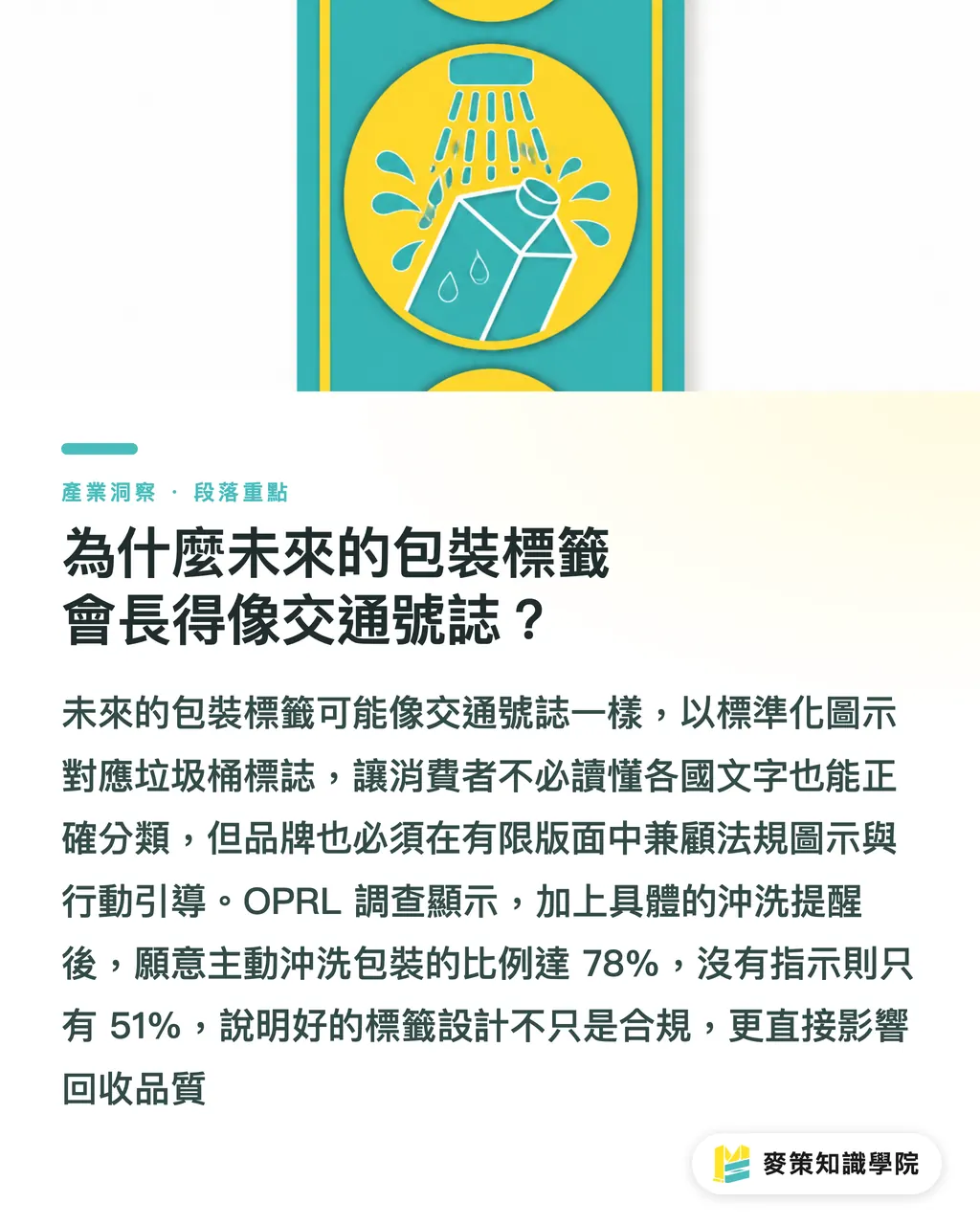
To overcome language barriers across borders, the EU is very likely to adopt standardized pictograms proposed by the Joint Research Centre (JRC), matching symbols on packaging directly to those on recycling bins
Practically speaking, this pushes the communicative function of packaging labels to the limit. Consumers will not need to read different languages. They just match the icon on the pack to the icon on the bin. For brands, however, it means carving out dedicated, non-negotiable print real estate for these mandatory graphics
Is dropping in a legal pictogram enough? OPRL's 17 years in the field says no. If you do not talk to the consumer, recycling quality falls flat. Their latest survey data is proof: when labels include a clear Call to Action, 78% of respondents actively rinse their packaging. Without instructions, that number plunges to 51%
That 27% behavioral gap makes or breaks the purity of the recycled stream. Good label design is no longer just about slapping on a required symbol. It is about fitting clear, concise messaging into tight spaces to hit upcoming sustainability targets
With 24 Months on the Clock, How Should SME Printers and Brands Prepare?
In this regulatory holding pattern, the most practical playbook is white space and modularity: building flexible design frameworks to weather policy uncertainty
Since the overall direction points toward unified pictograms, export brands commissioning new packaging should deliberately reserve dedicated, fixed-size zones near the barcode or container base. Picking the right print partner here saves serious hidden costs. A commercial printer with advanced customization capabilities and compliance awareness like MINDS can help clients set up modular artwork architectures during prepress. Once the rules pass, you only need to swap specific layers to output CTP plates, rather than redesigning from scratch
To navigate this transition smoothly, exporters should tackle these priorities in the second half of the year:
1. Audit high-risk inventory: Take stock of packaging materials immediately. Prioritize burning through legacy stock that takes over a year to deplete and cannot be over-stickered
2. Adopt modular artwork design: Force new packaging concepts to leave room for dual EU and UK labelling. Keep backgrounds free of complex gradients so overprinting stays clean
3. Track OPRL support tools: OPRL is building a dedicated EU labelling tool, which will be a handy resource for aligning with EU standards and avoiding costly rejected shipments
Key Takeaways
The delay in EU PPWR labelling rules is not a cancellation. Brands still have only 24 months to roll out redesigns
The UK's pEPR labelling scheme is watching EU developments closely. Cross-border packaging must prepare for the layout headache of two diverging standards
Pictogram labels will become standard. Adding a concrete call to action drives up to 78% of consumers to properly prepare packaging for recycling
New packaging orders must reserve white space and use modular layer structures so updates can be swapped in at a moment's notice
Further Thoughts
My advice to every brand manager and print buyer managing European product lines is to treat this delay as a final dress rehearsal. Do not wait until the law is published to audit your packaging. Spread out your dielines today, sit down with your printer, and find out where you can free up space. In the face of green trade barriers, whoever cuts compliance costs earliest wins
Further Reading
FAQ
- With the EU PPWR labelling rules delayed, should we put our packaging redesigns on hold?
- No, that is not advisable. Once the act passes, you will only have a 24-month transition window. We recommend using modular layouts for new packaging now to reserve space for future pictogram labels
- What happens if UK and EU packaging labelling rules end up diverging?
- Products sold across both markets will need to carry two different sets of compliance graphics. Small packaging may run out of printable surface area, forcing brands to adopt multi-layer peel-off labels or manage separate SKUs by country
- What will the upcoming EU packaging labels look like?
- They are expected to follow pictogram-based designs similar to the JRC proposals, matching icons on packaging directly to sorting bins to bypass language barriers
Related articles

The Print × AI weekly
The print and AI know-how designers, brands and enterprises can use before they commit — one email, every week
MINDS Free Tools
Imposition calculator and preflight file check — free prepress tools, right in your browser.
MINDS Group
Need actual printing or gifting services?
From premium printing to online ordering and festive gifts — the MINDS Group sister brands take it from here.