

Why Is Everyone Talking About Flexible Packaging Recycling Now?
Because the EU's Packaging and Packaging Waste Regulation (PPWR) is due to take effect in 2026, while the Chinese market has also begun tightening its environmental standards, multilayer composite plastics that cannot enter recycling systems will face customs clearance delays or steep taxes in both major markets
Over the past few months, I've spoken with quite a few clients in cross-border e-commerce and food exports. Their biggest anxiety is whether the flexible packaging they currently use, meaning bags and films without a fixed shape, actually counts as recyclable. For decades, packaging manufacturers have laminated PET, aluminum foil, PE, and other materials with different properties layer by layer so biscuits would stay airtight and coffee beans would not lose their aroma. These high-barrier multilayer films perform extremely well on the shelf, but once they reach a recycling plant, the layers cannot be separated, so they ultimately end up in an incinerator. Regulations now explicitly require packaging to be recyclable. A structure once taken for granted has suddenly become a landmine for brands going global. This flexible-packaging sustainability wave is no PR slogan. It is a trade barrier with real teeth

Can Mono-material Really Replace High-barrier Multilayer Films?
Technically, it still cannot replace them completely. But with specialized coating processes, mono-material already meets the standard barrier needs of nearly 80% of products on the market
Since laminated multilayers cannot be recycled, the industry's most obvious answer is to switch to mono-material, meaning that a single type of plastic polymer makes up more than 90% of the package's total weight. Replace the original composite structure entirely with PE or PP. But this immediately runs into the second problem: lower barrier performance
Mono-material naturally provides weaker protection against oxygen and water vapor. For processed foods with shelf lives that can easily reach a year, that is a deal-breaker. To make up for this weakness, material suppliers now add an ultra-thin transparent silicon oxide (SiOx) or aluminum oxide (AlOx) coating to mono-material films, or use EVOH as a high-barrier interlayer. As long as these additives stay within the 5% limit allowed by regulations, the entire pouch can still be classified by recycling systems as mono-material. The catch is that these advanced films currently cost more to source, and web-tension control during printing, along with heat-sealing conditions during pouch making, all need to be retested. That is a serious test of a printing plant's production efficiency
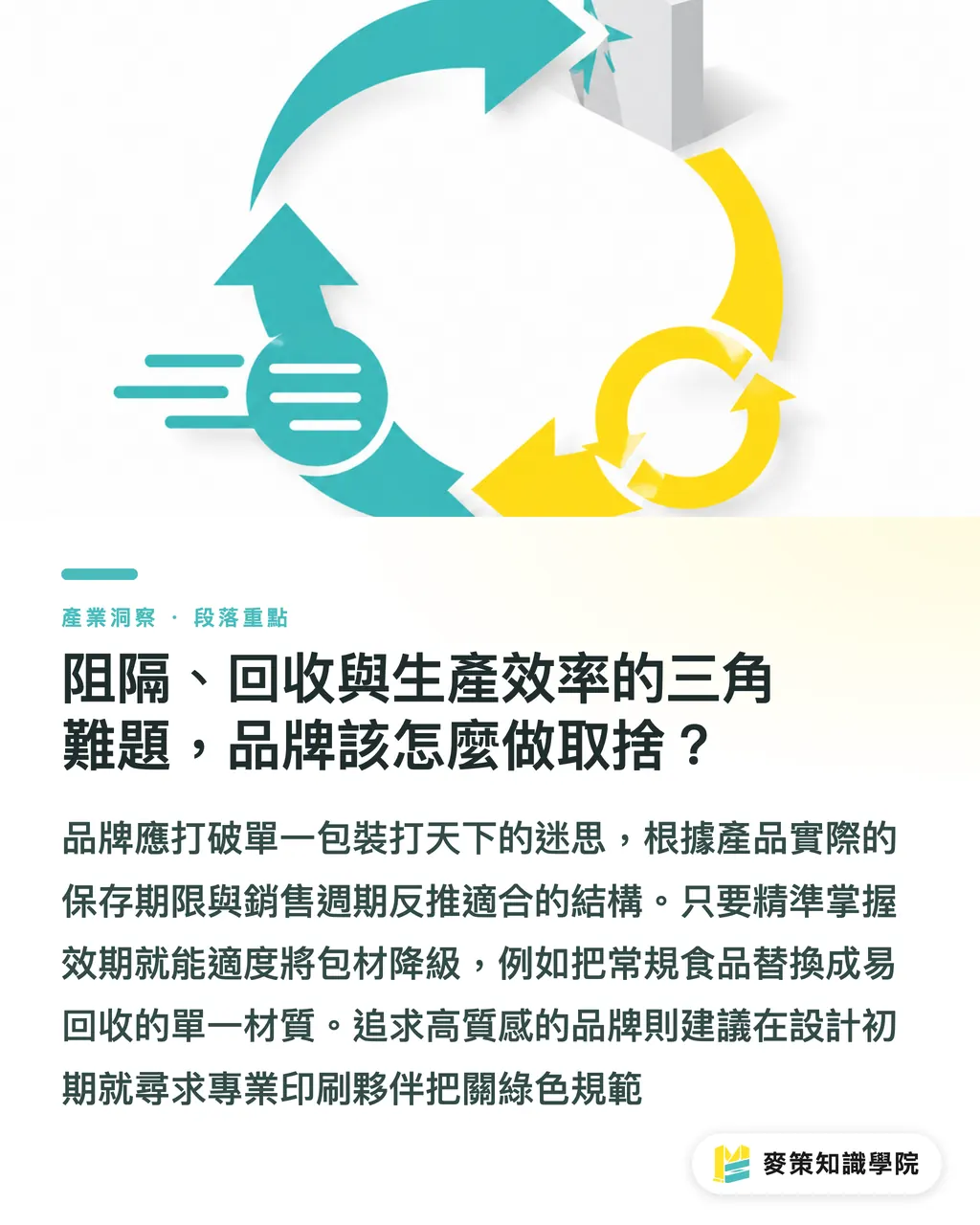
How Should Brands Weigh the Three-way Trade-off Between Barrier Performance, Recyclability, and Production Efficiency?
Brand decision-makers need to give up the idea that one packaging structure can handle everything. Instead, they should work backward from a product's actual shelf life and sales cycle to determine the right packaging structure
When I evaluate options with clients, I usually ask procurement and product managers to draw up a material-selection comparison table for barrier performance and recyclability, then make the call right there in the meeting room. Often, the product does not need to last that long at all. It is simply that the brand insists on top-of-the-line barrier materials for peace of mind. Get the shelf life right, and you can step down the packaging material. This really is not hard
・Shelf-stable foods with long shelf lives: These products are extremely sensitive to light and oxygen, such as medical-grade nutritional products and specialty coffee beans, and it is still difficult to move away from aluminum foil composite layers. For now, the industry can only look to future chemical recycling, a technology that breaks plastic waste back down into petrochemical feedstocks, to break the deadlock. What brands can do today is make sure their packaging labels comply with local recycling-sorting guidelines
・Conventional foods and e-commerce shipping bags: This is where mono-material can shine. Snacks and apparel packaging fall into this category. We recommend starting material-conversion tests immediately and replacing multilayer films with a mono-material PE structure
・Brands seeking customization and a premium look: If you need special surface treatments or precise color management while also wanting to meet environmental requirements, the demands on the printer's equipment and inks are extremely high. Bring in a printing partner who understands the regulations at the design stage, or work directly with a mid-to-high-end custom commercial printer such as MINDS. Have them check sustainability requirements starting with the prepress files so you do not discover during proofing that the material will not print properly
How Can Small and Midsize Manufacturers Prepare for Regulatory and Technical Change?
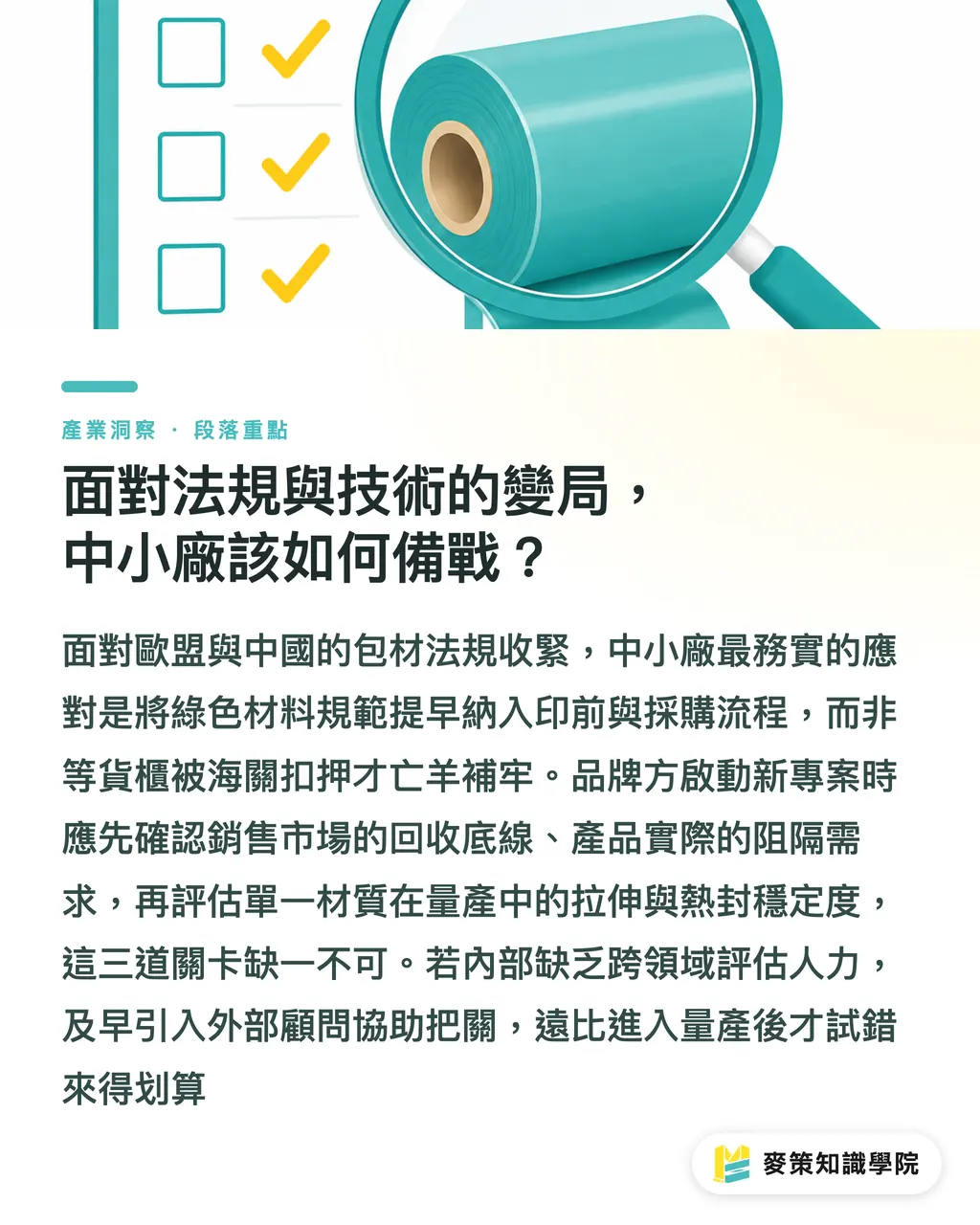
The most practical move is to bring sustainable design and material requirements into the prepress and procurement processes early. Do not wait until a container is held by customs to start looking for alternatives
The practical shift from mono-material to chemical recycling tests more than a packaging plant's process capabilities. It also tests how brand clients think about cost and sustainability. I recommend that brands and designers apply the 'Mai Strategy Three-Gate Prepress Check' framework directly when launching a new project, making sure every decision is backed by evidence
1. Confirm the regulatory baseline in the target market: Are you selling in Europe or China? What materials does the local recycling infrastructure recognize as recyclable?
2. Audit the product's actual physical requirements: Where is the minimum acceptable barrier rate for water vapor and oxygen? Can you trade a shorter best-before period for a better sustainability score on the packaging?
3. Test the new material's stability in mass production: Mono-material stretches and deforms easily during printing, and the heat-sealing temperature window during pouch making is narrower than with multilayer films. This requires the printing plant to fine-tune settings repeatedly on the production line. Brand owners need to build this testing time and the scrap costs into the project schedule. If your team lacks the people needed for cross-functional evaluation, timely outside support from Mai Strategy Knowledge Academy's consulting team can substantially reduce trial-and-error costs
Key Takeaways
・The future of flexible packaging lies in a dual-track approach, mono-material and chemical recycling. Multilayer composite films that cannot be recycled will gradually leave international markets
・Mono-material's barrier weakness can currently be reinforced with high-barrier coatings or EVOH interlayers kept within the 5% limit, but mass-production challenges in printing and heat sealing still need to be overcome
・Brands should not blindly chase top-spec barrier performance. They should downgrade packaging based on the product's real shelf life and strike a balance between environmental compliance and cost
・Bringing sustainable design into prepress and making good use of a professional consultant's evaluation framework is the shortest route for export brands to clear customs smoothly
Further Thoughts
For Taiwan's printing manufacturers and brands, rather than passively waiting for material suppliers to launch a perfect low-cost substitute, it makes more sense to review product lines now, identify packaging that is over-engineered, and start mono-material conversion tests. For SaaS providers, this also creates an opening: future packaging design and procurement systems will need built-in carbon-footprint estimates and a database of local recycling regulations, so that when decision-makers enter a material and its dimensions, they can immediately see the environmental cost and compliance risk of the order
Further Reading
FAQ
- What is mono-material (Mono-material) flexible packaging?
- It means that more than 90% of the package's total weight is made up of a single type of plastic polymer, such as all PE or all PP. This structure removes the separation problem created by different materials that are difficult to peel apart, allowing it to enter existing plastic recycling systems directly. It is currently the mainstream solution for meeting packaging regulations in different countries
- If multilayer film is replaced with mono-material, will food shelf life necessarily become shorter?
- Not necessarily. Although mono-material has lower inherent barrier performance, an ultra-thin silicon oxide (SiOx) or aluminum oxide (AlOx) coating, or an EVOH interlayer, can now greatly improve gas-barrier performance. As long as these high-barrier layers account for no more than the 5% allowed by regulations, the package still counts as recyclable mono-material
- If chemical recycling can handle multilayer films, why switch to mono-material?
- Chemical recycling can indeed handle complex materials, but global infrastructure and capacity are still seriously inadequate, while processing costs are extremely high. Until chemical recycling becomes widely available, mono-material is the most practical transition path with immediate results for brands responding to urgent regulations such as the 2026 PPWR
- What production challenges do printers face when handling mono-material?
- Mono-material films have lower heat resistance and are prone to stretching and deformation. On high-speed presses, this can lead to registration problems. At the final pouch-making stage, the heat-sealing temperature window also becomes very narrow, making weak seals or heat-shrink deformation more likely. Machine settings must be adjusted again, and the printer needs to build up experience
Related articles




The Print × AI weekly
The print and AI know-how designers, brands and enterprises can use before they commit — one email, every week
MINDS Free Tools
AI background removal, a LINE sticker maker, spine & imposition calculators — all free, right in your browser, no upload.
MINDS Group
Need actual printing or gifting services?
From premium printing to online ordering and festive gifts — the MINDS Group sister brands take it from here.