
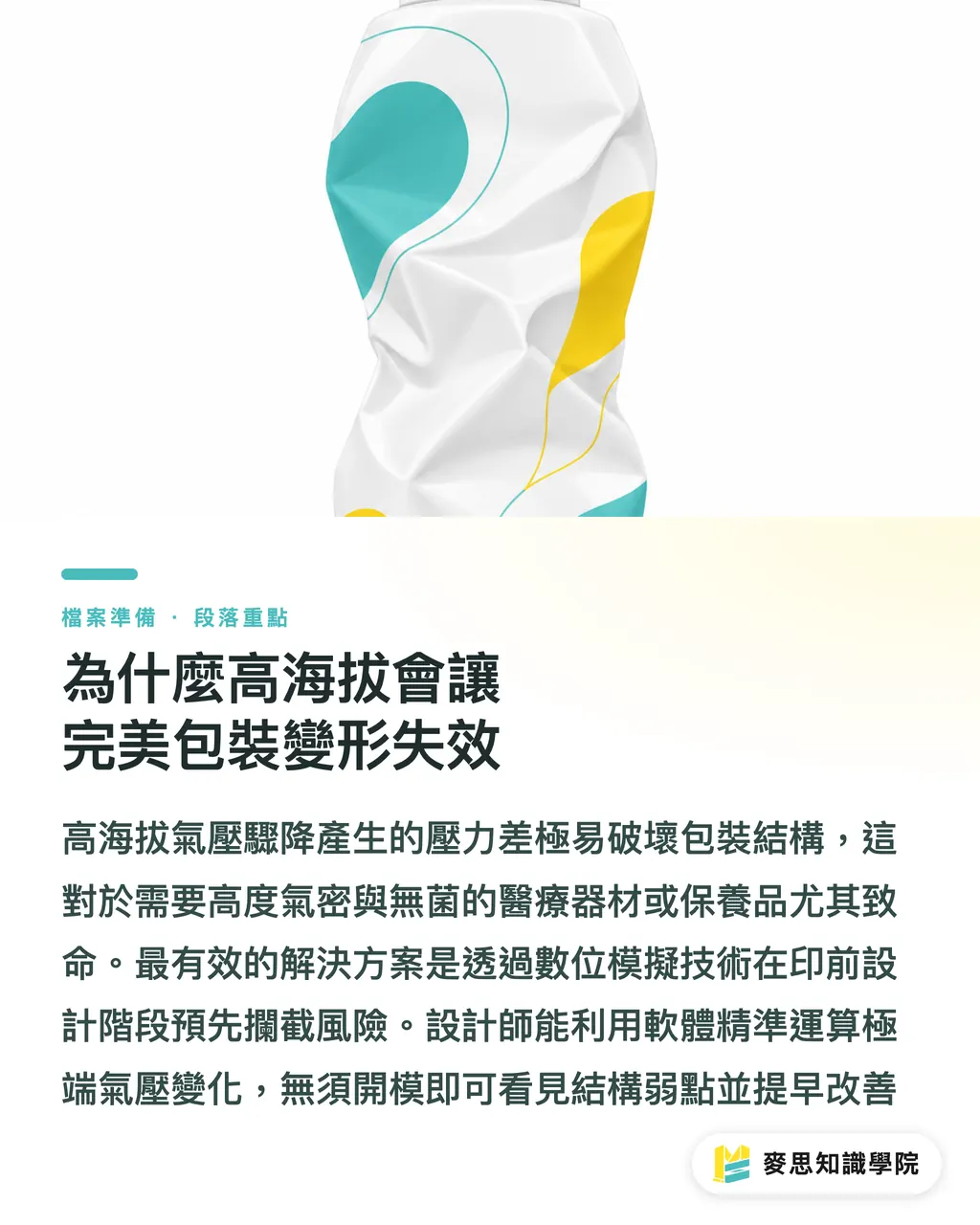
Why High Altitude Wrecks Packaging That Looks Perfect
The sharp pressure drop as you climb puts massive stress on both sides of a bottle or jar, and that's usually the thing that kills the structure
The sharpest fix is to catch the risk at prepress, before anything gets made
When the Mai Strategy Knowledge Academy consulting team walks a client through a structural review, harsh transit scenarios are always first on the list
Digital Simulation turns packaging materials and physical load data into numbers, crunches extreme pressure changes in software, and lets designers spot weak points without cutting a mold
Lately I've been talking to medical device and high-end skincare clients who demand airtight, sterile packaging
At altitude, even a tiny deformation can break sterilization or spoil the product
How Digital Simulation Predicts and Fixes Bottle Deformation
Old way of testing altitude on a bottle: build a batch of physical samples, chuck them in a pressure chamber. Slow. Expensive
BMT's latest published case study shows they can now predict, pretty accurately in software, how a bottle deforms at different altitudes
The workflow is straightforward:
・ Parameter modeling: feed the bottle's 3D geometry and the plastic's thickness-stretch behavior into the system
・ Environmental loading: set the target altitude's air pressure plus any wild temperature swings
・ Weak point mapping: a heat map flags exactly where stress piles up and the structure is most likely to give
Structural designers tweak the bottle's fold lines right on screen, re-run the calc immediately, and cut blind-test costs to the bone
It's a real shift in R&D thinking: solving problems at the drawing-board stage, not after the mold's already cut
How Much Hidden Cost Does Simulation Testing Save
Over the past few months it's been hard to miss: European and US brand clients have moved from sustainability slogans to hard compliance rules
Once a line starts running serious post-consumer recycled (PCR) content or chasing aggressive lightweighting, the new material's physical behavior is usually all over the place
Traditional physical prototyping can't keep up with how fast materials are being swapped in and out
The real commercial win with digital simulation is how cheap it is to fail
It validates how new materials hold up across environments, so brands can meet EPR (Extended Producer Responsibility) rules without trashing half their stock
For tricky structural and material testing work, pairing with a shop that has solid mid-to-high-end custom commercial printing experience like MINDS gives you a much more accurate material strength read at prepress
What Taiwan's Designers and Mid-Tier Packaging Shops Should Do
With brand-side physical testing demands getting stricter, leaning on the old-master gut-feel playbook isn't going to cut it anymore
Baking environmental variables into the design thinking is homework both the factory floor and the design desk have to do together
A few pragmatic moves:
・ Build a material database: start logging and quantifying the physical stress behavior of your go-to eco materials so you're not guessing from scratch every time
・ Sync structure with prepress: get prepress people who actually understand structure in the room from day one, so layouts that can't survive transit get killed early
・ Use lightweight tools: plenty of SaaS options out there do basic 3D pressure simulation; you don't have to buy heavy industrial software on day one
For standard spec jobs, a standardized online ordering platform like MYS keeps the margin healthy. But the moment you're dealing with new materials or high-altitude shipping, the upfront structural validation pays for itself
Key Takeaways
・ Altitude pressure differential is the silent killer in transit; digital simulation lets packaging run its survival test on a screen
・ BMT's work shows parameterized deformation prediction can wipe out the sunk cost of mold cutting and round after round of physical samples
・ Now that PCR and similar eco materials are baseline, digital simulation is the cheapest way to handle unstable material behavior
・ Moving physical testing thinking upstream into prepress design is the real lever for higher packaging yield and international compliance
Further Thoughts
Digital simulation is quietly reshaping who holds the cards in the packaging supply chain, and saving on prototyping fees is just the entry-level dividend
Once a designer or packaging shop can show a brand client hard simulation data proving that a specific fold-line change keeps the bottle from cracking up a mountain, you own the solution conversation
As AI matures, expect software to spit out auto-corrected, pressure-optimized designs on its own, a real monetization lane for SaaS builders and the print industry to go deep together
Further Reading
FAQ
- Why does high altitude deform plastic bottles
- Air pressure is lower at altitude, so the pressure inside the bottle is relatively higher. That internal push outward causes the bottle to balloon or burst, and once it's back at lower elevation the reversed pressure differential tends to make it cave in
- What's the biggest difference between digital simulation testing and traditional prototyping
- Traditional prototyping has to wait for a mold before anything goes into a pressure chamber. Digital simulation takes your material data and runs the deformation math in software right away, so it's much faster and the cost is almost nothing
- Can regular small and mid-sized print shops actually use this kind of technology
- Software tools are getting lighter. Even without heavy in-house simulation gear, a mid-sized shop should at least build the prepress habit of predicting problems in advance, and bring in outside specialists for the high-risk jobs
Related articles

The Print × AI weekly
The print and AI know-how designers, brands and enterprises can use before they commit — one email, every week
MINDS Free Tools
Spine width and imposition calculators — skip the manual math, free in your browser.
MINDS Group
Need actual printing or gifting services?
From premium printing to online ordering and festive gifts — the MINDS Group sister brands take it from here.