

Why Faster Production Lines Lead to More Recalls and Customer Complaints Due to Micro-Defects
Over the past few months, I have visited several contract manufacturers rushing to meet delivery deadlines. The most common scenario I see is a frustrated owner complaining that their newly purchased high-speed automated production line keeps jamming, or that batches are being returned by clients after micro-defects are discovered post-delivery
Recently, experts from Industrial Physics issued a very specific warning at a packaging industry forum, noting that the metal packaging industry (such as aluminum cans and tinplate) is facing huge recall risks
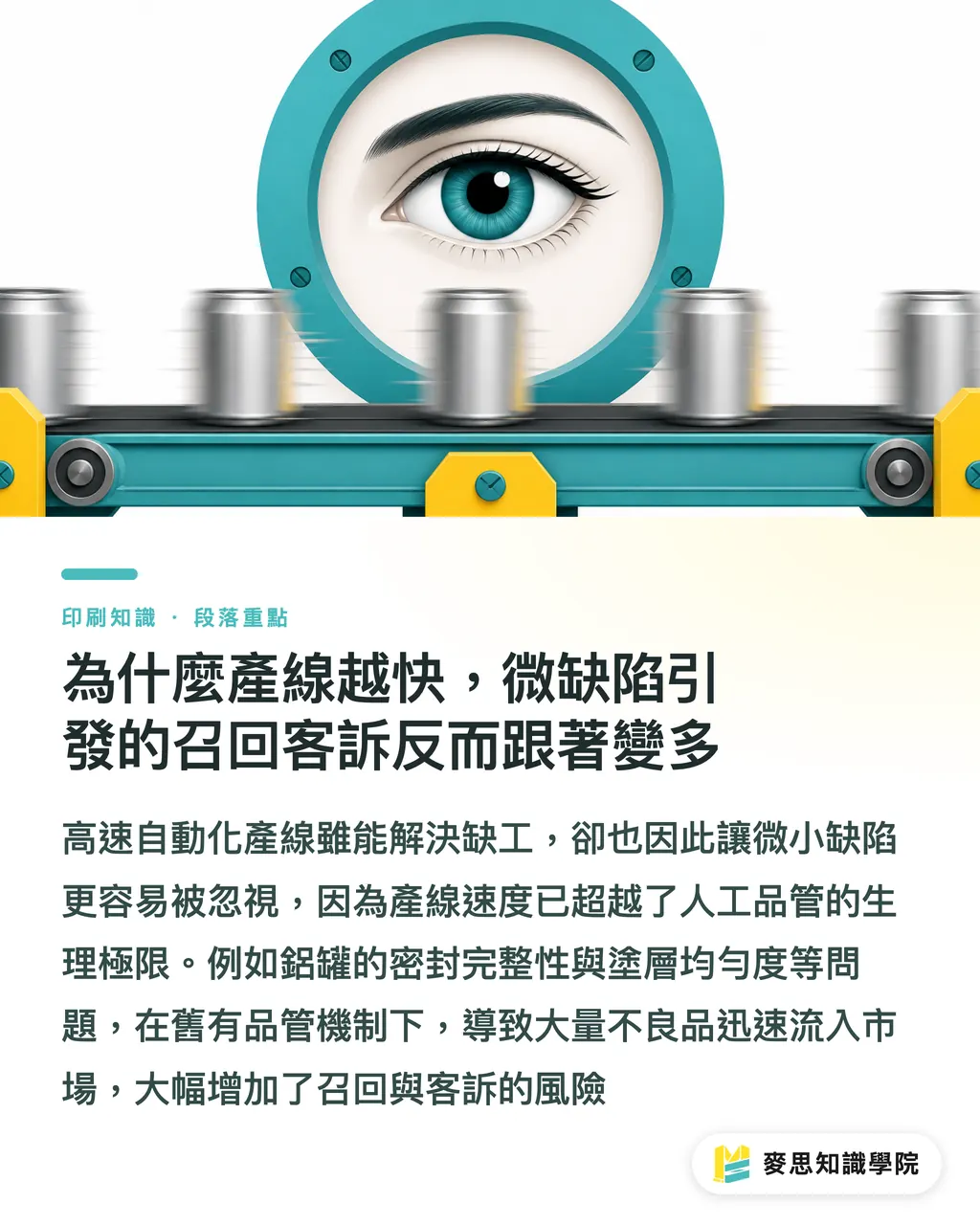
When production line speeds are pushed to the limit, micro-defects like seal integrity and coating uniformity in aluminum cans have long since exceeded the physiological limits of manual inspection
We always assume automation can solve labor shortages, but we overlook the fact that if quality control mechanisms remain limited to manual spot-checking, it will only allow defective products to flow into the market dozens of times faster
How Automated Measurement Catches Flaws That Even Experienced Craftsmen Can't See
I often watch technicians pull samples by the machines. The traditional practice is to pull a few sheets every few hundred prints to check at the color console; this worked in the era of slow-speed machines
However, regarding the physical characteristics of metal packaging, Industrial Physics strongly advises operators to implement online automated vision measurement and leak detection systems
The core of this system is not merely taking photos for comparison, but implementing Statistical Process Control (SPC)
It can detect minute pressure losses or weak points in coatings in real-time during high-speed production, intercepting anomalies through data trends before any customer complaints, which are invisible to the naked eye, occur
This is like what I mentioned when analyzing medical device packaging previously: as equipment gets smaller, the requirements for packaging barrier properties and sterilization compatibility increase exponentially, making this kind of precision physical measurement, which is imperceptible to the human eye, the only solution
From Metal Packaging to Flexible Packaging and Labels: How Small and Medium-Sized Taiwanese Print Shops Can Find the Right Pace for Upgrading
Although the aforementioned forum focused on metal packaging, my long-term observations on production lines and at client sites suggest that this online quality control logic is just as urgent for Taiwan's label and flexible packaging print shops
Hidden variables in packaging automation often lie in post-processing parameters. Your beautiful packaging may constantly jam in the client's automatic cartoning machine often because tolerances for thickness, folding lines, or spot UV are out of control
・Taiwanese factories need to break the old mindset that "pre-press inspection is defensive, and once on the machine, you rely on the technician's hands-on struggle."
・They should gradually shift quality control resources from post-event defect identification to introducing inspection equipment for online preventive measurement
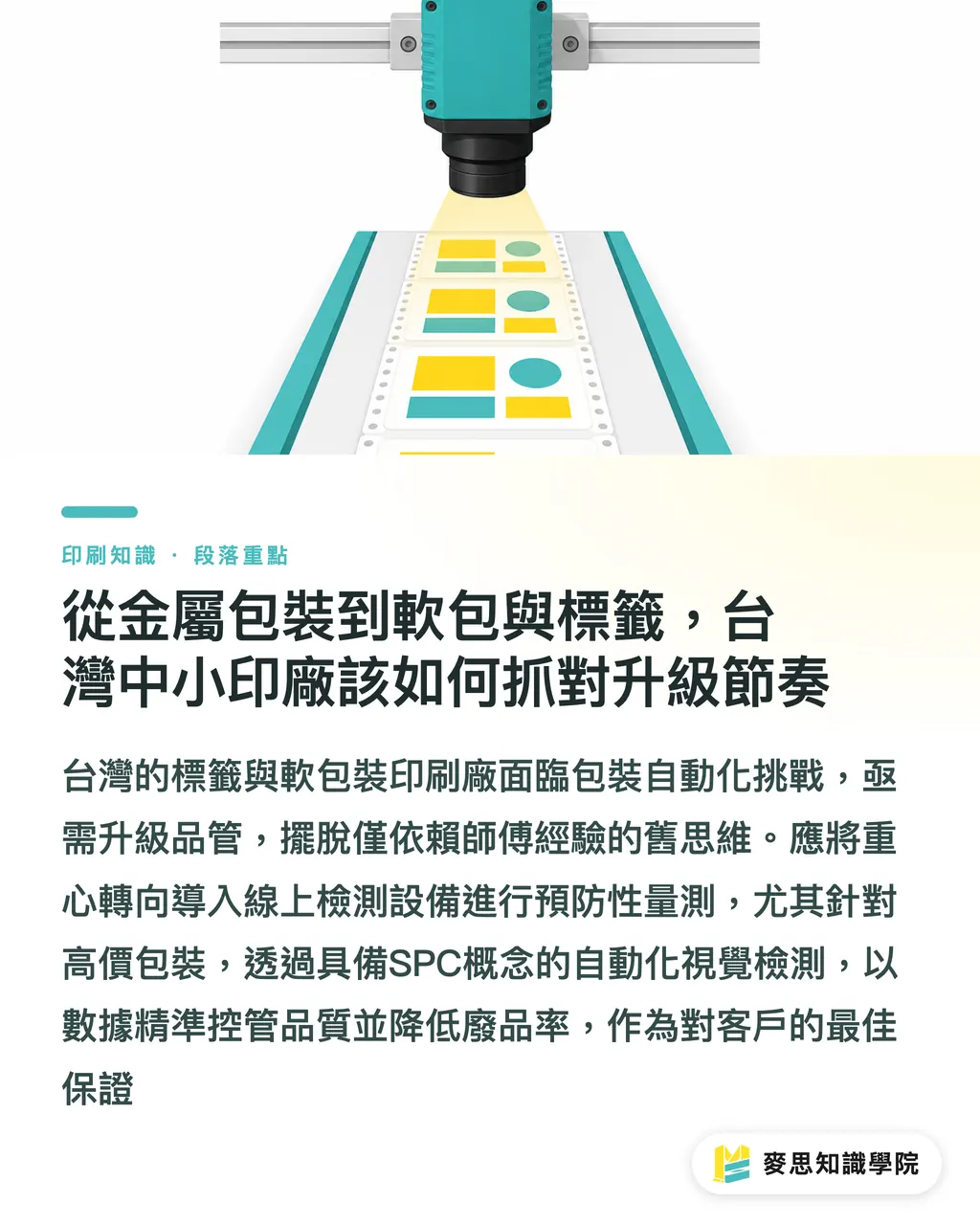
・For high-value medical supplies or export food packaging, introduce automated visual inspection equipped with SPC concepts
・Use measurement data to minimize scrap rates and provide inspection reports as the ultimate quality guarantee for brand clients
Key Takeaways
・The physiological limits of manual inspection can no longer prevent micro-defects on high-speed production lines
・Leak detection and visual measurement can transform quality control from post-event spot-checking to pre-event interception
・SPC (Statistical Process Control) is the backbone for stabilizing high-frequency production quality
・The logic of preventive measurement is equally applicable to Taiwanese flexible packaging and label printing factories
Reflections
The most obvious change in production lines over the past few years is the addition of various machine vision and physical measurement systems, a pair of tireless eyes
For potential clients of MINDS or general printing plants, do not skimp on the budget for online inspection systems when purchasing high-speed equipment
When your competitors are still relying on humans at color consoles for defense, only those factories that can provide accurate SPC reports proving the physical strength of their packaging will be able to land those high-margin, high-end contract manufacturing orders
Further Reading
FAQ
- Why does metal packaging particularly require automated leak detection?
- The seal integrity of aluminum cans and tinplate directly affects the preservation of contents. Tiny pinholes or uneven coatings during high-speed movement are extremely difficult to identify with the naked eye and must rely on air pressure or precision visual measurement
- Is it necessary for general small and medium-sized print shops in Taiwan to introduce SPC and machine vision?
- It is absolutely necessary. Nowadays, brand clients have extremely strict requirements for packaging yield rates. Plus, automatic cartoning machines are very sensitive to material tolerances. Online inspection has become the baseline for preventing customer complaints and returns
- Will automated physical measurement completely replace on-site quality control inspectors?
- No. The machine is responsible for high-frequency fatigue visual recognition and micro-defect detection, while inspectors shift their focus to handling abnormal data and adjusting process parameters, creating a collaborative relationship that uses each other's strengths
References
- Industrial Physics expert urges metal packaging industry to invest in automation · packaginginsights.com
Related articles



The Print × AI weekly
The print and AI know-how designers, brands and enterprises can use before they commit — one email, every week
MINDS Free Tools
AI background removal, brand stamping, and a LINE sticker maker — free design tools, right in your browser, no upload.
MINDS Group
Need actual printing or gifting services?
From premium printing to online ordering and festive gifts — the MINDS Group sister brands take it from here.